
Non-Fiction Reviews
Review of The Recognition of H. P. Lovecraft: His Rise from Obscurity to World Renown
Beatrice Steele
S.T. Joshi. The Recognition of H. P. Lovecraft: His Rise from Obscurity to World Renown. Hippocampus Press, 2021. Paperback. 340 pg. $25.00. ISBN 9781614983453.
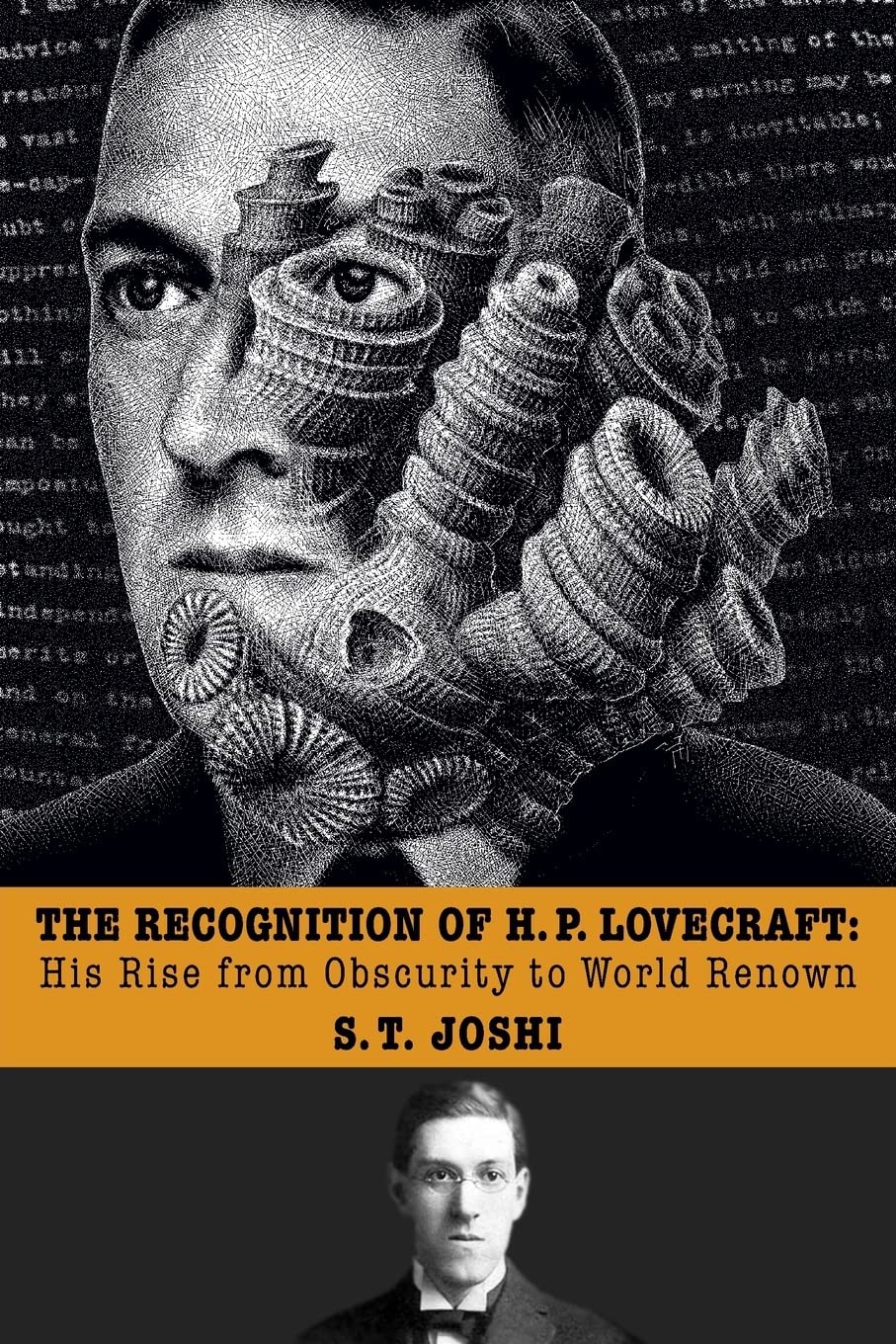
When H. P. Lovecraft died in 1937, not a single book of his stories had been published. This is a fact we are frequently reminded of in S. T. Joshi’s The Recognition of H. P. Lovecraft: His Rise from Obscurity to World Renown. This thorough study attempts to explain at least part of Lovecraft’s meteoric rise to worldwide fame by charting public discussions of his life and work. I use the slightly vague term “discussions” to describe the materials Joshi draws upon in this study because they are incredibly wide-ranging. He assesses all kinds of engagement with the Lovecraftian paper trail, from critical notices, scholarly tomes, and translations to rock music and pulp films. Despite some diffidence in the preface about whether he is the correct choice to author a book such as this, perhaps because of his own considerable stake in the recognition of Lovecraft, it soon becomes clear that nobody is better placed than Joshi to track and evaluate these developments. The reader gains useful insight into the circumstances that led to Lovecraft gaining popularity in a society that is arguably even weirder than the early twentieth-century one he inhabited. Joshi does not confine his study to Lovecraft’s fictional works, but also examines the legacy of his essays, poems, and philosophical thought.
One imagines that this body of research could have been rendered as a vast bibliographic list of items that make mention of Lovecraft. This might have proved useful for academics searching for a database comprising every important piece of public recognition. Indeed, Joshi acknowledges such previous projects, particularly where they do manage a significant act of textual excavation, but this book could appeal to an audience of casual Lovecraft enthusiasts as well as academics. It acknowledges that the story of his ascent is a fascinating one in itself. Yet, Joshi is careful to prioritise the impact of the fiction and not let the substance of his discussion become trapped in tangents about the author’s personal life.
The Recognition of H. P. Lovecraft begins with a newspaper column on the meteorological station Lovecraft built and ran as a teenager. His fascination with astronomy was what first encouraged him to write a letter to Scientific American. Lovecraft’s membership in the United Amateur Press Association opened up a new world of colleagues, friends, and rivals. Joshi briefly covers this amateur press career, but the book is primarily invested in responses to Lovecraft’s imaginative work. Indeed, members of the UAPA were generally not receptive to the fiction, but by the time Joshi moves on to examine Lovecraft’s pulp career, the engine of approbation is beginning to get started. Fictional outings in Weird Tales and Amazing Stories were met with acclaim, although Joshi is careful to point out that the editor of Weird Tales did not choose to publish letters critical of Lovecraft’s work.
Despite the famous caricature of Lovecraft as a reclusive genius, Joshi makes it clear that his friends and associates were the ones who kept his memory alive long enough for the popular paperbacks and movie adaptations of the 1960s to filter into serious scholarship in the late 1970s. The remarkable aspect of this trajectory is just how many setbacks Lovecraft’s reputation suffered and overcame. An interesting case study is that of 1945, a watershed year which soured into an annus horribilis. During this year there were many publications concerning Lovecraft, including an Armed Services Edition of The Dunwich Horror, illustrating the traction Lovecraft was gaining in the English-speaking imagination. In Joshi’s opinion, the tide was turned by an extremely negative review by Edmund Wilson, an eminent American critic. In him, Joshi appears to have located the quintessential case of the literary snobbery that would dog anyone who wanted to take Lovecraft seriously as an artist for years to come. In particular, Joshi highlights Wilson’s comment about Lovecraft being more “interesting” than his work (113). It becomes clear in the last part of the book as to why Joshi thinks that these probings into the author’s personal life are something to be regarded with suspicion.
The latter chapters are nothing short of gold dust for any scholar seeking a comprehensive and informative history of monographs and articles on Lovecraft. The canonisation of Lovecraft as a literary titan, in addition to the seismic effect of his work in science fiction internationally, makes the general recognition of his talent seem a foregone conclusion by the time we reach the ninth chapter of the book. Joshi admits that a total audit of Lovecraft-related media by this point in time is basically impossible. Nevertheless, readers of SFRA Review will no doubt already be familiar with much of what Joshi covers in terms of the growth of Lovecraft in popular culture.
The most polarising aspect of this book is undoubtedly how it approaches the recent controversies surrounding Lovecraft’s prejudices. Joshi makes no bones about his negative opinion of “virtue signalling” (305). His main objection to the attacks on Lovecraft is essentially what many of Lovecraft’s defenders have said in the past, namely, that his views were conceived in a historical context that deserves to be considered. He also argues that the criticism of Lovecraft’s worst lines often devolves into slander and has achieved little more than the defacement of every other facet of the man’s personality. The end result has been the condemnation of the entire person rather than his views, many of which Lovecraft regretted later in life. Joshi does not hesitate in calling out cynical personalities who profited from Lovecraft’s legacy only to trample on his reputation later.
Joshi ends by reminding us of the most important point. Whatever we may think of Lovecraft the man, this controversy has had little effect on the sales of his fiction around the world. The Recognition of H. P. Lovecraft is ultimately a testament to the power of the stories, which have proved resistant to many different crises, and will certainly survive many more.
Beatrice Steele is a PhD researcher and freelance writer from Guildford, England. She gained a Master’s in eighteenth-century literature from the University of Oxford in 2022 and is now undertaking an AHRC-funded PhD based at the University of Exeter. Her research interests include Victorian science, visual culture, and astronomy. She is also a regular contributor to the Dotun Adebayo Show on BBC Radio 5 Live. In her spare time, she likes to read and write poetry. She recently won second place in the Jane Martin Poetry Prize, a national competition run by Girton College, Cambridge.

 SFRA Review