
Non-Fiction Reviews
Review of Absent Rebels: Criticism and Network Power in 21st Century Dystopian Fiction
Ben Eldridge
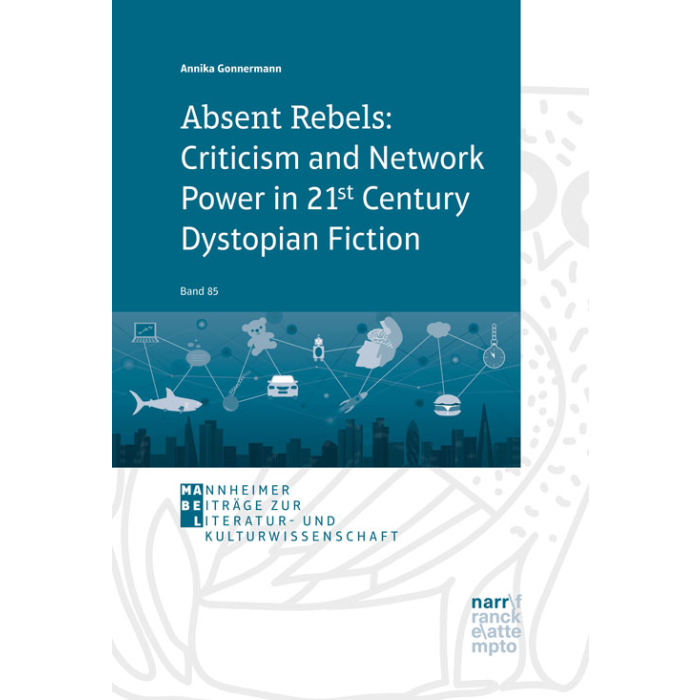
Annika Gonnermann. Absent Rebels: Criticism and Network Power in 21st Century Dystopian Fiction. Narr Francke Attempto, 2021. Print. 352 pg. €68.00. ISBN 9783823384595.
We live in dystopian times, at this early stage of the twenty-first century. Against a backdrop of environmental disaster and increasingly violent geopolitical manoeuvrings, a raging viral pandemic continues to exacerbate long-developing global inequalities. Meanwhile, dystopian fiction has also become inescapable. Novels such as George Orwell’s Nineteen Eighty-Four (1949) are once again topping global bestseller charts, television series including 오징어 게임 (Squid Game) (2021-) have come to dominate on-demand streaming services, and film adaptations like The Hunger Games franchise (2012-2023) continue to break various box-office attendance records. Annika Gonnermann’s Absent Rebels: Criticism and Network Power in 21st Century Dystopian Fiction (henceforth Absent Rebels) responds directly to this booming popular cultural embrace of dystopia, but makes a further seemingly provocative claim: such “classical” (12) fictional dystopias are effectively meaningless for the current age. Gonnermann argues that this type of dystopian fiction (which she identifies as material containing a “focus on political entities” [17], primarily totalitarian regimes) – particularly as such works increasingly infiltrate mainstream channels – cannot act as a subversive critique of its cultural status quo, but can exist only as a commodity that offers light, somewhat anachronistic, entertainment. While Big Brother is certainly still watching, Big Brother is also being watched, in record numbers.
Absent Rebels posits that the commodification of dystopia is a direct result of the economic milieu that engulfs contemporary Western culture: neoliberalism—that most highly aggressive and unchecked form of capitalism—functions by flattening, incorporating, and ultimately commodifying everything, even its own potential critique. According to Gonnermann, this leaves classical dystopias neither adequate nor appropriate for representing—much less challenging—contemporary forms of political organisation, because “the state’s monopoly of power” (18) is now subsidiary to the logistical and financial networks that underpin globalized capital. Gonnermann proceeds to claim that a “new relentless bleakness” (304) is evident in certain exemplary contemporary dystopian texts – her selection consists of David Eggers’s The Circle (2013), Margaret Atwood’s The Heart Goes Last (2015), M.T. Anderson’s Feed (2002), David Mitchell’s Cloud Atlas (2004), and Kazuo Ishiguro’s Never Let Me Go (2005)—and is beginning to “rejuvenate” ( 19) the genre in order to “spell out the inevitability of free-market capitalism” (304) and its attendant violent social impacts. Presented by Gonnermann as “especially progressive and subversive” (18), she argues that her chosen texts are identifiable by their lack of “rebels and dissidents,” (19) which means that they “urge readers to explore the possible alternatives to the dystopian world presented to them on their own” (19, emphasis in original). For Gonnermann, the lack of protagonists who can challenge the economic system that they are depicted as existing within reflects the truncated possibility of meaningful resistance in a more broadly networked society that features no clearly identifiable antagonists. The texts thus act as “phenotypes of a neoliberal economic system” (241), and function to “map out the contradictions of contemporary neoliberal capitalism” (19). Absent Rebels, then, is a timely and sometimes innovative contribution to the field of dystopian studies and is impressive for its ambition, even if it is rather frustrating to witness this ambition only inconsistently realised across the text.
The limitations are unfortunately apparent from the opening of Absent Rebels, which does read rather like a postgraduate dissertation, desperate to prove its bona fides in an overdetermined manner: the early definitional sections are laboured, and the literature review of canonical dystopian literature and literary history that comprises the first major chapter of the book is rather cumbersome, as are the frequent and extended footnotes that addend the text.[1] More problematically, however, Absent Rebels is underlain by a number of somewhat problematic assumptions that remain completely unchallenged. Take Gonnermann’s starting point, for instance:
What makes dystopia so fascinating is its ability to capture cultural anxieties and voice them in literary terms, so that it acts as a mouthpiece and tool of diagnosis and critique for social, political and economic developments… dystopian fiction is always meant as a normative criticism of the socio-historical and historical characteristics of its own origins. (38; 40 emphasis in original)
Claiming an invariable one-to-one correspondence between textual representation and societal critique is a basic misjudgement, because it presumes, amongst other things, that critique is in fact the raison d’etre of all dystopian texts: a highly dubious presumption given the cynically populist manner in which many such texts are written, produced and marketed.[2] But there is an even more fundamental supposition that informs Gonnermann’s claim: in positioning dystopia as a literary expression of extratextual criticism, and claiming that “the aim of any criticism is a transformation of the status quo” (45), she explicitly aligns dystopian texts with their authors’ attempts to engage in real-world revolutionary change. At its most fundamental, then, the premise about the essential function of dystopian literature is naïve in Absent Rebels: there is simply no necessary relationship between any specific piece of cultural production and extraliterary political effect or social reform. In this and other areas, and to its detriment, Absent Rebels repeatedly fails to distinguish between the fictional representations found within the pages of its selected texts and the external reality in which readers and writers live.
Relatedly, much of Absent Rebels understands its primary texts as predominantly, and oftentimes solely, didactic and veers, sometimes headfirst, into intentional fallacy. Take, for example, Gonnermann’s following rumination:
The challenge authors are faced with is to develop an appropriate imagery or language to capture neoliberal thought in its essence while avoiding the fallacies of methodological individualism, i.e. blaming individuals for systemic problems. (175)
What remains unclear is why—or even if—such innovations in form, theme or style are intended in the first instance, and, more crucially, why authorial intention matters in any case. The above quotation is indicative of a general trend by which Absent Rebels simply presumes the accuracy of each of its theoretical speculations, and frequently does not bother offering simple things like evidential substantiation. Indeed, the repeated blind profession of opinions on behalf of a hypothetical reader and the constant moralising throughout Absent Rebels can become fairly overbearing, even to a reader that is already sympathetic to its ideological starting point.
Credibility is further strained in Absent Rebels by the indiscriminate application of its central thesis to its primary texts. By reducing each of its focal texts simply to their relationship with “globalised predatory neoliberal mechanisms” (206), Gonnerman leaves any other themes that arise in the respective novels almost entirely adrift.
For all these problems, however, Absent Rebels does make some insightful observations on both a large and small scale. The foregrounding of theory – particularly in positioning capitalism as a kind of “hyperobject” (Morton 2013, 1) that is “almost impossible to criticise directly” (Gonnermann 66) – is highly productive, and some of the close readings of the primary texts are relatively compelling, particularly in the later chapters.[3] Indeed, Absent Rebels should be applauded for its serious exploration of contemporary texts and social systems. All in all, Absent Rebels is a book that demonstrates a lot of promise, but is heavily flawed on both a theoretical and a formal level. The fairly frequent errors with grammar and spelling are frustrating, and combine to undermine the text’s clarity and coherence in their own right, but also cause further issues with phrasing and stridency (for example, a claim that a text “obviously references” a specific event shifts to merely “hinting at” that event later in the same paragraph [152]). The latter issue is also likely responsible for some arguments being at odds with the evidence provided, instances of further dubious foundational bases provided for the claims being made, and occasional outright misrepresentation of some secondary source content.
NOTES
[1] The copyright page reads “Zugleich Dissertation an der Universität Mannheim,” (translation: “At the same time dissertation at the University of Mannheim”) so this may be an unrevised thesis. I do hasten to note that this is a good, interesting and somewhat innovative dissertation, but that fact alone does not necessarily translate directly into a wholly convincing academic publication.
[2] Gonnermann herself makes precisely this point, in fact: “novels in general, and dystopias, struggle to maintain their integrity as channels of criticism [because t]hey are always products of a neoliberal market policy and are produced as commodities by publishing houses and marketing departments to satisfy consumer demand for the highly popular dystopian genre” (2021, 67). Accordingly, it is one of the constant frustrations of Absent Rebels that Gonnermann seems unable to consistently maintain her own argumentative line(s).
[3] Morton describes hyperobjects as “things that are massively distributed in time and space relative to humans” (2013, 1).
WORKS CITED
Morton, Timothy. Hyperobjects: Philosophy and Ecology after the End of the World. Minneapolis: University of Minnesota Press, 2013.
Petrozza, Mille (Kreator). “Terrible Certainty.” Terrible Certainty. Berlin: Noise Records N 0342-2, compact disc. 1987.
Ben Eldridge an early career researcher of Literatures in Englishes & the current Vice-President of the Association for Canadian Studies in Australia and New Zealand (ACSANZ), who lives and works primarily on unceded Darug and Gadigal land. If not performing the exploitative, unpaid labour that is intrinsic to the functioning of the modern neoliberal ‘academic’ sector, Eldridge can be found either denouncing technocratic management or—like his personal avatar, the Canada goose (Branta canadensis)—honking eternally into the void of existential despair. This, he realises, may be a tautological claim.

 SFRA Review