
Non-Fiction Reviews
Review of Chinese and Western Influence in Liu Cixin’s Three Body Trilogy
Jerome Winter
Peyton, Will. Chinese and Western Influence in Liu Cixin’s Three Body Trilogy. Palgrave Studies in Global Science Fiction. Palgrave Macmillan, 2021. 161 pg. $54.99. ISBN 978-3030793142
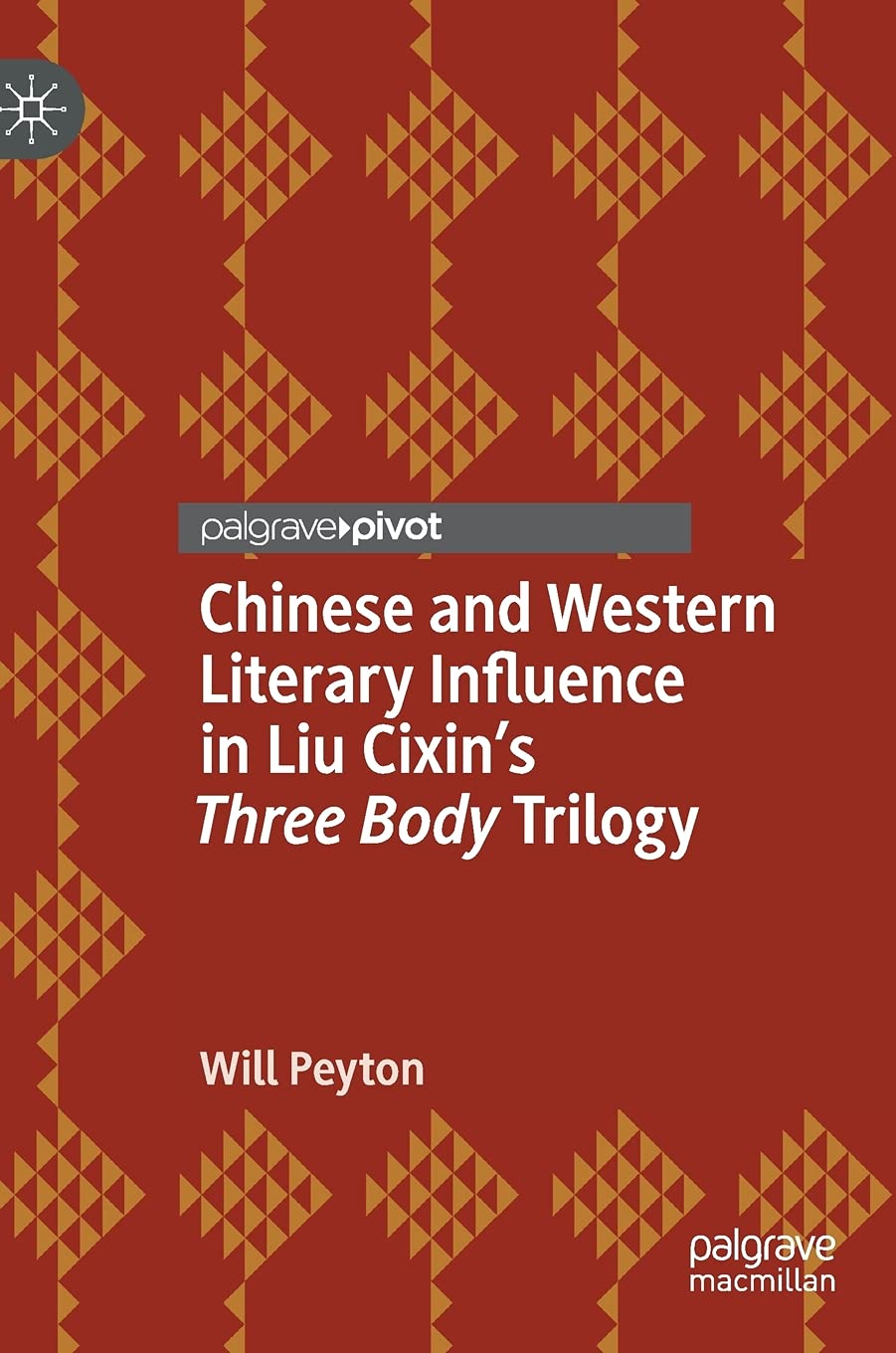
When the English translation of Liu Cixin’s Three Body Problem won the Hugo Award in 2015, the moment was widely hailed in the Western news media as the global emergence of ‘Chinese science fiction.’ To what extent was that coverage merely a convenient marketing label? In this book-length inquiry into the eclectic influences of Western and Chinese literature on the Three Body Trilogy, Liu Cixin-scholar Will Peyton suggests the writer’s interest in what the literary critic C. T. Hsia has called writing tinged by culturally distinctive ‘Chinese characteristics’ has been overstated; likewise, Peyton contends that in general the Sino-affiliated work typically grouped as Chinese SF (kehuan xiaoshuo) developed not simply independently from Western influence but in an extensive and dynamic dialogue with a wide variety of non-Chinese SF. Hence in this way Peyton advocates for understanding the Three Body Trilogy as a fascinating entry into the broad, cross-pollinating phenomenon popularly known as global SF: “Liu Cixin, like many contemporary Chinese authors, consciously views himself in a lineal relationship with translated Western writers, often making marginal reference to native Chinese fiction” (18).
Another controversial and complicated issue this book weighs in on is the precise political valences of Liu Cixin’s work and specifically that of the Three Body Trilogy. As now plastered on his Wikipedia page, in June 2019, Liu Cixin, in a profile-interview for the New Yorker, parroted the standpoint discredited by Western observers and promoted as the official position of the People’s Republic of China (PRC) that the mass detention of Uyghurs in Xinjiang is justified to preempt future terrorist attacks. Peyton does not merely condemn the Chinese writer from the cosmopolitan distance of the Western intelligentsia, as so many glib commentators have done; oppositely, and more subtly, Peyton also specifically refuses to argue that Liu Cixin critiques the political unconscious of ‘soft power’ implicit in endorsing a distinctive brand of politically flexible Chinese science fiction against the dubiously universalized stipulations of human-rights rhetoric (thus eluding a well-flogged whipping post typified by the anti-China sentiment of certain U.S. Republican senators opposed to Netflix’s in-development adaptation of The Three Body Problem). Instead, Peyton more productively historicizes Liu Cixin’s dystopian political “fatalism” as evincing a shrewd “ambivalence towards defining or engaging with discussion of political progress” (139) very much in strategic consonance with the ideological messages emanating from the PRC.
The argument of the book flows from such concretely historicizing moves. The second chapter delineates Liu Cixin’s critical assays against the anthropocentric narcissism of modern literature. The chapter performs a close reading of the virtual-reality simulations depicted in the Three Body Problem as vividly representing a putatively neutral scientism indicative of Western-influenced, post-Mao Chinese literature. The third chapter explicates the impact of the Early Modern writings of Thomas More and Tommaso Campanella as well as Darwinian thought on Liu Cixin, Chinese SF, and the Three Body Trilogy. Its specific argument is that the cosmic sociology of the trilogy fuses these utopian traditions with a contemporary scientism influenced by Western thinkers such as Peter Singer and Richard Dawkins. The fourth chapter analyzes specifically The Dark Forest (2008) and Death’s End (2010) for their evocation of a broad Shakespearean humanism. The fifth chapter frames Liu Cixin in terms of the discrepant flavors of historical realism rendered by Arthur C. Clarke and Herman Wouk. The fifth chapter discusses the classic dystopias by George Orwell, Yevgeny Zamyatin, and Aldous Huxley to limn the ethical relativity of Liu Cixin’s dystopian space opera and its glimmers of utopian scientism. The seventh chapter contextualizes Liu Cixin’s fiction as a mature outgrowth of Chinese youth fiction of the Cultural Revolution. The eighth chapter concerns the technologically utopian bent of both Liu Cixin’s trilogy and Chinese science fiction more broadly, and the ninth chapter traces the fatalism toward progress in Liu Cixin’s work to competing strands of Confucian and Daoist political thought. This last chapter includes a cursory conflation, by way of Karl Popper, of the sheer multiplicity of rigorous critical theory that can be swept under the banner of “Marxist historicism” (131) with the doctrinaire propaganda of the Maoist Cultural Revolution and therefore seemed tendentious to this reader.
All in all, though, this book greatly appeals to readers and scholars of science fiction, Chinese literature, translation studies, global studies, as well as those interested in close readings of Liu Cixin’s seminal trilogy in light of its historical and literary context.
Jerome Winter, PhD, is a full-time continuing lecturer at the University of California, Riverside. His first book, Science Fiction, New Space Opera, and Neoliberal Globalism, was published by the University of Wales Press as part of their New Dimensions in Science Fiction series. His second book, Citizen Science Fiction, was published in 2021. His scholarship has appeared in The Oxford Handbook of Science Fiction, Extrapolation, JFA, the Los Angeles Review of Books, Foundation, SFRA Review, and Science Fiction Studies.

 SFRA Review