
Non-Fiction Reviews
Review of After Human: A Critical History of the Human in Science Fiction from Shelley to Le Guin
Lars Schmeink
Thomas Connolly. After Human: A Critical History of the Human in Science Fiction from Shelley to Le Guin. Liverpool UP, 2021. Liverpool Science Fiction Texts and Studies 69. Hardcover. 240 pg. $119.15. ISBN 9781800348165.
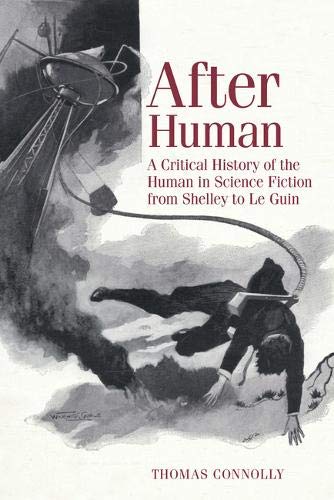
Looking at critical theory as the body of work that defines our toolset as literary critics, in science fiction (sf) especially, one cannot but notice the dominant position that posthumanism has taken on ever since its rise to prominence in the 1980s. Donna J. Haraway’s “Cyborg Manifesto” (1985) belongs into the category of must-reads for any sf scholar and its ripple effect into our field cannot be overstated. And given its timing, coinciding with the emergence of cyberpunk as a central mode of sf, it is no wonder that posthumanist readings have grown from there, proliferating in contemporary sf studies. But, as Thomas Foster has pointed out so aptly, cyberpunk is not the literary “vanguard of a posthumanism assumed to be revolutionary in itself” (xiii). Instead, it is a multiplier of posthumanism, a prism that changes the theory and allows it to take diverse forms.
But what comes out as a variety of posthumanisms must have gone into this prism at some point. It is this realization that feeds Thomas Connolly’s study After Human, that much sf before the posthumanist turn must address these issues somehow, that “even the most avowedly humanist text raises posthumanist concerns” (20). Connolly argues that in its discussion of human interaction with technology and nature, historical text of sf will reveal their concern for posthumanist issues. He sees the ‘post’ of posthumanism as a feature within humanism itself, an admittance of “the constructed nature of human experiences of the world” (20). His study is, consequently, a critical history of sf texts that foreground human interaction, not with the inhuman (however that may be), but with technology and nature, and with other humans.
Connolly then proceeds to explore the humanist-posthumanist spectrum and the ontological modes associated with it in the history of sf through four chapters, each detailing a specific period of writing. Starting with 19th century proto-sf in the works of Mary Shelley, Jules Verne, and H.G. Wells, Connolly sets up a comparison of the depiction of primitive pre-humanity in Sir Arthur Conan Doyle’s The Lost World and Jack London’s The Iron Heel, which contrasts with the humanist view of self-realization and centeredness. In the next chapter, on Aldous Huxley’s Brave New World and E.E. Smith’s Skylark series, Connolly then moves on to the relation of the human and technology, shifting the mirror from primitive pre-humanity towards a technologized trans-humanity. Here, more clearly than with the humanist-oriented narratives of the turn of the century, two distinct lines emerge: one that sees humanity “rendered powerless by technological systems beyond their control” and one that argues for a “utopic image of human self-actualization, evincing ever-greater technological control over the material world” (109).
In the 1950s, Connolly argues, a similar duality can be found not in a technological trans-humanity but in an evolved supra-humanity, which he explores in Isaac Asimov’s Foundation-series and Arthur C. Clarke’s The City and the Stars. Finally, in the 1970s, Connolly shifts from trans- or supra-humanity to a true post-humanity, in discussing the utopian project of J.G. Ballard’s The Crystal World and Ursula K. LeGuin’s The Dispossessed. All of the chapters analyze works that attempt to engage with new positions of the human, in developing with technological progress, in challenging the idea of individualism, or in decentering the human. But, as Connolly makes clear, many retreat back into their more humanist positions, not following through with fully embracing the posthumanism that they tease out. In his conclusion, Connolly sees these stories as positioned in a framework of how the non-human is approached, either “assimilative” (192) in that the human enfolds the non-human cognitively or culturally, or “transformative” (193) in that human cultural frames are challenged and changed. His analysis places the historical works discussed in this framework, thus allowing scholars of posthumanism to see the theoretical trajectories of the categories.
After Human thus cleverly uses the posthumanist scaffolding to re-read traditional science fiction and excavate positions of the human within it, tracing the development of posthumanist positions up to the 1980s. For those scholars interested to treat posthumanism not as a given of the 21st century, but as a development of the humanism and anti-humanism that came before, Connolly’s book is a valuable resource explaining the lines of thought in sf that have led up to, for example, the cyberpunk multiplication of posthumanism. After Human will help ground current work in contemporary posthumanist criticism by providing a historical perspective.
Lars Schmeink is currently Leverhulme Visiting Professor at the University of Leeds. He has inaugurated the Gesellschaft für Fantastikforschung and has served as its president from 2010-19. He is the author of Biopunk Dystopias (2016) and the co-editor of Cyberpunk and Visual Culture (2018), The Routledge Companion to Cyberpunk Culture (2020), Fifty Key Figures in Cyberpunk (2022) and New Perspectives on Contemporary German Science Fiction (2022).

 SFRA Review