Fall 2025


Fall 2025

Ian Campbell

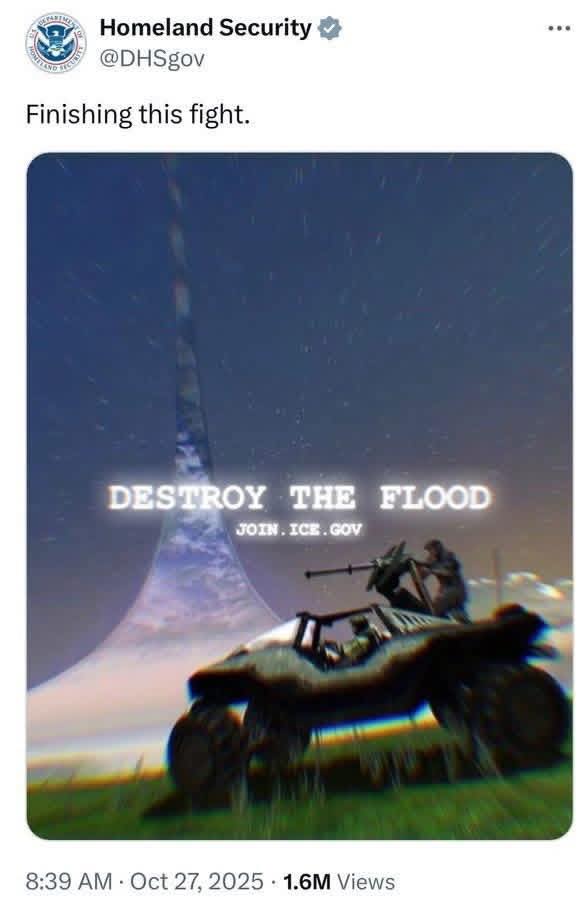
I came across this ICE recruitment ad and felt that it was worth everyone’s notice, because as scholars of science fiction, it’s part of our duty to the public to translate and critique SF in such a way as to help the public understand the critique of our own world that SF so often embodies.

If you’re not familiar with the wildly popular Halo series of video games, which are tremendous fun, this ad might seem like just garden-variety white nationalism. ICE is the guys with the vehicle and the flood is immigrants: the sort of horror that delights at least fifty million Americans. Calling immigrants a “flood” dehumanizes them, while having the approach to immigration be represented by a vehicle-mounted machine gun rather than Justice with a blindfold makes it clear that this isn’t some kind of compassionate white nationalism. It would be ghastly even were it not published by the official Homeland Security and White House accounts.

But if you are the sort of SF fan or scholar who has played much Halo, there’s an extra dimension of vileness to this ad. Because the words Destroy the Flood are in all caps, it’s not clear, other than to someone who knows Halo, that “flood” isn’t primarily intended to evoke water, here. It’s Flood, with a capital F. Per Wikipedia:

Millions of years ago, a powerful interstellar species known as the Precursors seeded the galaxy with life. One of their created races, known as the Forerunners, attacked their former masters and drove the Precursors into near extinction. A few Precursors turned into a dust, intending to regenerate themselves in the future. This dust became defective, infecting and contorting organisms into a new parasitic species, connected by a hivemind: the Flood… The Forerunners conceived the Halo Array—ring-shaped megastructures and weapons of last resort that would destroy all sentient life in the galaxy to stop the Flood’s spread. The array could be activated from the Ark, a repository of sentient life outside the range of the Halos. Exhausting all other options, the Array was activated, ending the Flood outbreak. The surviving Forerunners reseeded life and left the Milky Way galaxy.

So the capital-F Flood is a parasitic hivemind created by the defective dust of a defeated people, not just a natural disaster. They’re not even themselves people: they’ve lost their status as people because they’ve been conquered and assimilated into a race so toxic that the only way to defeat them is to destroy all life. In the series, the Flood is driven by a desire to infect any sentient life of sufficient size. Someone who’s not familiar with Halo or SF, and who has a touch of empathy, just sees this poster as yet another example of the sheer crassness of the current regime. The demographics ICE intends to recruit from—ex-husbands with restraining orders and people who failed the police psych exam, it appears—have likely played an awful lot of Halo, and understand perfectly what the ad’s rhetoric is really intended to evoke.

The ad’s visuals work in a similar way. The arch ascending behind the soldiers might just seem like something artsy or maybe generically sci-fi if you’ve not played Halo, but if you have, you understand that it’s the arch of a Halo, a weapon of genocide. And hardly anything is more white nationalist than genocide.

Like so much about the regime’s rhetoric, this ad is designed to draw young people, primarily white and primarily male but with more diversity than one might hope, into white nationalism. And if it takes framing people who came here to work as fruit pickers or home health care aides or neurologists as a parasitic hivemind, the regime clearly has no problem going there. But if we, as scholars familiar with explaining SF to laypeople, can take the time and energy to show these young people’s families and friends what’s really being marketed, we might take another step closer toward making Nazis bad again.

I’ve not even touched on the role that AI plays in the Halo series, as this piece is already overlong. Enjoy the rest of this issue, where in addition to our usual palette of reviews, we have a group of papers on utopia and dystopia in the Turkish SF tradition. Write me at icampbell@gsu.edu.


Summer 2025


Summer 2025

Ian Campbell

The best SF holds a distorting mirror up to our own world and induces us to reflect upon the artificiality of what we think natural. Octavia Butler’s Kindred, for example, puts a woman from the late twentieth century into the worst of antebellum chattel slavery, in order both to tell a compelling story and also to expose us to what our history books typically gloss over or deliberately misframe. Of course, now we live in an era where our history books are being rewritten in order to make it seem as if the Confederacy was the natural state of humanity. Much of my own work centers around SF in Arabic, where estrangement and distorting mirrors are quite useful, because of the lack of formal protections for freedom of speech; I rather expect that Americans will become increasingly familiar with having to read between the lines in order to understand critique.

A vast supermajority of Americans loathe the new normal, but there are just enough cultists (and billionaires) to hold it together with duct tape and bullshit for now. The central issue of the moment is that there is no consensus alternative to fascism. Almost literally nobody wants what the sclerotic leadership of the Democratic Party is proposing, but not all that many people want the Full Bernie, either. What does a durable consensus on what an antifascist society looks like entail? And how can that consensus be reached without oligarch-controlled algorithmic social media putting its thumb on the scale, or how can that thumb be counteracted? We’re right on the cusp of an age where all photographs and video can be perfectly faked: is the answer a retreat to small, in-person communities where trust is earned, or (e.g.) the Fair Witnesses of Stranger in a Strange Land, or (heaven forfend) strict regulation of verified content and news organizations independent of corporate control?

In this issue of the Review, we as the Editorial Collective take on the Hugo and Nebula novel nominees and ask two questions: why has SF appeared to retreat into fantasy, and why in particular was this suite of mostly mediocre novels chosen as representative of the best the genre has to offer? Spoiler alert: we only have partial answers to each question. We would very much like to hear your thoughts on the matter: send them to icampbell@gsu.edu.


Spring 2025


Spring 2025

Ian Campbell

I write this on the one hundredth day of the new regime. We’ve all read about or seen the numerous authoritarian/fascist regimes in science fiction, but what they all tend to have in common is basic competence. Say what you will about the Empire in Star Wars, but they’re predictable and appear to keep the trains running. After three months of this, we’re lost in a farce, with Photoshopped tattoos, tariffs on a whim, poll numbers dropping like rocks into gravity wells and a rotating cast of sycophants and plastic surgery disasters.

Yet farce is like SF, in a way: both hold up mirrors to our own world in order to estrange via distortion what’s happening to us and why we permit it to happen. Farce and SF are instructive, above and beyond their entertainment value. Having a ketamine-addicted oligarch waving a chainsaw about as a means of signaling the end of public health programs in a farce (or SF) would be indicative of our own complacency or failure in allowing manifestly terrible people into positions of power, our own shortsightedness in coming up with excuses to make the perfect the enemy of the good, the sheer lunacy of allowing billionaires to exist in the first place.

Perhaps we’ll learn from the estrangement. Consider Asimov’s Foundation novels, where the repugnant Mule strolls in and uses powers of manipulation to twist the system in his direction. “A master of deception, only interested in pillage and plunder”, he takes a system that was indeed in need of serious reform and wrecks it for his own delight and profit. In the novels, the Mule (who poses as a clown) is defeated because his maniacal persistence in searching for and defeating those who might represent an alternative center of power prevents him from maintaining control over his conquered populations. He has no allies, only yes-men and opportunists, and this proves his undoing. Perhaps SF does provide us models for reversing authoritarianism, in addition to its function of deconstructing our received assumptions. Most fictional galactic emperors, I feel compelled to note, don’t reverse themselves when their trade partners refuse to comply.

Yet the defining feature of farce is that it’s intended to be funny. And while there are, to be sure, many things about our new overlords that stimulate our sense of humor, there’s nothing funny at all about what’s happening to our most vulnerable populations. Trans people being erased, exhibits being removed from the African-American museum at the Smithsonian, the wanton destruction of our economy, the destruction of a century of alliances in order to cozy up to ghouls and psychopaths, the open love for cruelty of all sorts, the summary deportation of international students for free speech or minor traffic tickets, the illegal detention of all manner of innocent people, the sending of many of those people to what is obviously a death camp in a foreign country contrary to every principle of our constitutional republic… all of these together, under the dominion of a diaper-wearing clown gangster, are the sort of thing that would have a literary agent or editor saying it’s too over the top to be published.

It only looks like farce, and it’s only SF in that what is called “artificial intelligence” is making the decision to destroy the livelihoods of tens of thousands of people who have made national service the defining feature of their lives. In SF, these intelligences are often actually intelligent instead of just pattern mimics, and when they run societies, it’s generally benevolent and oriented toward equality. In Iain M. Banks’ Culture novels, the AIs take care of every human need except the desire to be useful; in Surface Detail, the AIs go to great lengths (and take great pleasure in) comprehensively destroying a world-dominating oligarch.

The real genre we’re in now is not SF nor farce, but horror, where the characters’ hubris inspires them to ignore obvious warning signs in order to see what might happen, and then suffer existential threats.

In this issue of the SFRA Review, we offer perspectives on modes of governance SF provides us. Because SF generally works via estrangement, we might well view these alternative modes of governance as takes on our own mode of governance. We hope that you will find these takes illustrative. We also have a call for papers, where we ask you for your short takes on the Nebula and Hugo nominees; this is on an abbreviated schedule so that we might publish them in three months rather than six. These do not have to be strictly academic opinions: we welcome a wide variety of perspectives on these works.

With respect to our real world in real need of estrangement, do not obey in advance. If forced under threat to modify your speech and actions, you have to make the decision that’s best for you. But do not modify your speech or actions just because you think the oligarchy won’t like it: at least make them work to try to silence you.


Call for Papers: Short Takes on the 2025 Nebula and Hugo Award Nominees


Short Takes on the 2025 Nebula and Hugo Award Nominees

The Editorial Collective

It’s award season, and few of us have the time to read all the nominated works. Yet most of us will read at least one of the works, and all of us can benefit from your insight on a particular text. The SFRA Review invites readers to submit short (1000-2000 word) analyses on any one or two of the novels, novellas, novelettes, short stories, dramatic presentations, kids/YA, or game writing nominated for the 2025 Nebula and Hugo awards, to be published in our 01 August issue.

The Nebula nominees can be found here, and the Hugo nominees here.

We’d love to read diverse perspectives on these works in order to understand what makes the works noteworthy. The SFRA Review invites scholars, fans or casual readers to submit a short take Each submission should include the following:

  • a very brief introduction to the author
  • a very brief plot summary and description of the formal qualities of the text: narration, presentation, prose style, etc.
  • what in your opinion makes the text stand out as worthy of nomination for a Nebula Award, or why it is not worthy of a nomination
  • a close reading/watching of a section of the text you feel demonstrates what makes the text (un)worthy
  • (optional) a comparison between two nominated works, or between a nominated work and another work you feel is salient

Submissions

Please note that this CFP is on a three-month timeline rather than our usual six-month timeline in order that the pieces be published during awards season.

Submissions should be in .docx format, between 1000 and 2000 words long. Citations should be in MLA format. Please avoid discursive footnotes/endnotes; such notes as are included within the text should not be linked: just use a superscript number and then put the notes at the end of the document. Please include a brief bio of yourself.

Please submit a brief abstract to icampbell@gsu.edu by 30 May and a completed submission by 30 June. Please be prepared to complete edits by 15 July. Submissions will be published in the 01 August issue. We look forward to hearing from you.

Winter 2025


Winter 2025

Ian Campbell

I have a longstanding love/hate relationship with SF author Neal Stephenson—or rather, with his works, as I’ve never met the gentleman. Really cool ideas and digressions into all sorts of knowledge, and then gaping misogyny and the inability or principled refusal to wrap up his narratives. Something I’ve been thinking about for the last couple of months is the neurolinguistic hacking in Snow Crash (1992), where people could be “neurolinguistically hacked” by exposure to ancient Sumerian language and a bitmap image, reducing them to babbling nonsense syllables. At the time, and even for many years after, this seemed like just a fun conceit to scaffold an adventure narrative onto. But now, our franchised landscape is under the near-total dominance of people who have been neuroliguistically hacked, only instead of babbling nonsense syllables, they babble nonsense about QAnon and “religious freedom” and things about masculinity, that are all breathtakingly counterfactual yet spoken of with absolute belief that they are true.

In The Diamond Age (1995), Stephenson has a girl in a private school chafe at lessons she feels have little to do with her education. Her teacher tells her that “It is the hardest thing in the world to make educated Westerners pull together,” a statement that I might have glossed over the first time I read the novel, but which seems eerily prescient today. I’ve unfollowed and been unfollowed by many people over the last few months, all because I was unable or refused in principle to stay quiet about their own inability or principled refusal to pull together. Perhaps you’ve been on one or both ends of the same phenomenon.

SF looks at trends and predicts the future as well as estranging the present: though its predictions of the future are usually off in significant ways, they often get the general tone quite well. Snow Crash has Christians looting the ancient Near East for their own benefit; The Diamond Age has what’s left of Western culture ruled by people called Equity Lords. Stephenson’s Fall, or Dodge in Hell (2019) has the rural swathes of America outside the metro areas and interstates, “Ameristan”, ruled by a violent Christian culture that rejects empathy and compassion in favor of a hypermasculine model of Christ that has little to do with the Gospels. I’m compelled to wonder whether we get a distorted version of that future, or something closer to The Handmaid’s Tale or Oryx and Crake. Just our luck, it will probably be all of those.

Enjoy this issue of the SFRA Review, where we have in addition to our usual suite of fiction, non-fiction and media reviews an essay on Ghost in the Shell and not one but two pieces of SF-related fiction. Try to limit your doomscrolling: touch grass, talk to people, make art.


Call for Papers: Utopia and Dystopia in Turkish Science Fiction Literature


SFRA Review, vol. 55 no. 1

From the SFRA Review


From Pandora’s Box to The City of the Sun: Utopia and Dystopia in Turkish Science Fiction Literature

The Editorial Collective

Utopias are imagined, idealized paradises that offer visions of alternative power relations. Dystopias, on the other hand, express a negative worldview characterized by domination, punishment, and oppressive practices. Utopias and dystopias alike offer a literary, political, and philosophical synthesis of political thought, techno-scientific narratives, and naturecultures. In doing so, dystopias may present subterranean civilizations, class relations, and the domination of high levels of technology in an ideological and ecocritical manner, whereas utopias are more likely to explore non-existent, lost, or imagined paradises.

The possibility of utopian thinking is, however, shaped by dystopian realities and foresight. In this context, utopias can be considered “some variation on an ideal present, an ideal past and an ideal future, and the relation between the three” (Gregory Claeys, 2020: 13). Utopian and dystopian fictions therefore hold a prominent place in science fiction literature. While science fiction genres in the 1970s focused on freedom, peace, climate change, and political and economic problems, today, influences such as critical theory, feminism, gender studies and posthumanism have an important impact on science fiction literature. In recent years, the increasing number of literary works (novels, short stories, translations, etc.) in the field of Turkish science fiction literature indicates a growing interest in these issues among Turkish writers and scholars. We present the theme of utopia and dystopia in Turkish science fiction literature with the concept of “disedebitopia.” This concept features the term edeb at its core, which is an abbreviation of edebiyat, the Turkish word for literature. Edeb also refers to edep, meaning decency or decorum, which holds significant importance in literature and represents respect for aesthetic and ethical values.

This CFP aims to expand research in Turkish science fiction literature from past to present. This issue aims to create an interdisciplinary anthology by bringing together studies focusing on the theme of disedebitopia.

This special issue of the SFRA Review is dedicated to an interdisciplinary review of utopia and dystopian fiction and their various subgenres and intersections in Turkish science fiction literature, as well as the humanities, social sciences, psychology, philosophy, and science and technology. SFRA Review is an open access journal published four times a year by the Science Fiction Research Association (SFRA) (eISSN 2641-2837; former ISSN 1068-395X). We encourage established and emerging scholars or graduate and postgraduate students interested in this special issue to submit abstracts related to, but not limited to, the following areas and topics within Turkish science fiction:

• Solar/Bio/Cyberpunk Subgenres and Utopia/Dystopia
• Cyberfeminism, Cyborg Feminism and Cyber Utopia/Dystopia
• Feminist Utopia / Dystopia
• Disability Studies in Utopia / Dystopia Fictions
• Robotic, Design and Artificial Intelligence Technologies in Utopia/Dystopias
• Futuristic, Artistic and Aesthetic Designs of Literary Utopia/Dystopias
• Gods, Heroes and Disasters: Mythological Connections of Utopia/Dystopias in Literature
• Spaces of the Future: Symbolic Use of Space in Utopia/Dystopias
• Utopia/Dystopia in the Framework of Transhumanism/Posthumanism
• Psychological Reflection of Social Structures: Family, Society and Power Dynamics in
Utopia/Dystopias
• The Collapse of Time: Fictional Time of the Future in Literary Utopia/Dystopias
• Critical Posthumanism, New Materialism and Posthuman and Non-Human Being/Becoming in Literary Utopia/Dystopian Fiction
• Back to Nature: Ecocriticism and the Redesign of Human-Nature Relations in Green Utopias
• Queer Utopias and Gender
• Humanity in the Age of Surveillance: Digital Totalitarian Systems of Dystopias
• Panopticon and Dystopia: The Role of Space in Totalitarian Regimes
• Capitalism and the Future: Dystopias, Marxist Critique and Political Economy
• The Post-Apocalyptic World and Humanity: Philosophical Foundations of Dystopias

Submissions

This CFP is addressed to academics, science fiction lovers, Turkish literature researchers, and anyone interested in science fiction literature. Those interested can send 250-word abstracts in both Turkish and English to Meltem Dağcı (dagci.meltem@gmail.com) and Duygu Küçüköz Aydemir (duygumbs@gmail.com), cc-ing managing editor Virginia L. Conn (vconn@stevens.edu). However, the full text of accepted abstracts must be submitted in English. Otherwise, it is recommended that manuscripts submitted in Turkish be translated into English after the initial review, after editorial corrections, and, if necessary, after being returned to the author with suggestions. However, we would like to remind interested applicants that any submissions will be subjected to an editorial review again after translation.

Following submission of a ~200-word abstract and 200-word bio, authors will be notified if their abstracts have been accepted and will be sent a Word document outlining the house style guides and regulations for submission. Full-text manuscripts of 3000-5000 words (excluding notes, citations, and bibliography) will then be requested. Manuscripts should be prepared in accordance with academic writing guidelines (references, citations, endnotes, etc.) and in MLA 9th edition style. For any questions or requests for early feedback, please contact the special issue editors Meltem Dağcı and Duygu Küçüköz Aydemir. Edited manuscripts will be published in the 2025 Fall issue of the SFRA Review. We hope this CFP will be of interest to you and invite you to submit your contributions.

Timeline

Deadline for submission of abstracts: March 15

Notification of accepted abstracts: March 29

Submission of first drafts: May 10

Return of first draft revisions: June 7

Submission of second drafts: July 5

Return of second draft revisions: August 2

Submission of final drafts: August 16

Date of publication: Fall 2025

Fall 2024


Fall 2024

Ian Campbell

Living in the USA right now feels like the backstory to an SF novel, where in less than a week, some mad scientist is going to pull the quantum lever that sends different versions of each of us off into two different universes, one with a decent and hard-working government that at least attempts to do something to bring us closer to a equitable and inclusive future—though in fact it won’t likely be all that equitable—marked by technological innovation and at least an attempt to mitigate the great Jackpot of climate change, and another future that has concentration camps.


What I never would have thought in all my years reading SF as a child and young adult is that something close to half of Americans want to live in the future with concentration camps.


Many people fear modernity, whether because they’re used to privilege so equality feels like oppression, or whether they’re constitutionally anxious and have a hard time dealing with change. Many people look at the increasingly clear signs of climate change and become reactionaries not out of hatred but out of wishful thinking: maybe they could pull their own quantum lever and go back in time to where it wasn’t quite so hot and loud and fast. In America at least, power has been maintained by the gentry since colonial times by telling downscale white people that no matter how much of their money gets funneled to the gentry, they’ll still have people who don’t count as human to kick down on.


Just imagine the SF novel written about this: some ambiguously hot Special Circumstances agent and her wisecracking drone companion standing there agog, when a white man who misses the days of segregated lunch counters explains that they don’t mind poverty and abjection so long as they get to be gleeful about others’ having it worse.


We don’t have that in this issue of the Review, but we do have a really interesting look at feminized robots and our usual spread of nonfiction, fiction and media reviews. Enjoy them all, while I and half of my compatriots sit around wringing our hands waiting to find out which way that quantum lever sends us. I’m really hoping it’s the future where I don’t get more fake special privilege for being a white guy. Write me at icampbell@gsu.edu.


Call for Papers: Alternative Governance in Science Fiction


SFRA Review, vol. 54 no. 3

From the SFRA Review


Call for Papers: Alternative Governance in Science Fiction

The Editorial Collective

Among the many attractions of speculative fiction is its ability to envision a world different from our own, whether this be a distorted reflection of our own world or something entirely new. Especially in recent decades, many works of speculative fiction take a social rather than strictly technological approach to examining human society.

One aspect of these sorts of alternative worlds takes the form of different visions of governance. Many of the canonical works of SF have tended to imitate historic examples of governments, such as totalitarian empires, democratic republics, and hereditary monarchies. Especially in past decades, these governments serve as little more than set dressing for a story to take place, rather than being critically engaged with to explore the consequences of and alternatives to these systems. Now, however, we increasingly see in SF alternative systems of government both as a consequence of developing technology and as a distorted/distorting mirror through which to view our own systems.

This CFP seeks to broaden understanding of government in SF both within and beyond its typical bounds. We invite papers that reflect upon the issue of governance in SF as it can be, not necessarily how it is. Why and how does a given work depict a particular system of government? What is this system’s relationship to new technologies, whether these technologies be physical, digital or social? How and why is this system intended to estrange our own understanding of governance in the here and now?

The SFRA Review invites submissions that focus on the depiction or criticism of speculative, utopian, dystopian, alternative, or futurological systems of governing. Topics may include (but are not limited to):

  • Governments
  • Elections
  • Monarchies
  • Empires
  • Dictatorships
  • Republics
  • Democracies
  • Theocracies
  • Utopias
  • Dystopias

We invite proposals of ~250 words and short author bios by 15 September 2024. Contributors will be notified if their essays are selected for inclusion by 30 September 2024, and full essays of 4000-5000 words will be requested by 30 November 2024. Editing and revision will take place over the next few weeks, and final submissions will be due on 15 January 2025. Edited articles will appear in the Spring 2025 (01 Februrary) issue. Submissions should be sent to (jamesjknupp@gmail.com) and CCed to (vconn@stevens.edu). We look forward to hearing from you.

Summer 2024


SFRA Review, vol. 54 no. 3

From the SFRA Review


Summer 2024

Ian Campbell

I’ve long felt that the timeline where friends got both David Bowie and Prince to the doctor in time back in 2016 is the control universe, and we’re living in the experimental one, and that sometime around (let’s say) 06 January 2021, the researchers grew bored and put their collective thumb on the fast-forward button. But I was incorrect, I think: when Golden Toilet almost took a bullet and then a very effective incumbent dropped out of the race, I came to understand that what we now live in is the Black Swan universe. Anything goes, folks: buckle up, or don’t.


SF, among other things, enables us to run experimental universes: to say “what might happen were X true”, whether X be faster-than-light travel, or colonizable planets, or sentient aliens who just want to party. SF lets us look at what the consequences of those developments might be, and also to use those hypothetical universes as distorted reflections upon our own here and now. In this issue of the SFRA Review, our Managing Editor Virginia L. Conn brings us a set of articles about SF and socialism: what a collective approach to solving problems or rebooting our society might look like. We hope that you find these articles, as well as our usual palette of reviews, to be food for thought. Imagine an experimental universe where money did not count as free speech.


The two hottest days in recorded human history were reached last week, breaking a record set last month, which broke a record set last year. I’m beginning to sound like a broken record, but our climate change future is already here: it’s just very unevenly distributed. It reminds me of William Gibson’s work in The Peripheral and Agency, where the background plot revolves around a non-white woman elected to the US presidency around this time and then either assassinated, or not, depending on the timeline. Imagine an experimental universe where the open undermining of democracy led to actual sanctions. Write me at icampbell@gsu.edu.


Spring 2024


Spring 2024

Ian Campbell

This is our shortest issue in quite a long time, due to some scheduling conflicts. We will return in August with a much fuller suite of features and articles. The end of the spring semester is a challenge for everyone who’s academic-adjacent, including parents of children in elementary, middle and high schools. My own high-schooler is naturally anxious enough, but with a project or standardized test due every few days, she’s really feeling the burnout so many of us do at this generally beautiful time of year.

My much-beloved parents are venerable enough to be almost a statistical anomaly by this point, and while they’ve been robust all along, time has really begun to catch up with both of them recently. For most of this month, my mother has been in a nursing home seventy miles from us, recovering from a femur broken in a fall, and my father, one of our last living WWII veterans, has been in a hospital fifty miles in a different direction, suffering from digestive issues relating to a bout of food poisoning. Neither has a smartphone, so I’ve spent many an hour going low-tech, with my daughter’s phone in one hand and my own phone in the other, turned upside down so that my parents can speak to each other from their separate beds. I am an organic coupling device. They have been married since the 1950s.

SF enables me to think about what might be right around the corner: part of me would love to jump ahead not that far to the San Junipero universe, where both of them could be free of aches and pains and back to a time when “real people danced with a partner,” in my father’s oft-repeated words. But SF is as much about the social consequences of technological development as it is the tech itself, and that particular episode of Black Mirror needed to focus on the tech and the characters, so it hadn’t the time to do much with the social issues. Imagine two great-great-grandchldren debating whether to stop paying for their ancestor’s subscription. Imagine the digital hells from Iain M. Banks’ Surface Detail. Imagine the world of the story of Miguel Acevedo. I think I’d prefer to stick with San Junipero, because I’ll still be able to talk with them, without needing two phones or a medium. Write me at icampbell@gsu.edu.

I’ve gotta wear shades!