Review of Lavie Tidhar’s Unholy Land


Review of Unholy Land by Lavie Tidhar

Amandine Faucheux

Lavie Tidhar. Unholy Land. Tachyon, 2018. Paperback. 264 pp. $15.95. ISBN 9781616963040.
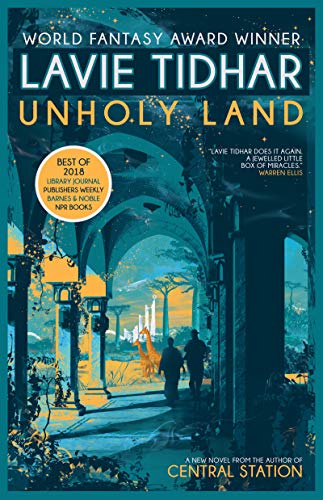

The protagonist of Lavie Tidhar’s Unholy Land, Lior Tirosh, is a science fiction/detective fiction pulp writer who leaves his home in Berlin to visit his sick father in Palestinia, the Jewish state nestled between Uganda and Kenya, before getting involved in an increasingly complex plot of parallel universes. The story’s narrator, gradually revealed to be Special Investigator Bloom, addresses a mysterious second-person character named Nur, who turns out to be an agent trained to move in between the worlds. Bloom follows both Tirosh and Nur from afar, although at times the narrator takes on omniscient powers, as it becomes clear that in travelling from Europe Tirosh has crossed more than international borders, but the border to another world.

The novel’s mirror frame—an author-surrogate protagonist to whom Tidhar attributes his own novels, including Osama (2011) and Unholy Land itself—invites the reader to lose herself into its composite worldbuilding, in which walls and borders and identities both possess the same meaning they do in the real world, and at the same time don’t. Tidhar bases his what-if thought experiment in a real historical moment, the early 20th century Uganda Program, which proposed to create a Jewish nation in East Africa (a land “unholy” but a land all the same), but in his novel, like in the best sf stories, it is our own world’s reality that suddenly appears strange. Like Tirosh, the reader must follow along without ever being securely anchored in either reality or fantasy, history or alternate history, the past or the present. In this country, too, Palestinians (a noun Tidhar no doubt uses ironically) erect a wall to keep out the indigenous people that were forcibly removed from the land; in this story, too, the PDF (Palestinian Defense Force) brutally harasses refugees and uses surveillance against young revolutionaries. But this is also a story in which ‘only’ a “Small Holocaust” happened (since European Jews moved to Palestinia before the rise of the Third Reich) and in which Hitler was assassinated in 1948. Tidhar’s incredibly vivid worldbuilding unveils a wealth of intriguing details: Palestinians speak Judean (at the end a character calls modern Hebrew “archaic” by comparison); old European Jewish families have become diamantaires; children read the story of the Judean Tarzan. 

This is also a novel that, at least when it focuses on Tirosh, develops complex and piercing emotional realities. Throughout the story, Tirosh is haunted by the (never quite described) death of his young son Isaac. His constantly resurfacing grief through memories of simple moments with the toddler showcases the talent of Tidhar’s prose. This is not the only thing that haunts Tirosh. His brother Gideon was killed in the war; his father is ailing and Tirosh is so reluctant to visit it only happens at the end of the novel; his niece Deborah is missing and her mysterious disappearance drives the action; and Tirosh’s memories are also increasingly conflicted as the story progresses.

Tidhar’s novel is a powerful, labyrinthine story reminiscent of China Miéville The City and The City (2009) and, in a much more subtle and controlled way, some of the best of Philip K. Dick. With its careful and intelligent treatment of some of the most difficult questions arising from the Israel-Palestine conflict, it will undoubtedly become a staple of postcolonial science fiction courses. Its straightforward prose and short format will provide for a productive introduction to discussions about border conflicts, nationality, nationalism, and imperialism while also allowing teachers to outline some of the key features of the best of sf. As Tirosh himself explains during a reading at a bookstore: “What we do [when writing stories of alternative realities] is literalise the metaphor…We construct a world of make-believe in order to consider how our own world is constructed, is told.” (113-4). 

Some of the novel’s shortcomings could come from Tirosh’s own pulp detective stories. When Bloom ceases to be the narrator in the background and acts as a character especially, the plot turns cartoonish and awkward. To give an example, when Bloom and fellow soldiers storm a refugee camp and harass a family, Bloom reflects to himself: “I did not enjoy humiliating [the woman]. I was merely carrying my duties. I was a professional” (148). The missing-girl plotline of Deborah, with its stereotypical mobster characters, ends up leading nowhere. It is actually quite hard to pinpoint, even by the end of the novel, why certain scenes took place (like the different assassination attempts on Tirosh or his search for the theodolite) or why some characters are introduced (like Melody, a woman who seems to be here simply for Tirosh to sleep with). Overall, Tidhar’s beautiful, almost poetic prose and the fascinating worldbuilding propel the reader to keep reading on in spite of some of the story’s somewhat vulgar plot points, and some of the transition scenes between the worlds have a Ubik-esque quality that I will not forget any time soon.

Review of Wade Roush’s Twelve Tomorrows


Review of Twelve Tomorrows edited by Wade Roush

Dominick Grace

Wade Roush, editor. Twelve Tomorrows. MIT Press, 2018. Paperback, 276 pp, $19.95. ISBN 9780262535427.


Twelve Tomorrows is volume five in a series begun in 2011 with TRSF, and the first to be published in book form rather than as an issue of Technology Review magazine. A more accurate if less streamlined title might be Eleven Tomorrows and One Yesterday, as the book includes only eleven new stories, and a new retrospective on the life and career of Samuel R. Delany. The remit of the series, as explained on the series website is to offer “original stories that explore the role and potential impact of developing technologies in the near, and not-so-near future.” A Delany retrospective might not seem to be the ideal fit for that remit, since Delany’s importance is arguably more for his innovations in style and in social extrapolation, rather than specifically in speculation about scientific innovation, but on the other hand, he is one of SF’s major figures, and more can always be said about him. The eleven stories come from diverse hands, including several well-known SF names (e.g. Elizabeth Bear, Liu Cixin, Paul McAuley, Nnedi Okorafor, and Alastair Reynolds) as well as from upcoming figures and writers not usually associated with SF. The overall quality of the anthology is consistent, but perhaps more narrow in focus than its stated goal would suggest. While it is unsurprising that implications of computer technology innovations should loom large, the anthology would be more diverse and more fully meet its aim of speculation about developing technologies if the stories tackled a more broad range of topics. Roush indicates in his introduction that he generally banned dystopian stories because he likes his “SF with a dose of hopefulness. […] Pessimists don’t invent vaccines or build moon rockets [ix]; however, several of the stories here are more cautionary than celebratory, and a few are outright dystopian. 

Several are about AI, or variations thereof, again unsurprising at this juncture. One of the few overtly dystopian tales here, McAuley’s “Chine Life,” offers a far future in which AI has mostly supplanted humanity and has split into factions, one of which wants humanity eradicated and the other of which ostensibly wants to help, but literally colonizes the bodies of human beings in order to do so. McAuley here offers a neat sort of twist on invasion/colonization. Somewhat differently, Clifford V. Johnson’s “Resolution” (told in comics format, a welcome innovation, though John’s style is functional) offers something of a variation, imagining a future in which an alien invasion goes unnoticed because the aliens (who are apparently incorporeal) have passed themselves off as the AI the protagonist thought she had developed. Bear’s story, “Okay, Glory,” is about a wealthy recluse whose AI is hacked into believing there has ben a catastrophe in the outside world, so confines him to his impregnable fortress of a house, until he pays the hacker/extortionists $150,000,000. The cautionary tale about the susceptibility of computer tech to hacking is competently enough handled, if not new, but the story suffers from a major plot hole: if one expects to be paid a huge pile of money, one must leave the person they are extorting a way actually to get to the money. Sarah Pinsker’s “Caring Seasons” also involves smart tech (whether actually AI or not is not spelled out) run amok, as it presents a retirement facility in which the medical protocols designed to protect residents instead become the tools that imprison them. J.M. Ledgard’s “Vespers” imagines the first interstellar spaceship, run by an AI that spends the story ruminating about its situation. Almost half the stories here, therefore, are essentially variations on a theme. As such, this group represents a suite of stories that might be considered in tandem in a classroom to discuss how SF deals with AI.

Most of the rest of the stories also play on the implications of computer tech, in one way or another. Ken Liu’s “Byzantine Empathy” presents an intriguing story about attempts to co-opt cryptocurrencies to serve charitable ends—or, conversely, to allow one charitable organization to become the most powerful charitable organization in the world—by melding social media and giving. Liu Cixin’s “Fields of Gold” (which might also be connected to the AI stories) posits that the accidental launch of a woman into space on a doomed voyage may become something that would unite the world in an attempt to reach the stars, but we ultimately learn that the real woman is long dead and replaced by a computer simulation, when the rest of Earth catches up and sends out a ship that can catch up to hers. Reynolds’s “Different Seas” carries remote control to an extreme by positing humanoid helpers that can be inhabited remotely to aid people in crisis. The story includes an ironic twist that is perhaps unnecessary. Malka Older’s “Disaster Tourism” might be seen as a complementary piece, as it involves the use of drones in rescue work, when an inexplicable infection breaks out.

Only the remaining two stories carry us any distance from computer tech, S.L. Huang’s “The Woman Who Destroyed Us,” and Okorafor’s punningly titled “The Heart of the Matter.” The former deals with a medical innovation that allows for the tweaking of brains, which can allow for the cure of mental conditions, or simply for self-improvement. Whether such tech makes one more truly oneself or whether it transforms people into something else—whether this is an advance created by a Frankenstein, or a genuine boon to humanity—is treated with some nuance. The story is neither a stereotypical warning about science daring to tread where it ought not, nor a paean to advancement, though it perhaps skews in the latter direction, as it is narrated from the point of view of a woman who initially views it as the former and hopes to destroy its creator but who comes ultimately to see value in the procedure. “The Heart of the Matter” explores age-old fear of scientific advancement by representing the replacement of a Nigerian President’s heart with an artificial one as something that inspires superstitious fear in some—a fear exploited by a would-be usurper, who takes advantage of credulous equations of new technology with witchcraft.

Overall, then, this is a strong volume that does indeed offer speculations about new and emerging technology. The stories are all solid, if thematically and stylistically for the most part fairly staid (I imagine many readers will have recognized familiar themes and plot points in the brief precis above). The book is possibly useful for a course on SF and tech, or on contemporary trends in SF.

Review of Stephen King’s The Institute


Review of The Institute by Stephen King

Dominick Grace

Stephen King. The Institute. Scribner, 2019. Hardback, 576 pp. $30.00. ISBN 9781982110567.


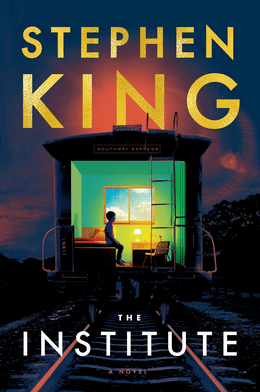
The Institute, Stephen King’s most recent novel, is one of his few books that might arguably be regarded as SF, or at least SF-adjacent. King’s work usually falls squarely into the horror category, but SF tropes occasionally assume central roles in his books (e.g. though clearly horror, The Tommyknockers’ monsters are the aliens—or the ghosts of aliens—associated with a spacecraft that has been buried for millennia, a plot device many will recognize). Of these, the most frequent are paranormal abilities such as telepathy, telekinesis, precognition, and other powers of the mind, which are usually permitted in SF despite having little in the way of scientific justification. Indeed, King’s career began with Carrie (1974), ostensibly horror but focusing on a teen-aged girl with telekinetic powers, rather than on fantastical creatures or monsters. The Institute is another such novel, this time focusing on children possessed of telekinetic or telepathic power who are being kidnapped and dragooned into the service of a shadowy organization for ends that remain obscure until well into the book, providing a modicum of expense. Surprisingly, the organization in question is not The Shop, as long-time readers might have anticipated, since it was The Shop who came after pyrokinetic Charlie McGee in Firestarter (1980) and who turned up to mop up at the end of The Tommyknockers.

Thematically, though, the novel most clearly hearkens back to The Dead Zone (1979). Johnny Smith, that novel’s protagonist, acquires a precognitive ability that allows him a glimpse onto a potentially apocalyptic future, one that he decides to prevent by assassinating Greg Stilson before he can become President and begin a nuclear war. Smith’s solo mission is institutionalized in this latest novel, as the unnamed Institute kidnaps children with paranormal abilities and experiments on them (in ways that effectively amount to torture) in order to use their precognitive abilities to foresee potential future catastrophes and then their telepathic and telekinetic abilities to kill those who will cause said catastrophes. Doing so quickly uses up these children, effectively destroying their conscious minds, leaving behind only shells whose remaining mental powers serve as the battery for weaponized telepathy and telekinesis.

The idea of using precognitive abilities (or of other ways of gathering information, such as time travel) to engage in first-strike prevention is far from new in SF. Nor is the idea of children with special abilities being used (whether with their consent or without) being trained to intervene in world events—Marvel’s X-Men perhaps being the pre-eminent example. King’s take on these ideas is perhaps less original than it is a synthesis of possibilities. He uses it to comment on the extent to which ostensibly good ends can be used to justify increasingly horrifying means. The argument Institute leader Mrs Sigsby, among others, makes, is that the work they do has saved the world multiple times, because by combining the knowledge they glean from precognitives with the powers they can exploit and enhance in the telepathic/telekinetic children, they can use those mental powers to kill those who would create disasters.

However, King’s focus is on children who have been kidnapped, and who have also usually also had their families murdered during the kidnapping—protagonist Luke Ellis has been represented in the media as a runaway who slew his family, as a way not only of eliminating parents who would look for a lost child but also as a way of tainting Luke should he ever escape. Their training is often indistinguishable from torture. As a result, readerly sympathy is clearly aligned with them, to make the figures running the Institute (and, we can assume, those running the numerous other facilities around the world, that we learn about later in the book) come across as monstrous. And since for much of the book, we do not know why these children are being used the way they, we are readers are further encouraged to side with the children. Furthermore, all the characters on the side of the Institute, with one exception, are depicted, to a greater or lesser extent, as sociopathic or otherwise morally corrupt. That their essentially evil (for want of a better word) behavior may itself be caused by or at least enhanced by toxic psychic contamination bleeding into their own heads as a side effect of the experimentation and exploitation they inflict on the children may be read as a metaphor for how power corrupts.

King therefore largely games the system, leaving little room to consider whether the ends do indeed justify the means. Here, they clearly do not. In the current world of rising nationalism and authoritarianism (and King is vocally anti-Trump) this is not necessarily a bad message. It’s just not a very subtle one. But then, King has never been renowned for his subtlety.