Review of Memory’s Legion


Review of Memory’s Legion

Robert J. Creedon

Corey, James S.A. Memory’s Legion Orbit, 2022.

.

Memory’s Legion is a compilation of the novellas and short fiction of the Expanse universe of James S.A. Corey. The Expanse consists of a series of books and short stories, a role-playing game, and a television program. Small parts of Memory’s Legion make up a collection of shorter fiction that was produced for other media. Each is available through other means, but together they are placed in a chronological order related to the main series of books. For someone who only knows the TV series and RPG game, Memory’s Legion expands upon the worlds, characters, and periods of the series. This collection isan amazing introduction to the many elements of the Expanse universe and series. I accessed this text through Audible, which additionally provides authors’ notes (spoken by the authors) and allows the listener to hear the correct pronunciation of names and places. This review will try not to reveal any spoilers but only hint at their existence.     

“Drive” is the first short story. It covers the technological advancement that makes space travel more profitable and accessible in this universe. The Expanse is set 200 years into the future. This story, set 150 years before the main plotline of the series, follows Solomon Epstein as he invents the Epstein Drive to allow faster space travel. The drive enables humankind to venture throughout the solar system, including the Outer Belt and the moons of outer planets. It is a wonderful blend of hard soft science as the authors “show” rather than tell in this story of the first flight. Although theory, it gives a wonderfully detailed explanation of the related theoretical physics. Solomon Epstein reflects upon his past as we learn what this new technology does to him, the pilot. It is a very skillful tribute to this fictional inventor that sets off the entire “expanse” or colonization of the solar system.  

The next three stories are all interconnected as they cover the main zones and characters of the series. “The Butcher of Anderson Station” introduces Colonel Fred Johnson and the Belters with the theme of political strife between governments, corporations, and the Belters. We see how Johnson evolves and observe the living conditions of the people of the Belt and Outer Planets. “The Churn” introduces the background of a major character from Earth with a surprise twist. The hidden twist helps the reader to focus on a wonderful story of the lives of the common people of Earth, demonstrating how the lives of people on Earth are shaped by their high population numbers. We see things like “Basic” Universal Income, free mass transit, and underground economies of the average citizen without looking at only the elites. Once the twist is revealed, it makes a lot more sense. From the TV series, the actor is subdued and only hints at what the character is experiencing, which can be felt from his performance. After reading this, you will have a greater appreciation for elements of his performance and backstory. Finally, “Gods of Risk” continues the story of Bobbie Draper and introduces us to common life on Mars. Mars is colonized and seems to be very much like a modern-day Earth in lifestyle and opportunity. Each of these stories establishes the political environment of their cultures through a personal story that draws in the reader. Each gives its flavor to a crime story of sorts but that just is the medium for these great character stories. Much of the jargon and flavor of each world is conveyed so this makes a great introduction to the cultures for both reading the series and playing the RPG version. 

“The Vital Abyss” covers a discovery and technological development that was not explored well in the series. The story presents a very interesting argument in ethics and philosophy wrapped into a weird story of an unusual situation. I now see that there was really no place for this in the main series, but it is a very deep story that is a pleasure to experience. Strangely, this story also introduces the reader to a theme or element of the Expanse universe that might be missed. A major character has a diverse education that bridges ideas and concepts from many sciences within the story. This mirrors the biological education of one of the authors that adds layers to many of the stories. We also see the higher education skill of secondary fields like philosophy from the author notes or interview at the end of the Audible reading. This does support that any beginning writer should read or listen to this collection with interviews as a lesson on the importance of diverse personal skills and techniques in world building.

“Strange Dogs” reads simply as a horror story but has many layers. We have advanced forward into time to the colonizing of the planet, Laconia, within the Expanse universe. We meet a young girl named Cara who is growing up on the world as part of what was supposed to be just a five-year mission. She is being raised with rules from Earth on a world where most of those rules do not apply. She is a young, responsible girl trying to do the right thing, but all the rules have changed. The authors say that this is a story of immigrants. The first generation tries to live by their rules from home, but Cara develops through her learning of the rules of the planet. Within this horror story, we see that the planet has different technologies and abilities. I do not see it as horror even though it ends very horror like. It has more of a colonization / immigrant edge to it as two cultures experience conflict. As a Canadian who works in a First Nation community, I recognize a familiar misunderstanding between the Laconians and humans as they try to help. It reminds me of the Westerns where a young child becomes part of tribe or the Star Trek NG episode “Suddenly Human” where the child is reintroduced to humans after being raised by an alien culture. This is a much more interesting way of dealing with the bridging of two different cultures by a person. The total distrust of the events due to human-centered beliefs causes the horror but what would have happened if the characters connected as Cara does, accepting the gifts and knowledge of the “Strange Dogs”? What are we learning from the Indigenous peoples now that we are actually listening and trying to understand? “Strange Dogs” therefore prompts the reader to carefully consider these pivotal topics.

“Auberon” is a story filled with political intrigue. This is due largely to its plot, which focuses upon the aftermath of the Laconian Empire’s takeover of the universe and its subsequent placing of governors on its planets. Strangely, it opens with a wonderful speech about how change is constant and that there is therefore a dire need to learn new rules quickly. There are definite connections to “The Churn” and the recurrence of the social political emphasis in the Expanse universe. We see how a governor deals with a very corrupt planet with limited trusted forces and how the criminal underworld adapts and survives. We learn about the problems of winning a war. What really gets me is how this story is so perfect as a teaser for the series without giving anything away. There is even a reference to “Strange Dogs” linking them. The author’s notes additionally enrich this section. For these reasons, it is a short story that prompts the reader to explore the rest of the series.

“Sins of the Father” tells the tale of one of the characters and how this character ends up wrapped in a very strange fate. A major event happens in the universe, so we see the effects on a group of colonists. Once you read this story, you will also see a strange karma in the fate of the main character, but what struck me was how Earth is being destroyed and we look at the stars and science for solution. Between “Strange Dogs” and this story, we are told it is not a guarantee. There is a secondary lesson in the stories of the Expanse about life on this planet and possible outcomes. This might not be an intentional theme, but I picked up on the possibilities. Not everything turns out, especially for 400 with no way home and no chance of rescue.

The short stories and novellas in this collection are a wonderful gateway into the Expanse universe, whether it is for a reader of the books, a watcher of the TV series, or a gamer interested in the RPG. This also carries great weight for the aspiring writer to see the craftsmanship and diversity of knowledge necessary for creating a realistic universe. We see biology, politics, and philosophy as major viewpoints for the writing. The Expanse universe was also used for a campaign for a roleplaying game by the author. One thing many tabletop or Role Playing Games do is incorporate elements of different fictional worlds. Many read the works of the authors to get the flavor of the universe in which they are playing. The authors of the Expanse do well in explaining the science and technology involved in these stories and exploring the culture of both the leaders and the common folks, especially those of the underworlds. There is even new terminology like “goldilocks planets” and “living on basic” to explain concepts in this view of the universe. 

This collection allows the players to jump off many places for their own games and campaigns through this long story arc. This is a wonderful piece of writing as both an introduction and teaser to the Expanse books or TV series. The Audible package also includes the author’s notes in an interview format after each story, which, by providing the authors’ comments directly, greatly enriches the text. It is a nice package to give clarity plus it provides great insight into the writers and the process. Those author’s notes are very informative to both readers and future writers. For those watching the TV series, these stories are linked in as titles and more. Reading or listening to the stories provides a depth and scope unavailable to consumers solely of the television series. The quality of the reader in the Audible recording is great as there are those voice changes that help the listener understand who is speaking. Additionally, it is read at a great pace and is clearly spoken. Overall, this book and its format are top quality and worth your time whether you be an avid fan or someone looking for a mind-opening piece of science fiction. It provides escapism, provokes important ideas, and introduces strong characters, culminating in a great reading or listening experience. 


Robert Creedon is an intermediate and high school teacher in the Canadian First Nation community.  With backgrounds in emergency services, sociology, and teaching, he has cultivated an interest in science fiction through tabletop role playing games, film, media, and books for over 40 years.  This is his first review of fiction, but he has reviewed books on popular culture and philosophy before.  Robert has also participated in over 50 productions of theater and media.   

Review of A Master of Djinn


Review of A Master of Djinn

Ian Campbell

P. Djéli Clark. A Master of Djinn. Tordotcom, 2021. Hardcover. 400 pg. $18.59. ISBN 978-1250267689.

.

Clark’s debut novel won the Nebula Award for Best Novel in 2021, and in 2022 won the Compton Crook Award for Best Novel and the Locus Award for Best First Novel. It was also nominated for the Hugo Award for Best Novel in 2022. The work depicts an alternate steampunk-esque Cairo of the 1910s, where the technical innovations are the work of the djinn or the result of their influence. There are many social innovations, as well, more on which below. The timelines split in the 1870s, when in our world Egypt was nominally independent but in practice dominated by the British and French: the proximate cause of this was Egypt’s vast indebtedness to those countries, partially due to the cost of the Suez Canal. In Clark’s world, a mystic going by the name al-Jahiz was able to open the door between our world and what Clark refers to as the Kaf, the world of the djinn. The irruption of mystical force into the world enabled Egypt to leapfrog the Western powers both technolgically and socially; this irruption spread to other colonized lands, enabling those societies to throw off their Western oppressors via their cultures’ particular sorts of sorcery and magical beings.

This alternate history provides the background for a police procedural that becomes an epic struggle for power through control of the djinn. Fatma el-Sha’rawi is a senior agent with the Ministry of Alchemy, Enchantments and Supernatural Entities, which is itself part of a highly modernized and efficient Egyptian government. When a British man with ties to the colonial past, who is also the leader of an esoteric brotherhood devoted to al-Jahiz, is murdered along with his whole brotherhood in a clearly sorcerous manner, Fatma is called in to solve the mystery: her main companions in this quest is her new partner, Agent Hadia, and Fatma’s lover Siti, whose heritage proves crucial. The McGuffin here is the Seal of Solomon, which has the power to bind the djinn in service: a villain cosplaying as al-Jahiz returned needs to re-open the gateway between worlds in the service of their own will to power. A Master of Djinn builds upon a previously-published novella and novelette, whose events are summarized in the text of this work. I should note that I have not read these earlier works, on the premise that the novel should be understood as a thing unto itself.

The novel has much to admire. Its world is vivid and particular: Clark has a good picture of Cairo and uses it to his advantage in structuring its steampunk alter. The world is also internally consistent. The novel is quickly-paced and an easy read. The central plot is well-structured, even if its sudden reveal is telegraphed much too clearly. Its version of the 1910s is startlingly modern in terms of social mores, above and beyond the overturning of colonialism: most contemporary readers will appreciate its feminism, queer relationships and other details.

What A Master of Djinn best represents, however, is the hollowing-out of the publishing industry and the vast disservice this does to both writers and readers. Clark is a first-time novelist, and it shows: there are clunky bits of exposition, even including a couple of instances that verge on “As you know, Bob,” and minor infelicities of language here and there. A caring editor would have had him cut down the number of descriptions of clothing, spaced out the introductions of some of the characters, etc. For example, djinn is the group plural and the name of the race of beings. The singular is djinni, yet “djinn” is used in the singular throughout the text; also, there are repeated mentions of masjid, which does mean “mosque”, but it’s singular and the word is consistently used in the plural, where it should be masájid. These infelicities should have been addressed in the editing process, but clearly were not. It’s a testament to Clark’s skill at keeping the story moving and portraying a vivid alternate universe that the novel won the awards it has—but this recognition comes despite, not with the help of, Tor and its editors.

The infelicities are sometimes grating but ultimately trivial—and again, I want to emphasize that my critique here is not of Clark, who’s done a great job as a first-time novelist. More problematic is the glaring lacuna that anyone familiar with the literary tradition in Arabic will find at the heart of A Master of Djinn: his portrayal of djinn very much goes against their nature.

Structurally, the djinn occupy a space in Muslim culture very similar to that of the fey in Celtic-influenced northwestern Europe. The djinn predate humanity—and often predate upon humanity. They are very diverse in form, and fall into groups based on similarity of form. They have great sorcerous power and live far beyond the mortal lifespan. They are arrogant, lack empathy and are often cruel, but are honorable in their generally Lawful Evil way. They can be bargained with, but will obey the bargain only to its literal word and will do what they can to make those words misleading. Some are more curious than actively malevolent; a very, very few are intrigued by humanity and might even verge on the benevolent. The primary structural difference between fey and djinn is that while Christianity is inimical to the former, the djinn are fully imbricated in the Muslim tradition—though the djinn existed in the cultures of the region prior to the advent of Islam. The djinn were created first, and from fire; when god created humans from earth, he demanded the djinn bow down to the first humans. Some refused, while others obeyed. Some djinn became Muslims, while others did not.

The djinn of A Master of Djinn have all the superficial characteristics of the traditional djinn, and many of the powers. They certainly look like djinn: Clark, like many new writers, spends a great deal of space giving us physical descriptions of characters, and the descriptions of the very different physical forms (and outfits) of the djinn go a great deal toward the vividness of his world. The djinn have the same broad variety and particularity in the novel as they do in the literary tradition. Some of them act like djinn, whether their words and actions be arrogant, oblique, opaque or esoteric.

Yet Clark has humanized the djinn, and it takes away from the power and innovation of his world, in a way that might not be evident to those unfamiliar with the djinn. Partway through the text, Fatma sees an English woman reading from a luridly-illustrated book of 1001 Nights-esque tales. She responds to this by directly lampshading, anachronistically, the concept of Orientalism, first articulated by Edward Said in 1978, six decades after the novel’s setting. Fatma is right to sneer at the book she sees, but A Master of Djinn performs the opposite trope upon most of its djinn. The djinn are not human, and their djinn-ity is being done something of a disservice by the text. The novel is full of djinn who, despite their baroque appearance and habits, have opinions and take actions that make them seem like 21st-century progressives. Since the advent of the djinn, every hierarchy has been overturned: colonized and colonizers, democrats and authoritarians, men and women. The novel makes it clear that the djinn are the causal factor here: for example, the USA has banned the supernatural, and due to this it remains a backward land drenched in Jim Crow. While I personally am very much on the side of upending hierarchies, there’s a real issue of willing suspension of disbelief, here.

When presented with an alternate world, most readers of SF demand to know by what plausible set of circumstances that world arrived at its current state, but how the djinn caused a progressive revolution is the lacuna at the center of this novel. The technological revolution is clearly backstopped: it arises due to the djinn’s knowledge and sorcerous power, and this conforms to the nature and role of djinn in the literary tradition. With respect to social issues, however, the nature and role of djinn in the literary tradition is to preserve traditional hierarchies. They are for the very most part contemptuous of humans, and deeply resent having had to bow down to us. There are next to no female djinn in the tradition, and the male djinn have no more interest in feminism than do most of the human characters: the 1001 Nights is full of people of both sexes in drag, and notable female characters like Princess Budur who take on a man’s role, but none of it is feminist in the sense of saying that women should have the equal political, economic and social rights as men that they have mostly achieved via the djinn in Clark’s Egypt. The text states several times that while things aren’t yet perfect in Egypt of the 1910s, women have it rather better than their Western sisters. Yet the Egypt of 1870, before the timelines split, was socially conservative to a degree modern readers could hardly understand.

There was in fact a real-world Egyptian feminist movement in the 1910s, though not in the 1870s: it was instrumental in removing the British from direct rule. One of its chief leaders was Huda Sha’rawi (1879-1947), who is best-known for publicly throwing away her headscarf and thereby starting the period between 1922 and the 1990s when Egyptian women of the middle and upper classes did not veil. Fatma el-Sha’rawi is repeatedly said in Clark’s text to be from a downscale background and also a Sa’idi: someone from Upper (southern) Egypt, whose people are darker-skinned, regarded as hayseeds and come under a great deal of racist oppression in the real Egypt of then and even now. It’s a strange re-use of a last name, with the implication of making Egyptian feminism not only somehow djinn-driven but also populist as opposed to being entirely driven by a narrow upper class. The sort of reforms the real Sha’rawi advocated for were incremental, nothing like the openly queer relationship Fatma practices. I’m not advocating against feminism or queer relationships in SF novels: I’m arguing that A Master of Djinn doesn’t explain how any of this happened, and it’s a real distraction from an otherwise engaging story. I’m absolutely willing to suspend disbelief about the presence of the djinn in the novel, because it’s SF and the novum, and it’s cool. But they have to be djinn, and this novel for the most part transforms them into progressive humans. While this isn’t Orientalism, it is a little problematic to take this very well-documented aspect of another literary tradition and adapt the form but not the function.

Again, I’m not critiquing Clark, who deserves next to none of the blame for any of these lacunae: I’m blaming Tor. It would have taken the bare minimum of professionalism on their part to work with him to edit through the small infelicities, and only a little more to have someone familiar with the literary tradition in Arabic read the manuscript and explain where and how the djinn come across as counter to their nature as expressed in that tradition. Clark is clearly blessed with creative talent: I rather doubt it would have taken him long to articulate how the djinn became progressive and to integrate it smoothly into the novel’s additional chapters, and then to perform some minor redjinnification of some of the characters. His story and world are compelling, and I do hope that Clark continues to refine his voice and expand upon what he’s created.


Ian Campbell is the editor of SFRA Review.

Review of The 2084 Report


Review of The 2084 Report

Ada Cheong

Powell, James Lawrence. The 2084 Report: An Oral History of the Great Warming Simon and Schuster, 2020.

.

The 2084 Report is the only work of fiction written by James Lawrence Powell, an American geochemist who has written books on climate science, the Grand Canyon, the Colorado River and the extinction of dinosaurs. The novel is an authoritative chronicle of the effects of climate breakdown as experienced across the globe in an imagined near future. Composed of interviews collected and published in the year 2084 by an unnamed oral historian, it is organised thematically around specific, albeit overlapping, phenomena: droughts and fire, flooding, the rising of sea levels, melting glaciers and permafrost, resource struggles, fascism and xenophobia, death, and nonhuman extinctions. 

Powell’s book plays into a major trope within the cli-fi genre, one which features a future historian interpreting and documenting the errors, failures, and sometimes demise of contemporary life in the Capitalocene. The 2084 Report begins with a preface by a historian, dated Dec 31 2084 in Kentucky. He describes his methods to produce the book, “knowing that it will be read mostly by friends and family” (preface). Like works such as The Age of Stupid, World War Z, and The Collapse of Western Civilization, it conjures what Pieter Vermeulen describes as the “posthumous readability” (880) of climate breakdown and human extinction, evoking “a ravaged future in order to serve as a warning for its present readers” (869).

As is expected of works within this subgenre, Powell’s book is elegiac in tone, as ecological beauty vanishes, and communities lose their lands and livelihoods in the near future. Displaying the vivid speculative prowess of fictional prose, it details the eventual demise of cities and communities in both the Global North and South, as their water resources disappear, from Bangladesh and the Netherlands to Peru and Phoenix. The book features the “ghostly skeleton of some monstrous, dissected sea creature” that the Great Barrier Reef has become (part 8), and the demise of tropical glaciers—a miraculously beautiful “contradicción frágil” (part 4). As ecosystems are torn asunder, so too are monuments of civilisation: China’s Three Gorges Dam is destroyed when a “giant wall of water washed down the Yangtze, sweeping away everything before it” (part 2), and the Statue of Liberty meets a similar demise as “one giant wave toppled her” (part 2).

The novel thus offers a glimpse into what Greg Garrard calls disanthropy, “the world as it is when we are not looking… at once alluring and frighteningly indifferent” (942). Such an aesthetic centres around the downplaying of human agency and exceptionalism in the face of seemingly cosmological and uncontrollable anthropogenic climate phenomena. Vermeulen likewise suggests that works within this subgenre are “sustained exercises in abandoning human life to a geological gaze that is rigorously uninterested in understanding human exceptionality” (880), allowing contemporary readers to “begin facing up to the increasingly inescapable fact of human species finitude” (872). To critics like Garrard and Vermeulen, then, trope performs an important cultural function, one which leans towards a stoic acceptance of climate breakdown rather than action and activism in averting such a future.

Yet, Powell’s book suggests an alternate function that narratives and fiction have to play in the climate crisis. While such texts commonly employ a narrative temporality in which “the present is always also the object of a future memory” (Vermeulen 872), producing “an imagining of the future as if it were already past” (Vermeulen 872), The 2084 Report is slightly different in its temporal inflection. Rather than a book that mourns the future as foregone, it is very much present-oriented, focussed on human agency and the ability to avert a future-without-humanity.

The depth of knowledge that Powell possesses of climate science accurately brings to life the socio-political impacts that the impending ecological fallouts will create. It provides first-hand accounts of the creation and displacement of “25 million Bangladeshi climate refugees” (part 2), the “seemingly endless human chain (that) filled the roads” (part 4) when glacier meltwater dries up, the slow violence of water rations in Phoenix (part 1), and wars within the Arab nations over water (part 5). It is concerned with making real both the slow and dramatic consequences of climate breakdown, drawing strong causal links between climate phenomena and the subjective lives of different human beings. Despite its strong scientific focus (its range of interviewees invariably cite climate statistics), it grapples with both the slow, Nixonian violences of climate breakdown, and its large-scale catastrophes. The 2084 Report thus enables us to approach the material—and affective—reality of our near future.

Unlike the disanthropic works described by Vermuelen and Garrard, however, Powell’s book takes this as the first step towards tackling the climate crisis. As Energy Humanists like Imre Szeman and Dominic Boyer suggest, the climate crisis is not just a technological or scientific problem, but an imaginative and cultural one (Szeman and Boyer 3). Books such as Powell’s novel allow readers to begin properly understanding the affective and cultural consequences of climate breakdown and thus to act to avert it.

Its final two chapters are, perhaps, the most obvious example of this urgent aspiration towards the possibility of steering the planet away from climate catastrophe. While the book largely maintains that climate breakdown within the story has become irreversible, past the “point of no return” (part 9), it also insists on the ability to imagine a different future. The narrator, speaking to two professors in energy production and politics, reiterates:

you are saying that several countries, including Canada, France, and Sweden, had shown that an expansion of nuclear power production could have cut fossil-fuel emissions enough between 2020 and 2050 to keep the global temperature rise under 3.6 ° F [2 ° C] and to eliminate fossil-fuel use. More than two dozen countries, including the U.S., China, Russia, and India, had the necessary experience and controls. And yet it was not done. (Look to Sweden I)

The overarching question of the book, then, is not just “why, back in the first few decades of this century, before time had run out, people did not act to at least slow down global warming” (part 0)—but what are our last possible options in averting large-scale climate catastrophe?

In looking urgently towards the options we have at present, Powell’s book is closer in tenor to Kim Stanley Robinson’s The Ministry for the Future. Instead of a nihilistic reckoning with a world without us, it is occupied with the political and ecological cascade of actions and consequences that branch from our contemporary moment.

The book remains, ultimately, largely driven by facts, even as it colours in the subjective and affectual experiences of the immediate future. The interviewees presented are voices of authority (politicians/journalists) and scholars who are experts in energy politics, geology, engineering, anthropology and more—with the exception of an indigenous native of Brazil (part 1) and a native of the island of Tuvalu, off the coast of New Zealand (part 3). While the glaringly elitist selection of voices does make space for emotions, with characters feeling “terribly sad” (part 2) or remembering how their favourite beaches grew narrower (part 2), the book’s seemingly limited affective scope is not simply a result of its privileging of science over culture as in the age-old disciplinary distinction.

Rather, it recounts the chaotic, messy fallout of climate breakdown through an incongruously neat aesthetic. Beyond the cataloguing of its interviews by theme and didactic questioning, the prose of the book is largely rational, easy and authoritative. It is at odds with the structure of feeling that has come to characterise the Capitalocene in the 21st-century, one which Fredric Jameson describes as a fundamental break, a “situation where discontinuity has become more fundamental [MP1] than continuity” (318). The overwhelming, discombobulating nature of this simultaneously planetary and unevenly specific fate is unsatisfactorily conveyed by the oral historian’s curated and complete recounting of the near future. The neat sorting of climate phenomena into themes and the narration of the violence wrought by climate breakdown captures the content, but not form, of the experiences to come.

Rather, it recounts the chaotic, messy fallout of climate breakdown through an incongruously neat aesthetic. Beyond the cataloguing of its interviews by theme and didactic questioning, the prose of the book is largely rational, easy and authoritative. It is at odds with the structure of feeling that has come to characterise the Capitalocene in the 21st-century, one which Fredric Jameson describes as a fundamental break, a “situation where discontinuity has become more fundamental than continuity” (318). The overwhelming, discombobulating nature of this simultaneously planetary and unevenly specific fate is unsatisfactorily conveyed by the oral historian’s curated and complete recounting of the near future. The neat sorting of climate phenomena into themes and the narration of the violence wrought by climate breakdown captures the content, but not form, of the experiences to come.

Ultimately, The 2084 Report manages to turn “science faction” into a compliment, suggesting key ways in which narratives and fiction intervene in shaping conceptualisations of the climate crisis. While unable to convincingly pull it off through the quality of its prose, Powell’s book points authoritatively towards the shape of the troubles facing us.


WORKS CITED

Garrard, Greg. “World without Us: Some Types of Disanthropy.” Substance, vol. 41, 2007, pp. 40–60.

Jameson, Fredric. Allegory and Ideology. Verso, 2019.

Szeman, Imre and Dominic Boyer, editors. Energy Humanities: An Anthology. JHU Press, 2017.

Vermeulen, Pieter. “Future Readers: Narrating the Human in the Anthropocene.” Textual Practice, vol. 31, no. 5, 2017, pp. 867-885.


Ada Cheong (she/her) is a PhD candidate based at the University of Exeter. She is fascinated by the alimentary anxieties surrounding the world-food-system, and the ways in which issues such as industrial meat, ultra-processed foods, GM technology etc. register culturally in sf works from the 1970s onwards. Her research more generally concerns the politics and culture of the Capitalocene, and critically engages with the fields of the Energy Humanities and world-ecological literary studies. She is also a communicator and writer for the Food, Farming and Countryside Commission.

Review of January Fifteenth


Review of January Fifteenth

Jeremy Brett

Rachel Swirsky. January Fifteenth. Tordotcom, 2022. Paperback. 239 pg. $15.99. ISBN 978-1-250-19894-6.

There is so very much to examine about our present right now, but ironically, a crucial issue that concerns us all has been generally overlooked in recent science fiction. The issue is economic inequality, a subject of serious concern and equally serious implications for both the future of humanity and the planet. It brings suffering and misery and hardship to countless people, and all the forces of greed and corruption seem arrayed to support it.

There’s great dramatic potential offered by an issue with such grave planetary and societal import, yet I see few stories that try to grapple with it, except as background dressing (or as an aspect and outcome of post-apocalyptic disaster). This to me represents a missed opportunity, because some of the greatest literature in any genre is that which, first, has something to say about ourselves and the human condition when subjected to immense stress and second, describes what happens when people attempt to solve vital problems. I believe the genre would greatly benefit from more stories in which people apply similar degrees of resources, thought, or effort to economic inequality. Acting with narrative boldness to counter the seeming inevitability of capitalism’s continued dominance may seem as science fictional (fantastical, even) as it gets, but the limitless reach of SF’s imagination should not preclude us from envisioning possible solutions or alternate economic pathways for ourselves, even if, as Rachel Swirsky demonstrates in her intelligent novella January Fifteenth, the consequences aren’t predictable or even, sometimes, just.

Set in a near-future United States, the novella takes place over the course of a single day, the day every American receives their yearly Universal Basic Income payment (“UBI” is defined by the Basic Income Lab at Stanford University as “a periodic cash allowance given to all citizens, without means test to provide them with a standard of living above the poverty line.” From that basic definition there are all manner of differing opinions on what qualifies as UBI or who should receive it.). Swirsky’s novella benefits from timeliness, certainly, since UBI as a method of reducing economic inequality has become a part of the national economic conversation in the USA over the last few years, with debates involving people as disparate as Andrew Yang, Hillary Clinton, economist Thomas Piketty, Bernie Sanders, and Mark Zuckerberg weighing in. It is an idea that appeals to many, and it is no wonder that Swirsky has turned her narrative gifts towards a fictional exploration of its potential impact on the complicated lives of human beings.

The novella centers four women, each from a vastly different stratum of American society and each impacted by UBI in a vastly different manner. Although the four never interact, Swirsky’s story amounts to a kind of mosaic, where the different lives and fates of the central characters come together as diverse bits making up a greater whole—the overall societal picture of UBI and the ways, great and small, that it impacts people and society. In upstate New York lives Hannah Klopfer and her two small boys—for Hannah, January 15th is a day less about economic security and opportunity and more about trauma. It is the anniversary of the day she took her boys and fled her abusive, mentally unbalanced, former wife—now stalker—Abigail. Hannah is on the run and living as quietly as she can; picking up her UBI check is a time to be watchful and scared of discovery by Abigail.

In Chicago, Janelle, a freelance reporter in a post-journalism world, scrounges at the request of news aggregator services every January 15th for man-on-the-street interviews of people and their opinions on UBI. For Janelle, an orphan who raises her 14-year-old sister Neveah alone, the day is one of predictable banalities and arguments with her firebrand liberal sister over the injustices of UBI. The story moves west into Colorado, where Olivia is a freshman in college and the child of great wealth; for her and her friends in Aspen, January 15th is “Waste Day,” where the fabulously rich compete to see who can burn through their UBI in the most dramatic and flamboyant manner. And last, there is pregnant teenager Sarah, a “sister-wife” in Utah whose “family” travels the long route on foot through Utah to pick up their UBI payments in person.

What makes Swirsky’s novella so intriguing is not that it lays out the details of a UBI-based society, nor that it explores the traditional arguments about UBI (freedom vs. dependency), but that it instead concentrates on how traumas, abuses, and everyday circumstances “affect our lives. They affect our happiness. They certainly affect how and why Universal Basic Income could change our circumstances” (Author’s Note). In the United States of the novella, UBI fails to actually solve any of the characters’ individual problems on its own, but it provides avenues and opportunities for people to evolve and change. It also, like anything else, can be a negative force: Sarah notes that “the prophet’s wives and children trekked on foot every year to protest the state’s requirement that they go in person to receive their benefits. The state claimed that it was to mitigate ‘abuses of the system,’ but everyone knew it was just another way to harass them for having different beliefs” (35). Meanwhile, the yearly UBI gives license to Olivia’s friends to be crushed under the weight of their own decadence and insecurities. And darker elements are hinted at—at one point, Janelle hears rumors of Native women being sterilized or else having their UBI withheld, and people being forced to sign loyalty oaths to receive their money. As Swirsky notes, money does not solve everything, and it can not necessarily correct injustices in an already problematic system.

The imperfections and limits of UBI are important themes of the novella, in fact. At one point, Janelle and Neveah argue over the history of the program, Neveah appealing to Janelle’s youthful liberalism. In this scene, the compromises and betrayals and hidden motives that accompany any reform are laid bare:

[Nevaeh] added, “I don’t believe you’ve really changed everything you think.”

“What I think – and what I thought – is that UBI is better than having nothing.”

Neveah started to respond. Janelle held up her hand.

Janelle continued, “What I think – and what I thought – is that we had an extraordinary moment of political will after Winter Night. The whole country was breathing a sigh of relief. We weren’t just trying to get ourselves back on track; we were trying to figure out what kind of track to get on. It was like we had this dream together of improving the world.”

“Right? So- “

“What I said was that it would be a one-shot deal. We had one sure arrow to fire from that bow. And whatever we didn’t make sure to fix then, it probably wasn’t going to get fixed for a long time.”

“You were right!”

“Yeah, I was….UBI is definitely better than having nothing.”

“But you were right about everything,” Neveah said. “You called it patchwork legislation…you said once the opposition realized UBI was definitely happening, they were going to try to make it hard to collect. Like drumming up paranoia about bank breaches to make us use checks and the mail. You said they’d start saying states needed the right to make their own rules, but they’d really mean states should be able to make people jump through hoops. You said it was ‘enshrining unequal access.’”

Janelle shrugged. “And now the law’s been written.” (55-56)

Through a single day in the lives of four wildly disparate women, each bearing their own particular emotional burdens and life experiences, January Fifteenth provides a smart and thoroughly realized series of proofs that the human element is vital to the outcome of any attempts at economic or societal restructuring. It shows how narratives of economic inequality, no matter the genre, cannot be simplistic if they are to be either remotely realistic or conducive to imaginative considerations of real-life reform. Society is complicated, people and their relationships are complicated, and realistic stories about this kind of inequality—stories we need to tell—will be complicated, too. Economic inequality is a corrosive phenomenon that threatens us all with an ever-more uncertain future, and Rachel Swirsky has done us all a great service in writing a story that thoughtfully explores the human impact of attempts to reduce it.

WORKS CITED

“What is Basic Income?” Stanford University, 5 Jan. 2023, https://basicincome.stanford.edu/about/what-is-ubi/.

Jeremy Brett is an Associate Professor at Cushing Memorial Library & Archives, where he is both Processing Archivist and the Curator of the Science Fiction & Fantasy Research Collection. He has also worked at the University of Iowa, the University of Wisconsin-Milwaukee, the National Archives and Records Administration-Pacific Region, and the Wisconsin Historical Society. He received his MLS and his MA in History from the University of Maryland – College Park in 1999. His professional interests include science fiction, fan studies, and the intersection of libraries and social justice.

Review of The Galaxy, and the Ground Within


Review of The Galaxy, and the Ground Within

Gabriela Lee

Chambers, Becky. The Galaxy, and the Ground Within. Harper Voyager, 2021.

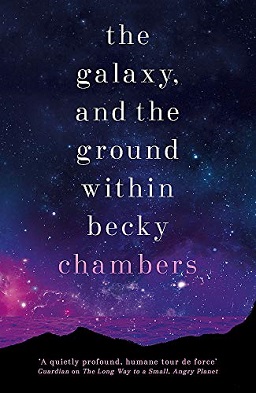
Stepping back into the world of Becky Chambers’ Wayfarers series is a comfort. Beginning with the first novel, A Long Way to a Small, Angry Planet, and culminating in the fourth and final novel, The Galaxy, and the Ground Within, Chambers creates a vibrant, messy universe where humans are just a footnote in galactic history. In fact, in the Wayfarers universe, it is the humans who need to be saved by the other alien species with superior technology; it is the humans whose status as an independent and legal species needs to be acknowledged by the Galactic Commons, the parliamentary system that governs most of the known, traveled universe.

But Chambers is not concerned with the big picture of the galaxy—she is interested in the stories of the individuals who simply live their lives, and how they navigate a world in which people (and when I say “people” I mean all the sapient beings in this universe, not just humans) travel halfway across the galaxy through what is essentially traffic-controlled wormholes but still struggle with ordinary, everyday problems. In fact, one could say that Chambers is preoccupied with the personal, and it is through the personal that she is able to connect to the universal.

It is this particular preoccupation that makes The Galaxy, and the Ground Within approachable, despite the fact that it is the only book in the series in which none of the protagonists are humans. Instead, the novel focuses on four different beings stranded on Gora, an unassuming planet in the middle of what is essentially an intersection of five busy highways in space. Because of the interstellar traffic that passes through Gora and the wait time it takes to traverse the interspatial tunnels from one part of the galaxy to the other, many businesses spring up in the area to cater to travelers waiting to cross to other parts of the galaxy, including restaurants, bath houses, and travelers’ inns. One of them is the Five-Hop One-Stop, a kitschy intergalactic bed and breakfast that welcomes all visitors, no matter the species.

The novel’s plot is fairly simple: during a routine visit to the Five-Hop One-Stop while waiting for their turn in the queue to make their space jump, three guests are stranded when a major communication satellite malfunctions in Gora airspace, rendering the transportation hub inert. While the Galactic Commons Transit Authority and Goran officials scramble to repair the satellites and get the transportation tunnels back in order again, everyone is ordered to stay at their respective habitats, effectively stranding the three guests at the Five-Hop.

One of them is an Akarak named Speaker, who is described as small and stunted, with her arms ending in hooks that allow her to swing from one pole to another. The Akaraks are considered a fringe species, existing in the margins of the civilized universe without a home planet of their own and unable to live in more civilized spaces because of their unique biological needs; namely, they breathe methane instead of oxygen and are therefore unable to live outside of mechanical suits. Another guest is the exiled Quelin, Roveg, a designer of artificial simulations for entertainment and education. The Quelin, a monolithic society that despises change and insists on the enduring permanence of their own culture, branded Roveg a traitor after he was identified as the creator of narrative simulators that challenged Quelin ideology. Though he has since recuperated his career and finances, he is still permanently cut off from his family and home. The final guest is the Aeluon military cargo captain Pei, a character we briefly meet in the first book, as she heads to a secret rendezvous with her human lover. The Aeluons are considered one of the “Big Three” species that established the Galactic Commons and are generally considered one of the most advanced species in the universe. However, because of biological and social expectations, such as a declining birth rate, Aeluons are generally discouraged from romantic relationships with other species. Rounding out the cast of characters are Ouloo and her offspring, Tupo, a Laru mother-and-child who run the transit stop. Ouloo struggles with raising her child with a wealth of options while at the same time trying to figure out her place in the wider galaxy; similarly, the adolescent Tupo struggles to figure out their place in the world while they grow into their body and gender identity. The Laru are described as long-necked and fur-covered, are in part identified by their strange gaits—commonly alternating their walking style between two and four limbs—and are widespread across the galaxy, so much so that they no longer have any meaningful or traditional ties to their own home world.

The enforced proximity of the five characters reveals lines of tension. For instance, Pei’s work in a military-adjacent career is constantly challenged by Speaker, whose entire species was almost wiped out during a planet-side war generations ago, but the effects are still being felt in the present. Roveg’s exile also becomes a sore subject for him, especially when he confronts his own prejudices against Speaker and Pei, as well as his own personal philosophy of maintaining neutrality at the expense of everything else. However, the manufactured closeness also unveils intersections of commonality between everyone. Speaker’s reluctance at revealing her worry for her missing sister, Tracker, changes as Roveg and Ouloo attempt to help her find alternative means of communication outside the habitat. Pei’s frustration at the way by which her species are discouraged from entering relationships outside of their people boils over when she is faced with the choice of whether to be a mother, and though Aeluon motherhood is nothing like human motherhood, the choice still remains. Even Ouloo is challenged by the extended presence of visitors in her habitat and how their needs clash with the needs of her son.

Unlike many SF novels, Chambers smoothly gets around the thorny problem of exposition and explaining how the world works by utilizing short intermission pages that occur between chapters. They take the shape of planetwide bureaucratic announcements from the Galactic Commons Transit Authority that update the shelter-in-place policies around Gora. This allows readers to follow both the passage of time as well as provide ongoing updates of the events happening outside the Five-Hop. Similarly, Chambers uses the character of Tupo as a reader intermediary: as the youngest character, Tupo can easily shift between the four adults and ask questions, thereby expanding on our understanding of how each character sees each other and themselves. Although she consistently reminds the readers of the significant differences between the five protagonists—especially during the denouement of the novel, in which Pei, Roveg, Speaker, and Ouloo all have very different approaches and actions towards Tupo’s accidental poisoning—the novel seamlessly integrates their characters through constant interactions within each chapter.

In fact, it is very easy to forget that one is reading a story in which there are minimal mentions of humans or humanity. Chambers’ writing shines as she writes through the complexities of imagined species and cultures and touches on our own complex cultures as well. Though some may consider The Galaxy, and the Ground Within a slow novel in which nothing of note happens (which is a valid critique, especially if one expects a science fiction novel to be full of action) I would argue instead that the novel refracts and defamiliarizes genre tropes in SF and provides an alternate way of thinking about belonging and alienation in an unfamiliar space. It is to Chambers’ credit that The Galaxy, and the Ground Within welcomes the wayfaring reader with open arms.

Gabriela Lee teaches creative writing and children’s literature at the Department of English & Comparative Literature at the University of the Philippines. Her second collection of SF short stories, A Playlist for the End of the World (University of the Philippines Press, 2022), was just released. She recently received a National Children’s Book Award in the Philippines for her children’s book, Cely’s Crocodile: The Story and Art of Araceli Limcaco Dans (Tahanan Books, 2020). She is currently a PhD student in the English Department at the University of Pittsburgh. You can learn more about her and her work at http://www.sundialgirl.com.

Review of Black Sun


Review of Black Sun

Athira Unni

Roanhorse, Rebecca. Black Sun. Saga Press, 2020.

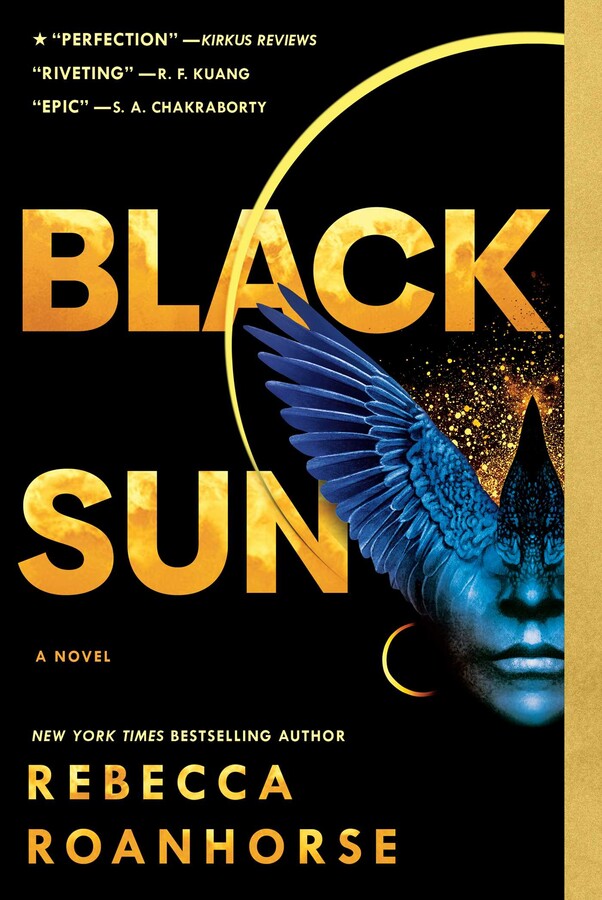
Rebecca Roanhorse’s epic fantasy novel Black Sun (2020) was received fondly by readers and won the Hugo Award for Best Novel in 2021. The book is the first part of the Between Earth and Sky series with its sequel Fevered Star (2022) already out. Drawing upon Polynesian and pre-Columbian American cultures, the novel explores the theme of embracing one’s destiny and ideas of celestial balance, sacrifice, vengeance, and justice. In a thrilling story that invokes a fresh, magical world, Xiala, a sea captain belonging to a mermaid-race, oversees the transportation of Serapio, the Crow God, across time for a celestial event called the Convergence in the city of Tova. Serapio was ritually blinded by his mother and trained by three capable tutors to prepare him for what awaits him in Tova. Xiala’s crew must be convinced of their mission with half-truths and she does not know Serapio’s true power until the very end.

Guided by the watchers and the sun priest, the people of Tova are not expecting the reborn Crow God to land on their shores. The four Sky Made clans of Tova—the Golden Eagle, the Water Strider, the Winged Serpent, and the Carrion Crow—exist mostly in peace except for the mournful Carrion Crow clan who have not forgotten the Night of Knives, a massacre of its members by the priesthood that led to the rise of Serapio as the Crow God. Naranpa, the sun priest who has raised herself from poverty to the highest echelons of the priesthood, and Okoa, the warrior prince of the Carrion Crow clan, are the other two major characters in the narrative.

The political intrigue in the fantasy world that Roanhorse builds makes the story interesting. The conflicting interests of the Sky Made Clans, Naranpa’s feeling of alienation inside the priesthood, and Serapio’s ambiguity towards his own power drive the narrative. The character of Serapio is a fantasy archetype, but he is an unlikely villain consumed as much by a thirst for vengeance as he is by a similar desire for justice: “…vengeance can be for spite. It can eat you up inside, take from you everything that makes you happy, makes you human” (350). Serapio considers himself to be the Crow God, commanding his flock of crows to attack, serve, and intimidate anyone who crosses him. Serapio’s loss of eyesight grants him a greater vision with the help of ‘star pollen,’ which he relies upon just as Xiala relies on her song to calm the seas and influence men. As a seafaring Teek, Xiala is good at leading her crew but is treated as an outsider because of her race. The character of Xiala makes readers confront their prejudices, overturning gendered expectations. There are other women in the story such as Naranpa and the Matrons of the Sky Made Clans who serve as leaders, while men serve as warriors or ‘knives.’ Such characters help readers understand the otherness felt by marginalised groups to some extent.

The landscapes in the novel extend from the Obregi Mountains to the Crescent Sea, and to the Cities of Cuecola and Tova. The descriptions of the places are sparse but are fleshed out in conversations and some illuminating phrases. At the beginning of each chapter, the location of action and days in relation to the Convergence is mentioned, situating the narrative for the reader. The Convergence is an eclipse event that takes place when three suns align in a single line and are obscured by the moon completely. Members of the priesthood undertake ritualised practices, including the Day of Shuttering when they strictly stay indoors. The title of the novel itself invokes this solstice event in which the sun disappears during a period of cosmic alignment. The indigenous way of narrating is to place it alongside temporal and regional markers populating the story world. Roanhorse does this with ease and an elegance that makes the novel immersive.

Compared to N.K. Jemisin’s Broken Earth trilogy, Roanhorse’s first novel allows for magical thinking that does not centre the apocalyptic tone too prominently. Jemisin’s novels carry the weight of a post-apocalypse, but Roanhorse crafts vivid characters and an exciting narrative with the Convergence revealing Serapio’s true power. The vengeful destruction that Serapio unleashes can be seen in two ways. The massacre of the Night of the Knives can be seen to justify Serapio’s anger, but Serapio does not feel like he belongs to the Carrion Crow clan at all, having been brought up as a weapon. With an anti-hero at the centre of the narrative, Roanhorse weaves a memorable story that can be taken forward in interesting ways. The ambiguity of Serapio’s character compares to Jemisin’s female protagonist in her trilogy, although the latter is a much more complex character due to her maternal role, and her duty in saving/re-making the ‘broken’ earth.

The characters of Serapio and Xiala are set up as binary opposites in terms of the powers they wield. While Serapio summons the shadow into him, Xiala casts her song out into the world. These oppositional forces allow for a balance in the narrative and an interesting juxtaposition that is also gendered. Xiala’s queer sexuality and Serapio’s chosen celibacy allow for their companionship to develop in a striking way. Towards the end of the novel, Serapio’s destiny is realized in some sense, with consequences, and Xiala is left to wonder at his power. Roanhorse sets up the two characters to respond to each other and their conversations reveal the differences in how they think about their respective journeys. While Serapio feels like he has been brought up for a purpose, Xiala lives from day to day with a mission to get her crew across the Crescent Sea to Tova and reap the rewards of such a journey. Roanhorse’s novel also invokes the idea of befriending pain in relation to training the mind and the body, with Serapio’s tutors teaching him that sacrifice is essential to fulfill one’s destiny.

The novel is a good example of speculative fiction that values diversity of characters in terms of race, gender, and sexuality. In a world that increasingly recognizes the importance of inclusive thinking and representation, Roanhoarse’s novel makes for a satisfying read that shows us how indigenous life can be portrayed in a fascinating manner. The fantastical world that Roanhorse developed is sure to inspire more speculative fiction writers to come up with similar works that will show how various indigenous people have lived in conjunction with the natural world, with knowledge of celestial events and clans that protected and fought for their kin.

Athira Unni is a PhD candidate at Leeds Beckett University, UK. Her PhD thesis is on dystopian and utopian fiction from South Asia and the Caribbean. Her research interests include women’s writing, utopian studies, postcolonial studies, studies of the Anthropocene, memory studies and 20th-century American poetics.

Review of Moon Knight


Review of Moon Knight

Jeremy Brett

Slater, Jeremy, creator. Moon Knight, Marvel Studios, 2022.

It is interesting to watch the Marvel Cinematic Universe begin to explore the wider cosmologies that undergird the franchise’s framework. Generally speaking, it wasn’t until the introduction of Dr. Stephen Strange and Dormammu’s Mirror Dimension in 2016 and then T’Challa’s visions of Wakanda’s Ancestral Plane in Black Panther (2018) that audiences started seeing how the MCU consists of overlapping dimensions populated by what we would refer to as gods, magic-users, and vast alien entities, combining into a boundless cosmology humans experience through radical shifts in reality. The most intriguing example of the MCU’s cosmological perspective and its relationship to human existence comes with the Disney+ series Moon Knight. The series is also a fascinating exploration of the ways in which humans, emotionally broken and scattered, construct their own identities and realities as crucial survival strategies. Moon Knight’s central conceit, in fact, involves the physical and psychological impact of clashing perceptions of reality—on an intimate personal level as well as a multidimensional universal one.

Moon Knight is fascinating in part because of its cosmological infusion with elements of Egyptian mythology that in the MCU form an actual dimensional plane of reality. The Ennead are the Egyptian pantheon, and include the moon god Khonshu. Khonshu has adopted American mercenary Marc Spector (Oscar Isaac) as his avatar and dispenser of justice—his Moon Knight. Overtly, the series pits Spector/Khonshu against cult leader Arthur Harrow (Ethan Hawke): Harrow seeks to revive the goddess Ammit, who balances a person’s virtues against their sins and directs their posthumous fate accordingly. However, a far deeper conflict is at work, giving the series a much more complex and profound dramatic richness. The show features another chief protagonist, Steven Grant (also Isaac), a humble museum gift shop employee. Before too long, we see Steven and Marc are separate personalities sharing Marc’s body at different moments. Radically different personalities, in fact—Steven is bumbling and nonviolent, Marc effortlessly physical and a skilled fighter. They even appear as Moon Knight differently – Marc as the classic comic book image of Moon Knight (a caped, cloaked Batman-like figure) while Steven is dapper in a snow-white suit.

The MCU’s new emphasis on structural cosmic complexity is skillfully mirrored in the series’ dramatic demonstration of human psychological complexity. It is interesting to note how Steven and Marc both work at self-definition through the establishment of distinct identities—particularly Steven, who until the series’ conclusion strenuously defines himself in opposition to Marc. Convinced of the truth of his own values and personal history, Steven insists on his existence as an independent being with autonomy. His experiences may resonate with viewers conscious of the personal and psychological importance of controlling and defining their own identities and the ways in which they present themselves to the world at large. Moon Knight may not become an icon for gender identity, but his/their struggle with their own sense of being will be familiar to those needing such an icon.

On a grander level, the struggle for the world plays out on two distinct levels in the series. The last episode makes this explicitly visible in the series’ final fight, where Ammit and Khonshu battle each other unseen on one plane of existence while Marc/Steven and Marc’s wife Layla (May Calamawy) fight Harrow and his devotees in the “real” physical streets of Cairo. It is a concrete expression of the ways in which reality is perceived differently at different moments by different people. On an emotional level, however, this struggle for a fair and workable reality is much more poignant in reference to Marc’s character evolution. We find that Marc, as a child, suffered grievous emotional and physical abuse at the hands of his unbalanced mother, who blamed Marc for the death of his younger brother. The traumatized Marc created Steven as a psychological shield to insulate the best parts of himself from his mother’s abuse. The intimate battle at the series’ heart – the work that Marc and Steven do to, if not reunite, then reconcile themselves and their realities to one another—is what gives Moon Knight its emotional complexity. Indeed, this struggle is made most manifest when, during the hallucinatory journey via boat towards the Duat (the afterlife), Steven sacrifices himself to save Marc, leading Marc towards the realization that the two need each other to be whole, that each gives to and supports the other in ways that make them into a full human being together. Marc confesses to Steven, frozen and dead outside the Gates of Osiris, “You are the only superpower I ever had.” Shared realities can give strength and endurance where a single reality cannot do the job.

Moon Knight complicates the issue of perceiving reality by presenting Steven and Marc as holding drastically opposing emotions, worldviews, and life experiences. Which of their realities is “true” if both individuals are experiencing vastly different lives? Moon Knight asks its viewers to question our relationships to the world around us and the complicated connection between mind and body. Of course, that last connection has long been a part of humanity’s relationship to its various conceptions of the divine—when we touch the metaphysical, how much of our experience is tangible and how much an intangible projection of our inner selves? As the series progresses, we see an ongoing deepening of the levels of existence through which humanity moves day-to-day, as well as continuing evidence of the MCU’s new focus on the relationship between humans and the divine, or at least the multidimensional beings identifying as “divine.” (I appreciate, speaking of this, the reveal that Marc is Jewish—the first identified Jewish superhero in the MCU.)

Jeremy Brett is an Associate Professor at Cushing Memorial Library & Archives, where he is both Processing Archivist and the Curator of the Science Fiction & Fantasy Research Collection. He has also worked at the University of Iowa, the University of Wisconsin-Milwaukee, the National Archives and Records Administration-Pacific Region, and the Wisconsin Historical Society. He received his MLS and his MA in History from the University of Maryland – College Park in 1999. His professional interests include science fiction, fan studies, and the intersection of libraries and social justice.

Review of “The Conquest of Gola” and Other Stories by Leslie F. Stone


Review of “The Conquest of Gola” and Other Stories by Leslie F. Stone

Sue Smith

Weinbaum, Batya, editor. “The Conquest of Gola”: and Other Stories by Leslie F. Stone. JustFiction, 2021.

In her edition of “The Conquest of Gola” and Other Stories, Batya Weinbaum convincingly argues for a closer critical evaluation of the work of Leslie F. Stone, a Jewish-American woman author who wrote during science fiction’s pulp and golden ages. In brief, Weinbaum’s intent is to highlight Stone’s contributions to science fiction written from a Jewish female perspective and understood from within the context of 1930s America. According to Weinbaum, the value of exploring Stone’s work in this period is to acknowledge and appreciate her unspoken political view and desire for a more inclusive world. For Weinbaum, Stone’s political outlook can be found in her science fiction work in a subtext of race and gender that presents a complex negotiation between insider-outsider identities vying for acceptance and ultimately, assimilation. This recurring theme in Stone’s work, according to Weinbaum, presents the plight of the Jewish immigrant in alien form at a time when Jews were persecuted and viewed with suspicion in America. As Weinbaum argues, sensitive to the Jewish predicament, the key theme in Stone’s stories is the Jewish desire for Americanization, a goal pursued by both first- and second-generation Jews.

To give an overview of the collection, the edition begins with a preface, an introduction and five main stories, which are bookended by two short pieces of writing. The first is titled “Letters of the Twenty Fourth Century” (1929) and the second is the appendix, which is titled, “Day of the Pulps” (1997). To give a brief overview of these works, “Letters of the Twenty Fourth Century” features a male narrator who produces an up-beat letter to a friend about life in a bright new technological future. “Day of the Pulps” is Stone herself addressing a contemporary readership in 1997. In this address, Stone provides commentary about her writing career during the 1930s alongside her expressed desire to restart her career in later years. In a more sombre tone, Stone also includes in her discussion the reason for exiting science fiction at the end of World War II. As Weinbaum points out in her comment on the final piece, it was Stone’s Jewish beliefs in Kaballahism, in which words are believed to give life to what they describe, that brought Stone to the idea that it was her writing of science fiction that contributed to America’s decision to use nuclear weapons to end the conflict with Japan.

Situated between Stone’s initial optimism for the future and final dismay at the technological turn in WWII are the five main stories that showcase her utopian ideas of acceptance and the assimilation of diverse populations. At the start of each story, there is Weinbaum’s supporting explanation of cultural trends in science fiction alongside the social and historical events at the time, which help to foreground the relevance of Stone’s work. To sum up briefly: the five main stories are in chronological order and map out Stone’s science fiction that covers common themes of evolution, eugenics, sex, and race by using the trope of the human-alien encounter. In “Men with Wings” (1929) and “Women with Wings” (1930), two stories that focus on genetic engineering and the evolution of the human species, humans have progressed by evolving and developing the ability to fly. To ensure their survival, social progress depends on cooperation between the sexes by accepting human and alien alike in order to create a single species of winged human founded on a mutual respect for species diversity and racial difference. In contrast, “The Conquest of Gola” (1931) presents a battle-of-the-sexes scenario as an all-female society fights off a male invasion. “The Conquest of Gola” explores the limitations placed on women by an American patriarchal society as formidable female aliens refuse to be assimilated by their male counterparts. Instead, they, as a species, remain intact, and with their knowledge of science, keep their power and independence. Finally, in “The Fall of Mercury” (1935) and “The Human Pets on Mars” (1936), Stone turns to the tale of the space pioneer as humans from Earth meet aliens on Mercury and Mars. Again, it is the human-alien that Weinbaum argues reflects anxiety felt at the time over the Jewish presence in America. While the key idea in these stories is to promote similarities between species in order to establish a common ground in which to gain acceptance and find agreement, it is, as in “The Fall of Mercury,” the niggling persistence of the “foreign body” that threatens the stability of identity in these opposing societies.

Weinbaum’s academic quest to collect Stone’s writing into a single volume is motivated by a desire to let the voice of a Jewish-American woman writer be heard. Indeed, Weinbaum’s passion and choice to focus on Stone is a worthy project offering insight into one woman’s response to the precarity of gender and race between the two World Wars. Although Weinbaum makes it clear that Stone often wrote from the perspective of a male character, Weinbaum’s insight into cultural trends in science fiction, which she thoughtfully interweaves into the social and historical events of the time, provides a rich context within which to read Stone’s work from a Jewish feminist perspective.

Sue Smith has an interest in feminist science fiction with a focus on cyborgs, disability and gender. She has published articles on disability and cyborg fiction in FEMSPEC (2010), David Bolt’s edited book, Changing Social Attitudes Towards Disability (2014), BMJ: Medical Humanities (2016), Journal of Literary and Cultural Disabilities Studies (2017-2020); Journal of Transcultural Psychiatry (2020); and she has provided book reviews for a range of journals.

Review of The People’s Republic of Everything


Review of The People’s Republic of Everything

Sébastien Doubinsky

Mamatas, Nick. The People’s Republic of Everything. Tachyon Publications, 2018.

Nick Mamatas (born 1972) is an award-nominated American fantasy, horror and speculative fiction and non-fiction writer, known for his anarchist political commitment. His most well-know works are the novels Move Under Ground (2005), I am Providence (2016), Second Shooter (2021) and his non-fiction book, Starve Better: Surviving the Endless Horror of the Writing Life (2011).

The People’s Republic of Everything is his fourth short stories collection. It is comprised of 14 short stories and Under My Roof, a novella-length story. It draws upon multiple genres, from political steampunk (“Arbeitskraft”) to science fiction (“Walking with a Ghost”), social-realism (“North Shore Friday”) and dystopian fiction (“Under My Roof”). Although there is no real narrative nor thematic unity in the volume, Mamatas’s peculiar irony and political views can be seen as the red thread connecting the stories.

We can, however, loosely regroup them under three main categories: political, realistic and poetic. The works making up the first of these categories are “Arbeitskraft”, “The People’s Republic of Everything,” “The Glottal Stop,” “We Never Sleep,” and “Under My Roof.” Under the banner of “realistic” are “Tom Silex, Spirit Smasher,” “The Phylactery,” “North Shore Friday,” “A Howling Dog,” and “Lab Rat”. Finally, “Walking with a Ghost,” “The Great Armored Train,” “Slice of Life,” “The Spook School,” and “The Dreamer of the Day” form the poetic corpus.

The stories that are contained in the political category perfectly illustrate Nick Mamatas’s anarchistic views. “Arbeitsskraft,” for example, imagines Engels, Marx’s friend and co-author, as a Frankenstein-inspired steampunk character set on creating a collective, revolutionary mind based on dialectal materialism with the help of cyborg-like match girls. In the same manner, “We Never Sleep” features Rudolf Diesel, the inventor of the fuel bearing his name, as a crazy scientist living in an underground laboratory in a parallel world setting and creating a brand new ideology with the help of a pulp writer. In these stories, Mamatas uses his anarchist position to make fun of and criticize both capitalism’s and communism’s positivist ideology, putting them back-to-back in their dangerous delusion. With the novellaUnder My Roof”, Mamatas turns to a more Pynchonesque or Vonnegutian style of story, in which family man Daniel Weinberg builds a nuclear weapon in his basement with the help of his son and secedes from the United States by founding the free state of “Weinbergia.” Beyond the wacky humoristic narration, Mamatas tackles the notions of nation, freedom, and domestic politics in a way reminiscent of Hunter S. Thompson’s political writings.

The realistic stories uncover a lesser-known and more personal aspect of Mamatas’s narratives. Although they more or less belong to the noir, speculative fiction or weird horror genres, they stand out as being built on more personal aspects of Mamatas’s life. It is an interesting choice of works and it pushes the collection towards a fictional self-portrait of the author that we could definitely link with some Philip K. Dick’s works. “The Phylactery,” for instance, is based on Greek traditions and family anecdotes before moving into specific territory. It also gives the traditional Mamatas reader or a newcomer insight into how his fiction can be built on personal references and how it is transmogrified in the stories. Obvious non-genre references that come to mind are Jack Kerouac’s Dr. Sax, which is a pulp horror tale combined with childhood memories told in stream-of-consciousness style, or William S. Burroughs’s series of novels, which blend first-hand experiences and nightmarish visions. In that way, Mamatas seems to be continuing the Beat tradition and pointing at creative possibilities in their wake, an echo of what he did with his 2005 Beat and Cosmic Horror novel, Move Under Ground.

Finally, we come to a set of stories that moves away from classical genre definitions and that could fall into the “poetic” field in the largest sense possible. In “Walking with a Ghost”, the main character, Melanie, creates a virtual version of Lovecraft, which has become sentient. By blending the figure of the founder of cosmic horror into a speculative fiction A. I. narrative through anecdotes linked to Melanie’s life, Mamatas displaces the traditional tropes of horror and future technology to the periphery of the story, and chooses to focus instead on the strange relationship between his main character and Lovecraft, creating a strangely poetic moment. The same can be said of “The Great Armored Train”, in which Leon Trotsky is confronted by a supernatural phenomenon during the 1917 Russian Revolution, more precisely the ability of a young woman to transform into a lethal owl. Here, by leaving the truth undecided (is the transformation real, or, as Trotsky is convinced, just an illusion?), Mamatas manages to suspend the reader’s disbelief, which is one of the essences of poetry. Once again, Mamatas proves his reluctance as a writer to be easily categorized and the fact that a genre cannot be reduced to a list of tropes and styles.

If The People’s Republic of Everything is not a truly coherent collection, it will nonetheless be of interest to the classic Mamatas readers precisely because of its wide range of styles and stories and for any reader because of the multiple influences that one can find within or behind their constructions. It also questions many definitions of genres (from horror to speculative fiction, and even steampunk, for that matter), as it chooses to veer towards the literary instead of the usual plots and structures. Yevgueny Zamyatin, Karel Čapek, Kurt Vonnegut, Jack Kerouac and William Burroughs are more obvious references than, say, Michael Moorcock, H.P. Lovecraft, Philip K. Dick and Vernor Vinge. The People’s Republic of Everything is therefore a bit of a side-track in Nick Mamatas’ works, but interesting precisely because of its undefinable and undefining nature

Seb Doubinsky is a bilingual French dystopian writer and poet. He is the author of the City-States Cycle, comprising, among others, The Babylonian Trilogy, The Song Of Synth, Missing Signal, The Invisible, and Paperclip. Missing Signal, published by Meerkat Press, won the Bronze Foreword Reviews Award in the Best Science-Fiction Novel category in 2018. He lives in Denmark with his family and teaches literature, history and culture in the French department of Aarhus University.

Review of Hunting by Stars


Review of Hunting by Stars

Jeremy Carnes

Dimaline, Cherie. Hunting by Stars. Abrams, 2021.

Content Warning: This novel and review discuss Residential Schools in Canada, which may be distressing or triggering for some readers. It also contains some spoilers for The Marrow Thieves by Cherie Dimaline.

Hunting by Stars is the highly anticipated follow up to Cherie Dimeline’s (Métis) 2017 novel The Marrow Thieves. Both novels tell the story of a dystopian Canada after people lose the ability to dream. A lack of dreams eventually leads to a lack of sleep and, by extension, a fundamentally changed society. However, in the midst of collapse, settlers in Canada learn that Indigenous people are still actively dreaming; in an effort to determine why Indigenous peoples still have access to their dreams, the Canadian government develops centers to imprison, study, and experiment on Indigenous individuals. The system is based on the residential schools common in the 19th and 20th centuries, where Indigenous youth were separated from their communities and cultures, had their hair cut, and were violently “educated” according to Western cultural standards. In fact, the Native characters throughout both books refer to each of these centers as schools; some of them were built atop the bones of the old residential schools, themselves covering the bones of Indigenous youths. Settler society and systems of power repeat themselves again.

While The Marrow Thieves introduces its readers to a cadre of characters that comprise a found family as they run from recruiters, soldiers sent to capture Indigenous people to take them to the schools, Hunting by Stars focuses more on the violent settler system itself. In many ways, this is a book about the ways settler colonial education extends tendrils into young Indigenous minds in an effort to drive out their communities and cultural ontologies. Of course, it is equally about the violence enacted upon Indigenous peoples in general to extract seemingly necessary resources, in this case dreams.

In The Marrow Thieves, readers follow Frenchie, a Métis teenager, as he watches his brother get kidnapped by recruiters. That same brother, Mitch, returns in Hunting by Stars as a brainwashed worker for the settlers in the schools. As Frenchie continues to resist the violent invasions into his mind and body, Mitch continually reminds him of the ways that the school’s program helped him and how it will help Frenchie and others. After all, as Mitch admits, it’s better to be working for the schools than to be killed in them. Throughout the novel, Frenchie must toe the line between working for the schools as an act and becoming conditioned to believe the worst in his communities because of the school’s violent indoctrination, a balancing act made poignant by his found family outside the school and his brother inside urging him toward assimilation.

The school, the stand-in for the systemic oppression of Indigenous communities, doles out violence again and again as the program works to keep “residents” calm and obedient. In some of the most difficult passages from either book, Hunting by Stars describes torture designed to claw into the psyche of “residents” and consume them from the inside out. As Frenchie undergoes much of this torture, his hopes and dreams, fears and desires are laid bare as he confronts the traumas he’s faced and the utter loneliness he is made to feel through complete isolation. The system and the individuals who design and run it understand that a central goal of the program must be driving a wedge between “residents” and their families and communities. Many of Frenchie’s strengths in The Marrow Thieves are found in his family; his weaknesses are exploited in Hunting by Stars when he is separated from them.

While Frenchie’s perspective was the sole one in The Marrow Thieves, Hunting by Stars cycles through the perspectives of various characters, many of whom readers already know. Miigwans (Miig), the stand-in father figure for Frenchie and his partner Isaac take the found family away from the recruiters to protect the others while Rose, Frenchie’s love interest, begins the journey to the nearest school to try to rescue Frenchie. For tension’s sake, she is accompanied by Derrick, another boy around her age who is also vying for her affections.

Thus, much like its predecessor, Hunting by Stars is a book about communal connection. It examines the search for connection against the power of huge systems: settler colonialism, capitalism, and nationalism. It explores the fallout of violently forced disconnection. In all of this, it never forgets that systems are maintained by people and people are blinded by systems. In as much as systems are maintained, they are often done so through a process of blinding: a skewing of knowledge or understanding, a cloaking of truth, a redirection of desire. Oppressed communities then come to serve the larger system that continually keeps them oppressed; this is most clear in the character of Mitch.

Throughout these broad conversations that examine the social systems dictating our lives, Hunting by Stars considers local levels of relationality and oppression. From alliances found in the most unexpected of places to the appropriation of Indigenous cultures by New Agism in the time of dreamlessness, Dimaline takes particular care to show that love and demoralization both come in the closest of spaces. She also makes sure that we continually remember that loss happens here as well–marking it as personal, bodily as much as it is communal and collective.

While this particular novel, and its predecessor, might see most use in Indigenous literature or science fiction courses, there is applicability broadly through the analogous ways this novel gestures toward the historical backdrop of settler colonialism in Canada and the United States. One of the best pedagogical applications lies in the central metaphor of the novel itself—residential schools in Canada. Both The Marrow Thieves and Hunting by Stars are young adult novels that circle around the generational trauma caused by the residential school system and the ways by which Western education has had deleterious effects on Indigenous communities broadly. From the specifics of the residential school system to the broader connections across settler colonial policies, Indigenous language revitalization, and communal ceremony and connection, Hunting by Stars could play a pivotal role in many different cultural or historical studies courses.

At its very foundation, then, Hunting by Stars is a book about resistance and remembering. As Miig notes, “They never win when we remember.” The act of remembering and connecting is both about resisting and building a world that looks better than the one that Frenchie, Rose, and the others are living in now. Centrally, the book returns to the responsibility of ancestors—those that came before and will come after. Dimaline returns to the central mantra: “Sometimes you risk everything for a life worth living, even if you’re not the one who’ll be alive to live it.” In the end, community, language, and land are what matter fundamentally.

Jeremy M. Carnes is a recent graduate from the University of Wisconsin-Milwaukee and a postdoctoral fellow at the University of Central Florida. He is working on his first book on comics by Indigenous creators and the affordances of comics as a visual medium for considering land-based practices by Indigenous communities. He is also co-editing a collection titled The Futures of Cartoons Past: The Cultural Politics of X-Men: The Animated Series with Nicholas E. Miller and Margaret Galvan. He is reviews editor for Studies in American Indian Literature.