Review of The World We Make


Review of The World We Make

Sreelakshmy M

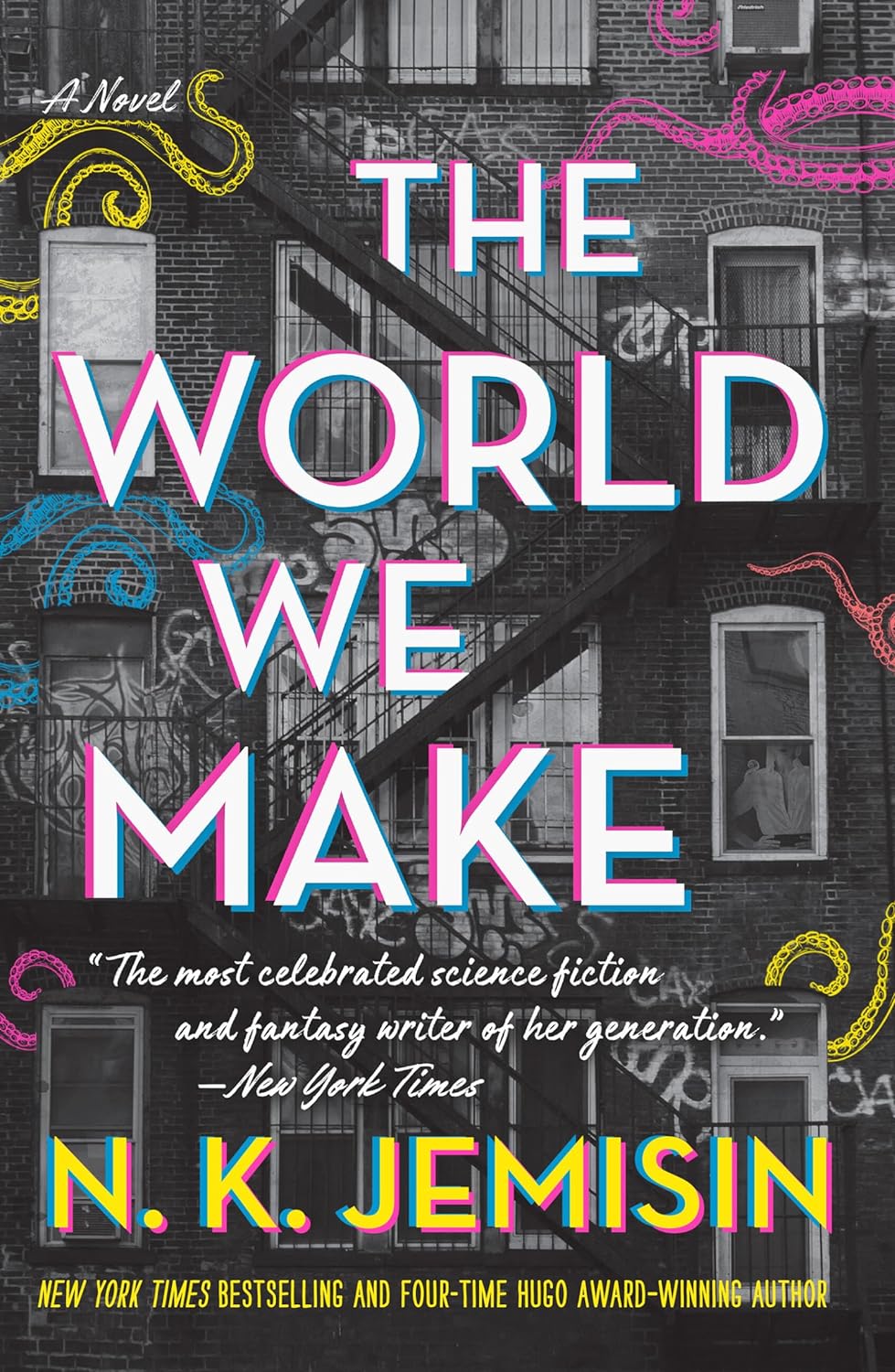
Jemisin, N.K. The World We Make. Orbit, 2022.

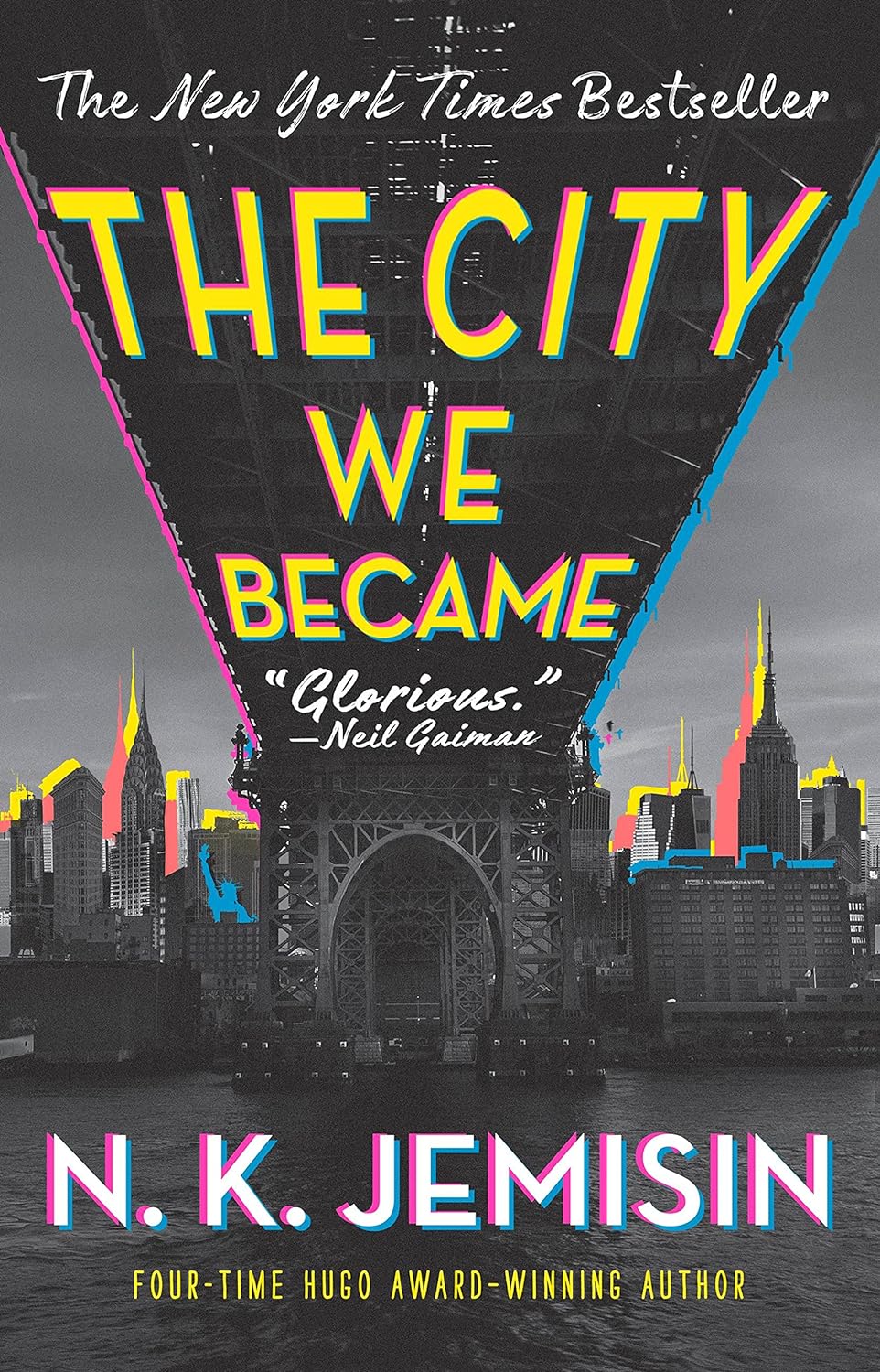
The trope of the city as a literal living, breathing entity is not new: it appears in the weird sci-fi of H. P. Lovecraft (whom Jemisin mentions in The City We Became) and Jeff VanderMeer to Jorge Luis Borges and Italo Calvino’s postmodernist narratives. However, what makes Jemisin’s cities stand out are their manifest avatars—human beings. Her Great Cities duology, The City We Became and The World We Make, is set in contemporary New York. It revolves around New York/Neek and his boroughs/avatars as they try to take back control of the city from an extraterrestrial entity that threatens to consume New York.

N. K. Jemisin is a multiple Hugo and Nebula award-winning sci-fi and fantasy author, best known for her Broken Earth trilogy. Her protagonists are trapped within a constant struggle against alien power structures that are usually thwarted via the use of fantastical elements. Great Cities is then comparable to a dystopic world ruled by utter chaos, anarchy, and totalitarianism that the Other entities try to impose upon New York and the rest of the world. The human manifestations of the boroughs must now wage a war for a normal world order free of surveillance and xenophobia. The juxtaposition of the alien world onto New York can be read as the literal descend of a totalitarian regime.

The first part of the duology ends in a promising note as the boroughs struggle and almost succeed at keeping “the Woman in White” at bay. The second part, however, is where things spiral as four of the boroughs—Manhattan, The Bronx, Brooklyn, and Queens—and New Jersey are forced to encounter the Woman who strives to get rid of them one by one. The novel follows the first-person narratives of each of them, and of Staten Island, which is exiled in The City We Became and subsequently aligns with the antagonists in their personal and multi-versal fights. The World We Make is Jemisin’s attempt at creating a world that lives and breathes on its own, full of cities that are constantly born and reborn with the help of their human manifestations. Employing the usual trope of good vs. evil, Jemisin stages a fight against xenophobia and gender inequality as the cities must fight with an alien entity that threatens to literally consume the earth.

Being a Butler scholar, Jemisin has always expressed a deep interest in Octavia E. Butler’s fiction. The premise of The World We Make, for instance, is comparable to Butler’s 1977 novel Mind of My Mind where Butler imagines an interconnected world in which telepaths are connected to each other via threads and patterns, constantly drawing energies from each other. It is this kaleidoscopic world that determines the future of humanity, a telepathic network that exists because of intricate mental connections and is ultimately controlled by a “patternmaster” who can mentally control/kill each of the participants. Jemisin’s avatars, then, behave in a similar fashion. They draw energy from abstract concepts such as mathematical equations or rap music or from concrete phenomena such as credit cards and souvenirs in order to amass enough power to fight their common enemy.

By creating a world that functions on proximity and the need to connect and cohere, Jemisin proposes the need for communication and community in our real world. This is not to say that Jemisin’s cities are free of racism, sexism, misogyny, and patriarchy. She advocates a world where multiversal corporate companies that enforce deep rooted misogyny and xenophobia can be fought with the help of goodwill and community. For instance, the extraterrestrial entity appears in the form of an impeccably dressed white woman who inadvertently captures human beings by attaching a small, white, fleshy tentacle into their bodies. Once you have this tentacle sprouting out of your body, you are under the absolute control of the “Woman in White” (Jemisin does not shy away from using conspicuous tropes of race and surveillance here).

Though she employs fantasy and speculation, Jemisin’s novel is steeped in realistic representations of the world. Neek notes at one point,

Periodically R’lyeh [Woman in White] sends forth a hollow, tooth-aching, atonal song that echoes across the whole city. The song’s a problem; listen to it for more than a few minutes and you start thinking Mexicans and birth control are what’s really wrong with the world, and maybe a nice mass shooting would solve both problems. (10)


WORKS CITED

Butler, Octavia E. Seed to Harvest. Grand Central Publishing, 2007.

Sreelakshmy M is Visiting Faculty (Assistant Professor) at the Department of Humanities & Social Sciences, National Institute of Technology, Warangal, India. She recently submitted her doctoral thesis titled “Reproduction, (M)Othering and Multispecies Community: A Study of Octavia E. Butler’s Select Fiction” at the Department of English, University of Hyderabad. Her areas of interest are speculative fiction, Afrofuturism, and fantasy studies. She has published in the Journal of Literary & Cultural Disability Studies (JLCDS).

Review of Light from Uncommon Stars


Review of Light from Uncommon Stars

Yen Ooi

Aoki, Ryka. Light from Uncommon Stars. Tor, 2021. Hardcover. 384 pg. $19.82. ISBN 1250789060.

The winner of the 2021 Otherwise Award (previously known as the Tiptree Award) that “celebrates science fiction, fantasy, and other forms of speculative narrative that expand and explore our understanding of gender,” and a nominee for the 2022 Hugo Award for Best Novel, Light from Uncommon Stars was published at the end of September 2021. The breathtaking cover design, with an elegant koi fish swimming in space, sets the reader up for an unexpected science fictional journey.  

In the beginning, we meet Katrina Nguyen, a young trans woman running away from trauma and abuse. Then quickly, in a parallel story, we meet Shizuka Satomi. We know little about her other than the fact that in comparison with Katrina, she is privileged and lives in a comfortable neighbourhood in Monterey Park, Los Angeles with Astrid who looks after her. This little introduction of both characters frames chapter one, and already, we are treated to perspectives of Asian-American communities—the big white Asian bus system, convergence of Asian languages, pentatonic folk songs, and more—that are very rarely seen in science fiction. But is Light from Uncommon Stars science fiction?

Soon after we meet the two main characters, we learn that Shizuka needs to find a seventh prodigy to be trained and have their soul delivered to the devil—she has already delivered six!—to escape damnation. On a drive, she gets lost in her own thoughts and finds herself needing the restroom, having missed several exits on the highway in San Gabriel Valley. She pulls off the next ramp, but comes to a residential area with only a big donut peeking over the trees. It is at Starrgate Donut that Shizuka meets Lan Tran, a retired alien starship captain, interstellar refugee, and mother of four. And it is afterwards, by a pond that is within walking distance from the donut shop that Shizuka meets Katrina, shares half a donut with her, and hears her play the violin for the first time.

In a Barnes & Noble interview with Miwa Messer, Ryka Aoki explains that these three women characters, she feels, would not normally have met, but when she throws them together on the page, they find companionship, unexpected family, and love, even though they might not feel they deserve it. The chance encounters are what propels the story forward, and each character questions not only their goals, but also their limitations: how they have limited their dreams in what they wanted to do. As they learn this of themselves and each other, it drives them to be more.

Light from Uncommon Stars is a story of relationships and of relationalism, as introduced by zoetology—the philosophy derived from ancient East Asian teaching that is grounded in the knowledge that association is a fact (Ames 87). These women—all heroes—are not portrayed as binary heroes. They are full characters who are aware that there is no end to the end, where the story doesn’t stop once they have reached their goals. Aoki describes this as a trait of the women she admires who have a realism with them. Ambition becomes much more nuanced because they realise that it is always balanced by repercussions, or damage one might do to the world, or even just remembering that even if they climb Everest, after they come down, they will still need to wash dishes (Messer).  

This associativeness explored through the characters’ journeys that are full of love, kindness, hardship, and difficulties, flows deeper yet into the core of the story itself as it balances genre-defying juxtapositions with the devil and a curse, aliens, interstellar travel, classical music, and American fast food as prominent features. Readers used to mainstream science fiction that provides clear binary storytelling, might question whether the book best belongs to fantastika, encompassing science fiction, fantasy, fantastic horror and their various subgenres. Or it might even be perceived to be kitsch. However, the onslaught of concepts is there to show us that there is a world (and indeed, our world is one of them) that can be a loving home to such diversity. It is crucial for creating the space to make the story work. Borrowing Seo-Young Chu’s informal definition of science fiction as “a representational technology powered by a combination of lyric and narrative forces that enable SF to generate mimetic accounts of cognitively estranging referents,” Light from Uncommon Stars’s cognitively estranging referents create such a distracting scene that it forces us to accept the Asian characters, transgender narrative, even the classical music theme, as the realism needed to ground the mimetic accounts (73). This goes beyond its representation of minority communities: it normalises the reality of these communities’ lives.

In A Stranger’s Journey: Race, Identity, and Narrative Craft in Writing, David Mura points out that “for most Asian Americans, American culture provides two unsatisfactory identities”: 1) one that is “perpetually foreign”; 2) a second described as the “model minority”, and a third that allows Asian Americans to understand that their “experiences are far more complicated than white Americans understand, and, indeed, than even [they themselves] may understand” (11).

Aoki sees writing as a public act; as an introvert—she is usually a very private person—it is a way for her to take part in society (Messer). With this skill, she deftly spins these complicated experiences into the story that is Light from Uncommon Stars because of, and for, her own experiences as an Asian American trans woman growing up in San Gabriel Valley.I am a British East and Southeast Asian woman, a classically-trained musician, a migrant, a teacher, a writer, a geek, and more. When I finished reading the book, I cried. I felt acknowledged, loved, and seen, not realising that these were things that I have been craving. Light from Uncommon Stars is a wonderfully entertaining, heartfelt, and wholesome novel, and if you give it more time and space, you will find yourself learning from it. Learning, as Aoki tells us, involves facing parts of the world that we are not able to change, and we might not be able to experience things the way we wish them to be (Messer):

‘When you’re trans, you’re always looking and listening,’ Katrina explained later. ‘It’s following, but it’s more than that. You need to see what might be coming, hear the next danger ahead.’

Shizuka nodded. So it wasn’t merely follow – it was follow and predict. Perhaps even follow and perceive.

This was an entirely different level of skill. (Aoki 130)


WORKS CITED

Bartter, Martha A. “Nuclear Holocaust as Urban Renewal.” Science Fiction Studies, vol. 13, no. 2, 1986, pp. 148-58.

Anders, Charlie Jane. “Ryka Aoki with Charlie Jane Anders / Light from Uncommon Stars.” YouTube, uploaded by The Booksmith, 28 October 2021, https://www.youtube.com/watch?v=bsCI7jjIX6k.

Chu, Seo-Young. Do Metaphors Dream of Literal Sleep? A Science-Fictional Theory of Representation. Harvard University Press, 2010.

Messer, Miwa. “#PouredOver: Ryka Aoki on Light from Uncommon Stars.” YouTube, uploaded by Barnes & Noble, 4 August 2022, https://www.youtube.com/watch?v=ze_thqxXNdY.

Mura, David, A Stranger’s Journey: Race, Identity, and Narrative Craft in Writing. University of Georgia Press, 2016.

Yen Ooi is a 2023 Hugo Awards finalist writer-researcher whose works explore East and Southeast Asian culture, identity, and values. Her projects aim to cultivate cultural engagement in our modern, technology-driven lives. She is currently completing her PhD at Royal Holloway, University of London looking at the development of Sinophone science fiction by East Asian diaspora writers and writers from Chinese-speaking nations. Yen is narrative director and writer on Road to Guangdong, a narrative-puzzle driving game. She is author of Rén: The Ancient Chinese Art of Finding Peace and Fulfilment (non-fiction), Sun: Queens of Earth (novel), and A Suspicious Collection of Short Stories and Poetry (collection). She is also co-editor of Ab Terra, Brain Mill Press’s science fiction imprint. When she’s not got her head in a book, she lectures, mentors and plays the viola. www.yenooi.com

Review of To Each This World


Review of To Each This World

Dominick Grace

Julie E. Czerneda. To Each This World. DAW, 2022. Trade paperback. 480 pg.$18.00. ISBN 9780756415426. EBook ISBN 9780756415433.

Julie E. Czerneda is a prolific author of SF and fantasy, having written over twenty (usually long) novels and multiple shorter works over the last quarter-century. Most of her novels are parts of series, but To Each This World is one of her rare stand-alones. Nevertheless, it revisits territory Czerneda has explored before. The novel is a space opera in which New Earth has an alliance (called a Duality) with the alien Kmet, which becomes complicated—and deadly—due to biological imperatives and communication problems.

Czerneda has a lot of balls in the air in this novel. New Earth is now, as far as our main characters know, the only place inhabited by humans, with Earth Original (one of many instances of Czerneda’s clunky writing in this book) lost or destroyed—what happened is never made clear—, the six sleeper ships sent out hundreds of years earlier to colonize other worlds lost, and New Earth now eschewing space travel except via the Kmet portals, which allow for instantaneous travel from one destination to another but are used solely for commercial ends. Kmet technology has allowed for the creation of polymorphic AIs, one function of which is to serve as aides; the AI Flip is a major character. Communication with the Kmet is handled primarily by the Arbiter, Henry, who is one of our three main characters. Human pilots work with the Kmet to control the Portals, giving us Killian, a second main character. However, humans never go to space in their own bodies any more, instead uploading their consciousnesses into epitomes, or clones (I assume; how the epitomes are grown is not clear); should the epitome be threatened with destruction, the consciousness can be returned to the hibernating “real” body. (And if you think that this is going to hit a snag at a critical point, well, you know your SF.) Furthermore, tech allowing the projection of “oneirics,” or humans who serve as advisors to our main characters, into the receiver’s mind while in a sort of trance state, means that Henry and Killian have access to assistance from New Earth-bound folk no matter where they are—the tech evidently allowing for instantaneous linkage across space. The plot catalyst is the receipt of a message from one of the evidently lost sleeper ships and the Kmet’s concomitant concern about humans being anywhere other than New Earth, as another alien race, the Dividers, represent an existential threat. The action of the bulk of the novel, then, takes Henry and Killian with a Kmet on a quest ultimately to seven other worlds to try to find human settlers/survivors and return them to New Earth. So: multiple alien species; substitute human bodies; complex AI; projected consciousnesses; sleeper ships; a space quest—this is a lot to manage, which might explain the fact that the book is almost 500 pages long.

Sadly, that makes the book too long, though paradoxically, not long enough. Though some of the planets visited on the quest are uninhabited (or no longer existing), our heroes encounter three different human colonies they must convince to evacuate within days. None of these are adequately developed, and Czerneds mainly waves her hands at the logical and psychological complexities that would be involved in such an endeavour, even for relatively small populations. On the other hand, Czerneda’s character-focused approach with her protagonists fails to be compelling because there is little sense of character growth or development. Killian, for instance, spends the novel with a chip on her shoulder, without ever really developing (or, to be frank, becoming tolerable). While one of the points of the novel is the difficulty of communication even among humans, never mind with aliens, the character conflicts here seem largely constructed for dramatic effect rather than being organic. Furthermore, while Czerneda is usually quite good at depicting plausibly alien aliens, there is little sense of depth or complexity to the Kmet, and when we do finally encounter them, the Dividers are an enigma at best. Indeed, at times what is even going on, let alone what motivates the characters, is a challenge to parse.

Czerneda does touch on interesting subjects, such as the morality of using “alternative facts,” one might say, to convince people to do what is in their best interest—at least insofar as those presenting the “facts” think. The intricacies of the insides of the Portals are fascinating, as well, owing something to the Gothic tradition, with plenty of hidden passages and concealed corpses, keys to find, and even a sort of ghost in the machine. Czerneda also requires the reader to consider the important question of whether the Kmet are evil because their actions are inimical to human survival. There is also a profound and fruitful irony in the human distrust of the Kmet, given that the novel makes clear that the humans have deceived the Kmet in various ways (e.g., by not letting them know about the substitute bodies or the oneirics, as these would violate the Kmet’s rules). Indeed, while the novel eschews any sort of overt political commentary, its depiction of politics governed by paranoia, betrayal, and Machiavellianism obviously resonates with our contemporary reality. Czerneda even nods to pronoun use, creating specific pronouns for the Kmet (kmeth) and the AIs (alt), though oddly, and despite depicting queer characters, she never (that I noticed) uses any pronouns for humans other than he and she.

In short, this is an entertaining albeit overlong space opera. It does not really expand or transcend the genre, and its length makes it an unlikely choice for classroom use.

Dominick Grace is the Non-Fiction Reviews editor for the SFRA Review. His primary area of scholarly interest is the Canadian fantastic across media.

Review of Ursula K. Le Guin: Collected Poems


Review of Ursula K. Le Guin: Collected Poems

RB Lemberg

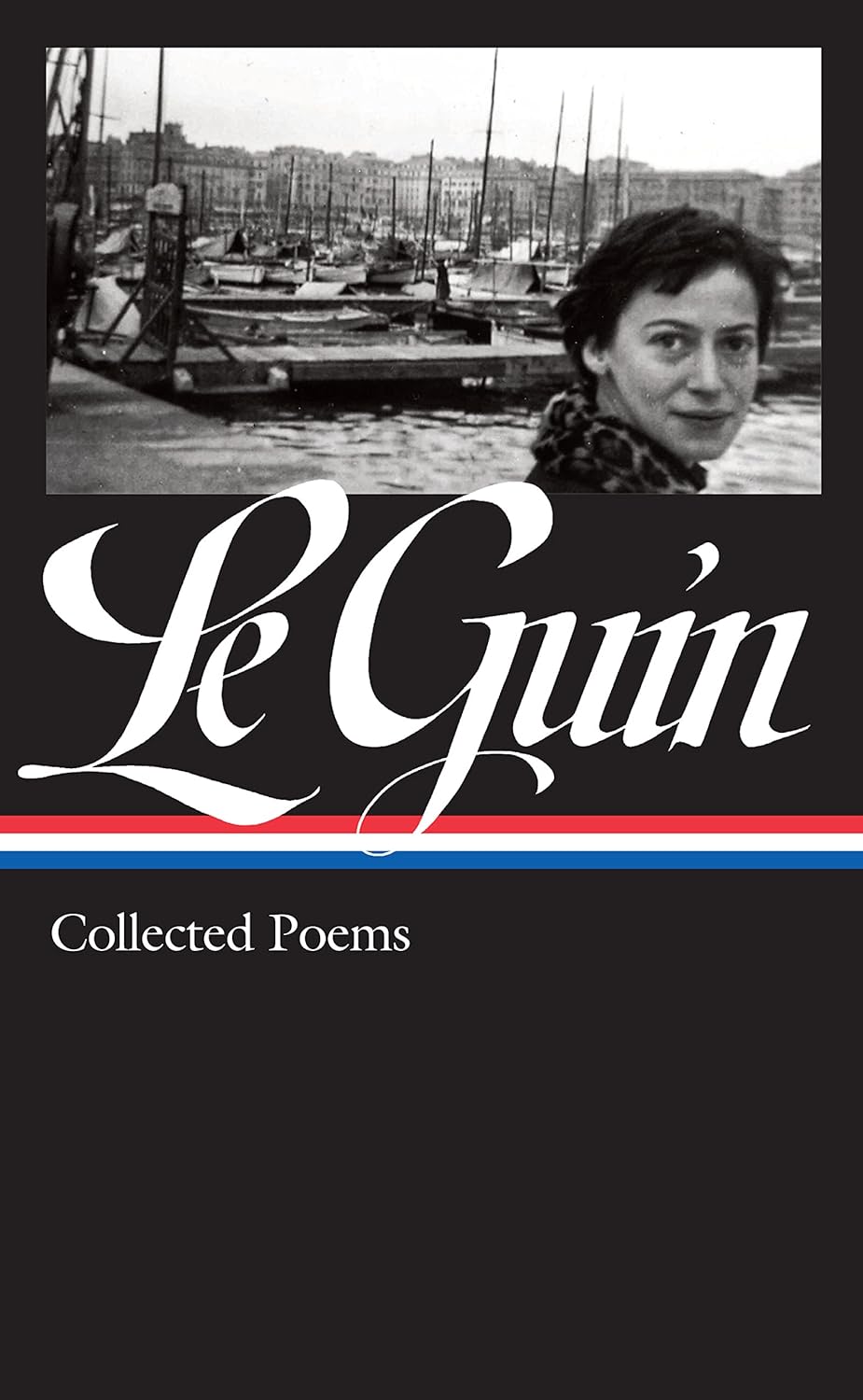
Le Guin, Ursula K. Ursula K. Le Guin: Collected Poems. Library of America, 2023. Hardcover. 850 pg. $28.73. ISBN 1598537369.

Overview of the Collection

Ursula K. Le Guin was one of the world’s most renowned science fiction authors, but her poetry is rarely discussed. Yet, poetry was a constant in Le Guin’s life. She began writing it at age five (Collected Poems 569); her first published work was a poem, “Songs of Montayna Province” (Collected Poems 647). She finalized her last book, a collection of poetry titled So Far, So Good, a mere week before she passed away. It was published posthumously in October 2018. Le Guin the prose writer remains famous for her lyrical, evocative style, which can be described as “a poet’s prose” (Collected Poems, xl). Le Guin’s poems are windows into her emotional life, her relationships with family and friends, and her deep and abiding love of the natural world.

Despite the importance of poetry in Le Guin’s life and writing, her poetic legacy remains largely unknown. Ursula K. Le Guin: Collected Poems is thus an important addition to many bookshelves. This book will help Le Guin readers gain a deeper understanding of her fiction through these poignant and intimate works; it will appeal in general to lovers of poetry and to readers of regional literature who are attracted to intricate and powerful writing about the Pacific Northwest. Le Guin’s writing is arboreal, and readers who delight in nature-inspired poetry will find many wonderful works in this book. Le Guin is, of course, a powerful feminist figure, and this collection will appeal to readers of feminist literature, broadly construed. Finally, this text is also an invaluable source for researchers.

Ursula K. Le Guin: Collected Poems reprints all nine of Le Guin’s major poetry collections, beginning with her wonderful Capra Press chapbook Wild Angels (1974), and ending with So Far, So Good (2018). In addition to the nine poetry collections, Collected Poems includes her translation of the Tao Te Ching and poems from chapbooks and collaborations such as No Boats (chapbook), The Uses of Music in the Uttermost Parts (poems set to music by Elinor Armer), and Out Here: Poems and Images from Steens Mountain Country (a collaboration with photographer Roger Dorband). The book also includes an important selection of Le Guin’s published but uncollected poems, including her very first publications from 1959 and 1960. I would have loved to know more about how the “Selected Uncollected Poems” were selected, and if anything was left out.

The supplementary material consists of an introduction by series editor Harold Bloom, a chronology of Ursula’s life and accomplishments, a bibliography, and an index of titles and first lines. The book also offers a handy section of notes explaining references in individual poems, such as various mythical figures (Ariadne, Anansi, Tlaloc), specific geographic locales (Oasis of Mara, Kishamish), and translations of words that appear in languages such as Welsh, Latin, Spanish, and Le Guin’s own constructed language, Kesh. In addition to Le Guin’s poetry, the book includes seven pieces of her nonfiction: two essays, two prefaces to books of poetry, a foreword, an afterword, and finally an interview focused on poetry.

A few words about what the book does not contain: while the Selected Uncollected Poems section reprints some of the poems that originally appeared in other books, such as Buffalo Gals: And Other Animal Presences (1987), it does not include all of the poems published in Le Guin’s non-poetry books. For example, her novel Always Coming Home (1985) contains many striking poems, which were not included here. Collected Poems does not include the collaborative translation with Diana Bellessi, The Twins, The Dream / Las Gemelas, El Sueño, perhaps because many of Le Guin’s poems published in that volume were also reprinted elsewhere and thus ultimately included as a part of other books (more on this collaboration below). The supplementary material supplies bibliographic information for the uncollected poems, but does not provide information about the first publication of individual poems from the nine collections – this would be good information to have, especially for the poems that were reprinted, rather than originally published, in the nine collections.

Collected Poems also does not include, or mention, Le Guin’s unpublished poems, such as those I have discovered in her archives (I plan to discuss them in my manuscript on Le Guin’s poetry).

Despite these minor qualms with some of the supplementary materials and editorial choices, I am extremely happy that this book exists and is available to readers. While Ursula K. Le Guin: Collected Poems is not an exhaustive volume, it contains most of her poetry—certainly the vast majority of her published poetry—and a good taste of her poetry-adjacent work.

The Introduction

As a scholar of Le Guin’s poetry and a poet myself, I confess that I was not satisfied with Harold Bloom’s introduction. Bloom looms large in the world of American literary criticism, but in this case, I would have appreciated a lot less looming, which is to say, less of a focus upon Bloom himself. For example, he highlights a poem on Le Guin’s long marriage to Charles Le Guin because he, Harold Bloom, has also enjoyed a long marriage. At times, the introduction reads as condescending in tone—he talks about Le Guin’s “intuitive poetics” (Collected Poems xlvi) and calls her “primordial” (Collected Poems xlvi) despite Ursula’s meticulous attention to matters of craft and her extensive knowledge of it, some documented in this book’s nonfiction sections. When discussing a single poem Le Guin wrote about Lorca, Bloom remarks that he feels that there is “a daemon speaking in and through Ursula K. Le Guin” (Collected Poems xliii). Her feminism is mentioned, but not discussed at all; at one point Bloom writes about “her Taoism, anarchism, ‘feminism,’ literary aesthetic” (Collected Poems li)—but Le Guin’s feminism does not need the assistance of scare quotes.

And while it was heartwarming for me to imagine two such prominent octogenarians corresponding, I would have much preferred to read an introduction by a different person—perhaps an SFF author who is both a prose writer and a poet (Amal El-Mohtar immediately comes to mind, or Sofia Samatar), or alternatively a writer-scholar and/or a biographer who could help connect the poetry to Le Guin’s life and larger body of work (like Lisa Tuttle or Sandra J. Lindow). Judith Barrington, a feminist author, friend, and collaborator, would be another fantastic choice. I wished for the introduction to highlight Le Guin the poet’s significant contributions to feminist letters, to nature writing, and to regional / Pacific Northwest writing, and I did not find much of it in this text.

In addition to ultimately finding the introduction unsatisfying, I also dispute the inclusion of Le Guin’s Tao Te Ching translation in this volume and the simultaneous exclusion of her translations of Gabriela Mistral and Diana Bellessi. Perhaps just Le Guin’s introduction to her translation of Mistral could have been included (Mistral xix-xiii).

Le Guin’s translation/version of the Tao Te Ching relies on Paul Carus’s translation and transliteration (“The Feminine and the Tao”). Le Guin herself explains that her version is “a rendition, not a translation. I do not know any Chinese” (Collected Poems, 290). Regarding the inclusion of the Tao Te Ching, Bloom highlights and immediately dismisses any concerns: “Scholars tell me that her work is disputable, but I see nothing to dispute” (Collected Poems li). Translating without understanding the original is a practice specifically perpetuated by white translators, often involving the East Asian literary tradition. Ezra Pound engaged in exactly such a practice with regards to Classical Chinese poetry, and this remains a topic of criticism and debate in translation studies (Williams; Yeh). This important issue continues to be discussed in the field (specifically concerning the practice of “bridge translation,” see Calleja and Collins; Wang).

Since the Tao Te Ching translation was included, I was surprised not to see any of Le Guin’s other poetry translations. I am especially concerned with the exclusion of The Twins, The Dream / Las Gemelas, El Sueño, a brilliant volume of co-translations with the Argentinean poet Diana Bellessi. Le Guin held translation close to her heart and engaged in it throughout her lifetime, but the practice of translating from a language one does not know at all is problematic. On the other hand, The Twins, The Dream / Las Gemelas, El Sueño is a beautiful collaboration between two feminist poets (Bellessi and Le Guin), who corresponded, exchanged translations, discussed and corrected each other’s work—certainly a much more intimate and thoughtful process, which honors the principles of feminist translation (Eshelman). Since the Tao Te Ching translation was included, these excluded translations warrant a discussion.

Walking with Ursula

With 700-odd pages of poems alone, it would not be possible for me to present a broad overview of Le Guin’s poetic work in a book review—although I refer the readers to my earlier essay in Climbing Lightly through Forests (Lemberg), which surveys all nine of Le Guin’s major collections. For this review, I will discuss a single aspect of her poetry—a theme of walking, and an echoing and recurring approach.

 Ursula K. Le Guin was an avid walker. She went on walks everywhere she went, in some cases repeatedly, sometimes, over the span of years. These intimate walks reflect the poet’s personal journeys. Most of these walking poems are not speculative, but perhaps one can think of them as speculative-adjacent: these earthly landscapes are transformed and reappear or reverberate through her fantastical worlds.

Ursula’s early and privately printed chapbook Walking in Cornwall (1976), reprinted in her second collection, Hard Words, is an example of such a walk, in which the poet reflects on the enduring power of togetherness, and of women’s labor:

It was home, once, Chysasuster village was.
Nine families, their cattle, their heartfires.

O small cold hearths, so old, so old,
Yet you could light a fire in them tonight.
It would be the same fire.
We don’t need very much:
water and warmth and walls, the flickering ring of faces
. (73)

There are three long poems in Walking in Cornwall. The second and third poem both end with an almost identical line: “and the wind is sweet as honey in the mouth” / “and the wind as sweet as honey in the mouth,” which reflect one of Ursula’s favorite poetic devices, repetition, an echoing return to places and thoughts that evoke the senses.

After the cataclysmic eruption of Mount St. Helens in 1980, Le Guin returns repeatedly to the desolate landscape, writing four poems originally published in the chapbook In the Red Zone (1983), later reprinted in her third poetry collection, Wild Oats and Fireweed (1988) and included in Collected Poems:

The earth fell on the earth. It looked like cloud
but it was dirt: the planet turning on itself.

Rock, slag, dust, earthgas, earthfire, earthwork.

A column of boiling stone. Ponderous.

From a distance thunderblue, but in itself earthdark,
grey, brown, black: a mountain inside out.

And the lightning struck, and struck, and struck.
Dancing like a hopjack strung up on the groundcloud,
the stoneplume, jagging between earth and earth,
the lightning struck, and struck, and struck.

The forest was dead in the first five minutes. (98-101)

Three decades after the explosion of Mount St. Helens, Le Guin returns to the same spot in “Summer Morning on the Volcano,” originally published in Finding my Elegy (2012):

The mist lifts off the little lake down there,
way down, across a gulf of shining air.

The upward spiral song of Swainson’s thrush,
a white-crown’s teedle-eedle in the hush:

there is this music in the morning, where
was only silence, and grey dust, and ash.

“We are her children, we are in her care,
our destroyer-mother,” sings the mountain thrush. (497)

In her collaboration with the photographer Roger Dorband, Blue Moon over Thurman Street (1993), Le Guin writes about walking the street for decades: “To walk a street is to be told a story. Through the years that I have lived in Portland, as I walked up and down my street, Thurman Street, it kept telling me its story. … When we started working on this book, I had lived on Thurman Street for over twenty-five years” (6-9).  A poem from that book, “The Aching Air,” was later collected in Finding my Elegy (2012) and in Collected Poems (863). In this resonant and heartbreaking piece, Le Guin narrates how a gorgeous chestnut tree, a neighborhood fixture for all the years she lived there, was cut down by neighbors who thought trees—and their companions, birds—were dirty:@font-face {font-family:”Cambria Math”; panose-1:2 4 5 3 5 4 6 3 2 4; mso-font-charset:0; mso-generic-font-family:roman; mso-font-pitch:variable; mso-font-signature:-536870145 1107305727 0 0 415 0;}@font-face {font-family:Calibri; panose-1:2 15 5 2 2 2 4 3 2 4; mso-font-charset:0; mso-generic-font-family:swiss; mso-font-pitch:variable; mso-font-signature:-536859905 -1073697537 9 0 511 0;}p.MsoNormal, li.MsoNormal, div.MsoNormal {mso-style-unhide:no; mso-style-qformat:yes; mso-style-parent:””; margin:0in; mso-pagination:widow-orphan; mso-hyphenate:none; font-size:12.0pt; font-family:”Calibri”,sans-serif; mso-ascii-font-family:Calibri; mso-ascii-theme-font:minor-latin; mso-fareast-font-family:Calibri; mso-fareast-theme-font:minor-latin; mso-hansi-font-family:Calibri; mso-hansi-theme-font:minor-latin; mso-bidi-font-family:Calibri; mso-bidi-theme-font:minor-bidi; mso-font-kerning:1.0pt; mso-ligatures:standardcontextual;}.MsoChpDefault {mso-style-type:export-only; mso-default-props:yes; font-family:”Calibri”,sans-serif; mso-ascii-font-family:Calibri; mso-ascii-theme-font:minor-latin; mso-fareast-font-family:Calibri; mso-fareast-theme-font:minor-latin; mso-hansi-font-family:Calibri; mso-hansi-theme-font:minor-latin; mso-bidi-font-family:Calibri; mso-bidi-theme-font:minor-bidi; mso-font-kerning:1.0pt; mso-ligatures:standardcontextual;}.MsoPapDefault {mso-style-type:export-only; mso-hyphenate:none;}div.WordSection1 {page:WordSection1;}

Where the most beautiful
horsechestnut held up deep branches
in a cathedral
full of wings and voices
and a golden light,
and the tall, rose-white flowers
smelled like the bread of heaven,
and eyes praised upraised,
being blest by seeing:where the tree was
the air’s empty. (683)

In this book and elsewhere, Le Guin’s abiding love for nature is tinged with a deep concern for the scope of environmental destruction perpetuated by humans—corporations and individuals.

Nature poems are abundant in the collection, but they are far from the only kind of poems one finds in Collected Works. Some of Le Guin’s poems focus on family; others remark on current events and engage with feminist themes, especially women’s rights. Some poems deal with Le Guin’s personal experiences (she discusses her abortion in a number of poems throughout her life). Many poems feature animals—Le Guin was especially fond of cats; some of the poems are humorous, such as the delightful “A Palindrome I Do not Want to Write” (Collected Poems 698). With a few notable exceptions such as the 1982 Rhysling-winning “The Well of Baln” (Collected Poems 80-81), Le Guin’s poems do not offer us much speculative / science fictional material. Instead, these pieces are glimpses into Le Guin’s life and her interests, and her incessant and enduring attention to the natural world, to the trees perhaps most of all, but also to animals, rocks, mountains—in the Pacific Northwest and beyond.

To read these poems is to become immersed in Le Guin’s world: a world of quiet wonder and great intricacy, of mythic grandeur, with wonderful flashes of humor and play. Ursula K. Le Guin: Collected Poems invites us to take many long walks with her. This book will become a staple for many readers, as well as scholars of Le Guin’s work—including myself.

WORKS CITED

Calleja, Jen, and Sophie Collins. “She Knows Too Much: ‘Bridge Translations,’ ‘Literal Translations,’ and Long-Term Harm.” Asymptote Journal. Accessed 8 August 2023.

Eshelman, David J. “Feminist Translation as Interpretation.” Translation Review, vol. 74, no. 1, 2007, pp. 16-27.

Le Guin, Ursula K. Always Coming Home. Harper & Row, 1985.

—. Buffalo Gals and Other Animal Presences. Capra Press, 1987.

—. Finding My Elegy: New and Selected Poems. Houghton Mifflin Harcourt, 2012.

—. Hard Words, and Other Poems. HarperCollins Publishers, 1981.

—. Lao Tzu: Tao Te Ching: A Book About the Way and the Power of the Way. A New English Version by Ursula K. Le Guin. Shambhala, 1998.

—. So Far, So Good: Final Poems 2014-2018. Copper Canyon, 2018

—. and Diana Bellessi. The Twins, The Dream / Las Gemelas, El Sueño. Arte Publico Press, 1997.

—. Wild Angels. Capra Press, 1975.

—. Wild Oats and Fireweed: New Poems. Harper Perennial, 1988.

—. (text), and Elinor Armer (music). The Uses of Music in the Uttermost Parts. Koch International Classics, 1995.

—., and Roger Dorband. Out Here: Poems and Images from Steens Mountain Country. Raven Studios, 2010.

Lemberg, R.B. “The Poetry of Ursula K. Le Guin: A Retrospective.” Climbing Lightly Through Forests, edited by R.B. Lemberg and Lisa M. Bradley, Aqueduct, 2021, pp. 101-150.

Mistral, Gabriela. Selected Poems of Gabriela Mistral. University of New Mexico Press, 2003.

Peterson, Brenda. “The Feminine and The Tao: An Interview with Ursula K. LeGuin [sic].” Embrace the Moon, https://embracethemoon.com/ursula-k-leguin/. Accessed 7 August 2023.

Wang, Yilin. “Barriers, Privileges, and Invisible Labor: A Sino Diaspora Translator’s Perspective.” Words Without Borders, https://wordswithoutborders.org/read/article/2021-06/june-2021-queer-barriers-privileges-and-invisible-labor-yilin-wang/. Accessed 8 August 2023.

R. John Williams. “Modernist Scandals: Ezra Pound’s Translations of ‘the’Chinese Poem.” Orient and Orientalisms in American Poetry and Poetics, edited by Sabine Sielke and Christian Kloeckner, Peter Lang GmbH, 2009, pp. 145-165.

Yeh, Michelle Mi-Hsi. “The Chinese Poem: The Visible and the Invisible in Chinese Poetry.” Manoa, vol. 12, no. 1, 2000, pp. 139-146.

R.B. Lemberg is a 2020 Le Guin Feminist Fellow and a scholar of SFF, LGBTQIA+ studies, and translation studies. As R.B. Perelmutter, they are a Professor of Jewish Studies and Slavic, German, and Eurasian Studies at the University of Kansas. R.B.’s literary work has been shortlisted for the 2023 Le Guin Prize for fiction, and was a finalist for the Nebula, Ignyte, Locus, World Fantasy, and other awards. Their novel The Unbalancing (Tachyon) and short story collection Geometries of Belonging (Fairwood) were published in 2022.

Review of Defekt


Review of Defekt

Yimin Xu

Cipri, Nino. Defekt. Tor Books, 2021.

Nino Cipri is a queer and trans/nonbinary writer and editor. They are a graduate of the Clarion Writing Workshop and the University of Kansas’s MFA program. They are the author of the award-winning debut fiction collection Homesick (2019) and the novella Finna (2020). Cipri´s Defekt is a winner of the British Fantasy Award. The narration takes places in an unknown time in a fictional corporate group, LitenVärld, an interesting Swedish name that means “little world” in English. As the narration reveals, the protagonist, Derek, is a humanoid working machine (Cipri’s narration does not specify Derek’s species) and the most loyal employee for LitenVärld. However, Derek’s diligent working schedule is interrupted one day when he suffers from concerning physical conditions: a nose bleed and bloody cough.

This marks an ironic narrative turn, for one would assume a working machine will not suffer from physical weakness, which in return, foreshadows the company’s overwhelming exploitation of its employees. But more ironic is that only by then is Derek informed that LitenVärld employees are entitled to sick leave. Thus, he asks for one day off; yet, unbeknownst to him, this single off day invites troubles with the company, in that his manager refuses to believe his reason for being absent and calls his loyalty into question.

Therefore, after returning to work, Derek is tasked with one special obligation: to eliminate the defects or ¨defekta¨ from other pocket universes. It is through the demystification of defekta and of pocket universes that we can catch a shivering insight into the company’s exploitative supply chains. Through blackholes, LitenVärld opens portals to other, smaller universes with cheaper labor – hence, pocket universes – and delivers requested products back to LitenVärld for assembly. However, when requested products go through blackholes, there is a chance of mutation owing to gravitational pulls, so that these lifeless products may be transformed “into animate, murderous, mutant furniture. Corporate calls them defectives, or defekta in Swedish” (74).

Here, behind the seemingly science-fictional motifs in his narration—black holes and animated objects—what the author presents to us is rather a realistic concern about modern-day globalization, rooted in Marxist political-economic insight concerning the estrangement of labor:

This fact expresses merely that the object which labor produces—labor’s product—confronts it as something alien, as a power independent of the producer. The product of labor is labor which has been embodied in an object, which has become material: it is the objectification of labor. Labor’s realization is its objectification. Under these economic conditions this realization of labor appears as loss of realization for the workers; objectification as loss of the object and bondage to it; appropriation as estrangement, as alienation.” (40)

To Marx, private ownership of production material produces the alienization of labor, in that under the capitalist mode of production, a worker is separated from his/her/their own products. In the era of globalization, this estrangement is furthered by geo-economic distances between developing countries where products are manufactured, and developed countries that claim most profits from production. Similarly, in the narration, Cipri manages to re-represent such an alienating process through a shift of locus from the pocket universes to the major universe containing LitenVärld.

Moreover, the estrangement of labor results in the deprivation of a worker’s significance, in that Marx argues that “man (the worker) only feels himself freely active in his animal functions – eating, drinking, procreating, or at most in his dwelling and in dressing-up, etc.” (42). In the novel, this alienized human nature manifests itself first and foremost in the protagonist’s inhuman identity as a human-made working machine and further in his loss of self-identification outside of his position at LitenVärld: “He always felt naked without his uniform, and the feeling was more acute with mirror was coming in handy” (21-22).

To Marx, the solution to this lies in the class struggle between the bourgeois and proletarians, led by a collective entity of the working class, the Communist Party in his The Communist Manifesto (1848). Cipri conducts an inward, but perhaps not less violent, search for such a solution. In particular, in the nightly inventory shift, Derek encounters the other four team members – his doppelgängers. Dirk is an earlier, masochist version of him whose dominating ego suppresses empathy, whereas Darkness represents the queer side of Derek, as demonstrated by the use of the non-binary pronoun “they.” The remaining two persona of Derek, Delilah and Dux, on the other hand, result from an industrial misfunction, in that Derek’s kinds are set to be adult men, while Delilah is a woman and Dux a teen. Led by the self-elected team leader Dirk, the five Ds set out to exterminate defekta in the inventory.

It is interesting to note how the five Ds form a small-scale patriarchy inside the small world of LitenVärld. It is more interesting to note an implicit connection between (conventionally-defined) masculinity and royalty to the company. Among them, Dirk is the most faithful one, whereas the rest of the four’s fidelity declines along with their waning manhood. This evokes how patriarchy, represented by Dirk in the novel, and capitalism, signified by LitenVärld, can be intertwined with each other, as Engels explores in The Origin of the Family, Private Property and the State (1902).

While others are searching for defekta, Derek realizes he can communicate with the outlaws. Sympathizing with them, Derek decides to show mercy, making himself a de-facto defekta in the eyes of Dirk. The two soon brawl with each other, carrying strong symbolism in the novel. As demonstrated earlier, the four Ds represent a unique persona of Derek himself, which makes the fight not only over fidelity to the company, but over the controlling of Derek’s self-identification – either with the capitalist corporate company or with himself. With the help of the other three, Derek murders Dirk and launches a revolution inside the little world by negotiating with the company at the end of the novel. The finale serves more than as closure for Cipri’s narrative arc but rather an indicator that capitalism and patriarchy can be overthrown by not only the unified working class, but the unified queering group. Here, I do not limit my understanding of queer to simply sexuality, but rather return to its archaic meaning, as in weird and marginalized. The two lexicons remind us of identity politics that draw attention to “the unjust squandering of resources on the less deserving – on migrants, people of color and queer people…. In this sense, identity politics is positioned in a variety of Marxist frameworks as ineffectual; as a politics founded on difference, it is inherently incapable of building the broad-based movement needed to destabilize capitalism” (Kumar et.al, 5-8). However, at the novel’s conclusion, we see a possibility or at least an attempt, albeit at the fictional level, of reconciliating identity politics with the Marxist paradigm of redistribution. The novel finishes with an email where the other four Ds demand that the company increase employee social welfare benefits. Moreover, the last chapter, titled “Changing the World, One Room at a Time,” foreshadows a potentially more radical and broader-based movement against capitalism. In this sense, identity politics proffers another possibility, as an analytical tool, of unifying the marginalized groups to co-sabotage capitalism.

WORKS CITED

Kumar, Ashok, et al. “An Introduction to the Special Issue on Identity Politics Introduction.” Historical Materialism: Research in Critical Marxist Theory, vol. 26, no. 2, 2018, pp. 3–20, https://doi.org/10.1163/1569206X-00001776.

Marx, Karl. Economic & Philosophic Manuscripts of 1844. Neeland Media, 2014.

Yimin Xu is a Ph.D. student in the School of Humanities and Languages at UNSW Sydney. Her research interest is gender in Chinese science fiction, Chinese fantastical literature and Chinese popular culture in general. Her current PhD project focuses on the modernity rhetoric behind gender representations in contemporary Chinese science fiction and the resurfacing of the late 19th-century national memory of Western semi-colonization in current Chinese science fiction writing. With her project, she hopes to contribute her own part to the great effort of de-colonization studies in China. In addition to this research, she is the country representative of Australia for the Science Fiction Research Association.

Review of Africa Risen: A New Era of Speculative Fiction


Review of Africa Risen: A New Era of Speculative Fiction

Jeremy Brett

Thomas, Sheree Renee, Oghenechovwe Donald Ekpeki, and Zelda Knight, eds. Africa Risen: A New Era of Speculative Fiction. Tordotcom, 2022.

The increasing exposure to the Western world of narrative traditions, subjects, and cultures outside its traditional worldview is one of the brightest trends in science fiction and fantasy today. These traditions have always existed and been a part of the human penchant for storytelling, of course, but for so long they remained, at best, occasional adjuncts by most readers and critics to the “standard” literary products of the Western sf/f traditions. However, African and Afro-Diasporan creators are moving more and more to the forefront, thanks in large part to recent collections such as Sheree Renee Thomas’ pioneering Dark Matter: A Century of Speculative Fiction from the African Diaspora (2000) and its follow-up Dark Matter: Reading the Bones (2005), Bill Campbell and Edward Austin Hall’s Mothership: Tales from Afrofuturism and Beyond (2013), Nisi Shawl’s World Fantasy Award and BFA-winning New Suns: Original Speculative Fiction by People of Color (2019, 2023), Zelda Knight and Oghenechovwe Donald Ekpeki’s BFA-winning Dominion: An Anthology of Speculative Fiction from Africa and the African Diaspora (2020), and so many others; to newer online venues like FIYAH Magazine of Black Speculative Fiction; and Black-led publishing ventures such as MVmedia. Writers from Africa and the African Diaspora such as Ekpeki, Nnedi Okorofor, Tade Thompson, Tochi Onyebuchi, Sofia Samatar, Wole Talabi, Tloto Tsamaase, Eugen Bacon, and Namwali Serpell exponentially enrich the experience of encountering sf/f. 

So, then, the arrival of Africa Risen is less unprecedented and more another reminder – expressed as a wildly varied package of beautifully created content – that African and Afro-Diasporan voices demand and deserve wider exposure as well as a greater portion of sf readers’ and publishers’ attention, that there have always been multiple, not to say infinite, creative possibilities for examining our shared human future, and that African speculative fiction is, in fact, here and has always been with us. As the editors note in the collection’s introduction, “[r]emember that this is a movement rather than a moment, a promising creative burgeoning. Because Africa isn’t rising – it’s already here” (4). The book presents its readers with thirty-two highly individual visions of where African sf is going, not limited by age, or gender, or national borders, or life experience. In doing so, the editors have produced a work that provides an impressive and multifaceted introduction for new readers looking to explore those aforementioned creative possibilities, and if, in the process, African and Afro-Diasporan speculative fiction can achieve wider ranges of reader attention and enthusiasm, that is truly all to the good and bodes well for future instances of creative richness in the genre.

Certainly, no readable review of any collection can provide detailed descriptions of every story in it, so I restrict myself here to highlighting several of the ones I think are the most interesting (well-written is not the defining factor here, since all the stories contained therein are worthy of praise for their style and writing quality—a tribute not only to the writers themselves but to the collection’s editors for their judicious powers of content selection). Several of the stories involve intimate connections with the electronic world: Steven Barnes’ “IRL” has particular value in these days of increased online presences, in its story of young Shango, who spends much of his time in the Void (a virtual Earth of fantasy kingdoms where ordinary people can exercise outsized, dramatic influence on their fellows) but who ultimately manipulates that fantasy world to affect his real emotional and financial existences. With “A Dream of Electric Mothers,” Wole Talabi gives us a future Oyo State where governance is directed by the collective memory of generations of ancestors preserved in a national data server and accessed through induced REM sleep. The story is a beautiful meditation on the power of memory and the advantageous necessity of political consensus.  In Ada Nnadi’s lively and humorous “Hanfo Driver,” the beleaguered Fidelis, grubbing for freelance employment in Lagos, finds himself roped into his friend Oga Dayo’s latest scheme and driving a hoverbus of dubious condition through Lagos traffic. In a story of much grander scale, “Biscuit & Milk” by Dare Segun Falowo relates the chronicle of a pan-African ship fleeing into space to escape a dying Earth, finding instead a long journey of deep struggle and new definitions of home. And the collection’s opening tale, “The Blue House” by Dilman Dila, skillfully charts an artificial person working through the central human question of identity.

A number of the stories here concern the struggles of the ordinary or the small, in worlds both fantastical and futuristic. Many of these stories see people grappling with particular issues of social, economic, or political injustice. In Tananarive Due’s heartwrenching story “Ghost Ship,” the sadly relevant issue of the exploitation of migrants is spotlit in the tale of Florida, an American expatriate obliged by her crushing debts to smuggle a mysterious cargo by sea from South Africa to the United States (a dystopian US in which millions of nonwhites have fled to avoid racism and police violence). The dark evil of American racism is noted in another story, “Ruler of the Rear Guard” by Maurice Broaddus, concerning American student Sylvonne, who flees the horrors of her home country for a Ghana that has led the way towards welcoming home the people of the African Diaspora. Resistance to hatred and unjust power is seen in tales as disparate as WC Dunlap’s “March Magic,” which sees a group of righteous witches coming together with soul magic to bring dreams of racial progress into reality; Joshua Uchenna Omenga’s fabulistic folktale “The Deification of Igodo,” where a brutal ruler seeking to become a god faces deserved and dire consequences from divine entities; Tobias S. Buckell’s “The Sugar Mill,” where centuries of white injustices have soaked the land with ghosts and angry memories; “Mami Wataworks” by Russell Nichols, a tale of a terrible future in which increasingly scarce water becomes a weapon that the powerful use to hold down the ordinary and the innocent, but which is poised for radical change via the intelligence and creativity of clever Amaya; and Tlotlo Tsamasse’s visceral, searing “Peeling Time (Deluxe Edition),” which strikes a blow against the objectification and easy disposal of women in our human society, where trauma and toxic masculinity take on monstrous forms.

Beauty and the intensity of life and human existence abound throughout the collection, in stories of spaceships, spirits, and bodily transformations. The sheer variety and scope, combined with the geographical and cultural diversities on display, give a real richness to Africa Risen that makes it an excellent introduction for both scholars and casual readers of African and Afro-Diasporan traditions and demonstrates (though of course no proof is actually required) the robustness of the A + A-D speculative presence.

Jeremy Brett is an Associate Librarian at Cushing Memorial Library & Archives, where he is both Processing Archivist and the Curator of the Science Fiction & Fantasy Research Collection. He has also worked at the University of Iowa, the University of Wisconsin-Milwaukee, the National Archives and Records Administration-Pacific Region, and the Wisconsin Historical Society. He received his MLS and his MA in History from the University of Maryland – College Park in 1999. His professional interests include science fiction, fan studies, and the intersection of libraries and social justice.

Review of A Psalm for the Wild-Built


Review of A Psalm for the Wild-Built

Brianna Best

Chambers, Becky. A Psalm for the Wild-Built. Tor Books, 2021.

A Psalm for the Wild-Built, published by Tor, arrived in the hands of readers in 2021. Becky Chambers’ first foray into softer sci-fi, Psalm speaks to both readers’ need for comfort in the middle of the COVID-19 pandemic and our alienation from the structures of “normal” daily life. Psalm for the Wild-Built offers a vision of what a different kind of life might look like. Sitting at the junction of science fiction and fantasy, the novella asks important questions about what a future built on sustainability and care might look like.

Psalm for the Wild-Built takes its audience on a journey into the far future, after an event called the “Awakening.” The “Factory Age” has long collapsed and the world that emerges from the rubble is one in which humans strive, as much as they can, to allow the natural world to heal from the damaging effects of the past. In the catalyst to this worldview shift, the Awakening, robots gained sentience. Offered the choice to stay or to create their own society, the robots decided to go off into the forest “so that we may observe that which has no design—the untouched wilderness” (2).

We follow two characters. Dex is a nonbinary monk whose job it is to travel from village to village to offer tea service; feeling that something is missing from their life, they decide to travel off the well-worn paths of Panga—their world—to an old hermitage ruin. On the road, the robot Mosscap walks out of the forest to introduce itself.

When they meet, Mosscap reveals it has been sent on a mission by the robot community to answer the question “What do humans need?” It offers Dex an exchange: Mosscap will help Dex get to the hermitage ruins and in return, Dex will teach it all about human customs and culture. The book follows this meeting of first contact between robot and human and examines the unlikely yet tender friendship that forms between the two. Both must answer questions that get to the heart of being in the world: what do humans need? And, for Dex at least, what makes a life fulfilling and driven by purpose? As the series continues, these questions become inextricably tangled together.

Psalm for the Wild-Built explores speculative fiction’s role in addressing our political and climate crises: how might the future look if we manage to survive? What can we build from the ruins? And how might speculative fiction build worlds to strive for?

Psalm for the Wild-Built draws on a recent trend in speculative fiction that focuses not on the future of technology or space travel but rather on the ecological consequences of decades of striving toward these things. The culture created by Chambers in the novella does not rely on technology; it avoids the trap of declaring technology itself as the root of all past evil and exploitation. For instance, Psalm takes seriously the question of artificial intelligence, though perhaps it would be better to call it “mechanical consciousness.” My preference here lies in the distinction between “intelligence” and “consciousness.” Will Douglas Heaven writes for the MIT Technology Review that “intelligence is about doing, while consciousness is about being” (Heaven). The decision made to go out and observe the untouched wilderness exemplifies what it means to be concerned with being rather than doing. And I opt for “mechanical” in place of “artificial” because artificial implies an opposing “natural.” “Mechanical” represents the vessel of Mosscap’s consciousness, its mechanical body, without having to imply that its consciousness is unnatural next to Dex’s. Chambers imagines a world where humans exist only as one part of a vast network of both human and non-human species that work collaboratively toward all their survival.

What seems maybe the most significant about this book is the tenor of its emotion. The world-building is idealistic. Everyone in this world has food and shelter. Money does not exist anymore. The preservation of animal life and the environment is the top priority on Panga. And people are nice. For some readers this is a weakness of the text. Talking to a friend of mine recently, I was surprised by his critique of the idealism in the novella.

I am reminded of conversations that I have had over the past few years concerning the idea that any sort of belief in the inherent goodness of things is naive and therefore escapist or unrealistic. This is not just a conversation in Science Fiction Studies, but I am reminded here of Suvin’s distinction between science fiction, which often has important conversation about ethics and society, and fantasy, which offered only escapism from society. But I am wary of the idea, too, that sincerity and escapism do not have a place as useful rhetorical modes in literature or that they are inherently uncritical. The low stakes of the novella may not draw some readers in, but for me they provide almost a meditative refuge in the act of reading–a moment of leisure that provides an escape from the seemingly never-ending drive to work and produce work.

And the novella does offer some concrete ideas about building a sustainable future that we might test against our current everyday experiences. The novel asks important questions about how science fiction can respond to the crisis of climate change and late capitalism without resorting to the same types of liberal humanist ideals about progress that got us here in the first place. The novel also imagines a world that is delightfully queer and accepting. Even if it may seem too good to be true, Psalm for the Wild-Built offers a mode of speculation that allows us, while reading, to exist in a world that we might one day wish to create for ourselves.

I am planning on teaching this text in the fall 2023 semester in a class designed to look at how recent speculative fiction imagines possible futures. I am pairing this text and Catherynne M. Valente’s novella The Past is Red because they offer two distinct ideas of what the future may hold. The Past is Red offers what might be considered the “more realistic” version of the future we are headed towards—a planet full of garbage and ruin and greed. Psalm for the Wild-Built, on the other hand, offers a world in which the impulse to care for each other and live sustainably becomes the dominant way of life. Is this naive? Or do such imaginings of worlds enable us to realize that they might also be possible for us?

WORKS CITED

Heaven, Will Douglas. “What an Octopus’s Mind can Teach Us about AI’s Ultimate Mystery.” MIT Technology Review, https://www.technologyreview.com/2021/08/25/1032111/conscious-ai-can-machines-think/. Accessed 24 April 2023.

Slavic Folklore, Communism, and Time: Lyuben Dilov


Slavic Folklore, Communism, and Time: Lyuben Dilov

Andy Erbschloe

.

Bulgarian fantasist Lyuben Dilov died in 2008, but his humanist tech-magic satires live on and provide a glimpse into a segment of Soviet-era intelligentsia who were dutifully ridiculing the excesses of the West while also lampooning their own self-appointed leaders behind a veneer of distant stars and time machines.

Translating any older book well demands familiarity with the context of its writing and the audience it was written for. But SF, in theory, should be more forgiving. Being inherently futurist and instructive or at least cautioning, it should escape its substrate and offer its audience a future less burdened by the contemporary shackles that bind reader and author alike. It’s not cynicism! Proper science-fiction just isn’t written about how great your society is now. Imagine: Let’s keep doing this! Forever! In every corner of the universe!

Following that logic, translating an old time-travel book should be even easier, in theory; especially one conveniently structured with well-known elements of Slavic folklore. Lyuben Dilov’s Unfinished Novel of a Student spans four millennia. It was submitted to the Bulgarian state publisher in 1985. And as its translator, contrary to logic, I find that it isn’t even clear if my obligation is to the readers of the ’80s, the ones of today, or the ones in the twenty-fourth century. I’m worried that it might be all three.

Over thirty years after its publication, it took about three years to translate Unfinished Novel to English. Our language changed in the thirty; and about the same amount in the three. For example, in the past, you may have been frightened to discover someone “following” you. The Oxford English Dictionary(OED) changed it in 2020 to be a good thing. In 2021, they revised the entry for “mass extinction”, so these things aren’t completely devoid of semantic consequence. Dilov didn’t write about mass extinction in this book, an unforgivable sin for any SF writer in our own era. In the 1980s, Dilov and his colleagues were tasked with writing “socialist realism” about the future as a place of universal abundance and equality. In 2022, OED added an entry for “energy poverty”.

Socialist realism, the prevailing philosophy dispersed by the Ministries of Culture of the various Soviet-ized states, saw art as a tool to build the ideal citizen, and their science-fiction was no different. There was no mandate to explore the furthest bounds of technology, only a mandate to create the ideal citizens to be responsible for that technology. So when Isaac Asimov has two robots having a conversation with each other, that would essentially be outside the genre of “speculative fiction”, the SF/fantasy of the Soviet world that utilized familiar, localized human structures like folk tales and myths.

In Unfinished Novel, the borrowed Slavic folk structure in turn borrows heavily from sci-fi tropes and scenarios. Lyuben Dilov wrote this about originality in his 1981 novel, The Missed Chance

…originality is not contained in the unrepeatableness of a given plot or situation – the question is what you express through it.

We’re fortunate for Dilov’s forgiveness. Isaac Asimov’s short story “Cal”(1991) is remarkably similar to The Missed Chance. I wonder if Asimov read the Russian translation?

I made all Dilov’s talking computers genderless, and I made other “contemporary” linguistic choices, mostly related to gender. The decidedly non-English source challenges the translator to imitate the texture of the original’s lexical choices. Translator Brian Nelson uses the term “creative imitation”. But the heaviest lifting of bringing the future of the past to this present now is matching the cadence, and that’s all in the context.

Dilov excuses himself from any technical continuity errors right from the introduction,

Let the reader not worry if some things seem unmotivated and unclear, they also seem so to the author…

and the translator asks only this same consideration because no human knows the secrets of time, right?

Well, in Slavic folklore, Baba Yaga knows them. And in Unfinished Novel, the Professor of Temporal Flight knows. Everyone who comes into contact with foreign times must have their memories wiped; everyone but him. By Dilov’s time, Soviet state atheism had degraded the Christianity that had corroded Baba Yaga’s paganism before it. So Dilov’s professor hearkens back to the dual-natured Baba Yaga of pre-Christian folklore: both creator and destroyer, bridge between the living and the dead, lacking free will. Completing the allegory, Baba Yaga is often depicted as the goddess of masculine-femine duality and of time.

But history books and propaganda movies, not only religions, are also used to nudge society towards desired change. We find that not only our hero Cyana but also her twentieth-century beloved, at various times, find employment as historians. This allows Dilov to hint that maybe historians are flawed humans too, despite whatever era they write from or about.

Another facet of Slavic folklore is the appearance of three brothers, and this is rather clearly reflected in the three men Cyana encounters off course in her malfunctioning chronolet. When faced with the unimaginable future girl and her chronolet, the first two are tried and found wanting. Just like in the tales, the third is the fool who turns out wise in the end. This one was the historian, now changed professions to, guess what… a SF writer. But rather than him saving the damsel from the dragon, it’s Cyana who comes back to retrieve him from the wastelands of the twentieth century, easily defeating the dragon (his wife) with her future judo.

Dilov did foresee Cyana’s multifunctional smart watch but not the “selfie” which entered English way back in 2014 alongside “wardrobe malfunction”. Cyana does experience “wardrobe malfunction”, however, on a few occasions along her journey: not understanding why her skirt is too short for rush hour in “contemporary” communist Sofia, or why Praxiteles shouldn’t sculpt her fully nude in tyrannical ancient Athens. This is Dilov’s take on the conflicting mores and virtues of disparate societies and how their hypocrisies, if there are any, always look sillier from a distance. And fittingly, even some of Dilov’s own ideas about decency may have already fallen out of favor by now.

Coincidentally, Dilov was the first to formulate a Fourth Law to supplement Asimov’s Three, preceding Asimov’s own Zeroth Law by nine years (The Path of Icarus (1976), Robots and Empires (1985))

Dilov excuses himself from any technical continuity errors, but he then constantly reminds the reader that you won’t get any disclaimer like that from a historian, no matter the number of their Laws.

An Excerpt from the Introduction to Unfinished Novel

In this novel, we’ll be describing the adventures of a history student from the twenty-fourth century. We’ll go on to discuss the machines of time and also time’s messes which cannot but occur when people and machines meddle in its course. Let the reader not worry if some things seem unmotivated and unclear, they also seem so to the author. For, time is the foundation of clarity in our lives – if it gets mixed up, the natural order of everything gets mixed up.

But this natural order of things is not actually natural at all. Humans have invented their own time; they’ve forged it into shelves, racks, cupboards, and chests of drawers to arrange in them, one after another, the works of their own hand – and works not made by hands too – while real, universal time is probably just one shelf with no beginning and no end, so that no matter where you set something on it, you will still never know exactly where it’s located. That’s why, with the invention of the time machine, humans would confuse only their own time, not universal time. In universal time, it wouldn’t be illegal at all for a novel like this one to not look like a novel and to begin, for example, with its third chapter instead of its first. And it is not illogical for it to remain incomplete because, even according to the laws of our thinking, for the reader of today, it isn’t possible for a given action or event which will occur in several centuries to be completed.

Therefore: do not blame the author for the mess he dared present to you! It is ours, it is human


Review of Elder Race


Review of Elder Race

Lucy Nield

Tchaikovsky, Adrian. Elder Race TorDotCom, 2021.

.

Adrian Tchaikovsky’s 2021 novella, Elder Race, is a beautifully constructed cocktail of fantasy and speculative fiction. Much like Tchaikovsky’s previous works, including the Arthur C. Clarke award-winning Children of Time (2016) and the BSFA-winning Shards of Earth (2021), Elder Race considers the future of humanity away from planet Earth. The story begins on Sophos 4, a planet colonized by humanity around 1,500 years ago. Over time, the modified humans who call Sophos 4 home have forgotten their ancestors’ science and all tales of Earth, or “the otherworld,” have slowly ceased to exist (111). In the space left void of science and Earth knowledge, a new culture and language emerges in the surviving communities. It is a seemingly primitive culture, with a strong belief in magic and “ancient creators who had, the stories said, placed people on the world and taught them how to live” (35). Those who live on Sophos 4 believe that there is one of the ancient sorcerers left on the planet, the last of the Elder Race, who has lived in a local tower for centuries and can only be called upon when there is a threat from old magic, which only he can understand.

The novella’s narrative is split in two, starting with Lynesse, the fourth daughter of the Queen of Lannesite, one of the domains on Sophos 4. Lynesse leads a life she believes is purposeless. As the fourth daughter, she is far from being next in line for the throne, and her unshakable belief that she is a disappointment to her mother seems to influence her every move. She vehemently believes the old stories of her ancestor, Astresse Regent, who awoke the last of the ancients, Nyrgoth Elder. The stories say that Astresse summoned Nyrgoth Elder from his tower and together they fought the evil Magic that was awoken by the warlord Ulmoth. The ancient sorcerer banished the mechanical monster that Ulmoth controlled, and together Astresse and Nyrgoth Elder were victorious. Now that a “new power has arisen in the Ordwood that men say is a demon who steals minds,” Lynesse climbs to the Elder Tower to seek the sorcerer’s help as her ancestor did a century earlier (37).

The other half of the narrative is from the perspective of Nyr Illiam Tevitch. An “anthropologist second class of Earth’s Explorer Corps,” he is centuries old and light years from home (25). Nyr came to Sophos 4 over three centuries ago as part of a team of anthropologists; expected to observe and study the descendants of the original colonists, they were “sent to watch and not act” (147). Nyr has been alone in what remains of his team’s outpost for centuries; with “no word for two hundred and ninety-one years,” Nyr has spent most of the time sleeping, depending on the outpost’s suspension facilities to keep him alive (26). After a couple of centuries sleeping in the suspension pods in the outpost, Astresse Regent comes to him, asking for help, and against his better judgement he agrees. He falls in love with Astresse and considers staying with her. Instead, he ultimately chooses to return to his suspension pod, promising Astresse that should her family be in peril again, they can come to him. It is hard to know if he regrets his decision to leave Astresse; he thinks of her as “a woman of primitive culture who could never have understood what I am, and yet magnificent, radiant. And I had been alone for so long by then” (31). Perhaps trying to denounce the affection he once felt, he diagnoses it instead as a symptom of his loneliness.

As soon as Nyr (Nyrgoth Elder) and Lyn (Lynesse Fourth Daughter) meet, there is a jarring and undeniable language barrier and cultural differences. These lead to miscommunication and trouble understanding one another emotionally, with the differences in linguistic nuance and common vernacular (on both sides) being constantly misunderstood or overlooked. The split narrative provides insights for the reader to comprehend the intention of each character, as does much of the dialogue, but the language barrier remains intact throughout. The “linguistic chasm,” as John Folk-Williams calls it, between Lyn and Nyr is a side effect of the passing of time, but it also highlights the stark differences in belief constructs and local social norms. Many examples litter Nyr’s and Lyn’s interactions, but there are a few of note.

Nyr tries and fails to explain to Lyn and her companion, Esha Free Mark, that he is in fact not a sorcerer. There are simply no appropriate terms in Lyn’s language for what Nyr understands as “scientist,” or “scholar,” so when he states these signifiers, “in their language, these are both cognates for wizard” (85). Nyr’s hypothesis is that, should he attempt to dispel Lyn and Esha of their belief that he is an ancient wizard, he might end up saying “I’m not a wizard; I’m a wizard, or at best a wizard,” an imagined interaction that he finds less than amusing (85). Whilst this is a valid obstruction in their communication, which prevents Nyr from explaining that he is an anthropologist and not a wizard, Tchaikovsky appears to forget that the term and “scholar” and its appropriate definition do not exist for Lyn, which was a slight surprise. Throughout Tchaikovsky’s work, he shows a skill for consistency within the lore of his novels, never forgetting or making errors. However, in this novella he states that the term “scholar” referring to a specialist in a particular branch of research, does not exist for Lyn or the other inhabitants of Sophos 4, but Lyn does use the term slightly later in the text within the same context that Nyr would use it to define himself. This small, perhaps overlooked, slip was something I never thought I would notice in any of Tchaikovsky’s work and hope never to notice again (109). Regardless of this, the difficultly Nyr encounters in his attempt to explain his position continues, and he struggles on to try to explain who he is to Lyn and Esha. He decides to break the rules of anthropology, to tell the ‘true story,’ hoping that they will be able to understand (110). Unfortunately, the language barrier holds fast, and whilst he tries to explain that humans travelled to Sophos 4 from Earth, they hear something else entirely.

Nyr tells stories of humans arriving from Earth, then adapting to their new planet, engineering body modifications for humans and the native livestock, as well as the machinery used in the colonisation process, but all Esha and Lyn hear is that the Elders used “magic” to travel from the “otherworld” (111) and began “teaching the beasts and plants their place, naming them and giving them their roles,” and about the “monsters” that did the will of men (112). Nyr tries his best to remove magic from the conversation, but once he is finished, Lyn simply states, “yes, that is how we tell it,” unable to grasp the concepts he has tried so delicately and desperately to explain (115).

The juxtaposition of Nyr and Lyn is remarkably insightful. In emphasising the generational differences and language barriers, Tchaikovsky successfully dramatizes the ideas surrounding witchcraft being an early version of medical science, or the well-known Arthur C. Clarke phrase that any sufficiently advanced technology is indistinguishable from magic. In this novella, Tchaikovsky uses this concept to highlight the difficulties confronted when attempting to cross technological, cultural and language barriers, as well as dramatically different belief systems. In doing so, Tchaikovsky also illuminates the distinctions between Fantasy and SF narratives, and by blending the two genres into one novella he makes it extremely difficult to speculate on the story’s outcome. When approaching a text of either genre, one holds certain expectations or assumptions, which are immediately useless when reading a novella that combines the two.

Unlike some of Tchaikovsky’s other texts, there are fewer allusions than one might expect. Whilst there are some of the usual tropes such as suspension pods, the use of technology to regrow or augment body parts, and someone being very far from home, one might not notice the key text that influences Elder Race unless they take a look at the dedication in the front of the book. In the dedication, Tchaikovsky nods to the late Gene Wolfe and his story “Trip, Trap,” which was the novella’s major inspiration. Constructed as two intercutting narratives, much like Elder Race, the story follows Garth the son of Garth in a fantasy-medieval setting (which is not dissimilar to Lynesse Fourth Daughter) and Dr. Morton Finch, a field xenoarchaeologist investigating possible ancient spacefaring technology. Whilst the narratives are quite different, their structures, focuses on magic, generic combinations, and constructed barriers are similar. The significance of this intertextual connection reveals much about Tchaikovsky and his skills as a writer, as well as the impact of manipulating genre. In his other works, he often utilises puns or alludes to other works in a clever and whimsical way for apparently humorous reasons. However, in using “Trip, Trap” in such an opaque manner, he reveals that his skills move beyond amusing allusions, whilst also illuminating the impact one can have when they blend genres, particularly disrupting expectations and dramatizing the apparent and somewhat noticeable correlation between what can be understood as science and what is viewed as magic.

Elder Race is an emotional novella, and through the narrative Tchaikovsky does what he does best, exploring the future humans might have away from Earth. With this text, Tchaikovsky reminds us that although he has crafted inspiring and award-winning SF novels, he is also an imaginative fantasy writer. Using the inspiration of Wolf’s intercutting narratives as a starting point for his own work, Tchaikovsky creates a story with feeling, magic, and science. Whilst one might find this text frustrating due to its characters’ failure to communicate, the novel confirms what we already know: Tchaikovsky is a commanding, imaginative writer, who can master and manipulate genre is any way he sees fit.


WORKS CITED

Clarke, Arthur C. Profiles of the Future: An Inquiry into the Limits of the Possible. Indigo, 2000.

Folk-Williams, John. “Elder Race by Adrian Tchaikovsky – A Review.” Scifi Mind, www.scifimind.com/elder-race-by-adrian-tchaikovsky/. Accessed 28 December 2022.

Wolf, Gene. Storeys from the Old Hotel. Ord Books, 1995.

Lucy Nield is a PhD student and GTA in the Department of English Literature at the University of Liverpool. Her research interests include dog-culture, posthumanism and the Anthropocene within contemporary speculative fiction. She has been an organizer for the Current Research in Speculative Fiction conference at the University of Liverpool since 2019 (@CRSFteam) and is a regular contributor to The Fantasy Hive (@TheFantasyHive). Lucy is an active member of the Olaf Staple Centre (UoL), has been published in Foundation (2021 & 2022) and SFRA (2019 & 2022), with a pending chapter for Bloomsbury’s ‘Future Werewolf,’ (2023), a pending article for Comparative American Studies: An International Journal (2023), as well as a special collection with Extrapolation (2023).

Review of The Mimicking of Known Successes


Review of The Mimicking of Known Successes

Jeremy Brett

Older, Malka. The Mimicking of Known SuccessesTordotcom, 2023.

.

The science fiction detective story is a subgenre with a most respectable line of ancestry and descent: its conventions of the world-weary sleuth or law enforcement agent, the femme fatale (or homme fatale), the uncovering of deadly secrets, the exposure of the seamy and corrupt underbelly of society—all woven into tapestries of fantastical and futuristic settings—have been explored in a myriad of works. We see it in stories ranging from Asimov’s The Caves of Steel and Dick’s Do Androids Dream of Electric Sheep? (whose noir elements became turbocharged in the 1982 film adaptation Blade Runner)to Rusch’s Retrieval Artist series, Morgan’s Altered Carbon, Mieville’s The City and the City, Chabon’s The Yiddish Policeman’s Union, and Scalzi’s Lock-In. Why the SF and detective genres have mixed in such fruitful combinations might be connected to their mutual concern with the truth of things: detective stories, from the most simplistically pulpy to the most cleverly devised, are tales of uncovering truths, the truths of personal lives, of relationships, of the motives driving people to extremes, and of how societies and their structures (governments, law enforcement, corporations, capitalism) operate in the “real world” in opposition to ideals of law and justice. The best traditions of SF also look towards the exploration of truths—how things such as scientific advancements, encounters with the alien Other, or even simple contact with the unforgiving, hard vacuum of deep space cause human beings to reexamine themselves and their place in the universe and to make revelations about the truth of our existence.

Malka Older is no stranger to stories in which the hidden is uncovered or in which truth becomes a crucial resource. Her Hugo-nominated Centenal Cycle (Infomocracy, Null States, and Plate Tectonics, 2016-2018) explores a near-future Earth whose planetwide political system consists of constantly shifting microdemocracies that depend on information flows for their very existence – the truth of which has nation-changing potential. And she has co-created/co-written several streaming serials—Orphan Black: The Next Chapter and Ninth Step Station, the latter of which is a series of literal detective stories—whose primary themes include the harm done to innocents through deliberate informational occlusion by the powerful. Drawing upon these traditions, Older brings readers a new and honorable addition to the SF detective tale: The Mimicking of Known Successes. An impactful opening sets the tone and the expansive exoticism of the novella’s setting:

The man had disappeared from an isolated platform; the furthest platform eastward, in fact, on the 4°63’ line, never a very popular ring. It took Mossa five hours on the railcar to get there, alone because none of her Investigator colleagues were available, or eager, to take such a long trip for what would almost certainly be confirmation of a suicide.

The platform appeared out of the swirling red fog, and moments later the railcar settled to a halt at what could barely be called a station. Mossa, who had not been looking forward to the long trip herself, had nonetheless passed it in a benevolent daze, looking out at the gaseous horizon that seemed abstractly static and as it moved in constant strange patterns. Once disembarked, she found the rhythm of talking to people on the platform only with difficulty. (Prologue)

At once the necessary economy of information is provided: we have a possible crime, certainly a mystery. We have a detective, one dogged and curious enough to take on a case in which others see no promise, a detective who does not relate well to other people. And we have a setting that is at once familiar to mystery readers: the investigator disembarking from a train into a crime scene. But Older immediately puts an SF spin on this by dropping the reader without warning into a world we instantly know not to be our own. Mimicking is set in a far future, where humanity has fled an environmentally ravaged Earth and set up a ring-structured colony called “Giant” that orbits Jupiter. But within this extraordinarily evocative setting, Older weaves a tale consisting of multiple strands: a “cozy” mystery (one where bloody or extreme violence is generally eschewed); a story of academic life, with all the intrigue and internal rivalries those stories tend to feature (most of the novella is set in the area of Valdegeld University, a center of scholarly tension between rival Moderns, Speculatives, and Classics); and a Holmesian pastiche, in which brilliantly cerebral and peerlessly logical Investigator Mossa teams up with Classic Scholar Pleiti, the novella’s narrator and source of emotional comfort, occasional inspiration, and eventually, romantic connection for Mossa.  

Several kinds of truths are laid bare over the course of Mimicking. The most obvious and relevant to the detective genre of which the novella is unquestionably a part, is that of the mystery itself: the whereabouts and fate of arrogant Scholar Bolien Trewl, last seen at the very platform Mossa arrives at as the story opens. But moving farther along the novella’s ring, Moss and Plieti also uncover truths about their own needs for romantic human connection—it is heart-wrenching to watch Pleiti hesitantly expressing, if only to herself, her desire for Mossa while Mossa responds for much of the novella with tempting, teasing closeness that belies her own deep yearning. In the end, the most profound truths may be less the ones that come at the end of a chain of evidence or a series of clues, and more the ones that reveal things about ourselves as living, connected human beings. In a scene close to the novella’s end, Mossa and Plieti confront their mutual attraction, something both characters take pains to avoid before this pivotal moment.

“Mossa. Mossa. You are doing important work. And – and –  and I don’t know anything about Investigator culture, but I could tell your colleagues respect you, admire you even. And you have your own home in this beautiful city. You have changed since university, even if not exactly in the way I – and mostly – and mostly I don’t care.”

“You don’t?”

I should have, I knew that, but I couldn’t. “I don’t.”

“Does that mean – do you mean – Plieti, might I kiss you?”

“Yes,” I said in a rush, and threw my arms around her.

But the most crucial truths within the novella’s own universe involve rival interpretations of humanity’s future in space. The eventual return to a reconstructed Earth is a common dream on Giant—much of the story, for one, circles around the Koffre Institute for Earth Species Preservation, a sanctuary for genetically-reconstructed Earth plants and animals maintained as a resource for the eventual reseeding of a renewed Earth. It is a topic of crucial importance, but on Giant beliefs in its immediacy and practicality become the source of extreme and dramatic tension. As a Classical Geography Scholar, Pleiti studies ancient Earth history as part of a long-range collective plan to re-create the old Earth, but other factions see the truth elsewhere. Pleiti exclaims to a rival Scholar at one point, “You are going to overturn years, decades of planning for Earth reanimation, delay the time when we can finally go back” to which her enraged colleague replies, “It’s never going to be Earth!… Not the Earth that you Classicists deify! It’s never going to be exactly like it was before, and that means you’re never going to be willing to let us get back there.”

Which truth about humanity’s return home is closer to objective reality? Does a colony-wide reconstructive endeavor planned and carried out over decades, if not centuries, better resemble the truth of the situation, or should impulsive, individual decisions rule the day? The truth, as with most things, lies somewhere in the middle, Older tells us. Or, as Mossi puts it, “[A]ttempting to approximate an idealized past is most certainly both futile and foolish, but individually disrupting what absolutely must be a collective endeavor is no better, and selfish as well.” The same sort of collectivist vs. individualist tension marks Older’s Centenal Cycle, and we also see echoes of it in detective fiction, where individual decisions based on impulse and passion and idiosyncratic interpretations of the truth give birth to crime, and where lone investigators must solve crimes for the common good. It is in these concerns with the tensions of warring truths, as well as the expertly drawn Holmes-Watson relationship of Mossa and Pleiti, that we see how beautifully and skillfully The Mimicking of Known Successes follows in the footsteps of the best of both SF and detective fiction.


Jeremy Brett is an Associate Librarian at Cushing Memorial Library & Archives, where he is both Processing Archivist and the Curator of the Science Fiction & Fantasy Research Collection. He has also worked at the University of Iowa, the University of Wisconsin-Milwaukee, the National Archives and Records Administration-Pacific Region, and the Wisconsin Historical Society. He received his MLS and his MA in History from the University of Maryland – College Park in 1999. His professional interests include science fiction, fan studies, and the intersection of libraries and social justice.