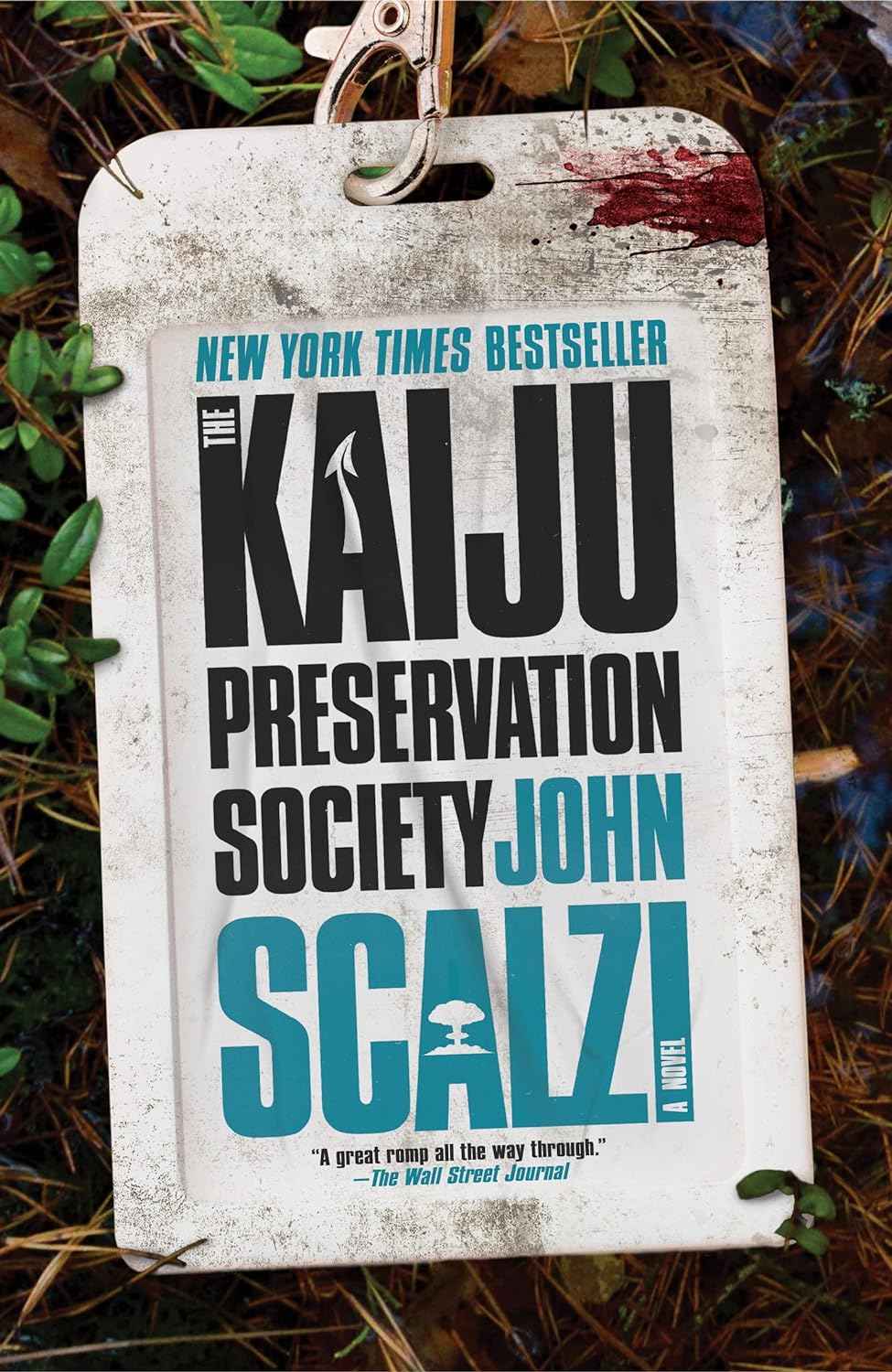
The Kaiju Preservation Society


Review of The Kaiju Preservation Society

Kristine Larsen

Scalzi, John. The Kaiju Preservation Society TOR, 2022.

During the COVID-19 pandemic, Hugo Award winner John Scalzi struggled to complete a rather serious novel project before the contracted deadline, but eventually admitted defeat. He, like many of us, embraced the need for self-care, and instead produced what he calls in his lengthy Author’s Note a “pop song” of a novel, “meant to be light and catchy,” in less than six weeks (262). As he further explains, writing The Kaiju Preservation Society “was restorative…. I had fun writing this, and I needed to have fun writing this. We all need a pop song from time to time, particularly after a stretch of darkness” (262). However, just as a light-hearted earworm can garner Grammys, Scalzi’s replacement assignment was honored with the 2023 Alex Award of the Young Adult Library Services Association and the 2023 Locus Science Fiction Foundation Award for science fiction novel.

In the early months of COVID, first-person narrator and English Ph.D. program drop-out Jamie Gray finds that their six-month term at the management side of a start-up food delivery service does not go as planned. Reduced to delivering food for said company to make ends meet, Jamie meets a past acquaintance who offers employment at a mysterious company known only by the abbreviation KPS. The job is described as working with “large animals” in an isolated location for months at a time. After signing various ominous non-disclosure agreements, Jamie and several likewise underemployed Ph.D.s step through a nuclear-powered dimensional doorway in Greenland into a parallel Earth. But instead of a commercial ‘Kaiju Park’ featuring genetically engineered monsters, this is a natural ecosystem—albeit one featuring a completely alien biology—that scientists study while simultaneously preventing the kaiju from entering our world.

As Jamie and the reader discover, nuclear reactions “thin the barrier between universes” (41), allowing travel between these two Earths. The start of humanity’s nuclear age allowed several kaiju—who are themselves largely powered by their own internal nuclear reactors—to enter into our world in the 1950s. Although instinctively attracted to a new source of food—the fallout from nuclear bomb tests—the kaiju were ill-adapted to our world and quickly succumbed, although rumors of eyewitness accounts became the impetus for the original Godzilla film. An international project, KPS, was created to keep the kaiju on their side of the barrier while studying them in secret. Once funded by governments, billionaires now provide much of the support, leading to the inevitable: celebrity tourism. While the official gateways are tightly controlled by international agreement, the threat from unrestricted black-market doorways looms large; therefore, KPS also protects the kaiju from humanity, for as in the case of much of science fiction, the real monsters often wear a human face.

After surviving a number of threats posed by the wild kaiju and their parasites (bringing to mind a slightly kinder and gentler Cloverfield), Jamie and the scientists are drawn into a predictable conspiracy involving evil capitalists and the disappearance of a kaiju named Bella and her eggs during a conveniently scheduled shutdown of the official gateways. The rescue mission to return the kaiju and its young to their native climate (before Bella’s bioreactor becomes unstable and causes a nuclear disaster in our world) includes numerous mad scientist tropes, befitting the general timbre of the novel. 

While the physical gateway between worlds is rather underwhelming (compared to passing through garage doors on opposite sides of a room), Scalzi does due diligence in world-building and scientific speculation for a novel of this relatively short length, especially on the biological side. As explained in an interview, Scalzi felt the need to provide a reasonable scientific basis for his giant creatures, explaining “God knows I love a Godzilla movie, but the physics of Godzilla are all wrong” (Sorg). The resulting fictional lifecycle of the kaiju is interesting; as a kaiju’s internal bioreactor can go critical, nuclear explosions are a natural part of the alien ecosystem. The resulting energy attracts other animals to feed upon the ‘carcass,’ providing a consistent explanation as to why the first hydrogen bomb tests attracted kaiju through the weakened dimensional wall into our world. The use of artificially developed kaiju pheromones to control kaiju behavior (including encouraging Bella and her reluctant mate Edward, members of an apparently endangered species, to breed) reminds one of a throwaway line involving T-Rex urine in Jurassic Park 3 (during a scene in which a young boy uses the liquid to scare away most of the island’s dinosaurs). Although some critics have poked holes in his science (e.g., Howe), the kaiju origin story is plausible enough for light science fiction. Indeed, this “pop song” of a novel certainly doesn’t take itself too seriously, delighting in numerous pop culture references to such disparate works as Stranger Things, Pacific Rim, Doom, Twilight, The Incredibles, and even Pitch Perfect for good measure.There are the expected direct nods to Japanese kaiju films, such as the names of the KPS bases playing homage to the original Godzilla’s director and producer. Subtle celebrity tourist name dropping includes the COVID-era president’s adult sons and possibly Bad Astronomer blogger Phil Plait.

Yet, for all these details there is scant description of the physical details of the individual kaiju (except for size), Jamie offering that human terms such as eyes and tentacles are insufficient to capture the unearthly physiology. Additionally, similar to protagonist Chris Shane of Scalzi’s Lock In (2014) and Head On (2018), Jamie Gray’s gender is never revealed. Scalzi openly embraces this (as well as the inclusion of trans or non-binary characters in the novel), offering that it is “reflecting the world I know” as well as the context of the communities described in the novel (Scalzi, “A Month”). Scalzi is also quick to warn in the same blog post that although Wil Wheaton reads the audiobook, this is not a clue to Jamie’s gender. Given that The Kaiju Preservation Society will probably be coming to a screen (small or large) near you before long, Jamie’s casting may provide an opportunity for a non-binary actor.  

Reflecting on each reader’s individual gendering of his protagonist, Scalzi offers that “what they decide brings an interesting and personal spin to the book, and I like that. It’s also fun for people to interrogate their own defaults and what they mean for them as a reader and human” (Scalzi, “A Month”). Such interdisciplinary opportunities for open discussion, as well as the novel’s short length, eminent readability, and embrace of pop culture references, make it a natural for inclusion in the classroom, especially in a first-year experience course. The overall depiction of a pointedly diverse group of young Ph.D.s specializing in biology, astronomy/physics, and organic chemistry/geology—self-described as “the foreign legion for nerds” (32)—as heroes brings to mind not so much Jurassic Park but the John Carpenter film Prince of Darkness (without the cringy, red flag sexual relationships) and could spark useful discussions on depictions of science and scientists in popular culture. While Jamie is not a scientist, their master’s thesis on sci fi depictions of bioengineering is deemed appropriate preparation for the team. The group’s acceptance of Jamie as an equal—despite the lack of a Ph.D. and a background in the humanities rather than the sciences—is refreshing, reflecting current efforts to incorporate the arts into STEM education (the so-called STEAM movement). The ensemble nature of this ‘fellowship’ of the kaiju also reflects the process of science in an excitingly realistic way. The world is saved not by a lone genius, but a group of amusingly ordinary scientists, who tell bad jokes and delight in scatological humor. Although they utterly fail at being cool superheroes, through friendship and a convenient character twist good triumphs over evil. The setting of the novel during the COVID pandemic also encourages discussion of individual experiences during that time, reflecting how we, like the characters in the novel, were largely isolated from society, with the exception of our nearest family or friends.

While The Kaiju Preservation Society takes its reader on a relatively satisfying joy ride befitting a summer pop song, it will be interesting to see how it, like the musical ditty, holds up in five years, as we move farther away from the pandemic and our memories of the experience fade.

WORKS CITED

Howe, Alex R. “Book review: The Kaiju Preservation Society by John Scalzi.” Science Meets Fiction, 10 Sept. 2022, sciencemeetsfiction.com/2022/09/10/book-review-the-kaiju-preservation-society-by-john-scalzi/.

Scalzi, John. “A Month of The Kaiju Preservation Society.” Whatever, 19 Apr. 2022, whatever.scalzi.com/2022/04/19/a-month-of-the-kaiju-preservation-society/.

Sorg, Arley. “Friendship In the Time of Kaiju: A Conversation with John Scalzi.” Clarkesworld Science Fiction & Fantasy Magazine, Mar. 2022, clarkesworldmagazine.com/scalzi_interview_2022/.http://clarkesworldmagazine.com/scalzi_interview_2022/


Kristine Larsen, Ph.D., has been an astronomy professor at Central Connecticut State University since 1989. Her teaching and research focus on the intersections between science and society, including sexism and science; science and popular culture (especially science in the works of J.R.R. Tolkien); and the history of science. She is the author of the books Stephen Hawking: A Biography, Cosmology 101, The Women Who Popularized Geology in the 19th Century, Particle Panic!, and Science, Technology and Magic in The Witcher: A Medievalist Spin on Modern Monsters.

The Imposition of Unnecessary Obstacles


Review of The Imposition of Unnecessary Obstacles

Jeremy Brett

Malka Older. The Imposition of Unnecessary Obstacles. Tordotcom, 2024. Hardcover. 208 pg. $20.99. ISBN 978-1-250-90679-3.

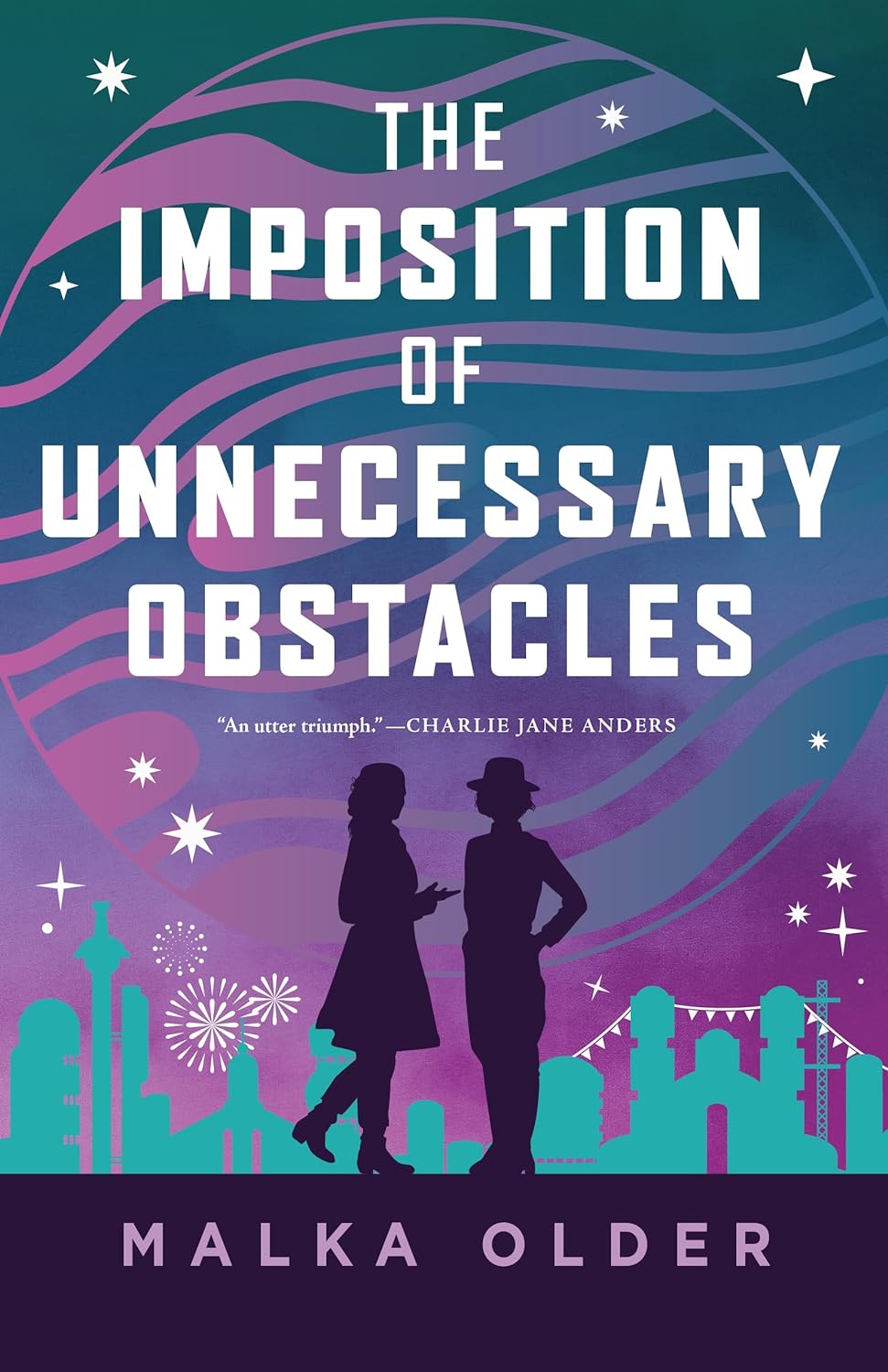
With The Mimicking of Known Successes, Malka Older introduced an intriguing queer detective duo awash in Holmes-and-Watson similarities (though perhaps all crime-solving duos are Holmes and Watson to one degree or another): the relentlessly logical, dogged investigator Mossa and her lover and partner-in-solving-crime, the academic researcher Pleiti. Following the crimes, scholarly scuffles, and dramatic revelations of Mimicking, Older has brought these two back together to solve another mystery set among the existential dangers inherent to life in deep space. In the grand tradition of mysteries, during the novella, important, and sometimes deadly, truths are exposed that lay bare the nature of the world around us as well as the deepest motivations and longings of the characters. All mysteries are, ultimately, searches for the truth of things, whether that truth is to be found in a cozy English drawing room, on the mean streets of 1940s Los Angeles, or even within a ring-structured colony that orbits Jupiter (or, as the book calls it,“Giant”) in the far future following the climatic destruction of Earth.

One central truth Older explores in this new chapter of the series involves the uncertainties that come with interplanetary existence. Mossa, at the story’s onset, has returned to Valdegeld University (where Pleiti works) because of a recent rash of seventeen disappearances among its population. We open with her musings on the disquieting ability of people to vanish from Ring society. She thinks to herself:

A startling percentage of cases brought to the Investigators dealt with missing persons. It might even be considered the raison d’etre of the service…After the controlled, condensed environments of the spaceships and stations, where everyone was within contact all the time, life on a planet with a dense, communications-unfriendly atmosphere seemed full of gaps and mystery. Particularly in the rapid expansion period, people would disappear into the growing network of platforms and rings, and there would be no way to know whether they were prospering or vaporized unless someone went to find out. (2)

Pleiti, enmeshed in her own more academic and theoretical mysteries, finds herself completely unaware of the vanishings all around her and is shocked to learn from Mossa how this went without notice, because the scattered can slip through the cracks without notice or perception of a pattern. But, then, patterns are what Mossa and her other fictional detective forbears seek to find. Detectives look to find meaning and purpose in seeming randomness. These are revelations for Pleiti, as is the uneasy feeling that perhaps she has been guilty of objectification and blindness towards her fellow residents. When Mossa notes that porters and other support staff are among the missing, Pleiti wonders, “‘Porters?’ That seemed even more surprising, somehow, and I wondered with a chill whether I did not see porters as people enough to be kidnapped” (32). That mindset, too, is a truth to be unraveled – how do we interact with each other in this kind of far-flung, disconnected society? How do we see one another and find value in each other, especially in an environment as unremittingly hostile as space, where coming together in viable communities may be the only way to survive?

Disconnection is key to the novella, as Older describes long-standing cleavages and prejudices among different Giant classes, particularly between people from Giant and the descendants of the rich, exclusionist settlers from its moon, Io. These kinds of familial and class prejudices form one variation of the kinds of “unnecessary obstacles” that we humans are always imposing among and between us, obstacles that constrain our ability to form communities and relationships and institutions and that can throw off a settlement’s unsteady balance. When Pleiti speaks to one of her scholarly colleagues, Zei, about the university faculty, Zei notes that “It has always been…precariously balanced, shall we say: dependent, like so many supposed systems, on the personalities involved. And their principles…Something is off” (97). Whereas Mimicking of Known Success involves a clash between differing, often violent opinions on when and how humans might return to an environmentally repaired and reconstructed Earth, Unnecessary Obstacles concerns itself with how we look at ourselves and those around us in the context of the societies in which we reside.

On a personal level, we see it with Pleiti, who is filled with doubts and insecurities about her relationship with Mossa:

…had I made it clear to her that it (Mossa’s home on Io) only mattered to me because it mattered to her? The thought that she might class me as an ignorant tourist, seeing only the surface, was like a pang of acid in my throat. Or maybe she hadn’t wanted me to see how much it mattered to her?..Round and round on their immutable rings went my thoughts, as I stared at the endless fog. (85)

Self-doubt and deliberate self-occlusion are also unnecessary obstacles Pleiti places in her path, as she confesses to Mossa her true feelings about her own dream of a renewed Earth: “I never really thought it was possible. I mean, reading about Earth, it was like…reading about Oz, or Pern, or Quistable. You want it to be your reality so much, but you also know it isn’t real. I believed in what I was doing, rationally I thought – think – it can happen, but it always felt…insubstantial somehow” (160). And on a more macro level, we see in the novella’s denouement how ideology and a heedless rush towards independence can themselves throw up obstacles such as self-deception or a romantic communal identity rooted in difficulty. As Mossa notes near the novella’s conclusion, “I dislike self-delusion. I particularly dislike when one or a few people’s chosen delusion is powerful enough to draw in others. And the idolization of the settlers for what they could not avoid as opposed to for their choices, the donkulous invention of obstacles to try and achieve the same status…” (192). When the final mystery is revealed, Pleiti sadly observes that “I looked again at the bare platform, sparse of society, precarious in every way, and wondered again at our human tendency to romanticize the imposition of unnecessary obstacles into our lives” (176).  It’s the narrative moment where Pleiti expresses for the reader a fundamental human fallacy—in space or Earthside—that so many of our problems are of our own making, and that we risk a great deal of harm in making those problems seem inevitable and unavoidable.

We are, or should be anyway, long past the romantic literary trend of the individualist conquerors and pioneers of space; we now reside in an age in which we must, if we are to survive as a species and a planet, come together in a greater cooperative spirit and sense of common humanity and truly recognize the worth of one another. We must realize a world where the disappeared are considered worthy of finding. This is an increasingly popular trend in the genre, from authors such as Becky Chambers, Annalee Newitz, Carrie Vaughn, Travis Baldree (in a fantasy setting) and Martha Wells (Murderbot may be constantly exasperated by humans, but its journey is one towards greater understanding and feelings of care both by and towards itself); Older’s tales of Mossa and Pleiti as they negotiate both their own feelings towards each other and the obstacles we deliberately throw in each other’s paths as we work our way through interplanetary existence are valuable additions to this growing canon of authors who face uncertain human futures with optimism, who believe in the never-ending capacities of humans to learn and thus to remove the unnecessary obstacles that come our way. The best detective fiction relies not only on solving puzzles but on the detective learning new truths about their own abilities and perceptions. As Mossa uncovers the truth of both the crimes she investigates and the unexplored aspects of her own nature, so Pleiti gradually learns to expand her own limits. As she says to Mossa in the novella’s final pages, “Our experiences have influenced how I work, for the better. I am grateful to have gone back to Io and seen more of it, even if I did hate the process of getting there…Oh yes, the danger. Well. A little danger is salutary, I think. A tonic” (206). Risk becomes a crucial learning experience, a lesson which might define the entire enterprise of human space travel and colonization, in fact.


Jeremy Brett is a librarian at Cushing Memorial Library & Archives, where he is, among other things, the Curator of the Science Fiction & Fantasy Research Collection. He has also worked at the University of Iowa, the University of Wisconsin-Milwaukee, the National Archives and Records Administration-Pacific Region, and the Wisconsin Historical Society. He received his MLS and his MA in History from the University of Maryland – College Park in 1999. His professional interests include science fiction, fan studies, and the intersection of libraries and social justice.

Review of Africa Risen: A New Era of Speculative Fiction


Review of Africa Risen: A New Era of Speculative Fiction

Reo Lewis

Tesh, Emily. Some Desperate Glory, Tor Publishing Group, 2023.

Twenty-four years ago, the goal of the prolific African-American writer and editor Sheree Renée Thomas in her highly-regarded anthology Dark Matter: A Century of Speculative Fiction from the African Diaspora (2000), was to “correct the misperception that black writers are recent to the field” (6). There is perhaps no better testament to the achievement of her goal than the ever-growing list of science-fiction and fantasy anthologies centring authors from Africa and its diaspora since Dark Matter’s publication: from Nalo Hopkinson’s So Long Been Dreaming: Postcolonial Science Fiction and Fantasy (2004) to Nisi Shawl’s New Suns: Original Speculative Fiction by People of Color (2019) and Dominion: An Anthology of Speculative Fiction from Africa and the African Diaspora (2020), edited by Thomas’ collaborators Oghenechovwe Donald Ekpeki, and Zelda Knight. The editors of Africa Risen no longer have to convince their readers that black writers are prolific in this genre because, to anyone with more than a passing familiarity with science-fiction and fantasy, the point has already been made. With the burden of proof removed from their shoulders, the stories in Africa Risen are free to “continue the mission of imagining, combining genres and infusing them with tradition, futurism, and a healthy serving of hope” (4). Undoubtedly, it is in the moments when this anthology takes advantage of this unimpeded creative and cultural freedom that the stories shine best.

From the contents page alone, Africa Risen begins to impress readers with the names of included speculative literary giants such as Tananarive Due and Steven Barnes. Barnes’ story “IRL” is the first real stand-out of the collection, a cyberpunk-esque exploration of black masculinity and fatherhood with characters motivated by the drive to provide for one’s family and community against the obstacles of corruption in the economic, justice, and healthcare system. It is a story that legitimises the use of escapism and worldbuilding as tools of survival. “IRL” quickly proves itself to be among good company with the other stories of Africa Risen. Wole Talabi’s “A Dream of Electric Mothers” turns bureaucratic indecision into an opportunity to commune with a digital ancestral hivemind, with a main character who finds resolution and strength through her maternal lineage. “The Sugar Mill” by Tobias S. Buckell is also about ancestral communion, except this time in the form of a ghost story with the intimate feel of a family drama rather than a campfire horror tale. Haunting manifests through bloodlines of trauma—the ghosts haunt the land where their blood was spilt and they haunt their descendant who carries their blood and the haunting doesn’t end until they are properly memorialised and safeguarded against neo-colonisers who would disregard their pain and their history. “The Lady of the Yellow-Painted Library” by Tobi Ogundiran (a story which has gained popularity after being featured on an episode of the podcast Levar Burton Reads) reads like an episode of The Twilight Zone, exploring the inescapable and cyclical burden of responsibility using an African Literature classic, Things Fall Apart, as the plot’s MacGuffin— the object that serves to set and keep the plot in motion despite usually lacking intrinsic importance, like The One Ring in The Lord of the Rings. “Hanfo Driver” by Ada Nnadi is a slice-of-life tale with casually diverse characters and a realistic view of how technological disparity will continue in the future, leading to a relatively low-stakes conflict and heartwarming humour.

With just a quick summary of these five standout stories, it is clear the impressive range of settings, themes, and characters that appear in Africa Risen. However, as to be expected with an anthology of thirty-two stories, not all of them work as well as the others. There are many stories in Africa Risen that lead the reader to think, “Didn’t I just read a better version of this a second ago?” But these choices come across as intentional rather than redundant. These stories are in conversation with each other, with the writer, and with the SFF generic tradition. Just because “Cloud Mine” by Timi Odueso is the eco-dystopia from a child main character’s point-of-view that resonated most with me due to its lens of systemic abuse and labour exploitation, it doesn’t mean another reader wouldn’t prefer Dilman Dila’s “The Blue House,” Russell Nichols’ “Mami Wataworks,” or Moustapha Mbacké Diop’s “When the Mami Wata Met a Demon.” Likewise, while Alexis Brooks de Vita’s “A Girl Crawls in a Dark Corner” is a standout for me, others might prefer the alternate history retelling of WC Dunlap’s “March Magic” or the feminist horror of Mame Bougouma Diene and Woppa Diallo’s “A Soul of Small Places.” “Liquid Twilight” by Ytasha Womack is a mermaid story with a cinematic feel and captivating characters who treat speculative work as a form of activism and vice versa, but another reader might prefer the representation of activism in Akua Lezli Hope’s “The Papermakers.” Stories within an anthology are collaborative, not competitive. The fact that many of these authors chose to write about similar topics only reinforces the importance of these themes in literature in general. These stories are just as concerned with the role of history, tradition, and ancestry as they are with futurism. These worlds are fully realised: there are no dystopias without hope and activism towards change and there are no utopias without realism and a critique of the status quo. And for every story that felt like it was treading familiar ground, there was also a story which had something new to say, whether it was about misogyny and trauma exploitation in the music industry (“Peeling Time (Deluxe Edition)” by Tlotlo Tsamaase), PTSD and the exploitation of child soldiers (“A Knight in Tunisia” by Alex Jennings) or the African-American fantasy of Pan-African return (“Ruler of the Rear Guard” by Maurice Broaddus). By the time you reach the end of the collection, you truly feel like you have experienced a cohesive yet diverse presentation of thirty-two Afro-speculative worlds.

As with any anthology, there isn’t space to review every story, but there is one story that it would be remiss not to mention as, in my opinion, “Air to Shape Lungs” by Shingai Njeri Kaguda, is emblematic of what Africa Risen is all about. Although it is not the diaspora story the editors chose to end the collection with (Dare Segun Falowo’s “Biscuit & Milk” gets that honour), to me it is the diaspora story of the anthology, the one that best narrates the feeling of home-seeking and anti-rootedness of the diaspora experience through a disembodied, airborne, communal “we” voice. It is narrated in two alternating sections, “Memory” and “Living Now,” which summarise perfectly the concerns of the authors throughout the collection. Speculative fiction is most often associated with futurism, but in the hands of these African and Afro-diasporic authors, speculative fiction is equally about the legacies of the past and the concerns of the present as it is about the imagination of the future. Africa Risen may not be revolutionary in the way Dark Matter was, but it is not the job of black writers to revolutionise with every story they tell: black speculative fiction writers, like all speculative fiction writers, only need to be allowed space to have fun, to debate, to explore and to innovate. Undoubtedly, with Africa Risen, Sheree Renée Thomas, Oghenechovwe Donald Ekpeki, and Zelda Knight have once again provided that space for African and Afro-diasporic authors to thrive.


Reo Lewis is a graduate of the MA in Comparative Literature from SOAS, University of London. She is currently a Creative Writing PhD candidate at the University of Exeter, with research at the intersection of speculative fiction, linguistics and diaspora studies. Her project is a short story collection that explores how the use of diasporic speech in fantasy and science-fiction worlds can contribute to decolonising the tropes of these genres.

Review of Some Desperate Glory


Review of Some Desperate Glory

Sarah Nolan-Brueck

Tesh, Emily. Some Desperate Glory, Tor Publishing Group, 2023.

Emily Tesh’s Some Desperate Glory takes a classic science fiction premise and scrambles it. What if there was an all-knowing artificial intelligence that could help us decide which actions would be serve the most people? What if we had a calculus for the greatest possible happiness? Valkyr—or Kyr—a young woman and warrior for humanity, lives in the shadow of just such an intelligence, an ultra-powerful, reality-bending force called the Wisdom. The major problem? Humanity did not invent this superpower, and the civilization that did, the majo, follows the Wisdom’s advice to destroy the Earth. Kyr is a warbreed, a genetically modified weapon for humanity’s revenge, born on Gaea Station decades after the death of her planet. She is a special favorite to her mentor and the station’s de facto leader, “uncle” Aulus Jole, and a clear frontrunner for a glamorous assignment in one of the combat wings. When assignments arrive, however, Kyr finds herself placed in Nursery, the child-bearing and rearing sector, a wing with all the fatality of combat but none of the glory. Reeling from this shock and the defection of her twin brother, Mags, Kyr takes the ultimate risk and leaves Station Gaea to prove herself and to find out the truth about her place in the universe.

Some Desperate Glory is Tesh’s best-selling first novel, following Silver in the Wood (2019) and Drowned Country (2020), the two novellas of the Greenhollow Duology that marked her dark fantasy debut. In a departure, then, from her previous works, Some Desperate Glory employs many of the familiar elements of high concept science fiction: a young hero with a singular goal, an alien enemy, and a slew of new combat-driven technology. Yet, the initial set-up belies the narrative’s complexity. Some Desperate Glory expands into a tale of manipulation, where coming of age includes shattering a worldview on multiple fronts and in multiple universes. Like many young heroines, Kyr learns that her world and her place in it could have been otherwise; furthermore, she is allowed to live the alternatives, in a fragmented and sweeping narrative that allows the reader to enjoy multiple facets of Tesh’s deep world-building.

Reminiscent of Melissa Scott’s Shadow Man (1995), Some Desperate Glory takes two wildly conflicting worldviews and smashes them up against one another, with interesting implications for gendered representation. While gender roles on Gaea are so strict as to control literal lifetime assignments, the majo have an entirely different understanding of physiology and procreation. What makes Some Desperate Glory a uniquely queer tale is the gendered deconstruction that comes from both the humans central to the novel and from an outsider’s perspective. The majo have a difficult time understanding Gaean concepts of gender and must puzzle over what they’ve learned about human physical markers to tell them apart. Majo themselves use agender pronouns to make themselves legible to humans, but they don’t seem to use these words to describe themselves in other contexts. On Gaea, there is no recognized form of life partnership, and sex is, ostensibly, reserved for reproduction, focused on meeting the station’s population targets. Queerness, then, is something Kyr can’t seem to properly process. Two of the girls in her mess are known to kiss and couple off, but Kyr doesn’t understand what is so important about “a sex thing;” to her, romantic attachment means distraction. As long as it doesn’t get in the way of Gaea’s operations, it’s harmless and unimportant. These multiple views—represented in Kyr, her companions, and a majo interloper—constantly collide to refresh Kyr’s worldview, providing constant revelations that alter her perspective.

While Some Desperate Glory is concerned with gender inequality and reproductive decision-making, it is unlike more common reproductive dystopias. Kyr’s concern is not primarily for her own fate or the fate of any potential children she might have; rather, as Kyr discovers the depth of the deception surrounding her, her greatest goal is to shut the system down altogether. Some Desperate Glory has all the brutality of Orson Scott Card’s Ender’s Game (1985) or Rivers Solomon’s An Unkindness of Ghosts (2017) and a similar pre-occupation with how birth and controlling leadership can circumscribe a life. The novel, however, reserves a special place for tenderness and community where little would seem to exist. Finding the capacity to turn a novel about militarization into a tale of friendship, collaboration, and daring, Tesh crafts a unique story, which is as mind-bending and fast-paced as it is enjoyable and kind.


Sarah Nolan-Brueck is a Ph.D. candidate at the University of Southern California where she studies how science fiction interrogates gender. Currently, she is researching the many ways science fiction authors critique medical legislation that restricts diverse gendered groups in the United States and how the genre collaborates with activism in this arena. Sarah was recently awarded the University of Oregon’s 2024 Le Guin Feminist Science Fiction Fellowship. She has been previously published in Orbit: A Journal of American Literature, the SFRA Review, Femspec, and Huffpost, and has work forthcoming in Utopian Studies and ASAP/J.

Review of The Ferryman


Review of The Ferryman

Adam McLain

Cronin, Justin. The Ferryman. Ballantine Books, 2023.

Separated into three islands—the main island, the Annex, and the Nursery—Prospera is a utopia cut off from the rest of the world. Created by the Designer to shelter the best of humanity, the inhabitants of the main island live paradisaically, pursuing whatever passion or desire drives them. This paradise does not mean that they do not work or live as mere mortals—they still age, if slowly; still work, just not menial labor jobs; and still die. But their death and birth are unique: they arrive by ferry from the Nursery in a body in its late teens, capable of basic human functions but also able to avidly learn new things, and they leave by ferry to the Nursery when their health number on their monitors reaches a low count, meaning they no longer enjoy life. This cyclical nature of existence is guided by Ferrymen like Proctor Bennett who lead those at the end of the cycle back to the ferry.

Proctor’s life in Prospera is idyllic. He has a good fifteen-year contract with his current partner, Elise. Although their relationship is cooling after many years together, they still are happy and content. His job is fulfilling, challenging, and a point of personal pride. He wouldn’t do anything to change his life. This changes, however, when he takes his father to the ferry and his father has a catatonic breakdown, telling his son, “The world is not the world. You’re not you… Oranios. It’s all Oranios” (62). His father leaves by ferry, but Proctor’s world is forever changed. As he searches for the answers to his father’s mumblings, he faces off against bureaucratic corruption bent on stopping him, class warfare building between the Annex and the main island, and the possibilities of what his life for the last hundreds of years really means.

Utopia, space exploration, climate fiction—Cronin writes the genre tropes well. I connected to each character as their backstory was revealed, and I lingered over sentences meticulously crafted to enhance the experience. The sentences are lyrical and whimsical; at times I thought I was moving through an ethereal dream only to be reminded that pain and strife still exist. Cronin’s use of the English language is his crowning point in this novel. But where I get stuck is there is no innovation with the tropes: each reveal is satisfying, but it is also predictable, if one knows science fiction well enough. This critique does not necessarily diminish the book. I wouldn’t go so far as to say that Cronin’s goal in the project is to subvert or expand tropes or send the genre along a new path. It is a text that is beautifully written, like Samuel R. Delany’s work, but also one that is not so concerned with generic questions, unlike Delany’s work.

Cronin’s exploration of utopia, turning point theory, simulation theory, climate catastrophe, and space travel are not meant to explore new depths in the subject; instead, he centers, and this is the beautiful part of the book, these grand ideas not around the ideas themselves but around the characters that enact them. His book becomes a meditation on relationships (parent to child, person to person, manager to employee) that left me re-thinking my own relationships and approaches to them. The central struggle of the book is with the loss of loved ones and not just a fight with authority, a quest for truth, and the revelation of survival.

However, after reading the book twice, I’m not entirely sure what the central message of the project is when it comes to the larger, systemic issues it presents. Along with its meditation on relationships, the book presents messages about class struggle, environmental destruction, and existence through mediations on simulation theory. These systemic questions become lost in the deployment of the tropes because Cronin does not emphasize one over the other; instead, he lets the tropes play out as they normally might in a blockbuster science fiction story. The critique of class, for example, is limited in its execution because it presents the same rich-vs.-poor dynamic that many utopias and dystopias exacerbate. The struggle leads to action—the oppressed in the Annex begin marching on the privileged on the main island—but Cronin doesn’t provide readers with enough paratextual information to give this struggle any heart or depth. A scene between the main character and his housekeeper illustrates this reading: Proctor converses with his housekeeper from the Annex about her son. He realizes that he barely knows anything about the son, even though he promised to take the son sailing. The scene shows the class separation and inhumanity between the wealthy of the main island and the working class of the Annex, but it barely goes beyond that presentation. His housekeeper is used later to smuggle Proctor information to sneak out of the Nursery, but beyond that, the book leaves this class relationship alone, thus leaving the message of class itself aborted in many ways. The final message on class, with the climactic reveal at the end, seems to be that class struggle brings about social change, since the Annex’s revolution against the main island ends in a social upheaval, but I am still unsure what the little moments about these broader, systemic arguments mean.

Even as I struggle with how Cronin does not do a lot with the tropes he’s working with, I also think that this deployment of tropes could be seen as a good part of the text: it is marketed toward a wider audience than academics discussing genre, and as such, the use of the tropes makes it easier to use The Ferryman as a starting point into the genre of the science fiction epic. When I went to the local Barnes and Noble to ask about Cronin, the bookseller took me to the horror genre bookshelves, because “that’s where Cronin is usually shelved” even though there is nothing remotely close to the horror genre in The Ferryman. The bookseller was thinking about Cronin’s earlier work, especially the 2010–2016 Passage trilogy, which is a post-apocalyptic, zombie-vampire series. But in shelving The Ferryman in this genre, I believe its use of utopia and climate fiction as a genre is a way to introduce this side of genre fiction to readers. Thus, I recommend The Ferryman as a strong entryway but not as a complication of science fiction. It can begin conversation rather than continue it, a good place to start an undergraduate or graduate course talking about utopia, futurism in science fiction, or climate fiction and space expansion.


Adam McLain is a Ph.D. student in the English department at the University of Connecticut. He researches dystopian literature, legal theory, and sexual justice.

Review of A Half-Built Garden


Review of A Half-Built Garden

Jeremy Brett

Ruthanna Emrys. A Half-Built Garden.Tordotcom, 2022. Paperback. 340 pg. $18.99. ISBN 978-1-250-21099-9.

After enough time, one might be forgiven in thinking that there can be no new First Contact stories to tell. It’s a truly singular event when an author takes a classic sf trope and spins it in a new direction infused with existential social and political relevance. This sort of literary shift was already accomplished by author Ruthanna Emrys in her “Innsmouth Legacy” series, in which she infused the classic Lovecraftian universe of cosmic horror with empathy and feeling for the marginalized in opposition to the racism endemic to Lovecraft and his era. With A Half-Built Garden, Emrys brings modern and lasting concerns for the future of humanity and Earth (which the novel takes pains to point out are not, to certain people, the same thing at all) to a wholly unusual and thoughtful story of alien encounter.

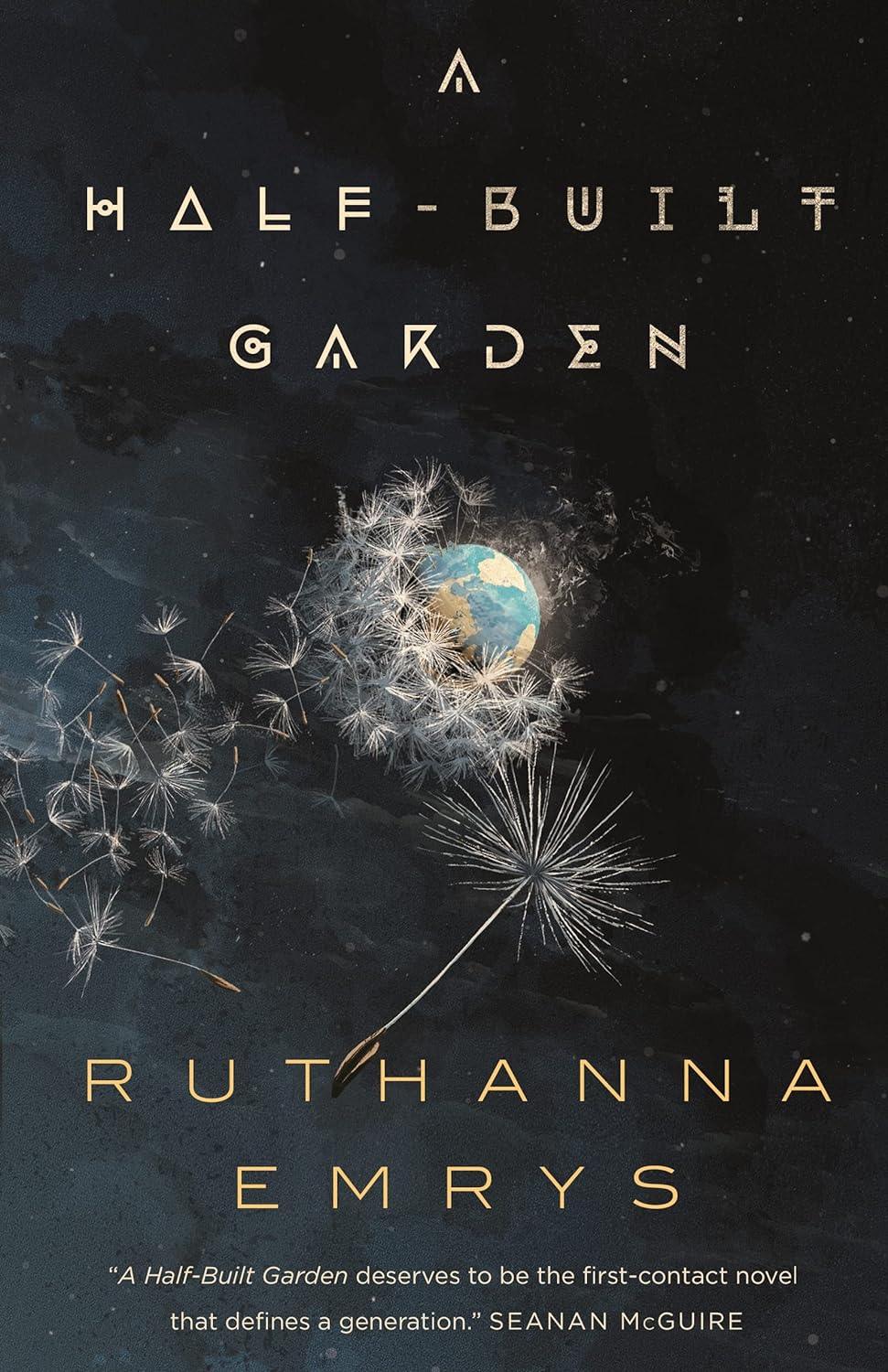
In 2083, the Earth has been engaged for several decades in a radical moment of social, political, and corporate restructuring. Nation-states have been replaced or supplemented by networks centered on the maintenance, restoration, and care of environmentally critical watersheds. The rampant capitalists that ravaged the planet in the 20th and 21st centuries have for the most part been reduced to small island enclaves, connected to the watershed networks and traditional governing structures in uneasy alliances of trade and supply. The networks, which sprung into existence as part of the Dandelion movement (the image, of course, suggesting seeds being spread by the free flow of the wind) govern themselves through collaboration, consensus, and intimate communication rooted in problem-solving. The Dandelion networks devote themselves to repairing what had been so desperately, horribly broken in the world by capitalism and nationalism. Adaptation and harmony are increasingly default human values, and for the first time, despite ongoing struggle, there is hope.

And then the aliens landed. So goes the cliché, but one thing that makes Emrys’ novel so particularly remarkable is the response from this altered world. The novel avoids chronicling an all-out defensive reaction from the militaries of the world, frenzied government scrambling, mass panic (in fact, among the most striking aspects of the book is the immediate acceptance by humans of the aliens as they walk among us), or the complete absence of panic or fear. Those responses are replaced instead with curiosity, acceptance, honest attempts at connection and friendship, attempts at exploitation (by the capitalists), and even sexual exploration (by protagonist/narrator Judy and her wife Carol with the alien representative Rhamnetin). Alien encounters, Emrys posits, bring out the full range of human behavior in people; we are not limited to our most atavistic responses. This attitude of optimism denotes the novel’s true throughline. We see it from the very opening, in which Judy notes “In the bad old days (the commentary said later), nation-states had plans laid in for this sort of thing. They’d have caught the ship on satellite surveillance. They’d have gotten in the ground with sterile tents and tricorders and machine learning translators, taking charge. In a crisis, we still look for the big ape.” However, “instead of a big ape shouting orders, the world got me.” (1) Humble Judy, of the Chesapeake Bay Watershed Network, becomes the Earth’s first ambassador to alien life after stumbling across a crashed spaceship – and, as she points out “That would have been a good time for cynicism – for someone to ask if we believed them, or if their definition of peace looked anything like ours. But no one wanted to spoil the moment of joy. We didn’t want to play nation-style realpolitik, or be properly mature and suspicious. We wanted to talk. However complicated things got afterward, I still can’t regret that.” (6)   In Half-Built Garden, hope in peaceful connection is a precious resource and a defense against a hostile universe.

And that hope is crucial, because the aliens have brought a choice that seems to be no choice. The aliens are comprised of multiple species (represented on this mission by the spider-like “tree folk” and the more insectile “plains folk”) from the Rings, a system of artificial worlds that exists because the Ringers have determined that all intelligent life inevitably destroys its own homeworld and must go into space to survive. Having discovered humanity before it’s too late, they bring an offer—really, more of a predetermined conclusion—to evacuate the planet and move humans out to the stars. The corporates jump at the chance, ready to leave Earth and reestablish their shattered traditions of dominance and power among new, alien markets. Nation-states (represented here mainly by NASA as the avatar of a reduced American government) are driven by curiosity and excitement to see what’s out there. However, the Dandelion networks have invested decades of rescue in trying to stabilize and repair the environment, and Judy, Carol, and the people who comprise those networks are not prepared to surrender their home for which they have fought so hard. The novel turns on this existential-level decision, and on the multiple conversations between and among humans and Ringers on humanity’s future. Emrys places the need for radical and trusting connection at the story’s center, the crucial importance of reaching for understanding across vastly divergent mindsets and motives.

A debate between the Ringers and Dandelion representatives towards the end of the novel summarizes these differing views of the universe that each party holds. Judy, the descendant of a traumatized humanity that teetered on the verge of self-destruction (as well as being Jewish and therefore a custodian of a tragic tradition of forcible wandering), points out that “It’s good to live in a time when we have a time we can love. Someplace we can afford to grow attached to.” One of the Ringers, Glycine, responds “But many of us believe you have to drag people out of a burning building, whether they love the building or not. The question is whether Earth is burning.” Judy’s friend and colleague Atheo fires back, “It’s burning…Well, it’s true. But we’re getting the fire under control. It’s a matter of whether you trust us to know the resilience of our own home, whether you treat us as adults who can calculate our own risk rather than kids who don’t know any better” (256). Emrys follows the traditional pattern of a story of alien contact in casting it as a moment for exploring the nature of humanity in the face of an overwhelming and world-changing event; her twist is presenting it as a time of choosing, not merely whether humanity will survive at all, but how and where. She asks the questions: is our home planet, the only home we have ever known as a species, integral to our identity? Will we be the same, and if not, how will we change, if we actually leave Earth and become part of a wider universe? Most critically, if motives are so different, can a true symbiosis between species and the creation of new families and alliances be achieved?

The novel proposes that an informed exchange and sharing of ethical values, together with recognition of differences among ourselves, is the key to effective symbiosis and the bridging of ideological divides. Judy at one point speaks of “the value and the means to achieve it. I’m trying to tell you [the Ringers] that we share the value. Our ancestors either didn’t share it, or didn’t act on it, but we do. And we do because we’ve developed technology for not only identifying our values, but for consistently acting on them” (318). And the trans character Dori offers her coming out as a gift to the Ringers, noting that her parents loved who and what she was more than what they expected her to be. She tells the Ringers that “we can use your gifts in ways you don’t expect, too—if you can cope with us using different means to achieve our shared values. Your technologies for making habitats livable could help save Earth…Symbiosis with Ringers could give us both new tools, new ways to survive in a cold universe” (319). The Dandelions ask an alien society averse to risk and afraid of catastrophe to take a chance on humanity’s potential and its promise, to let systems go unconstrained. In that request lies the continuation of the hope and determination that brought humanity out of its age of power into the late 21st century age of nature. The “half-built garden” of the title in the end, we find, is not only an Earth slowly and gradually being wrested from destruction, but a species just beginning to understand its possible role in a new and symbiotic galaxy.


Jeremy Brett is a Librarian at Cushing Memorial Library & Archives, where he is, among other things, the Curator of the Science Fiction & Fantasy Research Collection. He has also worked at the University of Iowa, the University of Wisconsin-Milwaukee, the National Archives and Records Administration-Pacific Region, and the Wisconsin Historical Society. He received his MLS and his MA in History from the University of Maryland – College Park in 1999. His professional interests include science fiction, fan studies, and the intersection of libraries and social justice.

Review of The City We Became


Review of The City We Became

Heather Thaxter

Jemisin, N.K. The City We Became. Orbit, 2020.

“Cities really are different. They make a weight on the world, a tear in the fabric of reality, like… like black holes, maybe”. The opening words of N. K. Jemisin’s 2020 novel The City We Became provocatively hint at the liminality of the spaces occupied by people and cityscapes. The very essence of a city is created by the nuances of its residents and the ways in which they interact with each other and the material objects that make up the topography of that specific space. Jemisin often addresses this interdependent tension in her works by implementing a kind of literary stratigraphy, uncovering layers of complex systems and external factors that determine the identity of any given city. In The City We Became, Jemisin develops her original short story, “The City Born Great,” which was published in her 2018 collection How Long ‘Til Black Future Month?.  

The protagonist in the short story, an unnamed, black, homeless youth is chosen by the city as a midwife to assist in New York’s birth. The City We Became picks up the narrative after a difficult and not entirely successful birth, leaving the character in a coma-like condition hidden beneath the surface, both literally and in terms of plot. While this character remains fragmentary and elusive, five avatars, each representing a different borough of New York, take center stage in the quest to deal with postpartum complications. These avatars each capture the diverse collective characteristics of the sum parts that make up the whole city, and, although they are drawn together to defeat the mysterious and menacing enemy who appears in the guise of an almost translucent “woman in white,” their individual differences cause friction as they are territorial and defensive.

These differences are identified in the way they communicate: Bronca (Bronx), speaks through art; Brooklyn (Brooklyn), via political language and the rhythm of hip hop; Padmini (Queens), utilizes mathematical equations; Manny (Manhattan), employs violence, particularly in his previous iteration, and the language of economics; and Aislyn (Staten Island), lacking a voice, has no means of communicating effectively and is easily manipulated by the enemy

Jemisin draws on the familiar tropes of speculative fiction and Afrofuturism—supernatural beings, myths, and spatio-temporal liminal gaps, in this case portals to multiverses—to reveal the fragile nature of this emerging city and the potential for other histories, existences, and futures. Interestingly, the avatars have hallucinatory visions of another reality of New York, although they don’t physically enter it. Jemisin plays with the theory of multiverses attempting to overlay each other in a palimpsestic manner. Bronca, the First Nation character, is used as storyteller to explain the idea of many worlds, which resonates with Neil de Grasse Tyson’s explanation of the hypothesis (Science Time); she then goes on to outline how worlds are constantly created through imagination (Jemisin 302).

The topography of the boroughs, islands separated by water and bridges, mirrors the flickering, “peculiar dual-boot of reality,” whereby people and places are connected and disconnected by perspectives (32). It is this apparent glitch between worlds or realities that is presented as being dangerous to the city’s “becoming” and the population who make up the city’s identity. Tendrils of white ominous nubs rise from cracks in the asphalt and seep into the “normal” New York, threatening to contaminate and obliterate that version of reality.

Explicit references to H.P. Lovecraft’s bigoted view of non-white people are made through an alternative reality, a city whose identity is produced by a specific, limited worldview represented by the sinister “woman in white” (the embodiment of Lovecraft’s demonic R’lyeh). The only avatar to align herself to this perspective is Aislyn (Staten Island) as she is already stunted by fear and self-imposed isolation. It is not surprising that Aislyn is the only white avatar as she represents the insidious effects of racism that run counter to and are threatened by the diversity of the population.

The woman in white determines that the “acculturation quotient is dangerously high,” and this is the sticking point for those like Aislyn whose phobias close off their minds to embracing difference (96). A city is born when “enough human beings occupy one space, tell enough stories about it, develop a unique culture, and all those layers of reality start to compact and metamorphose” (304). Jemisin draws on the history of Staten Island to highlight its arbitrary and tenuous connection to the city, hence its resistance to support the other boroughs and protect the vulnerable, primary avatar. The enemy, which is a city itself from an alternative reality, eventually becomes caught between realms. This sense of in-betweenness is the crux of the narrative, what could or would be if other dynamics were more dominant. In a final attempt to anchor itself into existence, the enemy clings to Staten Island, thus opening the way for the second book in this series, The World We Make.

Jemisin expertly captures the essence of what makes New York the city it is and creates complex, imperfect characters that embody that spirit. Her insight into the relationship between humans and the cityscapes they occupy is unique, thereby positioning her as an award-winning, leading author in this genre. Not only has she been nominated for and won numerous awards, including Locus, Nebula, and Tiptree, Jemisin is the only recipient of three consecutive Best Novel Hugo Awards and the recipient of the MacArthur Fellows Program (2020). Jemisin deftly incorporates her observations and experience of living in New York to reveal possibilities and challenge realities. The City We Became addresses many of the issues that are faced by modern-day populations in a way that is familiar, understandable, and raw, but, importantly, hopeful. The energy that overcomes the enemy emanates from the city itself, its sights and sounds mimicking a heartbeat. Once again, Jemisin adeptly peels back the layers to reveal the soul of the city in a way only she can.

WORKS CITED

“The Multiverse Hypothesis Explained by Neil deGrasse Tyson.” YouTube, Uploaded by Science Time 28 Nov 2020. https://www.youtube.com/watch?v=h6OoaNPSZeM.


Heather Thaxter is a PhD candidate by published works which include book chapters in The Bloomsbury Handbook to Octavia E. Butler and Introduction to Afrofuturism: A Mixtape of Black Literature and Arts. Heather’s research interests are Afrofuturism, postcolonial studies, and speculative fiction with a special interest in Octavia E. Butler. Currently employed as a lecturer, Heather is also on the Editorial Review Board of Essence and Critique: Journal of Literature and Drama Studies. ORCID number: 0000-0001-9473-6200.

Review of The Scourge Between Stars


Review of The Scourge Between Stars

Kristine Larsen

Jemisin, N.K. The World We Make. Orbit, 2022.

Scientists trying their hand at writing science fiction is certainly not a new phenomenon. However, since the landscape of the physical sciences has been (and to a lesser extent, continues to be) largely populated by white cis-het men, their tales will often be told through the lens of mirroring protagonists. CUNY Graduate Center astrophysics master’s degree student Ness Brown openly explains that one of their priorities in writing their 2023 sci-fi horror novella The Scourge Between Stars was “contributing to black female representation in these genres and specifically queer black female representation” (“Ness Brown”). Accordingly, Brown’s inaugural work features a diverse cast of characters, including a Black LGBTQ female lead and a dark-skinned, female-presenting and identifying android.

In a YouTube interview, Brown offers how they wanted to start the story from “a place of failure,” the crew of the interstellar spacecraft Calypso and the rest of its ragtag fleet fleeing a failed colony on the planet Proxima b, “limping back [to Earth], tail between our legs” (“Ness Brown). Indeed, conditions are painted as extremely grim for the humans aboard this multi-generational retreat to a climate change ravaged Earth. With dwindling supplies and limited means to communicate between ships, their desperation is palpable. Jacklyn “Jack” Albright, second-in-command and acting captain of the Calypso, strikes a precarious balance between pushing the barely functioning technology to its limits and stretching the resources to feed an increasingly agitated crew who are apparently destined to know no other home than this hamstrung ship. It is a powder keg waiting to explode, until they are faced with a uniting enemy, a pack of stereotypical deadly xenomorphs who hitched a ride from Proxima b, hunting down and horrifically disemboweling their human victims.

Brown successfully paints a dark, haunted house atmosphere, one of intense claustrophobia and visceral terror. While the author admits to openly drawing upon works such as Dead Space, DoomPitch Black, Alien, and Event Horizon, I also noted subtle echoes of the Cloverfield franchise (Semel). Taking a page from the Alien playbook, Brown wisely shows us mainly glimpses of the creatures, enough to demonstrate their utter alienness and mode of killing but leave sufficient mystery for the imagination to work on. What descriptions we do get are indeed evocative of generic insectoid ETs and the xenomorphs of Alien. However, while this work is obviously derivative of the Alien franchise in some ways (including the strong female lead and the uncannily human android), it sufficiently avoids being a direct copycat.

A scientist’s first fictional work may succumb to several additional traps, for example, a plot slavishly bogged down in the science, stilted and antiseptic writing, or a formulaic and linear plot. To their credit, Brown avoids all of these pitfalls, even while admittedly drawing heavily upon their six years as an instructor of introductory astronomy and astrobiology (Semel). Astronomical accuracy is added in clever rather than heavy handed ways, perhaps so understated that the casual reader may not appreciate them. Discovered in 2016, Proxima b is an earth-sized planet in the habitable zone of the nearest star system, the red dwarf Proxima Centauri, but as Brown correctly explains, it is subject to intense and possibly fatal superflares (Howard et al. 1). As a planet likely to be tidally locked, the most habitable (in a human sense) area is probably the terminator, the twilight area between the permanently star-facing and sunlit side (in the bulls-eye of said superflares) and the colder dark side. The terminator is precisely where Brown has their failed colony set up shop on this rocky world. While the planet’s atmosphere apparently shields the human residents from the star’s flare-generated ionizing radiation, the orbiting spaceships suffer significant degradation, similar to effects on the electronics of Earth-orbiting satellites from our Sun’s much smaller outbursts. The author expertly (yet, again, subtly) draws upon reasonable science in crafting the evolutionary adaptations found in their monsters, explaining the creatures’ strengths and (as one might expect) exploitable weaknesses.

There are, however, numerous missed opportunities for even more detailed storytelling due to the relatively short length of the novella format. For example, there is minimal information on the colonists’ time on Proxima b and why their colony failed (other than a vague inability to establish self-sustaining food production). There is also limited motivation for the whispered legends of the deadly indigenous life, now relegated to merely scary bedtime stories told aboard the retreating ships. Brown shares in an interview that the novella format was decided upon in concert with their publisher, and “a lot was necessarily cut from the story” as a result. Brown now admits that they would “love to … wax on at incredible length about Proxima b and the conditions of the failed colony” if the opportunity arose (“Ness Brown”).

Despite these limitations, Jack’s past (and present) family drama is treated with sufficient detail to motivate her conflicted emotions and desperate plans of action. She and the handful of characters she interacts with most often (including her lover, Jolie) are described in necessary detail for the reader to have a reasonable sense of their distinct personalities. But in such minimalist storytelling, little flesh is built over the bones of most of the other characters before it is literally ripped off by the monsters. This work could have easily been more fully rounded out as a full-fledged novel, especially as there are at least three distinct mysteries to be solved—the immediate one of the deadly xenomorphs threatening the ship; the disturbing relationship between the android Watson and its creator, Otto Watson; and the intermittent events that, like rogue waves in the ocean, jolt the ship without warning. In terms of the xenomorphs themselves, this astrophysicist was left with multiple questions concerning their biology. Discussions of destroying versus experimenting with the xenomorphs’ eggs are given short shrift, yet such investigations apparently take place off stage (resulting in one of several examples of deus ex machina in the story). The final twist of contact with advanced extraterrestrials (related to the intermittent jostling events) is vaguely sketched out in the finale, leaving the ultimate fate of the Calypso (and humanity more broadly) wide open.

While the novella does a decent job in painting the creepiness of the hubristic robotics specialist Otto Watson, there is no clear motivation to it. In many ways he is a two-dimensional character, when he could have been much more deeply nuanced. In contrast, his creation, the lifelike android Watson, is a fully integrated character that is given sufficient, endearing personality to evoke concern for her safety in the reader’s mind. The disturbing relationship between the android and its creator cleverly draws upon the history of the American master/slave relationship in nuanced ways, including the android’s forced taking of its master’s name, episodes of punitive physical restraint, and nonconsensual sexual attention. The Watson secondary story is creative and meaningful, and could have been easily expanded upon with a longer page count. Turning this limitation into a strength, the story’s relatively short length makes it more easy to include in the classroom, focusing on the Watson subplot in particular, and the experiences of the female/queer/BIPOC characters more broadly.

Brown has divulged that they have a work of “fungal horror” in the works, taking place on an alien world (“Ness Brown”). Hopefully the publisher of that work will allow them to produce a complete novel so that we might have a fuller sense of Brown’s talent as a science fiction writer and world-builder.


WORKS CITED

Howard, Ward S., et al. “The First Naked-eye Superflare Detected from Proxima Centauri.” Astrophysical Journal Letters, vol. 860, 2018, pp. 1-6, doi: 10.3847/2041-8213/aacaf3.

“Ness Brown author of The Scourge Between Stars.” YouTube, uploaded by UpperPen Podcast, 25 Apr. 2023, www.youtube.com/watch?v=MBEJwfuRVPo.

Semel, Paul. “Exclusive Interview: ‘The Scourge Between Stars’ Author Ness Brown.” PaulSemel, 1 May 2023, paulsemel.com/exclusive-interview-the-scourge-between-stars-author-ness-brown.

Kristine Larsen, Ph.D., has been an astronomy professor at Central Connecticut State University since 1989. Her teaching and research focus on the intersections between science and society, including sexism and science; science and popular culture (especially science in the works of J.R.R. Tolkien); and the history of science. She is the author of the books Stephen Hawking: A Biography, Cosmology 101, The Women Who Popularized Geology in the 19th Century, Particle Panic!, and Science, Technology and Magic in The Witcher: A Medievalist Spin on Modern Monsters.

Review of Corroding the Now: Poetry + Science | SF


Review of Corroding the Now: Poetry + Science | SF

Paul March-Russell

Gene-Rowe, Francis, Mooney, Stephen and Parker, Richard (eds) Corroding the Now: Poetry + Science | SF. Crater Press, 2023. Trade paperback. 288 pg. $20.00. ISBN 1911567462.

Corroding the Now is a chapbook, based upon the conference of the same name held at Birkbeck College, London in 2019, and consisting of essays on a wide range of SF-related topics and linguistically innovative poetry. These are not the kind of poems that might feature on the Rhysling Award or which we might associate with the genre of SF poetry (as, for example, in the work of Steve Sneyd and Jane Yolen). Instead, they are in direct descent from such avant-garde groupings as the Black Mountain School and the Cambridge School, in particular such complex poets as Charles Olson and J.H. Prynne, whose verse intersect multiple discourses – political, sociological, economic, technological, historical, and ecological. On occasion, the worlds of SF and linguistically innovative poetry have rubbed shoulders: Philip K. Dick was friends with both Robert Duncan and Jack Spicer (the latter a big SF reader); Samuel R. Delany was inspired by John Ashbery to write Dhalgren (1975); and J.G. Ballard’s friends in later years numbered the poets Jeremy Reed and Iain Sinclair.

However, as co-editor Francis Gene-Rowe argues in their introduction to the book, the affinity between SF and linguistically innovative poetry should go much deeper than that: both actively desystematise habitual ways of thinking which, in their routinisation, replicate the hegemony of a “Now” that Gene-Rowe characterises as “a tawdry work of dystopian science fiction”. This desystematisation is posited by the editors as a “corrosion” and ultimately a re-worlding; a dissolving of current political and intellectual regimes in order to unearth a latent utopianism. Although the approach here is thoroughly aesthetic, it complements wider attempts to decolonise the curriculum and to use science fiction as a survival tool as in the recent essay collection Uneven Futures (2022). By necessity, though, such an approach is selective: it’s hard to see what the military SF of Neal Asher would have in common with the kinds of SF represented here, while much of the poetry tends to side with the neo-Marxist rhetoric of Prynne’s successors: from Andrew Duncan and Ben Watson to John Wilkinson and Keston Sutherland. As with any anthology, there were pieces I preferred more than others, a tendency exacerbated by my sense that responses to poetry are more emotionally subjective than responses to prose. I will admit, therefore, that my preference in linguistically innovative poetry tends towards the less doctrinaire—poets such as John James and Douglas Oliver—and to the great wealth of women’s experimental poetry, beginning with such writers as Denise Levertov, Elaine Feinstein and Veronica Forrest-Thomson, all of whom encountered antagonism from their male-dominated coteries.

To that end, the editors are mindful of the historic biases within the experimental poetic tradition, and their contributors present a range of genders and sexual orientations, as well as abilities and ethnicities. Although there is no strict order to the contents, the arrangement displays a number of intersectional interests, ranging from neurodiversity to climate change to gender politics to Afrofuturism. Indeed, one of the stand-out sequences is “We Spiders” by the writer, artist and composer Amy Cutler, whose rhizomatic piece, consisting not only of the main poem but also a series of footnotes followed by a further poem that acts as a commentary, embodies both the interdisciplinarity of her work and the book’s intersectional aims. As Gene-Rowe suggests in their introduction, Corroding the Now constitutes an act of deterritorialization: a reclaiming of SF from its precorporation into technomodernity and a repositioning in terms of a poetic artifice that foregrounds process, fragmentation, dialectic, permeability and situatedness. This is a mighty claim, but it is pleasing to see a poetry anthology in step with contemporary protest movements, inspired by such poet/activists as Sean Bonney, rather than the backs-against-the-wall negative dialectics of the 1990s.

A suite of poems by, amongst others, Charlotte Geater, Jonathan Catherall and Chris Gutkind introduces the dystopian Now that the book seeks to corrode, often via metaphors drawn from the worlds of finance and computerisation. Iris Colomb’s visual poem and Suzie Geeforce’s AR text offer other ways of embedding and appropriating technological systems as poetic resource. These are followed by the first of the essays, Naomi Foyle’s wide-ranging proposal of an ecotopian SF poetics and Peter Middleton’s analysis of autism in poetry by Ron Silliman and science fiction by Ann Leckie. Foyle, inspired by such critics as Vicki Bertram and poet/activists as Sandeep Parmar, delineates a binary opposition (at least in the public imagination) between poetry as “soft” and “feminine” and SF as “hard” and “masculine”. She argues that an ecotopian, as opposed to utopian, SF practice could exist somewhere between these binaries, deconstructing their opposition in the process. Middleton’s account, superbly detailed and sensitively written, is one of the book’s highlights and, I would suggest, essential reading for all further attempts in thinking through disability both in poetry and SF. Drawing in particular upon the work of Erin Manning and Laurent Mottron, Middleton suggests that autism might be best understood as “an entirely different processing system” that produces a “complex network” of sensory perceptions. Using this model of autism as a critical lens, Middleton applies it brilliantly to Leckie’s Ancillary Justice (2013) and the characterisation of Breq, a ship-sized AI downloaded into a single human form. Middleton then finds a similar conceptual framework at play in Silliman’s sequence Ketjak (1978) before concluding that the conceptual schema, which we call poetics, could be regarded as being already a science-fictional discourse.

The next set of poems takes a more political turn. Verity Spott offers an Acker-esque sexual fantasy; Jo Crot (presumably another pseudonym for Jo Lindsay Walton) really, really hates Ian Hislop, editor of Private Eye and establishment satirist. Co-editor Richard Parker also offers a surreal fantasy but one in which anarchic notions of community are juxtaposed with genocidal images of state oppression. The following essays focus on the politics of the Anthropocene. Josie Taylor compares Fritz Leiber’s “The Black Gondolier” (2000) with Philip Metres’s poetry sequence, Ode to Oil (2011), in which both texts figure oil as a living, sentient substance. Meanwhile, Fred Carter explores the landscape poetry of Wendy Mulford, a key figure in the development of linguistically innovative poetry during the 1970s and 1980s, and a writer, like Olson, drawn to the history, politics and geography of place, not least the abandoned tin-mines and fragile coastline of Cornwall or the glacial impact upon the shaping of Somerset. Although at first glance Carter’s essay might have little to concern the SF reader, his superb examination of how Mulford handles differing timescales and the relationship between the human and non-human, as in Taylor’s essay, has much to say to SF’s treatment of alterity. Moreover, whereas so-called “new nature writing” has been dominated by the solipsism of male explorers such as Robert Macfarlane or by Mark Fisher’s neo-Marxist rendering of “the weird and the eerie”, Carter points to a woman writer in Mulford who preceded them both and who approached the subject of landscape from an explicitly materialist and feminist perspective.

The essays of Carter and Taylor announce an ecocritical turn in the following poetry by Cutler, Kat Dixon-Ward and Liz Bahs. Kate Pickering’s “Plot Holes”, meanwhile, subjects the Biblical story of the Garden of Eden to the quantum mechanics of Max Planck, playing upon the serpent’s intervention as a singularity—a wormhole—in space and time, which also suggests the possibility for a heretical reading of this key foundational narrative. Pippa Goldschmidt, too, commits a kind of heresy in recounting how she dropped out of astrophysics but discovered another way of making sense of phenomena in the form of poetry. Goldschmidt and Pickering’s contributions inaugurate another shift in the collection towards questions of space, where the radically indeterminate yet entangled relations of quanta (as indicated in Allen Fisher’s somewhat opaque series of prose and poetry observations) are contrasted with the instrumental usages of space travel for personal gain as embodied in the figure of Elon Musk. Unfortunately, although there is much to be criticised about the proposed new era of space exploration, I find that the poems in this section, as well as Robert Kiely’s polemic on SF and poetry, tended towards the doctrinaire and to playing to the gallery. To be really effective they required more of the elegance that Jo Crot displayed (à la Wyndham Lewis) in his take-down of Hislop as a “pseudo-Enemy”.

Instead, a more thorough riposte to the new space economy is advanced in the book’s final essays on Afrofuturism. Sasha Myerson and Katie Stone alternate in leading the reader through the poetry of Sun Ra in order to reveal the unity of thought that emerges through his written fragments, and in their oblique relationship to his wider body of work. Matthew Carbery, too, takes Sun Ra as his starting-point to reflect on the roles of time, history and futurity in the work of the Black Quantum Futurism collective, and in Camae Ayewa’s solo work as Moor Mother. This excellent pairing of essays not only expertly contests the instrumental ownership of space travel but also ends the collection on an optimistic note, by arguing that there has always been, and will always be, Black people in the future no matter the entrepreneurial visions of a Musk or a Bezos.

Overall, then, Corroding the Now is, as in the nature of a chapbook, a somewhat idiosyncratic affair which nevertheless captures a moment where we might see SF and poetry as sharing a common “taproot” (in John Clute’s terminology) or conceptual schema in Middleton’s vocabulary. Despite the attempts of the editors to supply an overriding thesis, readers may tap into either the poetry or the essays, or roam freely between them. Either way, there is much here to enjoy and be stimulated by; it is much more than the curate’s egg that it could have been. In particular, academic readers of SF criticism should note how little the contributors refer to what we think of as our common critical tradition—no mention at all of journals such as Foundation, Extrapolation or Science Fiction Studies—but, instead, they take their inspiration from sources far wider than what we assume to be the critical domain. Indeed, as SF expands into the cultural field, its tropes becoming indivisible from the lived contradictions already experienced by writers, artists, filmmakers, and musicians from genres not traditionally regarded as “SF”, so we should also pause and reflect on the continued relevance of some of our most cherished critical shibboleths. Although Delany is approvingly cited on several occasions, not once does Darko Suvin appear. Who needs cognitive estrangement when life, as lived, is already sufficiently estranged and in dire need of an art various enough to represent it?


Paul March-Russell is editor of Foundation: The International Review of Science Fiction and co-founder of the feminist imprint Gold SF. In another life, he was Curator of the Eliot Modern Poetry Collection at the University of Kent. He is currently writing a study of J.G. Ballard’s Crash.

Review of The Terraformers


Review of The Terraformers

Ian Campbell

Newitz, Annalee. The Terraformers. Tor, 2023. Hardcover, 338 pg. $28.99. ISBN 9781250228017.

In essence, the process of terraforming is quite simple: find an inhospitable planet and change its ecosystem to transform it into a garden. The existing planet, be it Venus, or one of the seven theoretically terraformable planets in the TRAPPIST-1 system, or the planet called Sask-E in Newitz’s text, maintains its motion about its sun, but everything else about it becomes new, different, better. Yet this process is in fact complex, difficult, tedious, and requires a tremendous amount of work and even more time. Moreover, it renders extinct the existing ecosystem, which may well not have been hospitable to humans, but was unlikely to have been entirely devoid of life. To actually terraform a planet requires vast resources of time, capital, and labor, in addition to the continuity of focus and organization necessary to maintain the process over a timescale likely longer than that of recorded human history.

Anyone reading this review is likely to understand that SF outside of pure adventure stories generally works on more than one level: it provides us with an engaging story about a world different from our own and permits us to read that world as an estrangement of our own as a means of critiquing or reframing some aspect of our societies. Heinlein’s The Moon is a Harsh Mistress has its inhospitable planet right in its title: it uses the Moon as a penal colony in order to describe the conditions under which an anarcho-libertarian society might evolve. The engaging story of how a computer repairman is led by an artificial intelligence to help direct a revolution against Earth also enables us to explore anarcho-libertarianism from the perspective of its adherents; the novel shows us that nearly anyone who has the opportunity to escape anarcho-libertarianism does so at once, but compels us to infer this while at the same time having its narrator extol its virtues. It’s quite possible to read Harsh Mistress as promoting rather than critiquing the political system it examines, because of the layers of subtlety in the text. Le Guin’s The Dispossessed performs through its own engaging story a structurally similar and even more nuanced presentation and critique of anarcho-communism with its inhospitable planet and the intense and less than totally successful attempt to terraform it over the decades since its colonization. The Terraformers, at its heart, is a fascinating piece of science-fictional metafiction: it compels us as readers to perform the complex, difficult, and time-consuming work of transforming over a hundred thousand words into an interlocked ecosystem of text hospitable to meaning.

The text presents us, in the year 59,006 of a calendar that we’re told began somewhere around now, with the planet Sask-E, whose terraforming is in its final stages. The Verdance Corporation, over the course of forty thousand years, had first seeded the oceans with blue-green algae to transform its atmosphere, then worked on seeding and maintaining a new ecosystem so as to create a version of Earth from the Pleistocene—i.e., the period of glacial cycles between c. 2.6 million and 11,600 years ago, during which hominins developed into anatomically modern humans. Verdance plans to profit from this by selling plots of land to the idle rich, who can then decant themselves or remote-operate human bodies in order to enjoy the unspoilt/created wilderness or life in the cities prebuilt by a different, subcontracted corporation. The ecosystem is maintained/expanded by a cadre of rangers, from which our initial protagonist Destry is drawn. She spots an anomaly, which turns out to be a squatter: someone off-planet operating the body of a human enjoying the Pleistocene by building a shelter and eating and skinning animals, the last of which horrifies Destry. She eliminates and recycles the remote body, then returns to base only to find that the Verdance VP in charge of the project is furious with her: the squatter was in fact a potential customer.

The desire to get away from direct supervision leads Destry to a distant location where Verdance is having a river rerouted to make an area more attractive to potential clients. She finds a community of Archaeans, the original rangers, who seeded the oceans and were then discarded by Verdance and supposedly left to die in the new atmosphere inhospitable to them, but who instead created an underground and hitherto fully concealed city near a volcano. The rerouting of the river will cause them huge problems, so they ally with Destry: because the Archaeans have (an also hitherto fully concealed) system of machines with which they can manipulate Sask-E’s plate tectonics, they are able to threaten Verdance’s profits to the point where Verdance is compelled to negotiate with them. The first and longest of the three sections of Newitz’s text ends with a treaty whereby the inhabitants of the underground city are recognized as self-governing. The second two sections address conditions after the planet has come to be inhabited by those to whom Verdance has sold the experience. At no point does the text raise the question of what the original ecosystem of the planet might have been like.

A primary novum of The Terraformers is that technology enables the creation of sentient nonhuman animals: in the text, larger herbivores such as cows and moose (though in fact neither animal is a pure herbivore here on Earth), then smaller ones such as cats and naked mole rats, all the way down to earthworms in the later sections. Verdance limits the sentience of animals and even some humans, in order that they have only enough to do their jobs properly. When a group of rangers including a sentient cow encounter a corporate dairy farm in the second section, great hay is made of the horror this evokes in the characters, both in that one might choose to drink milk from cows rather than almonds or oats and also in that animals’ potential sentience would be as limited as that of these cows clearly is. Later, a means is found to cancel the limitations on sentience and further the treatment of nonhuman animals as people. This is the closest The Terraformers comes to a traditional presentation of SF: we can read this particular story, engaging or not, and also understand the hypocrisy of how we in the West in the 21st century treat nonhuman animals. There is cow’s milk in the coffee I’m sipping as I write this, and when I’m done, I’m going to use the beef I bought at the farmer’s market to make tacos, but I would never even consider exploiting or mistreating the cat currently on my lap and whom I absolutely treat as capable of understanding what I say to her. I’m well aware of my own hypocrisy, but another reader might well be moved by Nemitz’s portrayal of how Verdance bottlenecks the intelligence of nonhuman animals and thereby re-examine their own practices or beliefs.

This serves as an example through which we as readers can understand what must be done to most of the rest of the text. With respect to characters, Harsh Mistress and The Dispossessed give us detailed background material on how Man and Shevek came to be: their childhood and young adult experiences determine their perspectives, their politics, their very language. Heinlein and Le Guin give us characters who have evolved inside their hothouse environments, in such a manner that they are not only vivid and engaging characters, but also represent their political perspectives from the point of view of natives of those societies. The Terraformers is metafictional: it compels us to extrapolate from the characters’ words and actions what made them come to take these positions. Destry is the only one of a couple of dozen speaking parts who gets any background at all, and it’s quite minimal. It’s up to us as readers to infer, or to create out of whole cloth, the societies or particular circumstances that might have created the other characters such that they all—humans, Archaeans and sentient animals alike—have essentially the same attitudes as very self-consciously progressive young Western people from our own century, even though the book is set on another planet, fifty-six millennia in the future. It occurred to me as I wrote the characters’ names and species on an index card in order to keep track of who they were, that Nemitz’s near-total lack of differentiation among them was part and parcel of the metafiction: it is as if the text were the blank planet upon whose new ecosystem was the complicated and time-consuming work I was doing to formulate species, societies or families that might have generated such convergent characters.

This same metafictional trope of terraformation exists on many other levels of the text, as well. We are told by Destry that the sort of ranger she is generally has the protection of the ERT, an interstellar umbrella organization of rangers, but that Verdance has cloned, or built from scratch (it’s not clear) rangers not subject to this protection. Destry knows this despite the repeated statement that Verdance prevents its on-planet employees from accessing interstellar networks. It’s left to us as readers to build the network of whispers or samizdat that might have clued Destry and her fellows into the knowledge of this protection coupled with the inability to (e.g.) signal the organization that might come to their aid. We are entirely left to infer, or to build for ourselves, what society might exist so far in the future that still has corporations controlling planets yet permitting something akin to free will among human employees, instead of using drones or AI to maintain their new ecosystem. We’re told the controller of the squatter body destroyed by Destry is thinking about taking Verdance to court, but entirely left to build what a society that still had courts this far in the future might be like. We’re told that Verdance has been at this for at least forty thousand years, but left to build from the ground up an economic system where corporations, which are governed by the constant desire of their investors for short-term profit increases, not only exist over that long of a timespan but also are able to justify to those investors the tremendous work and cost involved in terraforming a planet in terms of its distant future profit. Perhaps this is a deflationary universe, where the value of a given sum of money increases rather than decreases over time. We don’t know! We get to impose our own ecosystem upon the text, and thereby replicate the process of terraforming.

We’re constantly told things, rather than shown them: it’s up to us to terraform this text. Whereas Heinlein or Le Guin might have a character tell us one thing and show us another, The Terraformers leaves it up to us to show what might have happened. Very early in the text, the narration tells us that:

The ancient order of environmental engineers and first responders traced their lineage all the way back to the Farm Revolutions that ended the Anthropocene on Earth, and started the calendar system people still used today. According to old Handbook lore, the Trickster Squad—Sky, Beaver, Muskrat and Wasakeejack—founded the Environmental Rescue Team 59,006 years ago. That’s when the legendary heroes saved the world from apocalyptic floods by inventing a new form of agriculture. The Great Bargain, they called it. A way to open communication with other life forms in order to manage the land more democratically. (13)

We’ve already explored the question of how Destry knows this yet remains essentially a slave to Verdance, unable both to access networks and receive help from the ERT. But there’s more metafiction to this. Imagine this story in the hands of Heinlein, where some grizzled old Loonie would be telling the narrative with some detail to an audience, likely with sardonic commentary by some equally cantankerous author insert. Imagine it in the hands of Le Guin, who would show it to us through a tapestry or interpretive dance, complete with storytelling that made the legend meaningful (and plausible) and also included the distortions imposed by the vast timescale of the novel. But instead, we’re simply handed this story, and then the text essentially never touches upon it again other than to use the phrase Great Bargain every so often. What did the Trickster Squad actually do? What is the new form of agriculture? The text shows us multiple examples of farm fields: wheat, sugar, lavender, and somehow the fifty-Xth millennium still has people growing and using tobacco. How did this save the world? How did the Trickster Squad overcome the modern corporate state yet still preserve for aeons a corporate state? Or is this a new corporate state, and if so, how does it differ from our own? The text of The Terraformers does not show nor tell us any of this, and while at first this might be frustrating, it may eventually dawn upon other readers that it’s metafictional. We get to terraform the text: it’s almost literally a whole blank new world. It’s tremendously exciting.


Ian Campbell is the editor of SFRA Review.