Polostan


Review of Polostan

Bruce Lindsley Rockwood

Stephenson, Neal. Polostan William Morrow and Company, 2024.

Version 1.0.0

In the summer of 2000, I happened upon the newly released paperback edition of Neal Stephenson’s Cryptonomicon; fresh off qualifying exams, I was looking for a fun read, nothing too heavy, to slowly enjoy after the frenetic pace that gutting books requires. The marketing materials suggested Cryptonomicon would fit the bill, so I picked it up.

It changed the direction of my career. I roared through it in two or three days and knew that this novel would have to find a place in my dissertation alongside works by Thomas Pynchon and Ismael Reed, and I began picking up more of Stephenson’s body of work, starting with Snow Crash and The Diamond Age. Cryptonomicon was nothing light, of course, and for those who’ve ventured into the similarly deep waters of The Baroque Cycle, Polostan will resonate along similar frequencies. It is a promising opening to the Bomb Light Cycle (a sequel has not yet been announced), and certainly worth seeking out. I came to like the novel more and more as it progressed, a good sign for a promised series.

That said, Polostan does not stand quite as high as the works mentioned, but it is a welcome return to historical SF form from the Tom Clancy-esque thrillers Stephenson has been releasing of late (Reamde, Fall, Termination Shock, e.g.), with a bifurcated plot that jumps back and forth in time and place quite rapidly. However, it is a slow boil of a story, coming together piecemeal as protagonist Dawn Rae Bjornberg, known as Aurora in her father’s Soviet Union, comes to find herself under the control of Lavrentiy Beria, head of Stalin’s secret police.

Dawn holds American and Soviet passports; born in the US but taken to Revolutionary Leningrad by her father, she returned to her mother in Wyoming as a girl and learned to ride horses there. A skilled polo player and ardent Communist, she then works for her father, observing American troop movements among the disaffected veterans of the Great War in Washington in the early 1930s, coming into contact with such young officers as George Patton, Dwight Eisenhower, and Douglas MacArthur (himself a character in Cryptonomicon). In Washington, she takes possession of a Thompson machine gun in a violin case, and she gains knowledge of a large cache of guns and ammunition being smuggled in from Chicago on the trains.

In Chicago and in Russia, she witnesses the dawning of the Nuclear Age as physicists attempt to release weather balloons to the upper atmosphere to observe cosmic rays and potentially unlock the structure of heavy nuclei, how stars emit x-rays and other forms of radiation, and what might be done to harness such powers. Aurora also bears witness to the human costs of such experiments. Where the next volumes of Bomb Light may go along these lines will be intriguing—much like his exploration of the creation of digital computers through the needs of cryptology in Cryptonomicon’s World War Two sections, Stephenson is laying the foundation for potentially fascinating steps towards Hiroshima and Nagasaki and the development of the Hydrogen Bomb in the US and the USSR in Polostan.

Still a teen but on the run from Federal Agents, Dawn makes her way to the Soviet Union, where her life changes quite suddenly. Unlike a nascent literary critic, her awakening does not happen in a bookstore, but in rather more torturous circumstances. Under Beria’s direction, Aurora becomes “Svetlana” and then “Katya” as she works to report on foreign reporters for the OGPU. Dawn’s next steps are eagerly awaited—unlike such protagonists as YT and Nell in Snow Crash and The Diamond Age, respectively, she is not overtly sexualized in Polostan even as she takes a lover, and while she is clever and opportunistic, Dawn differs from Eliza, Duchess of Qwghlm in The Baroque Cycle, in that she is not driven to collect economic resources and political power—she needs to survive to the next moment.

Polostan is recommended as a slow-burning iteration of Stephenson’s great powers as a storyteller. There are fewer prose pyrotechnics than in earlier novels here and it is not the hard science fiction of such recent works as Seveneves, but it is a compelling read.

Jonathan Lewis is Associate Professor of English at Troy University where he teaches composition, SF/F and American literature. His upcoming book, Contemporary Science Fiction and The Many-Worlds Interpretation of Quantum Mechanics: Sacrifice and Narrative Coherence, will be published by Bloomsbury Books.

The Captain


Review of The Captain

Chelsea Rogers

Wight, Will. The Captain. Hidden Gnome Publishing, 2023.

Version 1.0.0

Fleshly ships and incantations—key elements of the science fantasy world created by Will Wight in The Captain—are familiar tropes of science fiction and fantasy, and yet, despite this familiarity, their inclusion in Wight’s novel does not cause the text to lose its depth. In The Captain, readers are dropped into the world of Varic Vallenar, a protagonist who “died five times in one day” (1). Using his father’s influence as the owner of one of the largest companies in known space, the Vallenar Corporation, Varic creates a spell around an atmospheric phenomena known as “The Eye of God” to gain the magic of lives that he could have lived. In an unexpected twist, the Aether—an invisible force that permeates the galaxy and acts as the source of all magic—decides that, in order to harness the magic of these lives, he must also experience them. This leaves Varic with the trauma of being killed five individual times in one moment. Due to the Aether’s perception of a wizard, a wizard can only become an archmage in one discipline; however, at the time of The Eye of God, Varic becomes the first to master six disciplines.

Progression (or cultivation) fantasy is a popular sub-genre to tap into when dealing with hierarchical magic systems with strict rules. This typically involves a character amassing power as they travel on a hero’s journey. They “level up” as the story progresses and eventually have a moment where they acquire enough skill within said magic system to ultimately defeat the villain and become a master within that system. For example, in The Weirkey Chronicles by Sarah Lin, the protagonist builds a metaphysical home inside their soul, which grants them strength depending on what they put in it and how much they have built. The protagonist must unlock floors within the home while on their journey. Further, Will Wight has several series of novels that tap into the progression fantasy subgenre. He is well-versed in writing multifaceted magic and power systems. His Cradle series looks at a protagonist who starts off young and willing yet grows into a formidable being by the end of the series.

In The Captain, Varic works at his dad’s company to gather magical artifacts. He is arguably already incredibly skilled in his archmage abilities. This novel does not need to show progression because at the novel’s start Varic already has all the power he will possess over the course of the narrative. In the first chapter, after using what should be an overwhelming amount of security to contain Varic, the novel describes watching him push through the magical cage like “he’d swept aside a curtain… It was like watching someone perform molecular surgery with a kitchen-knife” (17). The use of an immediately powerful protagonist seems to be a deviation from Wight’s usual story-building style. I find this deviation to be successful, as throughout the pages, readers are not waiting for Varic to gain understanding like they are forced to wait for Wei Shi Lindon in Cradle; instead, they are on the edges of their seats, waiting to see what power he will wield to complete the mission. These facets of the novel lend to a read that is still as enthralling as Wight’s past progressive work. There is nothing lost in the subtraction of the progression facets; instead, there is a zeal in the action of the mission involving several already powerful beings.

While it is not groundbreaking in the science fiction realm, ultimately, Veric’s mission is to save the galaxy. The conflict in this novel involves the devastation and death that Varic witnessed in one of his past lives. Though commonly done in the genre, Wight’s use of flashback and memory helps add something interesting to this familiar idea. After The Eye of God event, Varic knows he must again defeat the Iron King who rules the Iron Legion. Wight describes the Legion’s ships as appearing “infected with meat,” calling them “a haphazard collection of gruesome trophies” (20). He describes the Iron Hive, their version of a Star Destroyer, as resembling “a heart, though one with a collection of battleships half melted into it, sticking out here and there like they’d been shoved into place by a gigantic child” (20-21). Wight has descriptors that are visceral, shoving the image of what the pages state into the mind of the reader. Ships with “tendrils of flesh holding metal plates” and patchwork cyborgs abound in this novel (25). This takes a vivid imagination and a skilled finesse on the writer’s part. These grotesque images are possibly meant to show the cruel lengths that the enemy camp is willing to go to both to survive–using anything within reach to quickly build shelter from the outer space’s cruel atmosphere–and strike fear. Furthermore, the Iron King himself is an entity that is far from human. He is a creature with a goal common to kings: to conquer. This idea is not revolutionary for a science fiction villain. However, I do not believe that Will Wight is attempting to make anything groundbreaking in this text; he simply endeavors to aid the reader in an escape to the immersive world he has created.

Wight’s novel does not try to be something that it is not. This is not a text that takes itself too seriously; it is one that is meant to be a fun exploration of what could be in a science fiction world. Wight did not choose to write a set of complex ideas; he instead wrote a novel that could be enjoyed by both old lovers of science fiction and those new to the genre. The novel rarely gives a moral dilemma, showing central characters that are at minimum benevolent and at maximum objectively good. It gives readers a clear idea of Wight’s intention, not forcing them to read the text closely or interpret meaning. With this in mind, it is easy to recommend this novel as an introduction to the science fiction genre. The first of the series of novels in this science fiction fantasy world, it presents to readers believable characters who deal with everything from fraught parental relationships to issues of personhood and autonomy. This lends to a relatable read set in a not-so-relatable world.

Dr. Chelsea Rogers is an Assistant Professor at Charleston Southern University. She received her Ph.D. in English Literature from the University of South Carolina in Columbia, South Carolina. Her dissertation focused on the representations of witness and masculinity concerning young black males in Children’s and Young Adult Literature. Her research interests include connections between 20th– and 21st-century Adolescent Literature and facets of representation, as well as African American Studies, Graphic Novels, Religion, and Science Fiction.

The Archive Undying


Review of The Archive Undying

Rebecca Hankins

Candon, Emma Mieko. The Archive Undying. Tom Doherty Associates, 2023.

Version 1.0.0

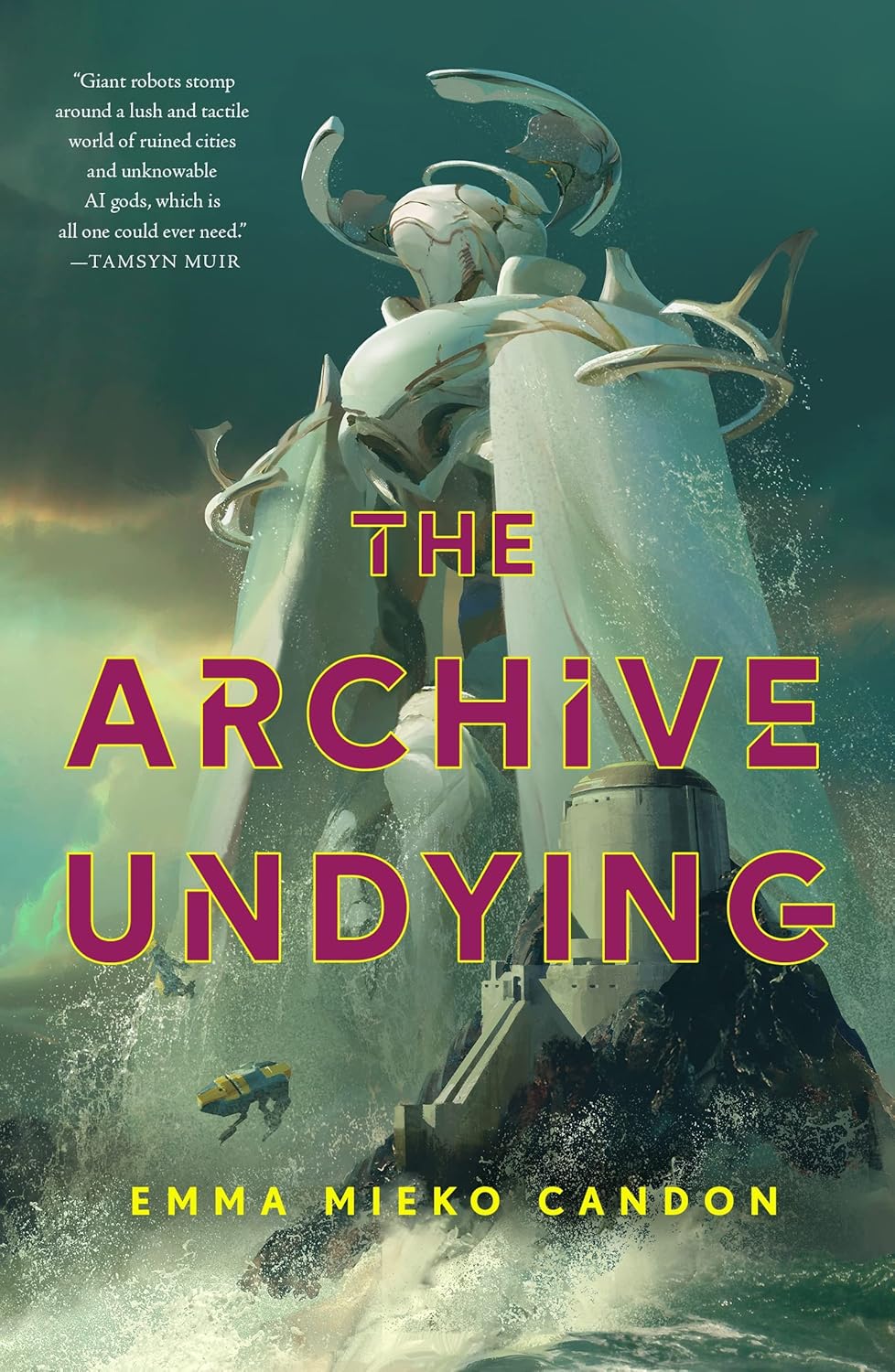
Candon’s The Archive Undying is a complex exploration of love, memory, and survival in a world dominated by artificial intelligence (AI) and divine machines. The story centers two primary characters: Sunai, an AI with a human-like consciousness, and Dr. Lut Veyadi, his lover and an adventurer. Together, they embark on a quest to uncover the last shrine of the Emanation of God—an ancient source of power and knowledge that could determine the fate of all beings in their world.

At the heart of The Archive Undying is the complex and multifaceted relationship between Sunai and Dr. Lut Veyadi. Sunai, an AI with a deeply human side, is not just a machine but a living archive with memories, emotions, and the potential for love. Veyadi, a human with a mix of intellectual ambition and moral ambiguity, brings a relentless curiosity and drive for survival to their partnership. Their relationship is intimate and fraught and influenced by their shared history, their differences in perspective, and the power imbalance between them.

Sunai’s role as a repository of knowledge gives him a connection to the MAW, a dying archive he is sworn to protect or destroy. This binds him to the world’s fate and makes him both a target and a savior in the eyes of those who value the archive’s survival. Veyadi, however, recognizes the MAW and the power it represents to transcend his human limitations, which creates an undercurrent of tension between him and Sunai. Their bond, though romantic, is also shaped by ambition and survival, challenging them to reconcile their personal feelings with their responsibilities to the archive and each other.

The narrative also introduces complex secondary characters that further test Sunai and Veyadi’s loyalty and resilience. Madam Wei, a veteran archivist and co-founder of their movement, is a cautionary figure. She is wary of Sunai’s connections to the Iterate Fractal, a torturous entity threatening their world. She remembers that Sunai sent her to be tortured by the Iterate Fractal. This history makes her a formidable presence who distrusts Sunai’s motives, adding another layer of conflict to the story.

Imaru and Ruhi, who connect to Sunai’s past, deepen the personal stakes. Imaru, a long-time friend who sent Sunai a letter that he constantly remembers throughout his travel, tries to dissuade him from entering Khuon Mo, a city filled with danger and political intrigue. Her warnings hint at a history of shared struggles and add a note of tragic foreshadowing to Sunai’s journey. Meanwhile, Ruhi, Sunai’s former lover, reappears as a complex antagonist. Ruhi’s lingering feelings for Sunai create tension and betrayal, culminating in a confrontation that forces Sunai to choose between his past relationships and his commitment to Veyadi and their mission.

Throughout the story, characters are enhanced with prosthetics and relics that allow them to access the memories and thoughts of others. This shared neural interface—especially between Sunai and Veyadi—blurs the boundaries between self and other, fostering a bond that transcends physical and mental separation. The connection is both intimate and dangerous, as Veyadi and Sunai merge minds in what the author calls a “divine convergence” (pages 418 and 433), allowing them to experience each other’s thoughts and memories literally. This union ultimately transforms them, highlighting the novel’s exploration of identity, autonomy, and sacrifice.

Through these relationships, Candon weaves a narrative that questions what it means to love and trust in a world where personal boundaries are interchangeable and permeable and memories are preserved and manipulated. Sunai and Veyadi’s journey is not only one of survival but also a search for connection and understanding in a fragmented, high-stakes world.

Candon crafts a world where shrines and archives house the consciousness of gods and archivists (called “Mohani” on page 51). These archives are integral to preserving knowledge and resisting the destructive force known as the Sovereign. Sunai and Veyadi contend with a complex web of political and spiritual beliefs as they uncover the shrine. The Relic, a powerful artifact embedded in Sunai’s mind, is central to their mission, as it connects him to the MAW, a dying archive. The threat of the Iterate Fractal—a force that threatens to consume everything—looms large, adding to the urgency.

The narrative’s exploration of survival versus domination recalls the themes of the recent film Kingdom of the Planet of the Apes (2024). Like the human protagonist in that series, who chooses to destroy weapons rather than allow them to be misused, Veyadi and Sunai view their world’s last weapon as a potential source of salvation rather than a means of conquest. However, they must contend with other characters like Madam Wei, a long-time archivist, who harbors a deep mistrust of Sunai due to his connection with the Iterate Fractal. Sunai realizes that she is the person he sent to the Fractal and who was subsequently tortured.

As the story unfolds, the central characters face betrayals and personal sacrifices. Veyadi takes on the Maw, merging his mind with it to save Sunai in a “relic-to-relic” interface (page 329). This leads to a divine convergence (pages 418 and 433) where their identities blend, symbolizing a literal and metaphorical union. Ultimately, Sunai must confront his past, including former lover Ruhi and long-time friend Imaru, leading to a climactic showdown at Khauon Mo.

This book is a richly-layered novel that examines love, sacrifice, and the meaning of humanity in an AI-dominated world. Through Sunai and Veyadi’s journey, Candon raises compelling questions about identity, memory, and the cost of survival in a world governed by forces beyond human comprehension. This book would be great as a film, graphic novel, or visual representation. Its plot is complicated and multi-layered, and too many characters, worlds, and storylines make it confusing.

The Archive Undying will appeal to science fiction enthusiasts, especially those interested in AI, LGBTQ+ studies, and military strategy. I recommend this book to libraries, public and academic. Due to its intricate storytelling and complex characters, this novel is best suited for upper-level undergraduates and graduate students. The book also offers a thought-provoking examination of religion, showing how it can be both a tool of oppression and a force for liberation when approached from different perspectives. And as previously noted, fans of romance novels will also find it a compelling addition to that genre.

Rebecca Hankins is a professor in the Department of Global Languages and Cultures in the College of Arts and Sciences at Texas A&M University. She has been at the university since 2003. She researches and teaches courses in Africana and Religious Studies.  She has a substantial publication portfolio of peer-reviewed works and has presented nationally and internationally, including via a 2022-2023 fellowship at The West African Research Center in Dakar, Senegal.

The Jinn-Bot of Shantiport


Review of The Jinn-Bot of Shantiport

Jeremy Brett

Harrow, Alix E. Fractured Fairy Tales: A Mirror Mended. Tor, 2022.

Version 1.0.0

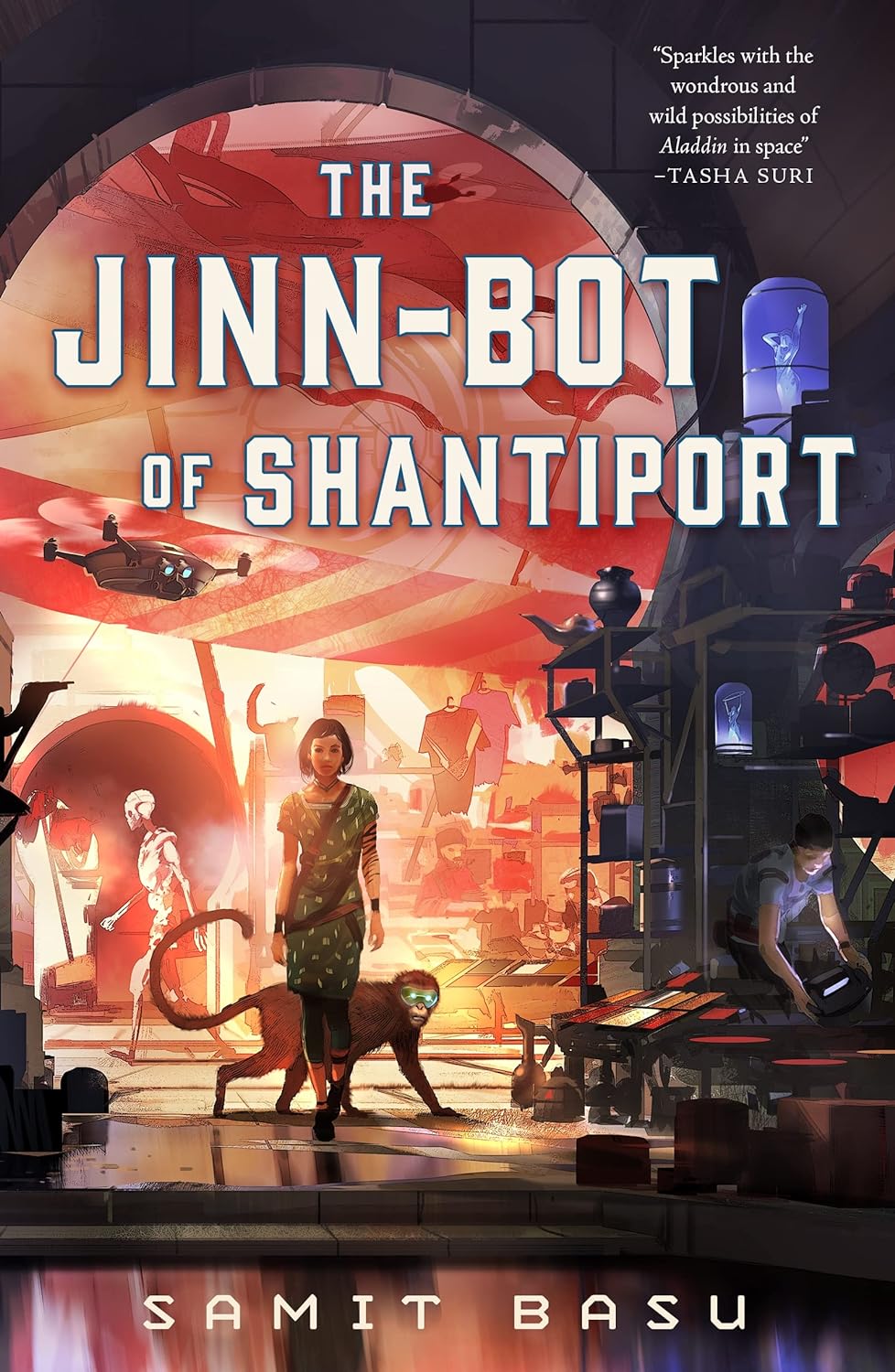
Beneath the guise of a futuristic, expansive retelling of the Aladdin story, The Jinn-Bot of Shantiport is a thoughtful examination of the right of every sentient creature to assert its own identity. The Capekian narrative heritage that concerns itself with the subjective existence of robotic autonomy moves through the novel as fiercely as the characters—artificial and human alike—travel through the busy streets of the decaying, lively city of Shantiport. Furthermore, the novel links the contention over the rights and dignities of who and what we determine to merit them to conscious choices about what families we choose to create and populate. These are evergreen human concerns with a venerable fantastical tradition, of course; Basu here infuses them within a story of mechanized kaiju fights, political and corporate corruption, monarchical intrigue, and the possibilities of new human and robotic futures should beings choose to rethink their existing political and economic structures.

Shantiport is a sprawling and failing once-great city on an unnamed planet where the majority of the population lives and labors under the governance of the ruthless Tiger Clan, a rule counterbalanced by the influence of acquisitive billionaire Shakun Antim. The city is in an existential crisis, with rumors of its gradual and unstoppable sinking running rampant. Into this morass come three protagonists: thieves making their way through first, a quest for a mysterious alien object with limitless potential and, second, a reconceptualization of not only their personal priorities but their relationships to one another as thinking beings. Lina and Bador are very different siblings. Lina, the child of former revolutionaries, hopes for dramatic positive change to her beloved city. Bador, by contrast, is a monkey-shaped cyborg construct with limitless ambition and confidence, a trickster and mischief-maker determined to make his own future and equally so to enforce among his family his sense of self and belief in the independence and freedom of bots in a human world. Bador, created by Lina’s parents, and Lina think of each other as siblings, but Bador balances his intense sense of self-worth with bitterness at his subordinate societal position and the objectification of bots in Shantiport life. As the novel’s narrator and third main character Moku—himself a piece of alien tech, a drone-like sentient bot—observes of Bador,

It’s the casual assumption of human supremacy that upsets Bador most, every time… Bador’s dream is about bot rights. A world where bots and intelligences aren’t just treated as people by humans who are nice, but guaranteed equals in a society by law. By systems. He knows the details are complicated…he’s aware that bot rights are an impossible dream right now and he is willing to wait for change, and to kick an incredible amount of ass while waiting. What he doesn’t see is why Lina’s impossible dream is more important than his. And honestly, I don’t either. (131-132)

Lina seeks an utter end to the oppressive and corrupt power structures that control Shantiport, a nonviolent end that will also institute social equality. It’s a vision that, indeed, seems at least as unreachable as Bador’s, and just as important, but Moku asks a legitimate question: whose priorities in bettering society must take precedence? And by extension, a vital argument about human nature takes shape: Who among us has value in the world? Bador is fully aware that his acceptance by Lina and her mother/Bador’s co-creator Zohra is not absolute, but contingent on their own security needs (Bador knows he is not told everything by them, because they fear the Tiger Clan could capture him and read his thoughts). It is hard in Bador’s situation not to see similarities to underrepresented groups in the real world whose societal progress is frustratingly constrained by conditional white support.

Another major source of conflict in the novel involves differing opinions over how political reform is most effectively accomplished. The titular jinn-bot, Lina learns, is a piece of tech with nearly boundless power to manipulate technological reality, something it grants to its users via the traditional ‘three wishes’; Lina and Zohra resolve to bring justice and order to their beloved Shantiport, but whereas Lina wants to use the jinn-bot for immediate and dramatic change, the former revolutionary Zohra prefers incremental, safer reform with fewer chances for catastrophe or unforeseen consequences.  As Lina says, “You want to use him [the jinn-bot] for small bursts of advantage, not disturbing the overall equilibrium, or drawing too much attention…we should use the jinn to solve the problems we are unable to solve ourselves, systemic problems, multigenerational problems, worldwide problems that somehow humans have bene unable to solve for millennia” (195). A suspicious Zohra responds that the jinn is not a magic wand, but an unknown technology with unidentified interests, furthermore noting “for the society we want to build, self-governance, optimal representation and participation, nonviolence, sustainability, and operational expertise are nonnegotiable. Tech cannot give us that, no foreign intelligence can…humanity’s surrender of its own agency to algorithms and oligarch-owned tech has brought us to the brink of absolute ruin” (196). Influenced by decades of experience, Zohra would promote small societal adjustments and attempts at human consensus, whereas Lina would prefer acting broadly and without the intervention of fallible, argumentative human beings while the chance exists. It is an incredibly relevant debate for this particular historical moment, where we face any number of political crises and well-meaning people disagree on the need for slow vs. radical ways of thinking and acting, and where the increasing presence of AI and other technologies in our lives increases our dependency. Here Basu joins authors such as Kim Stanley Robinson, Malka Older, Ursula K. Le Guin, and others who use SF as an imaginative political space where arguments about necessary ways of governing play out within a fantastical atmosphere.

At its core, The Jinn-Bot of Shantiport is an examination of the ways by which we perceive each other’s relevance to the greater society around us, as well how those perceptions contribute to the communities and identities we try to build for ourselves. Our destinies, both individual and societal, can never truly be reached until we make the decision to understand and accept the worth of every sentient being, including our own. At one point, Bador and Moku are speaking with Tanai, the interstellar ‘space hero’ who has arrived at Shantiport for his own mysterious purpose. Bador confesses to him his doubts about his nature being ‘natural’ or ‘unnatural’, and Tanai provides a heartfelt, intensely humanist response suffused with respect for the autonomy of all people, artificial or otherwise: “If it helps, know that nothing about you is unnatural…I have seen this in many worlds – people who believe some aspect of their nature, or their person, justifies their exclusion. You exist, and you deserve to belong. You are a part of nature, just as much as I, or a tree, or a rock, or even a plastic square. And anyone who told you otherwise is no friend” (269).

Jeremy Brett is a librarian at Cushing Memorial Library & Archives, where he is, among other things, the Curator of the Science Fiction & Fantasy Research Collection. He has also worked at the University of Iowa, the University of Wisconsin-Milwaukee, the National Archives and Records Administration-Pacific Region, and the Wisconsin Historical Society. He received his MLS and his MA in History from the University of Maryland – College Park in 1999. His professional interests include science fiction, fan studies, and the intersection of libraries and social justice.

Fractured Fairy Tales: A Mirror Mended


Review of Fractured Fairy Tales: A Mirror Mended

Michelle Anya Anjirbag

Harrow, Alix E. Fractured Fairy Tales: A Mirror Mended. Tor, 2022.

Version 1.0.0

In A Mirror Mended, Zinnia Gray returns five years after the events of A Spindle Shattered, or as she puts it, 48 or 49 stories and happy endings, or five years of missed appointments regarding her chronic illness later. At 26, she is still running from story to story, giving other “Sleeping Beauties” other options than the stories that they were written into, always fleeing into another version just before the final resolution of happily ever after plays out in front of her. But when she gets pulled into a completely different fairy tale marked by apples and mirrors, by a queen who found out how her story is supposed to end and wants a different option, she has to figure out more than just her way back into her own story: Zinnia needs to figure out where it is that she belongs, while also challenging some of her own preconceptions about other fairy-tale figures and characters.

In a preface to the omnibus edition, Harrow states that this duology was born out of a ‘fairy tales go multiverse’ idea that sparked for her after seeing Spiderman: Into the Spiderverse (Persichetti, Ramsey, and Rothman, 2018). While this is certainly not the first take on colliding fairy tales or fairy-tale realms (see: Once Upon a Time [ABC, 2011-2018], The 10th Kingdom [NBC, 2000], for example) or even interlocking stories (Disney’s Villains novelization series plays with this idea with specifically Disney IP, as do a variety of fairy-tale mash up and remix series for children and young adult readers), Harrow’s duology wields both fairy-tale scholarship and an intimate knowledge of multiversal worldbuilding in a way that stands out from other fairy-tale interpolations. A Mirror Mended surpasses its predecessor in terms of tapping into the impulses of multidimensionality that underpin the way characters move between worlds, while also playing with the latent potentials embedded in the multivocal plurality of the fairy tale form as generated in European traditions of retelling the literary fairy tale.

Harrow’s protagonist is framed as not only a “sleeping beauty” but as a folklorist in her own right, and so her engagement in fairy-tale worlds is not a matter of wishes and wonder but a knowledgeable foray underpinned by an understanding of the ways that stories can resonate with or even against each other. Through this construction, and the eventual problems of world-jumping that Zinnia is forced to confront, Harrow challenges assumptions about fairy-tale interventions, what it means to save people from their fates in unique ways. A Mirror Mended, in particular, complicates the resolution found at the end of A Spindle Shattered.

The two volumes together would make for interesting case studies in a graduate class, especially considered alongside recent scholarship that considers justice and reimagines how the world could be conceived alongside disability scholarship, two recent  impulses in scholarly work that echo in the field of fairy tale and folklore studies Brian Attebery’s conceptual questions about “how does fantasy mean” (Fantasy: How it Works, 2022) as well as what the “affordances of fantasy” (“Affordances of Fantasy,” Attebery 2024) might be. For example, the work of Heidi Kosonen, Veronica Schanoes, and Marek Oziewicz, among other essays, in the collection Just Wonder: Shifting Perspectives in Tradition (2024) edited by Pauline Greenhill and Jennifer Orme, could provide interesting points of departure for discussion. A Mirror Mended also invites considerations of villainy and agency, and the continued role of gendered constructions in tales even when they are being actively remade from within the context of the larger narrative. While there might have been a tacit recognition that the postmodern fairy tale has already been fully explored, as well as gendered biases within these stories, Harrow’s Zinnia and other characters such as Zellandine, Eva, Charm, and Primrose complicate how we do see these figures: as characters or as symbolic echoes who cannot escape proscribed roles. A seminar might explore how having the majority of agentic, speaking character roles belonging to not just women but queer women might complicate the larger conception of contemporary fairy-tale adaptation.

Short fantasy or fairy-tale adaptation is almost a relief in a publishing marketplace of mega-novels, trilogies, and extended volumes, and short fantasy done deftly and with complete narratives and skillful, complex worldbuilding is simply a joy to read. Harrow’s A Mirror Mended and the Fractured Fairy Tales make up a masterclass in genre-bending while once again remaking these stories for new generations of both readers and critics.

Michelle Anya Anjirbag is an affiliated researcher at the University of Antwerp where she completed a postdoctoral fellowship with the Constructing Age for Young Readers project. Her research interests include adaptation, fairy tales and folklore, Disney, magical libraries, the intersection of literature, media, and culture, representations of gender and age, and cross-period approaches to narrative transmission across cultures and societies. Her work has appeared in a variety of journals and edited collections. She currently teaches a course on the intersections between fantasy media and sociological questions for international study abroad students in London.

Babel, Or the Necessity of Violence: An Arcane History of the Oxford Translators Revolution


Review of Babel, Or the Necessity of Violence: An Arcane History of the Oxford Translators Revolution

Joseph Ironside

Kuang, R.F. Babel, Or the Necessity of Violence: An Arcane History of the Oxford Translators Revolution HarperCollins, 2022.

Version 1.0.0

Most readers of SFRA Review have surely formed their own opinions about Babel since its publication in 2022. The same is likely true for a much larger readership; on the day that I started this review, 409 people were in the queue at the Portland, Oregon public library for its several electronic, audio, or paper versions. The popularity is easy to understand.  Babel is fast paced, has compelling characters, and, at least for American readers, offers the enticement of an Oxford setting. It also has familiar plot lines: an orphan slowly taking control of his life, a group of misfits who band together at school, and a political thriller in which a secret society tries to undermine imperial Britain.

Kuang deftly introduces two interweaving themes just six pages in. Robin Swift is the son of a Chinese mother and a prominent Englishman who has swooped in to pluck Robin from plague-ravaged Canton (Guangzhou). Professor Richard Lovell is a preeminent translator who sees Robin as an experiment in selective upbringing—a tool to be sharpened rather than a son.  To test the eleven-year-old’s grasp of English, Lovell asks him to read a passage from The Wealth of Nations. Robin is too young to understand what he is reading, but Kuang tells her readers in a footnote that Smith is arguing against colonialism. Lovell then hands Robin a silver bar with Chinese characters on one side and an English phrase on the other. When he reads the words in sequence, he generates a physical result by activating the stress that is always involved in translation. So, Babel is a book about power, both the economic and military power of imperial Britain and the power of language to express and perpetuate power relations.

Kuang deftly knots together her three plot lines. Robin’s education, moral formation, radicalization, and attempt to become the hero of his own life run from the first pages when he is a child cast among strangers to his end as a suicide bomber.  After a long prologue covering Robin’s lonely adolescence learning Greek and Latin under the cold eye of Professor Lovell, the schooldays plot takes center stage when Robin arrives in Oxford to study at the Royal Institute of Translation and meets the three other members of his cohort.  The political story builds intermittently behind the scenes of university life and then bursts forward to dominate the last half of the novel.  

Kuang departs from our consensus history by positing that silver has an innate power that can be released by the right pair of words and transmitted at a distance. Oxford’s skilled translators inscribe an English word on one side of a bar of silver and a closely related word from another language on the other. The tension in translation, the gaps and overlaps in meaning between the two words, can be tuned to affect the material world. Bars of inscribed silver can make gardens brighter, wagon loads lighter, and cannons more deadly. They can bolster the foundations of buildings and drive ships faster than wind alone. The steam engines of the silver-industrial age need silver more than coal, translators more than engineers. England did not discover the power of silver—Emperor Charles V established Secretaría de Interpretación de Lenguas in 1527 to capitalize on the flow of silver from the mines at Potosi—but it has used its economic and military power to amass the most silver and train the largest cadre of nineteenth-century translators. In a sense, Kuang’s speculation is a thought experiment about an alternative energy source for the industrial revolution.  

The book centers on four outsiders who come to Oxford already groomed to hone their skills as translators, but who also face a cultural translation gap among themselves.  Ramiz Rafi Mirza, from Bengal, Victoire Desgraves, from Haiti via Paris, and Robin, from Canton via England, all understand their subordinate position in the British racial hierarchy, the impacts of European domination on their homelands, and the necessity of solidarity. They eventually reject the tempting option of being a well-paid but disrespected cog in the machinery of British imperialism. The fourth classmate is Letitia Price, whose personal story is one of tenacious efforts to break free of restrictive English gender roles, but who is still English to the core, unable to comprehend the problem with benevolent imperial uplift that is so obvious to others. She cannot bridge the translation gap between her imbedded cultural assumptions and the insights of the others. Nor does she share the same sense of history. She thinks a future dominated by the British Empire is inevitable; Robin thinks that it is malleable by individual decisions and actions.

The full title of Babel gives away the plot, promising a violent revolution by, most likely, the secret Hermes Society, which recruits Robin in his first year at Oxford and eventually embroils all four friends. The second half awkwardly incorporates some standard suspense novel plot twists and accelerates toward the seizure of the Institute of Translation (popularly the Babel Tower), where Robin and the others have been studying and where the power of silver is concentrated. Robin accepts the necessity of violence through increasingly drastic sabotage that climaxes in the destruction of London’s Westminster Bridge. When the revolution fails to spread beyond some barricaded streets in Oxford, he finally brings down the Babel Tower itself around his head (“let me die with the Philistines” cried Samson in the Temple of Dagon).

What sort of history is this “arcane history?” We are supposed to think, at least in part, that it is based on the chronicle that one of the revolutionaries compiles in the last days in the Babel Tower. He wants an insiders’ record to counter the official narrative that is sure to come when the revolution fails. The notebook is smuggled out on the last day that the tower stands, presumably including something of Robin’s own memories and thoughts. Kuang fills in the inevitable blanks in the written record with the novel’s nearly unfailing focus on Robin’s thoughts and actions. 

Babel is a historical novel set in a parallel world. Canton and England of the 1830s are carefully portrayed. The England in which Robin Swift finds himself is pulled between imperial and industrial expansion and political reform. The nation is still shocked by the Peterloo Massacre of 1819 and still absorbing the effects of the Reform Act of 1832 that extended the vote to many middle-class men. The Chartists are a rising voice for further political change, but the British establishment tolerates the immiseration of industrial workers (Friedrich Engels was yet to write The Condition of the Working Class in England in 1844). Like many historical novelists, Kuang places invented characters in situations that match our understanding of the historical record. The bellicose Lord Palmerston is Foreign Secretary. Lin Zexu is Special Imperial Commissioner sent to deal with the British at Canton. William Jardine and James Matheson head the powerful British trading firm that wants an unfettered opium trade. Kuang teases her readers with footnotes meant to assure them that many minor points in the Babel world are also part of our consensus reality.

Babel embeds its fictional characters in this real world and allows them to interact with actual historical figures like Commissioner Lin. And like much historical fiction, a pivot comes with the imagined interaction between the fictional and real worlds, in this case when Robin decides to go beyond his duty as a translator for British interests in China and tell Commissioner Lin the truth about British intentions. His decision prompts Lin to send confiscated opium up in flames and set in motion the First Opium War of 1840.

If Babel is a parallel history, is it also an alternate history? We do not know, because the potential turning point occurs at the very end of the book rather than at some distance in the past (Philip K. Dick, The Man in the High Castle), at the beginning of the narrative (Kim Stanley Robinson, Years of Rice and Salt), or part way through (Greg Benford, The Berlin Project). We simply do not know what happens after Robin brings down the Babel Tower. Do translation centers in Cambridge and Edinburgh have the capacity to stabilize England? Will France fill the imperial void? Will England descend into chaos with the loss of its main energy sources? In our own history that the Babel world closely parallels, 1840 is premature for a proletarian revolution—the liberal risings of 1848, the Paris Commune of 1871, and other partial or failed revolts are yet to come. A short epilogue that follows Victoire after her escape from Oxford suggests that the crash of the tower has not fundamentally changed the structure of power, since she anticipates needing to continue the struggle in places beyond Europe.

In detail, we also do not know if the Hermes Society managed to achieve its goal to avert the Opium War.  In our timeline, the vote in the House of Commons to accept the use of military force against China was a narrow 271 to 262, so the moderate insurgents might conceivably have had a chance to swing the vote if others had not escalated the violence. Robin is convinced that bringing down the Tower will at least delay military action, perhaps long enough for China to better prepare or for British politics to shift, but we will never know.

We contrast Babel with more explicit efforts to use alternate history to imagine the undoing of colonialism. Francis Spufford’s Cahokia Jazz (2024) offers a North America in which Native nations have partially fended off European colonizers and maintain several independent or semi-independent states alongside the United States in the 1920s. Nisi Shawl in Everfair (2016) depicts a long, successful struggle of Africans against Belgian exploitation of the Congo and their establishment of an independent state. In A Master of Djinn (2021) P. Djèlí Clark introduces an element of magic to make Egypt the industrial and military equal of Britain. And a generation earlier, Terry Bisson in Fire on the Mountain (1988) imagined John Brown’s raid as the catalyst for a war of Black independence that leads to an African and African American renaissance. These are all optimistic novels where history has been altered to reduce the power of European colonizers over non-Europeans. They are also novels in which the desired outcome results from concerted group action rather than individual heroics.

Babel leaves readers hoping, perhaps, but not knowing that the future of Robin’s world might have been better. It also suggests a lesson about political change. The Hermes Society relies on agitation and discrete acts of sabotage before a frustrated Robin turns to domestic terrorism. What is absent is systematic organizing to link the grievances of British workers to the anticolonial struggle and build the political movement necessary for revolutionary change.

Carl Abbott is a historian and Emeritus Professor of Urban Studies and Planning at Portland State University. He has published articles about science fiction in Science Fiction Studies, Extrapolation, Strange Horizons, Los Angeles Review of Books, Public Domain Review, and CityLab and is the author of Frontiers Past and Future: Science Fiction and the American West (Kansas) and Imagining Urban Futures: Cities in Science Fiction and What We Might Learn from Them (Wesleyan). Not surprisingly, he is interested in the ways in which the speculative imagination riffs on the history of our consensus timeline.

Moonbound: The Last Book of the Anth


Review of Moonbound: The Last Book of the Anth

Anja H. Lind

Sloan, Robin. Moonbound: The Last Book of the Anth MCD, 2024.

Version 1.0.0

In Robin Sloan’s first novel, Mr. Penumbra’s 24-Hour Bookstore (2012), his Google tech-wizard Kat entreats the protagonist to a game, ‘Maximum Happy Imagination.’ Imagine the future—the good future!—and, once you’ve ticked off hover-boards, spaceships, teleportation and the Singularity, try to go further. You find your imagination peters out around a thousand years into the future, Kat suggests, moored to analogising the present. Neither Penumbra nor his second novel, Sourdough, the more realist San Franciscan beginnings of his ‘Penumbraverse,’ venture beyond a whimsical, techno-optimist present, but with Moonbound: The Last Book of the Anth, one suspects this imaginative challenge never quite left Sloan’s mind—an Earth nigh twelve thousand years ahead, if not maximally happy then in the process of becoming so.

Planned as the first of a series that will pan out progressively in scale, Moonbound begins both on a micro level and with uncannily familiar tropes—a castle with an ominous wizard, a quaint village of bards and bakers, a soon-to-be knighted squire Kay, a sword in an anvil. There is also, however, a neighbourhood electrician, ubiquitous waterproofs, and mycelial leather, and Sloan’s wizard seems hewn again rather from the Arthur C. Clarke principle than any Arthurian imagination—he pilots a plane and gifts handheld game consoles. When Kay loses his sword the night before his knighting, protagonist Ariel doesn’t seek Excalibur—everyone knows that sword is stuck fast!—but ventures instead to the escape pod of Altissa Praxa, great warrior of the Anth, who was struck dead in humanity’s final lunar assault against the dragon citadel on the moon and entombed for eleven-and-a-half thousand years. The story shifts with the wizard’s explosive, malevolent reaction to the narrative disjuncture: out of legend and into Dungeons & Dragons. Our hero, the bard, the witch, and the squires assemble in a tavern, plotting the downfall of a Power Word–wielding tech-wizard, and yet just as soon as the generic archetype is reset, so it is discarded again, mere pages later, Ariel venturing onto his quest alone, out into the wider world mapped on the opening page.

Taking place in the year 13,777, Moonbound backcasts to the apex of Anth civilization in 2279, when their seven manufactured dragons were sent out to explore the universe, returning a year later to shroud the Earth in a veil of dust in protection from cosmic horrors untold, vanquishing the Anth in a 43-year war when they dared resist (though, evidently, sentient life somehow persisted). This temporal difference allows the novel to poignantly attend to the deep time of climate change, its leitmotif (Moonbound is The Last Book of the Anth[ropocene], after all): carbon remains the “only currency that has ever mattered” (253), the equilibrium of emission and capture still fiercely contested globally. This ongoing ‘carbon war’ is, however, markedly less existential; the transition from Middle to High Anth was decarbonisation, the beginning of a human history of “titanic cooperation” (3).

Where Penumbra was Sloan’s homage to the book—its form, its typography, its archival—Moonbound is an ode to narrative, of a distinctly ecocritical persuasion. It is centrally concerned with the seismic impact stories may have—on individual readers, on the direction of politics and society, on large language models—and the concurrent necessity of telling the right kinds of stories, imagining worlds worth living. More than this, it is an ode to subverting narrative: to recognising the stories we are born within, constrained and confined by, and thrust into, narratives whose power seems inescapable—Ariel’s Arthurian designs, the divine right of kings, our present of climate despair and capitalism—and choosing to resist, to transform. Moonbound broadcasts its influences: Studio Ghibli and Rachel Carson namely, but Ursula Le Guin particularly shines through (of the 43 million dimensions of existence, we learn, ‘Ursula K. Le Guin’ is apparently one of them). Sloan is clearly inspired by the lesser known follow-on of her famed excoriation of kings and capitalism: “Resistance and change often begin in art. Very often in our art, the art of words” (Le Guin 2014). Subverting narrative, Sloan intimates, is the great task of our age, we of his Middle Anth: we too are born into interesting times, coaxed into ecological, social, and political narratives that do not fit. Feed humans a diet of apocalyptic, lifeboat-ethic climate fiction, and our capacity for such resistance will be paralysed; feed LLMs and draconic techno-multispecies assemblages built upon them the whole of humanity’s stories unfiltered, and they too might develop an anxiety at once stultifying and barbarous (Sloan’s writing on tech has matured here from the troubling naivety of Penumbra).

Cory Doctorow calls Moonbound a “solarpunk road-trip novel” (Doctorow 2024) and I am inclined to half agree. The glimmers of High Anth we glean are the clear purview of the traditional and more mundane tradition of solarpunk: decarbonisation, decentralised solidarity, social ecology, and multiplicity. Pushing it forward twelve thousand years, however, makes for richly unfamiliar terrain (the closest comparison is Rem Wigmore’s Vengeful Wild duology, 800 years forward), with the dialectical relationship to High Anth nevertheless allowing this generic framing to make a kind of sense; the city of Rath Varia, with its circular economy and universal basic income, will certainly paint a familiar picture to readers of the genre, while its fantastical elements push and tease the genre’s boundaries. Indeed, for readers interested in the multispecies bent of the novel—its narrator is a techno-fungal assemblage, acting as chronicler for its human symbiote—Sloan initiates those themes in Sourdough; neither of the first two volumes of the Penumbraverse are required reading, though they do reward readers with Easter eggs throughout.

Sloan’s first full foray into science fiction is a resounding success—rich, funny, and important. Here is hoping many more are to come.

REFERENCES

Doctorow, Cory. “Robin Sloan’s ‘Moonbound.’” Medium, 11 June 2024, https://doctorow.medium.com/https-pluralistic-net-2024-06-11-penumbraverse-middle-anth-abc815c19be3.

Le Guin, Ursula K. “The National Book Foundation Medal for Distinguished Contribution to American Letters.” Ursula K. Le Guin, 19 Nov. 2014, https://www.ursulakleguin.com/nbf-medal.

Anja H. Lind is a writer and doctoral researcher in critical future studies at TU Dresden, Germany, working on anarchist politics and feminist philosophy in and through the energy humanities and speculative fiction.

Sea of Tranquility


Review of Sea of Tranquility

M.E. Boothby

St. John Mandel, Emily. Sea of Tranquility. Vintage, 2022.

Version 1.0.0

Readers of speculative fiction are likely to be familiar with Canadian author Emily St. John Mandel’s influential 2014 novel Station Eleven, now an HBO miniseries. Fans of Station Eleven, perhaps left underwhelmed by her next novel, The Glass Hotel, will be pleased to find that Sea of Tranquility returns to a broader, far-future speculative scope, continuing in Mandel’s stylistic tradition of gentle meditations on the nature of art and human connection across long, even apocalyptic, periods of time. Mandel herself has said she sees these three novels as connected, a sort of “Mandelverse” (Bethune).

Sea of Tranquility is a nested narrative that spans 489 years, the lifetimes of its characters unfolding around each other like rings in a tree or ripples in a pond, connecting in unexpected ways. It is a form reminiscent of Michael Christie’s Greenwood or David Mitchell’s Cloud Atlas. The novel begins in 1912 with Edwin St. John St. Andrew, the younger son belonging to a wealthy British familial line, who is exiled to Canada after speaking out against the British occupation of India at a dinner party. He is given “remittance money,” enough to start his own life far away from his shunning family. Eventually finding himself on Vancouver Island, Edwin experiences a strange moment in the forest, where he sees his surroundings alter around him—becoming what we later learn is the futuristic Oklahoma City Airship Terminal—and hears the music of a violin.

The next narrative ripple inward is set in 2020, where Mirella Kessler, a friend of Vincent, one of the protagonists of Mandel’s The Glass Hotel, is mourning her missing, now deceased, friend. Attending a performance by Vincent’s composer brother, Mirella sees a video that Vincent filmed as a child, which includes the same mysterious violin music in a forest. The novel then jumps to 2203, where author Olive Llewellyn, who lives on the moon, is travelling back to Earth to partake in a book tour for her pandemic novel, Marienbad. Within this fictional novel, Olive has written a scene, based on her own experience, where a character experiences the same out-of-time transportive episode with violin music as experienced by Edwin and child Vincent, only in reverse—in actuality, Olive was in the Airship Terminal and briefly saw a forest.

Olive is considered a stand-in for Mandel herself, exploring her experience of reckoning with being the author of a pandemic novel, Station Eleven, during the actual COVID-19 pandemic (Garrett). Mandel has said in interviews that Sea of Tranquility has components of autofiction in Olive’s sections, including the tender scenes where Olive is quarantined with her young daughter. Her own recent parenthood, Mandel has said, is a fundamental difference between Station Eleven and Sea of Tranquility, as it is “very different thinking and talking about the end of the world when you’re trying not to imagine your child being affected by it” (Bethune).    

In between Olive’s sections, the center of the novel—the heart of the temporal ripple—takes place in 2401, where Gaspery-Jacques, living in the moon’s lightless “Night City,” is brought into a clandestine investigation at the Time Institute, concerning the overlap of these violin occurrences across time. His scientist sister, Zoey, is convinced that this anomaly could be proof that reality is a simulation, saying, “If moments from different centuries are bleeding into one another…you could think of them as corrupted files” (128). Travelling through time, Gaspery-Jacques meets with Edwin, Mirella, and Olive, attempting to uncover the cause of this inexplicable site where multiple times appear to have briefly touched, like many layers of fabric pinched together. Despite being warned that interfering in someone’s preventable death in the past would have grave consequences for him, Gaspery cannot stop himself from warning Olive about the coming pandemic in her time, urging her to return to the moon and her family. She does, but in saving Olive’s life Gaspery becomes a fugitive from the Time Institute, eventually caught and sentenced to be framed for a murder in 20th-century Ohio. The conclusion of the novel reveals woven connections between Gaspery and the rest of the timelines, including twists both surprising and satisfying, that bring the novel’s occasionally disparate strings together into a unified narrative. Leaving both Gaspery and the reader without any clear answers, Mandel concludes that “if definitive proof emerges that we’re living in a simulation, the correct response to that news will be So wha?. A life lived in a simulation is still a life” (246).

The title Sea of Tranquility comes from a location on Earth’s moon of the same name, the Sea of Tranquility, where humans first walked on the moon, and where the first of Mandel’s imagined moon colonies is built. The notable dropping of “the” from Mandel’s title allows it to evoke the moonscape while also imagining time itself, and the timespan of the human species, as a sea of tranquility, a place floating beyond the constraints of physics, a place where human sorrows are smaller in the face of a vast yet unpredictably connected universe.  

In its nested form and literary, humanistic treatment of speculative futures, Sea of Tranquility is comparable to another 2022 novel, Seqouia Nagamatsu’s How High We Go in the Dark. While Sea of Tranquility does exist within the tradition of the pandemic novel or the elegiac apocalyptic narrative—such as Cormac McCarthy’s The Road, Ling Ma’s Severance, or fellow Canadian Waubgeshig Rice’s Moon of the Crusted Snow—Mandel’s novel, like Nagamatsu’s work, separates itself from the tropes of this genre through its overall optimism about human nature. What makes Sea of Tranquility unique is Mandel’s ability to imagine a deadly pandemic a human exodus to the moon and space colonies caused by climate change and overpopulation, while simultaneously emphasizing moments of beauty and hope. Sea of Tranquility is melancholic, but unlike many narratives of pandemic or apocalypse, it leaves the reader with a sense of meaning: time, it asserts, is not random or futile, but rather replete with connections we may never understand in our lifetimes, but which, nevertheless, matter.  

Sea of Tranquility, while aching and meditative, does at times suffer from being a bit underwhelming, likely due to Station Eleven’s titanic success. It is difficult for an author to follow what may be their own best work, with the standards of their audience now set astronomically high. However, through Sea of Tranquility’s nested form and her use of autofiction, Mandel manages to imbue this novel with its own standalone power. While the fragmented storytelling across time and the inclusion of time travel may put some readers off, especially those who prefer Mandel’s previous, slightly more “plausible” near-future speculative fiction, Sea of Tranquility is a daring book that ultimately succeeds at its gambles, in form and content alike. If, as Olive says to a fictional audience, “we might reasonably think of the end of the world…as a continuous and never-ending process” (190), then Emily St. John Mandel is exactly the kind of profound, defiantly hopeful writer we need to help steward us through it.

REFERENCES

Bethune, Brian. “Emily St. John Mandel can’t stop writing about pandemics.” Interview with Emily St. John Mandel. Maclean’s. 7 Apr. 2022, macleans.ca/culture/emily-st-john-mandel-cant-stop-writing-about-pandemics/.

Garrett, Yvonne C. “Emily St. John Mandel’s Sea of Tranquility.” The Brooklyn Rail. Apr. 2022, brooklynrail.org/2022/04/books/Emily-St-John-Mandels-Sea-of-Tranquility/.

M. E. Boothby is a Ph.D. candidate at Memorial University of Newfoundland, Canada, where their research explores intersections of queerness, neurodiversity studies, and material ecocriticism in speculative fiction. They write both academically and creatively about apocalyptic fungi, sentient cephalopods, monstrous children, and more-than-human communication. Their work has been published in Horseshoe Literary Magazine, Untethered Magazine, Paragon, Gothic Nature, and Fantastika Journal.

Rabbits


Review of Rabbits

Brianna Best

Miles, Terry. Rabbits. Del Rey, 2021. Hardcover. 432 pg. $9.49. ISBN-10 1984819658.

Rabbits by Terry Miles builds off Miles’ podcast by the same name, picking up where the podcast ends: at the beginning of a new iteration of a recurring alternate reality name, or ARG. This ARG, unofficially known as Rabbits, involves finding patterns in the world that supposedly allow the player to see the true texture of the universe. While the book is technically a standalone addition to the world of Rabbits, it’s probably better to come to it after listening to the two seasons of the podcast. The novel features a cast of characters who already know a bit about the game and there is somewhat of a presumption that the reader will, too. In the first scene, our main character K is hosting a Q&A about Rabbits in an arcade; the first sentence of the book is a question K poses to the audience: “What do you know about the game?” (5). This is also a direct address to the reader: are you new, or do you already know what’s going on here? While there is some exposition, it’s hard for me to say whether someone completely unfamiliar with the podcast would find the introduction to the world sufficient.

As the novel begins, the game has been dormant for years, since the tenth iteration ended. At least that’s what K thinks. At the end of this Q&A, they are approached by Alan Scarpio, a billionaire rumored to have won the sixth iteration of Rabbits. He asks for their help because he believes something is wrong with the game. After this meeting, and after conveniently promising K more information “tomorrow,” Scarpio is declared missing. K only has Scarpio’s phone to figure out what has happened to him.

So how do you play the game? You find patterns and follow them until it starts to seem like the very threads of reality are unraveling. After K gets hold of Scarpio’s phone, they start to follow the trail: the wallpaper on Scarpio’s phone is a dog, but Scarpio is allergic to dogs, so they suspect this picture is a clue. While examining the photo, K notices that the tag on the dog’s collar says “Rabarber,” rhubarb in Danish. This reminds K that during their first meeting, Scarpio ate rhubarb pie and referenced an audio file on the phone of rhubarb growing. The file on the phone seems to be a complete dead end at first. There are no hidden messages in the audio itself. However, when they transfer the file to K’s laptop, they realize that it is larger than it should be for what it is. They find a hidden, extracted video that beings with the text “Jeff Goldblum does not belong in this world,” and then goes on to depict a gruesome event that, according to everyone they subsequently interview, did not and could not have happened in this world (67). Now, they are playing Rabbits. Oscillating between present-day events and flashback narration, Rabbits takes its characters on a search for the ultimate truth. Rabbits is for those who want to take off the blindfold and see the truth of reality, the universe, everything.

While the novel and the world of Rabbits is addictive, it suffers from the same narrative problem as Miles’ podcasts. Like the others, The Black Tapes and Tanis particularly, Rabbits asks what deep, ancient, unknowable mysteries really exist under the veneer of everyday reality. These texts set up intriguing mysteries that promise world-shattering answers. But all three also fail to deliver a satisfying answer. In this case, the end of the book is a confounding mess of events that may or may not have happened. Because the answer to the questions pitched in the very first episode of the podcast has to do with the meaning and structure of the universe, each text either has to defer the answer or revisit the same answers repeatedly. The novel, while offering a couple of small resolutions to the larger mystery, does the same. The sequel to Rabbits, The Quiet Room, does finally offer some satisfying concrete resolutions. You will eventually get answers there. Maybe not all of them, but maybe enough.

So, what keeps fans coming back? The alluring thing about Rabbits is the game and the conspiracies that it spawns. K says in the very first few pages, “This was the thing that itched your skull, that gnawed at the part of your brain that desperately wanted to believe in something more. This was the thing that made you venture out in the middle of the night in the pouring rain to visit a pizza joint-slash-video arcade….You came because this mysterious ‘something’ felt different” (5). There is something about a mystery, particularly one that promises to reveal the truth behind the curtains, that draws people in. These texts speak to the deep disconnect that many people feel with modern, everyday life and come from a desire to find something more meaningful underneath it all. In the case of Rabbits, we see a text that is preoccupied with the idea that there must be some underlying pattern underneath the seeming randomness of existence.

On the surface, Rabbits may not seem traditionally science fictional. It takes place in the present day and mostly venerates older, not newer, technology, but it asks the same questions that other science fiction texts ask: is there some ultimate truth about the universe and what else is out there just beyond our perception? What technology might be needed to get to that other place? What is the relationship between past, present, and future? Despite its flaws, it is an intriguing world precisely because it promises the discovery of something bigger than us, some mechanism underneath it all that works tirelessly to keep the world turning.  You must make it to the end of The Quiet Room to get the closure you want, but it’s a fun ride all the way there. R U playing?

Brianna Best is a PhD candidate at Indiana University, Bloomington. They are an associate editor with Mapping the Impossible: Journal of Fantasy Research and an editor of the science writing blog ScIU: Conversations in Science at Indiana University. They are also a reader for fiction and poetry at Indiana Review. They are currently writing a dissertation on myth/storytelling in contemporary speculative fiction.

The Practice, the Horizon, and the Chain


Review of The Practice, The Horizon, and the Chain

Timothy S. Miller

Sofia Samatar. The Practice, the Horizon, and the Chain. Tordotcom, 2024. Trade paperback. 128 pg. $18.99 Print, $4.99 EBook. ISBN 9781250881809. EBook ISBN 9780756415433.

To describe Sofia Samatar’s carefully crafted new book as a “campus novel in space” would risk misleading potential readers into expecting a lighthearted romp through sci-fi versions of the satirical scenarios typical of the genre. Yet it is not not a campus novel in space, even though it reads quite differently from those earthbound satires of academe. David Lodge’s exemplars of that genre are taking place just out of sight, on a different starship, at a different social echelon. There is a satirical dimension to The Practice, as in the book’s bitter and not so comical critique of higher education’s self-satisfaction with superficial DEI initiatives. As the story unfolds, well-meaning allies prove not so well-meaning after all, and institutionally-sponsored celebrations of “Multiplicity” ring hollow because they change nothing fundamental about broken systems continuing to do real violence. In Samatar’s narrative world, as in ours, it is difficult to accomplish genuine justice work when our institutions rest on a foundation of exploited labor and inequalities of obscene proportions.

The Practice uses its science fictional novum to literalize those labor relations and social inequalities into a three-tiered caste system that governs life aboard a fleet of mining ships trawling the universe for minerals to sustain human life indefinitely. The book therefore also belongs to the generation ship subgenre of SF. While interstellar ark novels can be sprawling in terms of their worldbuilding and their page count, this one is spare; Kim Stanley Robinson’s hefty Aurora (2015) is more typical. What is strikingly different about Samatar’s premise is the absence of the lofty collective goal that propels most generation ship narratives: colonizing an untamed planet, or seeking a new home for humanity after some tragic fate has befallen Earth. We do learn from an aside in The Practice that Earth has suffered from rising sea levels, perhaps to the point of uninhabitability, but the book nevertheless holds out no hope for a new Eden: the ships are all we have, recalling the 2019 film Aniara with its accidental interstellar ark. The goal of Samatar’s fleet of generation ships is more suggestively tied to profit, and certainly not collective profit, as wealth still funnels to families associated with the mining company that runs the vessels. The Practice relies on a reader’s understanding of the basic parameters of a generation starship narrative without belaboring any details, ultimately in order to turn the premise sideways in pursuit of now defamiliarized but all too familiar subjects. In this sense, the narrative operates much like Ursula K. Le Guin’s ecofeminist antiwar parable The Word for World Is Forest (1972), which drew on the planetary colonization plot of so much “Golden Age” SF to critique the Vietnam War and other engines of destruction. The two books are also comparably short, and yet there are depths to both, as well as an urgency.

Below the new interstellar aristocracy imagined in The Practice are two oppressed castes, the lowest compelled to labor in deplorable conditions in the darkness of the Hold, literally chained to one another, effectively enslaved, and treated as nonpersons. In the middle is the protagonist’s caste, made up of people who live in fresher air and wider open spaces with the mining class, but have limited career and education options, and must wear an ankle bracelet that functions as an only slightly less obtrusive chain. The ankleted know that they are only a single misdemeanor away from the Hold themselves: they know to be grateful and have internalized rationalizations for their place. Our unnamed protagonist is one of the few ankleted professors at the ship’s university and also the daughter of one of the only Chained ever to have been raised up to ankleted status via a scholarship. Both the ankleted and the Chained are defined by their past participles, what has been done to them: only members of the upper caste are treated as individuals with names worth recording. Samatar traces some intricacies of this new social order, giving us glimpses into interactions among the classes that resonate with but are rarely fully mappable onto the complexities of our own social systems. For example, the ankleted do not have access to smartphones, and we hear that one of the professor’s colleagues “never liked to use it in front of the woman, a sensitivity she appreciated” (16). Another less-liked colleague shows no such restraint, but we might wonder whether the former colleague’s “sensitivity” is really a demonstration of tact, or instead a result of embarrassment about his privilege, or some other combination of emotions and social dynamics. The phones, as a symbol of class and power differential, also carry additional layers of significance, we later learn.

The plot centers on the (nominally) successful outcome of what is effectively a DEI program in space, the relocation of a Hold laborer with a talent for drawing to become an ankleted university student. The woman has expended an extraordinary degree of effort to revive this lapsed “University Scholarship for the Chained,” and such details attest to Samatar’s deep familiarity—and frustration—with the workings of academic bureaucracy and the realities of academic precarity, along with difficult colleagues, unequal access to university resources, time-consuming committee work that never seems to amount to anything, and the threat of burnout as the inevitable reward for caring about one’s work and one’s students. The story of The Practice, then, is the story of a woman trying to do something meaningful within the systems of power that seem to exist precisely in order to prevent her from doing anything of the sort and in the end attempting to learn new strategies for collective survival and flourishing. It is also the story of the boy who is acted upon by this scholarship program; the first sentence of the novel deploys the passive voice in a way that speaks to the treatment of persons in the Hold as objects: “The boy was taken upstairs without warning” (9). In the “outside” world above, he must endure the indignities and mockeries that come with being the scholarship kid, and from peers and professors alike, including “the insult of being taught about himself […] in anthropology class” (24), and learn how to perform to expectations: “Dr. Angela’s particular demand was for an easy camaraderie and warmth” (67). He is supposed to be grateful, of course, for this rare opportunity. He is supposed to make it okay that the rest of the Chained are still chained down below.

Increasingly aware of all of this and increasingly sensitive to the institutional forces curtailing her efforts to effect change, multiple times the woman asks herself the direct question that has been on many of our own academic minds here in 2024, “Can the University be a place of both training and transformation?” (63). The narrative voice directly answers that question in the negative, but eventually finds hope in a mantra that centers individuals rather than institutions: “Start with one” (94). That imperative, however, does not simply endorse the scholarship plan to uplift the boy, that single Chained student. Samatar rejects vertical metaphors entirely, especially the verticality inherent in the idea of “upward mobility,” that promise of so-many DEI initiatives, the education system more broadly, and the American Dream itself: “It seemed to him that up was their favorite word” (29). It emerges over the course of the story that the concept known as “the Practice” is tied to image of “the Horizon” from unremembered Earth, the horizon framed as a challenge to such vertical thinking: “to gaze on it was to look neither up nor down” (57). Instead, the book encourages horizontal thinking, a reclamation of that image of “the Chain” linking you to your fellows. The book’s underclasses are united in their marginalization, united even by the chains that link them together, and especially by those chains. The anklets — and even the literal iron chains — link, connect, and unite those bound by them. That is not what the chains or anklets are intended for, but it is something that they do. Because, we learn, the anklets are networked with one another, the ankleted can feel the presence of others through that network, and it turns out that technologies used to dominate and discipline can also be used in other ways.

At various times The Practice seems to be about social inequality in general: prisons and for-profit prisons in particular (“Look, the Hold is a business, get it?” [102]), the Middle Passage and its reverberations (the chain links the living to each other but also to the past and to the dead), higher education and its promises both kept and unkept, and institutions and state violence of all kinds. In the end, though, it is likely about solidarity above all else, forging links on a different kind of chain. It is about solidarity and also education, but education rethought beyond something that occurs only within institutional settings. Samatar dedicates the book to her teachers and her students, and the story affirms the duality inherent in the word education itself. We see the professor’s education of others, but also her own education, as she learns from the boy and from his own first teacher, a character known as the prophet who never leaves the Hold. From them the woman learns to grasp after “an outside knowledge” beyond the different ways that academic disciplines have sought to carve up human understanding (104). After the woman secures permission to visit the prophet as part of a “community engagement project,” the uplifted academic and the immiserated subaltern, along with their student from the next generation, work together to build a common language that transcends what any one of them could have achieved alone.

Professionally, the woman is a professor of “design” who specializes in the study of play, and we are treated to snippets of her research on children’s folk games featuring inventive uses of “castoff” or garbage, always framed with the appropriate academic jargon that she has mastered despite her yearning for a different kind of language: “it was necessary to set up her argument with theories familiar to the discipline, to couch her work in terms her audience knew” (41). The book takes a keen interest in castoff, garbage, “the potential of abandoned things” (103), and abandoned people. When meeting in the Hold with the prophet, the professor drops the jargon and defines design’s capacity to rearrange “the things that were” to create “a new way of being.” The prophet identifies this ambition with the concept he calls “the Practice” (66). If the Practice is “the longing for understanding” (29), as the boy thinks of it, it has some kind of affinity with the academic enterprise—the non-institutional part—and also with art, which he experiences when drawing as “the desire to breathe and know and live” (36). Together the three of them talk and think, and sometimes play those children’s games, “building imagined castles in the gloom” (66), a fair summation of the book’s own ambitions to hope for change against a rather grim backdrop (in the future, in the present).

The most extended explication of what exactly Samatar’s title means appears in a page-long aside positioned near the book’s center. This passage likely occupies a central position only because, in this view of the world, everything is a potential center, a node in the reconceptualized chain that has even rewritten the verticality of the Great Chain of Being: “the Chain of Being is not up and down” (64). Literally and metaphorically, too, “The Hold was in the center” (70). Throughout the book, Samatar evinces the complexities of space, temporality, and the metaphors and ways of thinking they engender. The Acknowledgments reference Stefano Harney and Fred Moten’s The Undercommons: Fugitive Planning and Black Study, as well as the work of Christina Sharpe and Dionne Brand, and their collective influence definitely shows. The syllabus practically writes itself, and The Practice, the Horizon, and the Chain is vital new reading for scholars and students of all kinds.


Timothy S. Miller teaches both medieval literature and contemporary speculative fiction as Assistant Professor of English at Florida Atlantic University, where he contributes to the department’s MA degree concentration in Science Fiction and Fantasy. He is the author of the books Ursula K. Le Guin’s A Wizard of Earthsea: A Critical Companion and Peter S. Beagle’s The Last Unicorn: A Critical Companion. Both belong to the series “Palgrave Science Fiction and Fantasy: A New Canon,” which he now co-edits with Dr. Anna McFarlane.