Inland


Review of Inland

Kristine Larsen

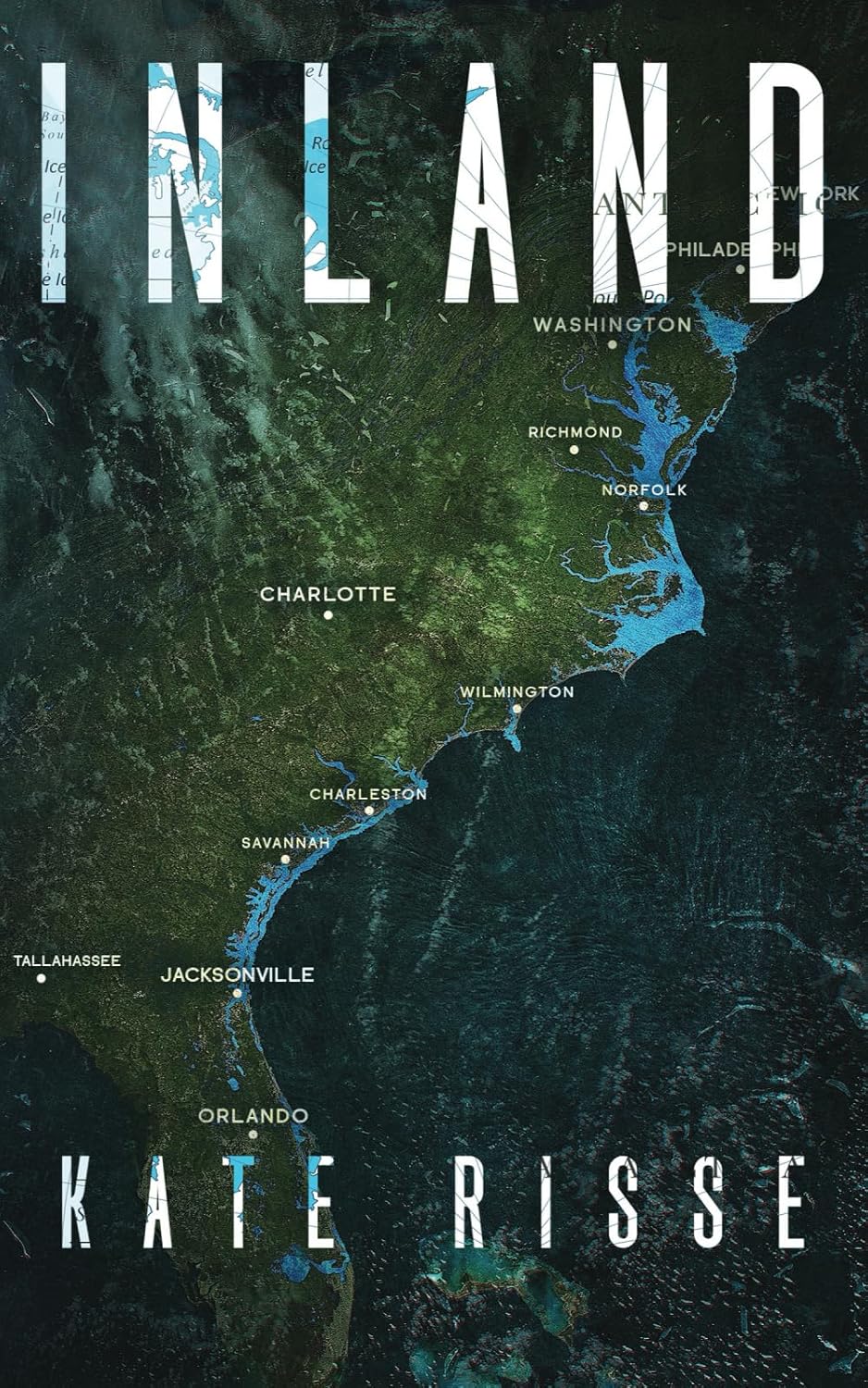
Kate Risse. Inland. 12 Willows Press, 2024.

Version 1.0.0

“When I was a boy and I would see scary things in the news, my mother would say to me, ‘Look for the helpers. You will always find people who are helping.’ To this day, especially in times of ‘disaster,’ I remember my mother’s words, and I am always comforted by realizing that there are still so many helpers — so many caring people in this world.”  – Fred Rogers

These words, from a 1999 interview, were famously posted in a viral Facebook post by PBS in response to the horrific Sandy Hook Elementary School shooting on December 14, 2012, and to this day are frequently resurrected after countless other senseless tragedies. Apocalyptic SF is replete with examples of the worst of humanity coming to the fore in the face of adversity and catastrophe. Another well-worn trope in such works is the helpless damsel in distress, doomed to sell her soul, or her flesh, in a desperate attempt to survive. More often than not, she is the victim of physical and/or sexual assault. Lastly, teamwork by male and female protagonists inevitably ends in comfort sex, a one-night stand (or sudden sequence of such events), often to be regretted in the morning or soon pushed out of the narrative as unimportant, fading into the background as if it were just one more trite plot device to be ticked off the author’s standardized to-do list. To Risse’s credit, her debut novel, Inland, only features the last of these three over-used tropes. Risse’s novel quietly celebrates Mr. Rogers’ “helpers,” although it takes some of her characters considerable time and effort to come to the same realization.

The tale begins soon after the beginning of a vaguely described weather catastrophe that, without warning, floods the eastern seaboard of the US. Speculations by Martin (who, it is insinuated, has some scientific background in climate change) sprinkled throughout the novel suggest it is related to years of rising sea levels and the mass thawing of glaciers and Antarctic ice, coupled with sudden shifts in the ocean currents (think The Day After Tomorrow with Noachian rain and waves rather than flash-freezing Arctic superstorms).

In contrast to many fictional cli-fi catastrophes, Risse’s is set just around the corner, in 2026, the author explaining that she wanted to portray climate change as “unwinding faster than was initially thought, or at least communicated to the public…. I decidedly didn’t want my novel to be a dystopian story set in the far-flung future. I wanted it to be about where we might possibly be heading soon and how that’s not a good direction” (Semel).

Boston native Kate Risse is intimately familiar with the Florida Panhandle coastline and barrier island where the novel begins, having spent many summers vacationing there. In interviews she credits the destruction she witnessed in the aftermath of Hurricane Michael in 2018 as a major motivation behind the novel (Rowland; Semel). In addition to her lived experience along the eastern seaboard, Risse also draws upon her Ph.D. in Hispanic Studies (Boston College) and her climate justice and Spanish language/culture courses at Tufts University in crafting details for her story (“About”).

This cli-fi ecocatastrophe is written in first person, the unfolding disaster described through the eyes of Juliet and the younger of her two sons, sixteen-year-old Billy. Individual chapters focus on Juliet’s desperate attempt to get home to Boston from her mother’s Dog Island beach home on the Florida panhandle and Billy’s equally desperate attempt to survive as the ocean swallows his Boston neighborhood and unexpectedly leaves him to fend for himself. The story of a second family, who lives a few blocks away, comprised of Martin (in Florida for a business deal) and his two teenage daughters, schoolmates of Billy (also stranded without adult supervision in the wake of the disaster), is intertwined (figuratively and literally) in the narrative.  

A MacGuffin of a complete disruption of all communication systems cuts off the parents from their stranded children, significantly raising the tension and driving Juliet and Martin’s desperate road trip north—or, rather, north-ish—following an inland path that allows them to not only play the role of good Samaritan, but be the repeated beneficiaries of similar grace. This is fortunate for the characters, as there is an apparent complete lack of governmental aid above some very limited local help within selected communities. While Juliet is openly skeptical of the basic goodness of humanity and repeatedly expects the worse from others, she is more often than not surprised to find that there are, indeed, as Fred Rogers offered, plenty of “helpers,” even in the worst of situations. This is not to say that Risse’s story is a Pollyanna tale; her characters also encounter realistic brutality and harrowing situations. But through these challenges they also discover their inner strength and hone their resiliency, all while learning to let go of parts of their old lives that no longer seem important while simultaneously holding fast to what truly matters.

The widespread failure of most radio, television, flip phones, and internet communication is exacerbated in the novel by a government smartphone ban that had gone into effect some months before. This ban was not intended to save the country’s youth from the mind-rotting effects of social media per se, but literally to prevent their brains (and bodies in general) from being poisoned by “toxic metals and radiation” supposedly associated with the phones (152). Again, the specifics behind the ban are doled out sparingly in the novel, alongside conspiracy theories and banal parroting of the government’s official pronouncements of the dangers. Fortunately, Billy and Juliet have contraband smart phones, and manage to send a few precious texts to each other, enough to convince Martin and Juliet that their children are still alive and attempting to leave Boston together.

While the first part of the parents’ road trip is told in great detail (from Dog Island, Florida, through West Virginia), the rest is either apparently uneventful (which seems strange given the trials the characters endure before this time) or held back for some other reason, until their arrival in southern Vermont. The novel ends with more questions than answers (not the least of which being an unshakable feeling that there is more to Martin than he is letting on), but does give the reader some closure in the form of the main characters’ emotional and physical status. There is certainly room for a sequel, which Risse has considered writing (Semel).

Taken in total, the work did not strike me as necessarily suitable for intense scholarly analysis. However, it would be interesting to see how different aged audiences might read the cellphone subplot in particular, especially given that the story is told from the viewpoints of individuals from two generations. I could see this book being used in a Climate Change Literature or Science and Society class at the college level; it could lead to some quite interesting class discussions and student personal reflections.

WORKS CITED

“About.” KateRisse, accessed 27 Sept. 2025, https://www.katerisse.com/about.

“Mr. Rogers Post Goes Viral.” PBS News, 18 Dec. 2012, www.pbs.org/newshour/nation/fred-rogers-post-goes-viral.

Rowland, Kate. “Creativity Never Ends: Kate Risse on Writing ‘Inland’ and Thinking About the Future of Our Planet.” The Justice, 22 Oct. 2024, www.thejustice.org/article/2024/10/creativity-never-ends-kate-risse-on-writing-inland-and-thinking-about-the-future-of-our-planet

Semel, Paul. “Exclusive Interview: ‘Inland’ Author Kate Risse.” PaulSemel, 1 Aug. 2024, paulsemel.com/exclusive-interview-inland-author-kate-risse/.

Kristine Larsen, Ph.D., has been an astronomy professor at Central Connecticut State University since 1989. Her teaching and research focus on the intersections between science and society, including Gender and Science; the links between pseudoscience, misconceptions, and science illiteracy; science and popular culture (especially science in the works of J.R.R. Tolkien); and the history of science. She is the author of Stephen Hawking: A Biography, Cosmology 101, The Women Who Popularized Geology in the 19th Century, Particle Panic!, Science, Technology and Magic in The Witcher: A Medievalist Spin on Modern Monsters, and The Sun We Share: Our Star in Popular Media and Science.

The Ministry of Time


Review of The Ministry of Time

Lena Leimgruber

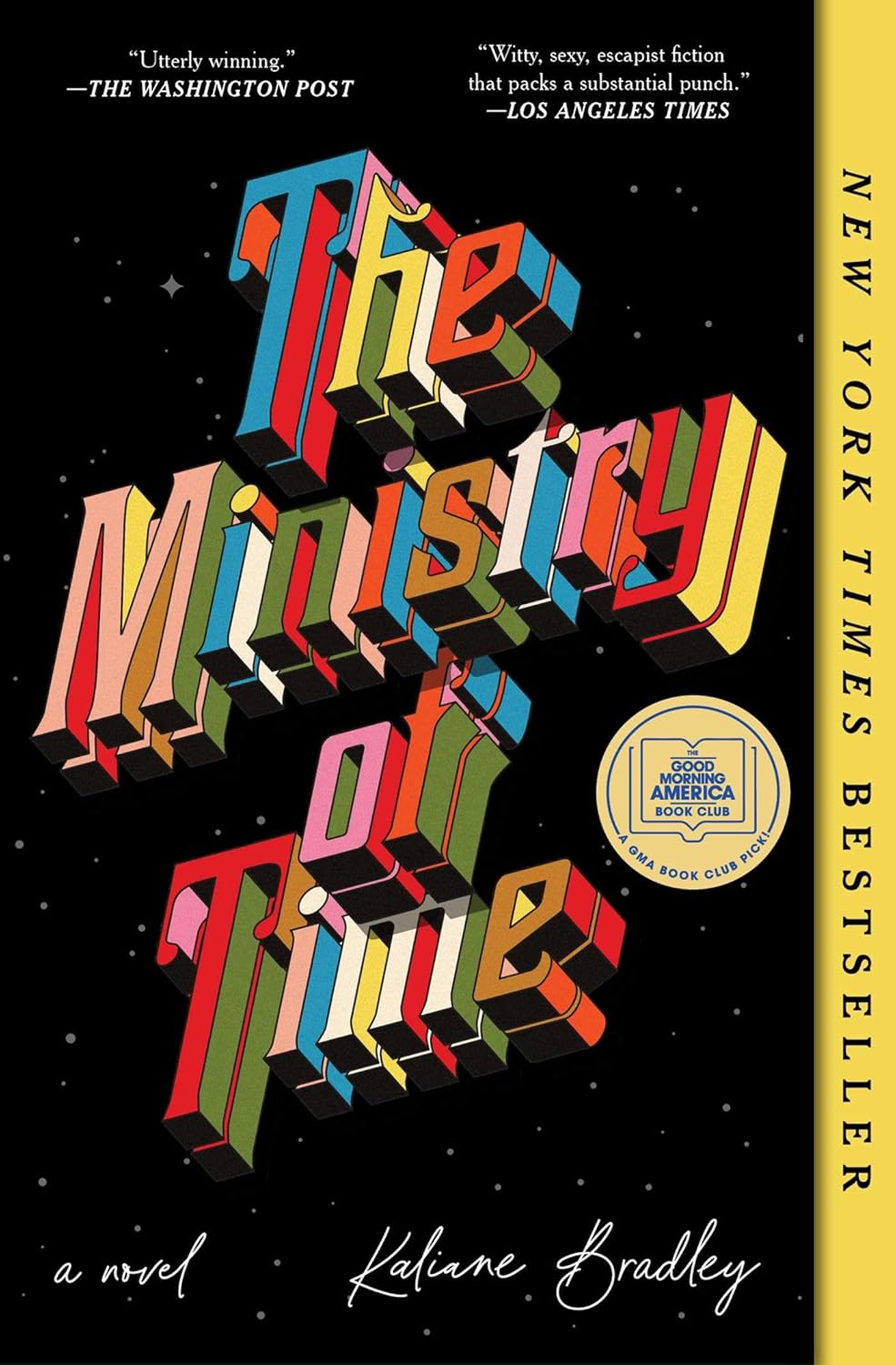
Kaliane Bradley, The Ministry of Time. Simon and Schuster, 2024.

Version 1.0.0

What does it mean to meet history face-to-face? In Kaliane Bradley’s The Ministry of Time, the past is not a distant tableau but a living presence, and the future is something to be negotiated. Bradley, a British-Cambodian author, constructs a novel in which temporal encounters become both deeply personal and ethically charged. The narrative alternates between two storylines: a near-future Britain, where the Ministry of Time, a secretive government agency, manages “expats from history”, and 1847, through the perspective of Commander Graham Gore, a naval officer aboard the ill-fated Franklin Expedition. The protagonist, an unnamed “bridge”, works at the Ministry’s Language Department, guiding historical figures as they navigate the modern world. The novel explores how people from different eras perceive and interpret one another, balancing the ethical and emotional challenges of cross-temporal interaction. Chapters in the contemporary timeline are numbered in Arabic numerals, while historical chapters employ Roman numerals, signalling shifts in perspective and highlighting the contrasts between past and present. The novel arrived with considerable anticipation, supported by an extensive marketing campaign and a wide distribution of advance review copies, which meant it had already generated significant discussion before its official release. Its reception was further boosted by its longlisting for the 2025 Women’s Prize for Fiction.

Placed within the broader history of SF, The Ministry of Time aligns with a tradition in which speculative devices are deployed to probe ethical, social and philosophical questions. Bradley’s use of time travel emphasises moral responsibility and cross-temporal understanding rather than adventure or spectacle. Her focus on romance across temporal and cultural divides situates the novel within a lineage of speculative love stories, while expanding the form to encompass postcolonial and environmental concerns. Even the historical elements (references to the Franklin Expedition) participate in a long-standing SF practice of revisiting the past to illuminate contemporary anxieties, although Bradley foregrounds intimate human connection rather than survival or horror. Through these combined strategies, the novel contributes to the interest in character-driven, ethically and politically engaged storytelling, demonstrating how speculative narrative can illuminate questions of identity, responsibility and the consequences of human action. Unlike many earlier works of SF, often celebrated for their focus on world-building, The Ministry of Time situates its speculative premise in a world that closely resembles our own. This allows the narrative to devote more energy to character, emotion and moral dilemmas, while leaving some readers wishing for a fuller exploration of the mechanics of time travel itself.

The title, The Ministry of Time, immediately evokes associations with speculative and political literature, notably Kim Stanley Robinson’s The Ministry for the Future. Both titles suggest governmental authority over temporal matters, positioning time as a domain requiring oversight and intervention. This framing aligns with Bradley’s exploration of a bureaucratic institution managing time travel and historical figures, emphasising the ethical complexities of such power. Additionally, the title may resonate with the Spanish television series El Ministerio del Tiempo, which similarly engages with time travel and historical encounters, though Bradley’s novel distinguishes itself through its focus on intimate, cross-temporal relationships and postcolonial themes. With some critics noting striking similarities between The Ministry of Time and El Ministerio del Tiempo, discussions around the novel have been complicated by a plagiarism controversy. While the publisher and author have denied any direct borrowing, the debate takes up questions of originality, adaptation and cultural borrowing.

It is also noteworthy how the novel has circulated internationally: while most translations retain a direct equivalent of The Ministry of Time, the Spanish edition avoids El Ministerio del Tiempo, the title of the TV series at the centre of the plagiarism controversy. Instead, it is published as Un puente sobre el tiempo (“A Bridge Across Time”), a striking shift that seems to signal both a distancing strategy and an attempt to reframe the novel for Spanish readers. This small but telling change does a lot: it raises questions of originality, intertextuality and ownership that shape the novel’s global reception.

It is also noteworthy how the novel has circulated internationally: while most translations retain a direct equivalent of The Ministry of Time, the Spanish edition avoids El Ministerio del Tiempo, the title of the TV series at the centre of the plagiarism controversy. Instead, it is published as Un puente sobre el tiempo (“A Bridge Across Time”), a striking shift that seems to signal both a distancing strategy and an attempt to reframe the novel for Spanish readers. This small but telling change does a lot: it raises questions of originality, intertextuality and ownership that shape the novel’s global reception.

While historical references appear, they primarily enrich the speculative backdrop rather than drive the plot. At its core, The Ministry of Time is a love story that explores the challenges and intimacy of relationships that span vast temporal divides. The bridge-narrator develops a profound connection with historical “expat” Graham Gore; through their story, the reader learns about both the dissonances and resonances that arise when individuals from very different times encounter one another. Through this central relationship, Bradley foregrounds questions of ethical responsibility, empathy and the consequences of human action: concerns that echo contemporary societal debates on postcolonial legacies and climate change.

Characterisation and emotional depth are central to the novel’s impact. Gore’s perspective conveys the physical and moral realities of nineteenth-century naval life, from survival and hierarchy to the assumptions embedded in imperial and colonial structures, while his encounters with the twenty-first century expose profound cultural dissonances and ethical tensions. The bridge-narrator reflects on her role with a mixture of fascination, care and responsibility: “It was so hard not to treat the expats like blank slates onto which I might write my opinions. […] Every time I gave Graham a book, I was trying to shunt him along a story I’d been telling myself all my life” (156). Her emotional engagement is inseparable from ethical reflection: in guiding historical figures, she must navigate the consequences of her influence, balancing empathy with moral responsibility. The romance between narrator and expat thus functions less as a conventional love story and more as a lens through which the novel examines moral agency, the ethical stakes of mediation across time and the lingering effects of colonial frameworks. By interweaving emotional intimacy with ethical and historical inquiry, Bradley demonstrates how SF can explore the complex interplay of personal connection, cultural understanding and human responsibility across temporal divides.

While The Ministry of Time clearly draws on SF and time travel tropes, its narrative structure owes just as much to the conventions of romance fiction. The novel is less invested in the technical details of time travel than in the emotional arcs that unfold around it. For many readers of SF, the absence of an explanation of the time-travel mechanism might be frustrating, but this absence also shifts the focus: relationships, intimacy and desire become some of the central motors of the plot. Reading the novel through a romance lens reveals how Bradley uses affect and attachment not only to anchor the speculative premise, but also to complicate questions of power, dependency and care across historical and cultural divides.

Bradley also engages thoughtfully with postcolonial and historical reflection. Gore’s nineteenth-century assumptions, his navigation of Arctic landscapes and encounters with Indigenous peoples reveal the legacies of imperial hierarchy and the categories imposed by colonial governance. The narrator reflects on this inheritance: “The great project of Empire was to categorise: owned and owner, coloniser and colonised… I inherited these taxonomies” (181). Through time travel, Bradley interrogates not only individual actions but the structures and epistemologies that shape historical events. Language again emerges as central: the act of naming, translating and interpreting carries moral and political consequences. By highlighting these stakes, the novel demonstrates how speculative narratives can illuminate the ethical and cognitive work involved in historical understanding and postcolonial critique.

A more troubling element lies in Gore’s attraction to the protagonist, which is explicitly linked to her resemblance to an Inuit woman against whom he has transgressed in the past. This “interchangeability” risks reproducing colonial logics, reducing both women to symbolic vehicles for Gore’s guilt and potential redemption. At the same time, it may be read as a deliberate narrative device to stress how thoroughly Gore remains trapped in the worldview of his own era: even as he is displaced into the present, he cannot shed the racialised and gendered assumptions that shaped him. Intentional or not, this aspect leaves a lingering feeling of unease with the reader and raises questions about the novel’s negotiation of colonial history through personal relationships.

Time travel (even though the novel could have done more in terms of explaining how it works) functions as a mechanism for ethical and philosophical exploration. The Ministry, ostensibly a bureaucratic institution, highlights the limits and responsibilities of human intervention across temporal contexts that are, by extension, social and environmental contexts. In this framework, language and cultural understanding become essential tools: “One of the many hypotheses coagulating in these early days of time-travel was that language infirmed experience — that we did not simply describe, but create our world through language” (56). This insight underscores the stakes of Bradley’s work as a bridge: guiding historical figures is not only a matter of translation but also of shaping their perception of the present, influencing how they act and how the world is subsequently understood. Bradley uses this premise to explore the ethical dimensions of mediation across time and, consequently, stresses the responsibility inherent in naming, interpreting and narrativising events. The language concerns that Bradley brings up also resonate with broader SF traditions, where language often functions as a lens to question the relationship between consciousness, society and reality itself. Ultimately, she links speculative narrative with philosophical inquiry and proposes that our engagement with the past carries both cognitive and moral weight.

The Ministry of Time resonates strongly with broader societal reflections on how nations reckon with their pasts. In Britain, debates around colonialism, restitution and reconciliation have intensified in recent years, and Bradley’s novel can be read as part of this cultural moment. By resurrecting a figure of imperial exploration and displacing him into the present, the novel forces readers to confront unresolved colonial legacies rather than allowing them to fade into comfortable amnesia. This mirrors wider movements, within Britain and globally, that insist on engaging critically with history, acknowledging its violence and considering possibilities for repair. At the same time, The Ministry of Time extends beyond national boundaries: it participates in an international literary conversation about the importance of grappling with the entanglement of past and present, recognising how colonial structures still shape today’s societies and futures. Similar questions are being asked in Canada, Australia and other (settler-)colonial contexts, where literature can become a key site for negotiating historical injustices and imagining new, more just futures.

Formally, the novel benefits from its dual timeline and alternating perspectives, which allow for nuanced explorations of temporal, ethical and emotional concerns. Vivid descriptions of Arctic landscapes and period detail provide texture and authenticity, while the focus on emotional and cognitive mediation ensures that the narrative remains both intellectually engaging and emotionally compelling. Bradley’s careful structuring, numerical versus Roman numeral chapters, reinforces the contrasts between past and present, which supports the thematic centrality of perception, interpretation and responsibility across eras.

While The Ministry of Time succeeds in its exploration of temporal ethics, linguistic mediation and emotional depth, certain narrative choices limit its impact in other areas. Readers with a particular interest in Arctic history or expedition narratives may find the historical sections comparatively brief and underdeveloped. The Franklin Expedition, though thematically resonant, serves more as a backdrop for cross-temporal ethical reflection than as a fully realised historical setting. This raises questions about why Bradley chose this particular historical context: the Arctic environment, survival challenges and the broader expeditionary framework are evocative but largely peripheral to the novel’s central concerns. While these choices are understandable given the novel’s focus on ethical mediation, language and cross-temporal encounters, the historical and geographic richness of the Arctic is not fully leveraged, leaving readers with the sense that the setting could have been more integrated into the narrative’s speculative and philosophical ambitions.

Beyond its literary and philosophical achievements, The Ministry of Time offers rich possibilities for scholarly engagement, particularly around the question of how understanding the past informs the present. The novel’s emphasis on cross-temporal mediation and responsibility encourages reflection on the ethical, environmental and social consequences of human action in the Anthropocene. Students and researchers could explore how Bradley’s narrative addresses the ongoing relevance of historical knowledge for contemporary challenges such as climate change, showing how interventions (temporal or societal) carry moral weight. Similarly, the novel’s attention to colonial hierarchies, historical encounters and the epistemologies inherited from empire invites analysis of how historical legacies continue to shape structures of power, cultural understanding and systemic inequities, including ongoing issues of racism. It is through the linking of speculative, historical and ethical inquiry that Bradley’s work provides a platform for discussions that span literature, environmental studies, postcolonial critique and social ethics. Doing so, she showcases how fiction can illuminate the stakes of grappling with history to better navigate present and future challenges.

Overall, The Ministry of Time is a richly imagined speculative romance that engages both the heart and the intellect. Bradley demonstrates how love across time can illuminate ethical, cultural and environmental stakes. Bradley shows that human connection, even across centuries, reflects ongoing societal concerns about climate, history and moral responsibility. The novel combines emotional resonance with intellectual rigor, making it a distinctive and compelling contribution to contemporary SF.

Lena Leimgruber is a PhD student in English Literature at Umeå University, Sweden. Her research examines representations of the Arctic in contemporary literature, with a particular focus on colonial histories, ecological crisis and more-than-human agency. Lena explores how speculative and environmental narratives challenge dominant cultural imaginaries and expose entangled legacies of imperialism and climate change.

Shroud


Review of Shroud

Zorica Lola Jelic

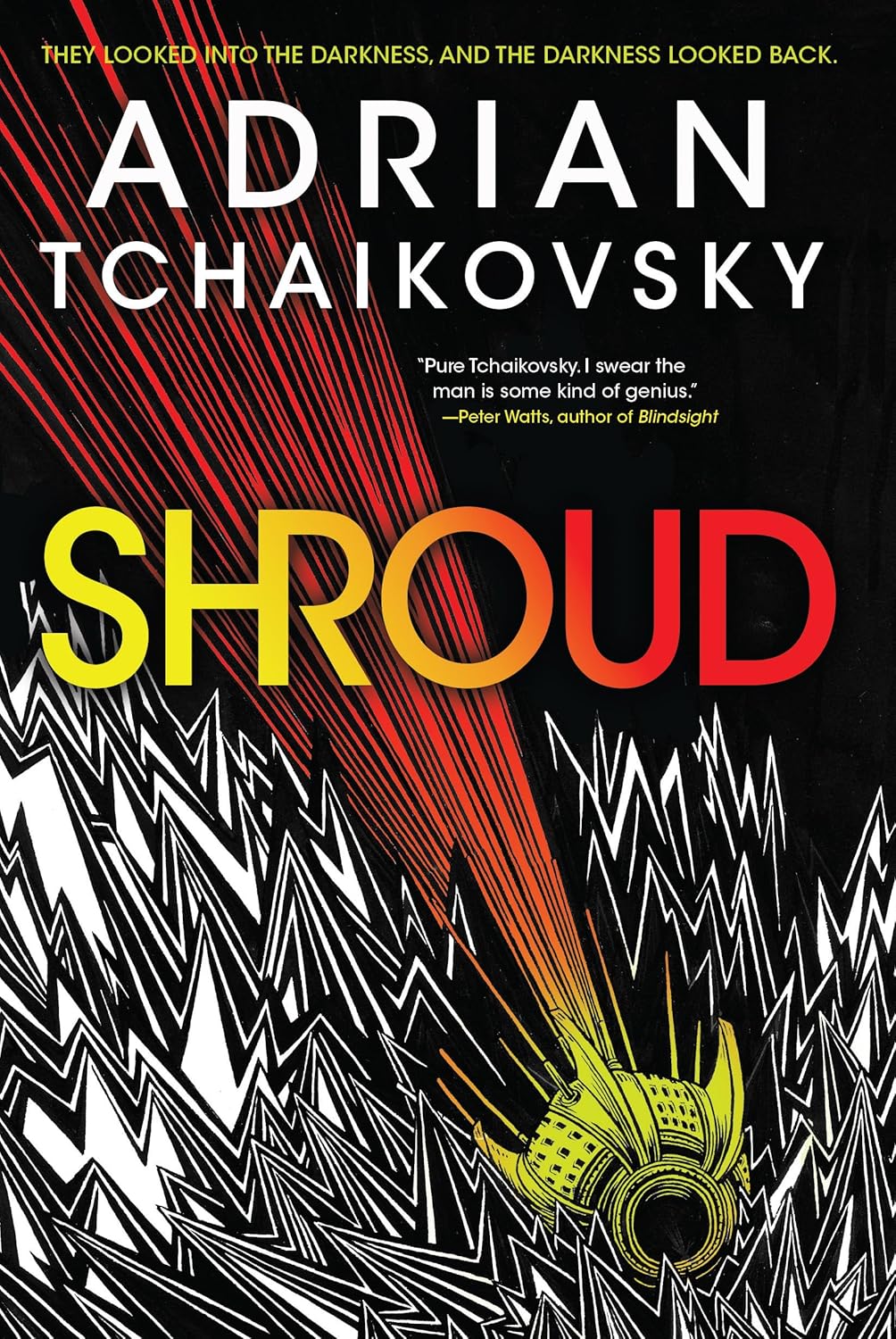
Adrian Tchaikovsky, Shroud. Tor, 2025.

Version 1.0.0

Adrian Tchaikovsky is possibly one of the best writers of science fiction today.  In his novels, he imagines and creates futuristic worlds as soft dystopias. The problems that arise in his novels are a result of human greed and bad politics rooted in the everlasting campaigns of acquiring more commodities. With this novel, Tchaikovsky puts forth a premise: the possibility of intelligent life evolving in complete darkness. In some distant future, humans have exhausted Earth’s resources and have colonized other planets. Children live in impoverished and confined shared spaces (hubs) with little food and even less opportunities unless they prove themselves to be potentially useful workers on spaceships. They travel throughout star systems in search of ore and other materials with the same colonial zest that humanity has cultivated over the centuries. Their bodies hibernate while doing so, and if there is no need for their particular skills, they can stay “shelved” indefinitely. By the same token, life spans can be prolonged since people can be re-shelved many times. The Garveneer Composite Mission Vessel approaches a moon in the Prospector413 system, which is always on the dark side of a planet and is, therefore, forever hidden from light. Due to its pitch-black nature that is hidden under layers of gasses, it is named Shroud. What appears to be an easy mission of doing pre-excavational research turns into a first-contact mission. The entity inhabiting the moon is named Darkness, and the reader soon finds out that Darkness is rather loud and has quite a story to tell. Yet, Tchaikovsky expands his premise and stretches the readers’ imagination further; it turns out that Darkness is a fast learner.

As in his previous novels, Tchaikovsky plays with the limits of science and describes the unknown with scientific knowledge known to readers. In this case, he shows how creatures living with no light develop a complex system of deciphering and tracking sound as it is done with natural sonars. However, sound is also a learning and communicating tool, which turns out to be too evolved for humans to understand. Tchaikovsky goes back to the greatest downfall of humanity—dismissing what cannot be understood as primitive and unworthy. Per instructions, the crew cannot afford to admit that intelligent life exists simply because not acknowledging life legitimizes the destruction of the same. Turning a blind eye for the sake of plundering and the never-ending prosperity of mankind seems to be the go-to modus operandi even in the distant future. Nevertheless, like any good hard science fiction work, this one opens the discussion on what it means to be human. For every colonizer throughout history, the category of humanity is stripped down to the notion that white man’s superiority implies morality. Darkness proves more than once that it has higher moral standards of understanding the other and alien life than humans do. It wants to learn and communicate in order to share knowledge and acquire new ones. It recognizes that learning about a different life form can benefit its own existence. Yet, ruthless human behavior forces the alien entity to become shrewd and recognize people for the threat that they truly are. Once more, Tchaikovsky shows how alien life does not have basic human emotions; yet, it has appreciation and a fascination with the workings of other life forms, which puts them in a morally higher category than people are. The lack of morality and respect of all life on the Garveneer shows that humanity, even though it has the technology, has still not evolved enough to make first contact with unknown life. This seems to be the strongest criticism of present-day people that Tchaikovsky provides. He also creates Darkness as an entity that has a learning curve similar to AI, which brings the reader back to the present moment and the debate on whether we should create more sophisticated AI machines when we are morally so corrupt that we do not recognize the responsibility that goes with such an endeavor. In other words, man’s hubris blinds him from recognizing his inability to compete with and monitor the rapid pace of AI innovation.

Furthermore, Tchaikovsky returns again to the representation of genderfluid people as well as the use of the ever so popular pronouns they/them for some of his characters. This could be his giving into or supporting certain social trends, which according to his novels will undoubtedly survive and make it into the future, or it could simply mean that humanity in some distant future will forego strict male/female interactions in favor of more conformable relationships, bodies, or identities. Perhaps, in the distant future, affinities will be based on proximity, because one cannot choose with whom one will be joined while mindlessly going through space in a pod ad infinitum. Still, the use of these pronouns and strange names can be misleading at times, as it was toward the end of this novel. Empathy also seems to be an ability that Tchaikovsky likes to use and explore. In the novel, it is quite clear that the humans have barely any empathy (except for a few crew members), while Darkness has a level of curiosity that prevents it from destroying life. On the other hand, the readers are left with difficult choices regarding who the villain in this story will be. In the beginning, one empathizes with the lithe crew members who are dispensable to the owner (Opportunities). However, as one finds out about Darkness, empathy is slowly transferred to the entity, while leaving only vague sympathy for the humans. In his previous novel, Alien Clay, alien symbiotic life did not have intelligence, although it acted and reacted based on innate hyper altruism. Darkness shows that it prefers not to destroy, but once its existence is threatened it chooses to learn and outwit the aliens (humans). The outcome of the story is suggested and, considering the exponential learning curve of Darkness, the readers will figure it out on their own.

Shroud is a well-written novel intended to pique one’s interest into the possibilities of alien life and how it might interact with humans. As a novel, anyone interested in science fiction will have a good time reading it. For science fiction courses, it is a good example of hard science fiction writing with an emphasis on space exploration (and excavation), space travel technologies, alien encounters, hive minds, and a fascinating concept of an alien species that processes learning as AI does. This novel can be used in undergraduate and graduate courses. I also find it as a valid work for scholarly explorations of narrative empathy, the aesthetics of peace, corporate exploration, and the evolution of consciousness and how humans can/cannot keep pace with it.

Zorica Lola Jelic, Ph.D. is an Assistant Professor at the faculty of Contemporary Arts in Belgrade, Serbia. She teaches English as a foreign language, Business English, Shakespeare, and English Drama. She earned her degrees in Shakespeare studies, but she also loves to write about literary theory and science fiction. She has published scholarly papers, coursebooks, and enjoys attending professional conferences.

Navola


Review of Navola

Ian Campbell

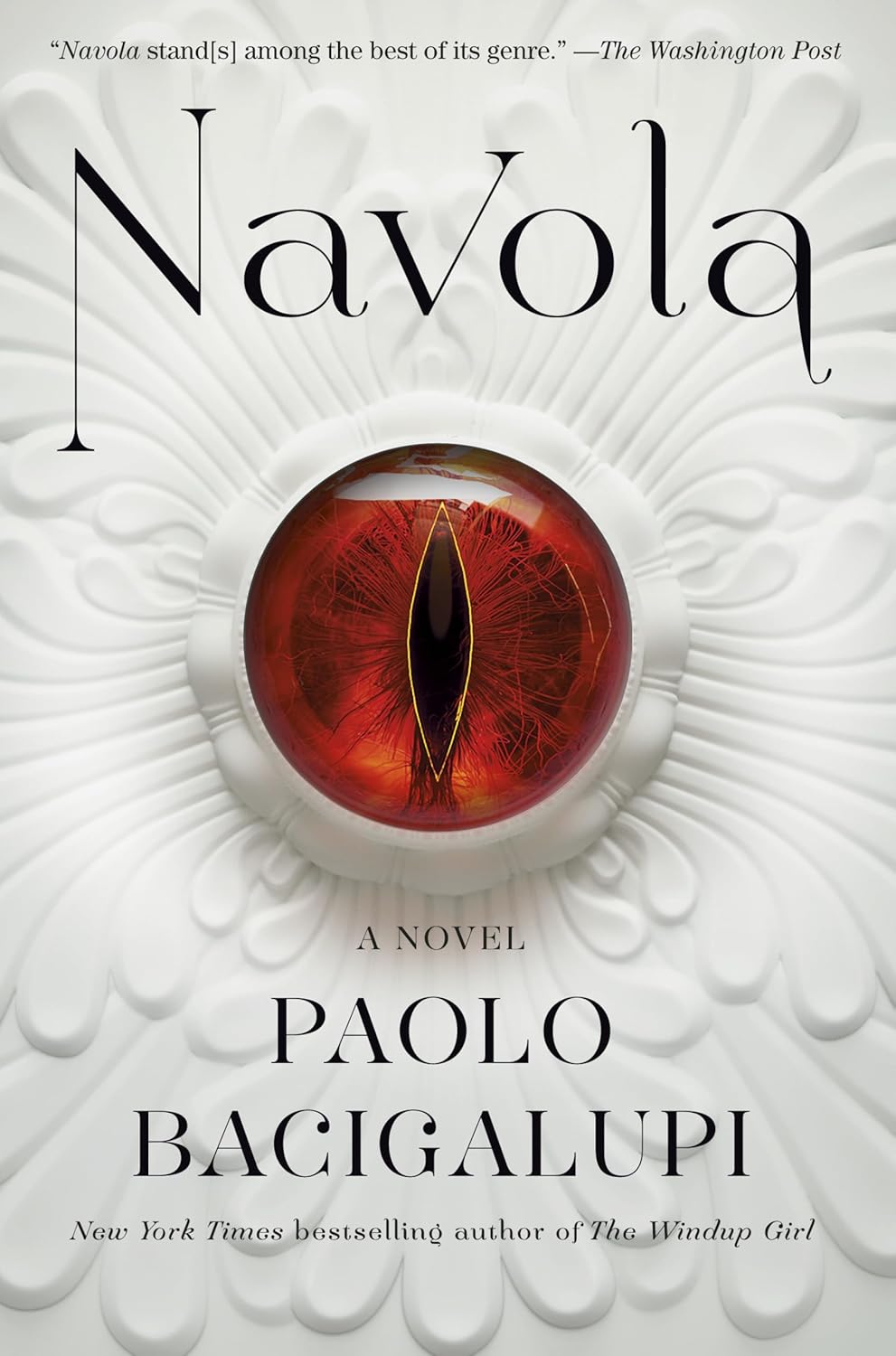
Bacigalupi, Paolo. Navola. Alfred A. Knopf, 2024.

Version 1.0.0

This competently written pseudo-historical fantasy novel is a textbook example of essentially everything that’s wrong with book publishing under late capitalism. I’m going to thoroughly spoil the novel here and also likely make it appear that Bacigalupi is my primary target, but he’s not: it’s the industry, the structure, not the individual. The story is set in an alternate-world version of the Italian Renaissance. Davico di Regulai is the only son and heir to a great and powerful banking house. The first three-quarters of the text centers around Davico’s being simply too nice and decent a person for the role that has been chosen for him by his patrimony. He’s kind, sensitive, naïve and open in a culture that values viciousness, indifference, cynicism and duplicity. He rather wishes he could become a physician and help people: he’s quite aware that he’s a bad fit for what he’s supposed to be. This is in no way a terrible setup for a good story. Either Davico is going to find a way for someone else to replace him so he can go pick mushrooms and heal people, or he’s going to grow into the role, lose just as much of his naïveté as he needs to in order to thrive, and take the banking house one step closer to domination. Or he’s going to grow into the role of patriarch/CEO but do it in a kinder, gentler fashion. But none of this happens; in fact, by the end of this 200k-word novel, we only get to the first couple of scenes of Act Two of how this sort of story typically works. I found myself nearly finished, thinking “well, this is all going to need to get wrapped up in a hurry, here”, and then it… doesn’t, really.

The initial chapters foreground a magical artifact in this otherwise non-magical world. Davico’s father has acquired at tremendous expense the eye of a long-dead dragon and has placed it on his desk as a symbol of his power and wealth. Davico comes to view the eye differently: he can sense the dragon’s dormant power and consciousness and is constantly fascinated by the glowing orb. The text does not explain why Davico in particular senses power through the eye, when neither his father nor any of the minions, allies, and rivals who sit across the desk from his father look at it as anything more than a trophy. We’re to infer, I suppose, that his sensitivity is the reason for why the eye reacts differently to him, but like many things in this story, we don’t get a clear explanation. Were I feeling charitable, I’d argue that Davico’s general head-in-the-clouds demeanor prevents him from looking too closely into the matter, and this is reflected in the text. The eye does enter into the final act of the story, or rather, what would be the final act were it a complete story.

Yet, aside from the eye, this world is mundane. Herein lies the true problem with Navola: it is much too close to our own world and yet too different to be literature worth the name. When I first picked up the book, I flipped to the first pages of actual text and so missed that there was a map before the first chapter. As I worked my way through the first third of the text, I kept thinking “this is a pastiche of our own world”. I was willing to accept pseudo-Italian city-states separated by rough terrain, on the premise that this was going to be an estrangement of the Italian Renaissance, and the developments in the book were going to defamiliarize me just enough with our own world to give insight into… any number of aspects of the time and place, such as how and why art flourished so much or how modern banking arose, etc. Compare Navola to, e.g., Neal Stephenson’s Baroque Cycle, which hews closely to our own world save for a few characters and does real work in not only telling a banger of a story but also providing a great deal of food for thought about how attitudes toward science and economics shifted during the late seventeenth and early eighteenth centuries.

Bacigalupi’s story takes so very long to get going, and is so filled with endless, loving detail about how this society functions, that an experienced reader of SF or fantasy is going to expect a similar payoff, only maybe with a dragon. But “the Italian Renaissance was real cutthroat” doesn’t justify a buildup this long. Why was it cutthroat? What was it about the city-states’ relative freedom from domination by larger imperia or kingdoms that produced such an environment? How did the flourishing of arts and culture dovetail with politics and economics? None of these questions is answered or meaningfully addressed by the text.

It was at this point that the kingdom of “Cheroux” to the northwest is introduced, and some part of my eyeroll made tangible led me to finding the map in the front material. Oh, look: it’s the Mediterranean, only some catastrophic event, distant enough in the past to be mostly legendary, has erased Greece, Turkey and the Balkans and left empty sea in their place. The city-states look more or less like Italy; Cheroux is in the place of France. Navola is simultaneously too close to and too uninvolved with our own world to function as a work of literature. The first three-quarters of the text is constantly filled with pseudo-Italian words for things. I’m proficient enough in Italian to be able to read a book or hold a conversation in the language, and nearly everything was just the regular Italian word but with one or two letters different: this was both very distracting and, like most of the rest of Navola, fundamentally very lazy writing, though in fact the sentences are lovingly constructed and very smoothly edited.

There are two effective ways to write a fantasy novel that estranges the Italian Renaissance and makes us rethink what we understand about the time and place. One of them is to do what Stephenson did with northwestern Europe during the Baroque period: carefully research everything, get the times, dates and personalities right, then insert fictional characters through whose points of view the action takes place, all as a means of showing us what it was like for the dominant paradigm to shift from ancien regime to something approaching the Enlightenment. There are ample sources on the events and personalities of the Italian Renaissance and the long history of French meddling in the affairs of northern Italy for Bacigalupi to have done this. The other way to write such a novel would be to give us some completely different world, mundane or magical, that reproduces the conditions of existence of the Italian Renaissance: geography gives rise to city-states whose main source of income and power is trade and banking rather than production, and while their internal rivalries usually dominate, they can unite to fend off larger powers. They might even have dragons. Consider, for example, the Song of Ice and Fire series, which Martin has stated has its roots in the real-world Wars of the Roses, but is its own, internally-consistent world (with dragons) that can be read as its own world without reference to its estrangement of English politics of the era, but which becomes that much better if you’ve read too many of Shakespeare’s history plays.

Yet, Navola does neither of these; rather, it’s a (very) thinly disguised version of our world without the depth, and it’s one that doesn’t give us any meaningful insight as to what the Italian Renaissance was really like. The real Renaissance gives us all kinds of vivid, three-dimensional people about whom quite a bit is known, but in Bacigalupi’s text the only person we get to know is Davico, who in fairness is a carefully drawn and internally consistent character. His father is a caricature; he has friends who each have one trait; the family’s household is generic but perhaps for the spymaster. The actual de’ Medicis were much more interesting. The text makes constant reference to the Navolese being “twisty” people, always concealing their true plans, but the novel doesn’t go anywhere with this: there’s no reflection on what it means to be twisty other than that Davico can’t pull it off, and the text isn’t twisty in form nor content, either.

For example, one way in which this world does differ significantly from ours is that it’s a fundamentally pagan society. There’s a monotheistic church, but it’s more first-among-equals than truly dominant: there’s also a whole pantheon of gods that have magisteria and mythology that is both detailed within the text and referenced by the characters. And to Bacigalupi’s credit, this is all done quite well. It just doesn’t go anywhere. The real Italian Renaissance was dominated from top to bottom by Catholicism: look at the intrigues of the Borgias to make one of their own the pope. Look at the art. If a fantasy novel that is a work of literature is going to change this and make its analogue of Italy polytheistic, that needs to tell us something about the role of monotheism in the events and paradigm of the time and place. But it doesn’t: it’s just lore and worldbuilding. It’s actually interesting and plausible, but irrelevant to any estrangement value the novel might have. The same goes for the giant gaping hole where Greece, Turkey and the Balkans used to be, which is not detailed with the same care as the polytheism. Remove those lands from the world, and then the novel can estrange how much of the Italian Renaissance had to do with refugees from recently conquered Constantinople fleeing to Italy. Guy Gavriel Kay’s Children of Earth and Sky series actually does this, though it too suffers from being both too close and not close enough to our world. But in Navola, the Italian traders and bankers just do business with the lands on the periphery of the sea.

There’s also a long subplot in the novel where Davico grows up with a “sister”, Celia, who is in fact the daughter of a family his father has removed from the power structure. It’s never clear quite why his father brings her into the family: is she a hostage, or the natural child of the father? Throughout the first three-quarters of the book, we consistently see that Celia is far better at twisty intrigue than Davico is. It’s easy to think “oh, they’re going to get married, and Davico can be the genial patriarch while Celia is the power behind the throne with a knife up her sleeve”, or else have the two of them think this and then we find that they’re actually half-siblings.

But none of this happens at all: the novel plays with our expectations, but very poorly. At the three-quarter point, Davico’s father’s adversaries pull off a surprise plot, and nearly every character we’ve met gets killed, including the father. Celia pulls a Villainous Heel Turn out of nowhere and blinds Davico, then completely disappears from the book. The adversaries put Davico in the oubliette, from which he gradually plots a way to get close enough to the dragon eye and use it to see through to effect his escape. The novel then ends rather abruptly with his riding off into the woods to plot his revenge. And it becomes clear that Navola is not a story at all, but rather the first installment in a cash-cow million-word series.

This is what I mean when I say that this novel represents everything that’s wrong with modern publishing. Somewhere out there, an unpublished writer has meticulously researched the Italian Renaissance and written a wonderful stand-alone historical fantasy about it: Lorenzo de’ Medici, Action Hero. Somewhere else, a different unpublished writer has written a wonderful fantasy novel with city-states and bankers and so forth, set in its own world that doesn’t look like Italy. I want to read both these books. Yet they won’t be published, because their authors have no track record and those two novels are both outside the bounds of easily-categorizable marketing copy. Rather, the publishing industry, concerned only with shareholder value, has let Bacigalupi publish a long prologue, and then marketed it with “by the Hugo and Nebula award winner.” I’ve read The Windup Girl, and while it evidently gets some details about Thai culture wrong, it’s a remarkable text that deserved the awards. I’ve taught it to undergrads three times now, and it’s a real, complex estrangement of colonialism, climate change and a host of other things. So, when I needed a beach book a couple of weeks ago, I thought “this will be good”, and it’s… not. It’s not bad, per se, but it’s basically the notes for an undergrad’s D&D campaign. I want to be clear here that I don’t blame Bacigalupi. It’s difficult to write award-winning literature, and were I such a writer, I’d absolutely jump at the chance to write something much easier and know I’d make a lot of money from it because of my past writings. I blame the industry that only answers to the profit motive and puts sales over quality.

Ian Campbell is the editor of SFRA Review.

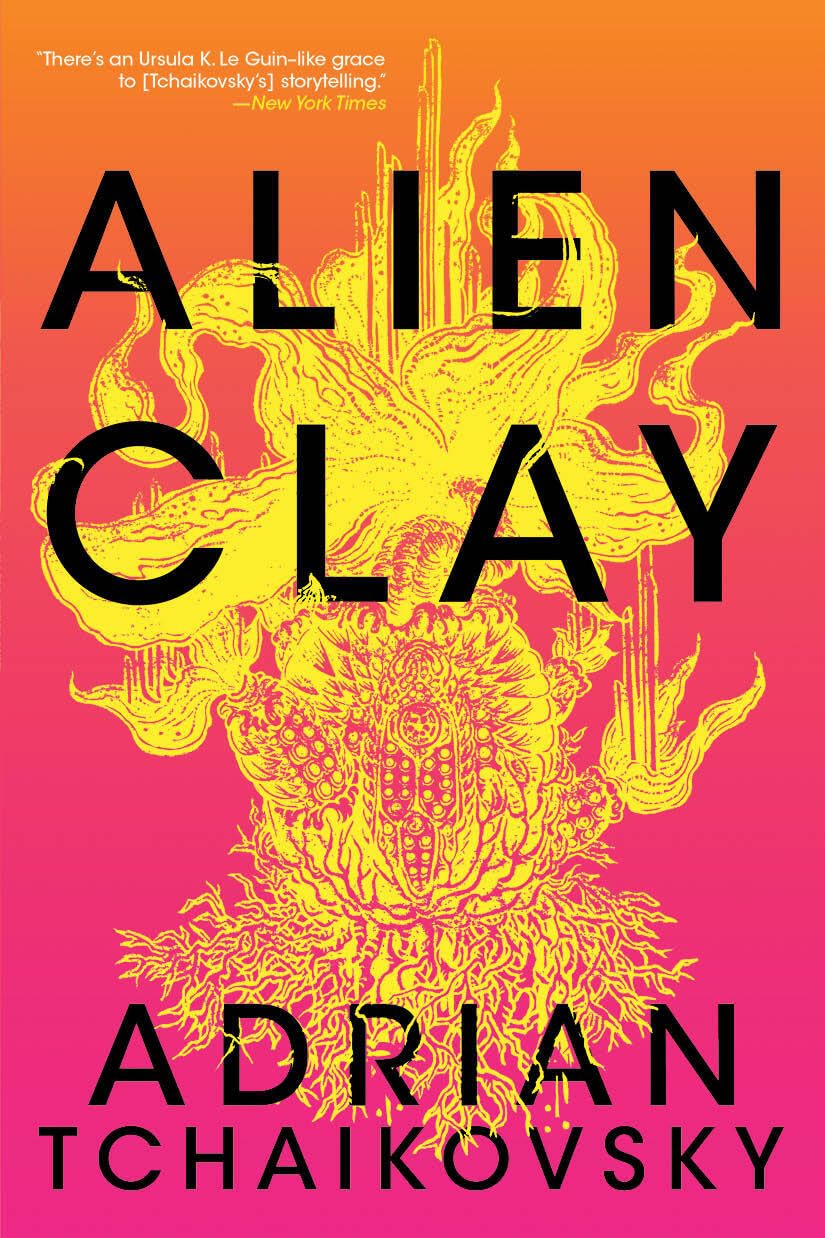
Alien Clay


Review of Alien Clay

Zorica Lola Jelic

Tchaikovsky, Adrian. Alien Clay. Tor, 2024.

Version 1.0.0

Adrian Tchaikovsky is an award-winning science fiction and fantasy writer whose series The Tyrant Philosophers and recent novels Service Model and Alien Clay are among the 2025 Hugo Award finalists. Alien Clay is a dystopian vision of future Earth. This is a work of science fiction that falls within the subgenre of exploration. Dr. Arton Daghdev lives in a country that is ruled by a totalitarian regime called the Mandate. Tchaikovsky traverses not only through alien space and biology, but he also pushes the boundaries of the human capacity to let go of individual freedom for the prosperity of the group or humanity as a whole. Admittedly, this novel was written in the aftermath of the COVID-19 pandemic, and it is difficult to avoid making that connection while reading it since the narrator is a scientist. Nevertheless, the reader embarks on this strange journey across time and space guided by Daghdev, an ecologist who researches exoplanets and alien life forms (albeit theoretically). However, Daghdev finds it difficult to conform to the Mandate’s one-minded political agenda. Therefore, he is forced to become an underground rebel who is, ultimately, convicted of high treason, imprisoned, and shipped to a penal colony located on planet Kiln, which is located fifty light years away from Earth. The beginning of the novel tugs at the readers’ political strings, challenging them to think about how far they would go to defend their beliefs. Furthermore, Tchaikovsky entertains the notion that suppressing academic freedom will undoubtedly lead to an Orwellian future.

As all admirable authors of science fiction do, Tchaikovsky introduces not one but two nova in order to lure the reader into the interestingly crafted Kilnish world. The first novum is the process of dehydrating the body in order to create body husks that are preserved for the remainder of the journey. Once the ship reaches its destination, the husks are re-hydrated and dropped in pods to the planet’s surface. This first novum is very much reminiscent of the old science fiction novels in which the technology is not exhaustively explained, and the workings and details are left to the reader’s imagination. The second novum is planet Kiln. Tchaikovsky uses his imagination, skills, and abundance of biological knowledge to describe an alien world that builds, destroys, and rebuilds itself. The Kilnish microorganisms and macroorganisms are by far the most amusing part of the novel. The world building is done in a satisfying way and is better developed than the characters. Even though the focus of the writing in the novel is on the object, as it should be in science fiction, Tchaikovsky does not leave his characters flat, and the readers are able to empathize with Daghdev and his companions as they endure the perils on Kiln. The readers do not have a problem with sympathizing with Daghdev during his plight; still, the last chapters of the novel oscillate between sympathy and empathy. At certain points, it is simply impossible for the reader to feel what the main character is feeling and emotionally going through.

Tchaikovsky writes the novel in such a way that every part of the journey, every day of life on Kiln is a game of Russian roulette, and the prisoners are, regrettably, less fortunate if they win. For the most part, the story unfolds in chronological order, while the last third of the novel is different since it presents current events in the camp with frequent flashbacks of the last seven days the group spends in the Kilnish wild. The flashbacks also show the Kilnish ecosystem in more detail, how life works on the planet, and how and why it slowly assimilates human biology into its own. Evolution on Kiln does not follow the Darwinian pattern, but this is not uncharted territory for Tchaikovsky since he already experimented with the merging of alien and human biology in Cage of Souls and simian and alien biology in Children of Time. This hybridization introduces an unachievable utopian thought because it is not in human nature to willingly submit to complete altruism. In the end, all of humanity may be assimilated by the Kilnish civilization. Daghdev’s utter elation is juxtaposed with the reader’s sheer horror of such a possible outcome and the unparalleled devastation that could happen to people on Earth. Tchaikovsky leaves it as a possibility; although, it seems that there is little to doubt when it comes to Daghdev’s determination to free humanity and give it the ultimate gift any scientist can bestow upon his people—the gift of infinite knowledge.

Tchaikovsky addresses some of the topics that he has written about in his previous works: rationality, volition, freedom, and individualism. He also addresses the posthuman in the biological sense, which differs from the traditional writings of posthuman technology. In this novel, readers can see an example of complete altruism and what it means to willingly let go of all individuality and any sense of personal freedom for the greater good. He challenges readers to let go of their anthropocentric arrogance and envision a world in which becoming a part of the Kilnish civilization means embracing collective life, thinking, and purpose. When it comes to literary theory, Alien Clay is also presentist even though it happens in the future. One cannot read it without thinking about various “mandates” that exist in today’s world, political hypocrisies, and all the freedoms that democratic societies promise but somehow fail to truly deliver. Toward the end, the reader circles back to establish answers to the elementary musings of science fiction (and philosophy) concerning what it means to be human and free. Finally, it is worth mentioning that the most appealing part of this novel is that Tchaikovsky adhered to the basic rule of this genre and took the “what if” and, just for a moment, let it become a “why not.”

Zorica Lola Jelic, Ph.D. is Assistant Professor at the faculty of Contemporary Arts in Belgrade, Serbia. She teaches English as a Foreign Language, Business English, Shakespeare, and English Drama. She earned her degrees in Shakespeare studies but also loves to write about presentism as a hermeneutical approach and science fiction. She has published scholarly papers, coursebooks, and enjoys attending professional conferences.

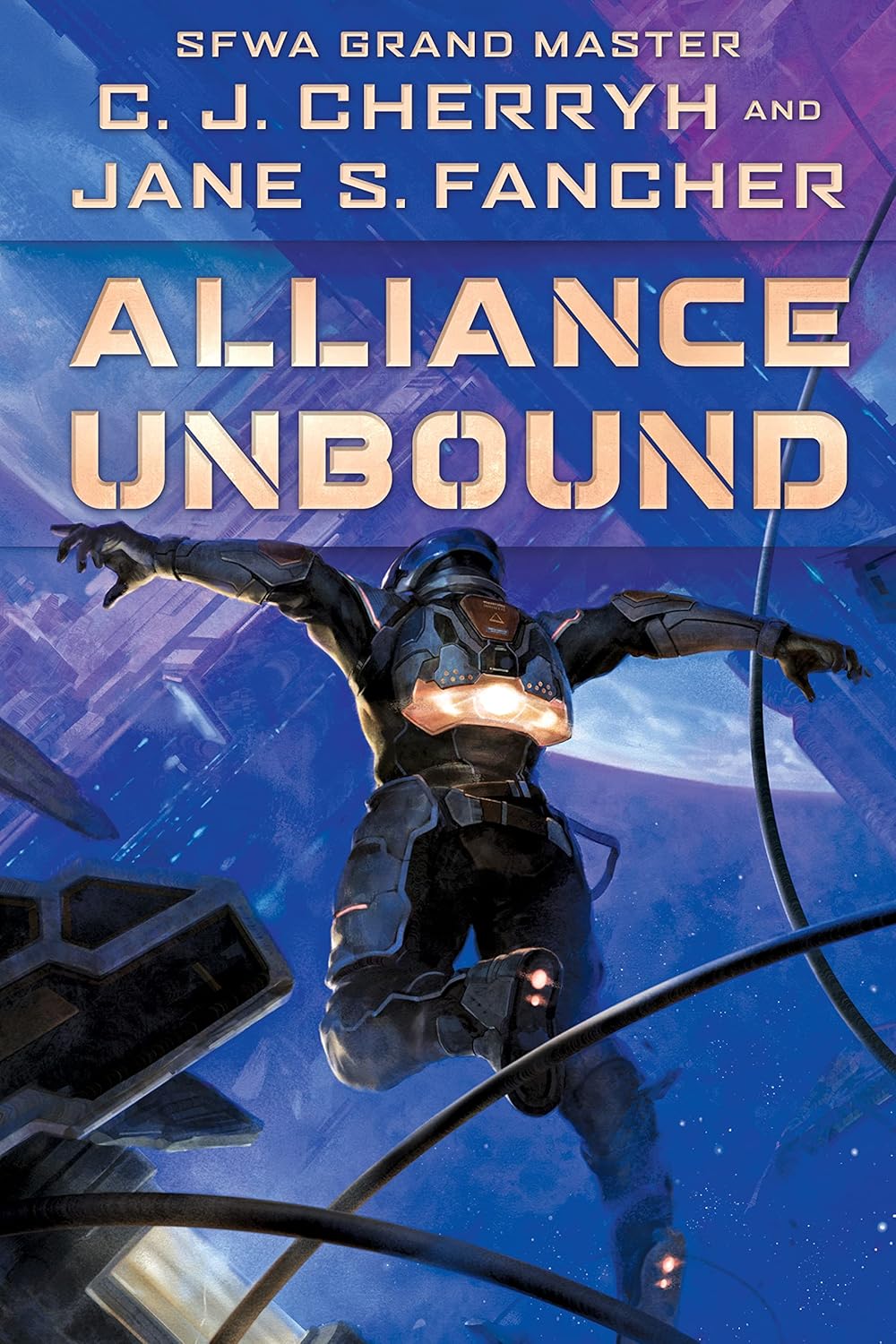
Alliance Unbound


Review of Alliance Unbound

Edward Carmien

Cherryh, C J, and Jane S Fancher. Alliance Unbound. DAW Books, 2024.

Version 1.0.0

In this second book of the “Hinder Stars” sub-series, C.J. Cherryh and Jane S. Fancher pick up the story as the merchanter super-ship Finity’s End (with guests from Galway aboard) arrives at Pell, the star system home to Downbelow Station and a key location of future history told later in the timeline of the Company Wars. Readers wishing to skip directly to this novel find a thorough recapitulation of Alliance Rising early in the novel (62-77).

The Neiharts of Finity’s End embody merchanter royalty of unimpeachable lineage, descended from the pre-FTL crew of a famed sub-light “pusher” ship. They arrive to accustomed luxury at Downbelow Station, including shopping, extensive gardens, and even the “Downers,” a sapient humanoid species acting as part of the station’s workforce. Their guests from Galway experience the sights as “rustic cousins in the big city.” Their home station, Alpha, seems rustic by comparison. Ross Monahan, escapee of the Earth Company thugs who pirated Galway at the end of Alliance Rising, faces sensory disorientation as holograms, part of the theme-park atmosphere at the “sleepover” (hotel) where the spacers reside on station, cause issues of concern for the navigator.

One part vacation spree and one part investigation leads to fun but also an abridged stay as trade goods come to light that strongly suggest a trade route not among the known paths trade takes here in space far from Earth (Sol system). Finity’s End hands off its cargo duties to other ships and heads for the unknown, bringing to bear classic tropes of earlier Cherryh novels, such as the dangers and stresses of space travel found in Pride of Chanur. They collect an ally in the shape of another merchanter, and counting Galway crew onboard Finity’s End this constitutes a deliberative body for the new Alliance, a union of merchant ships devoted to the idea that ships trading among the various stars inhabited by humanity be crewed by merchanter families, not Earth Company employees or Azi (cloned humans) from Cyteen.

Dangerous FTL travel leads the Neiharts and their Galway guests to an abandoned station in risky space at a binary star system. But Olympus Station, no longer abandoned, hosts no fewer than four ships: two mystery merchanters (the remaining holdouts who haven’t signed with the Alliance), a pusher ship that took a decade or more to get to this station (which isn’t the first to have done so), and a mystery FTL vessel of unusual design, evidently hauled here at sub-light speed by the pusher ship, a vessel ominously named not after a famous Earth explorer as with previous pusher ships, but after the Wellington that beat Napoleon. And here Cherryh and Fancher drop a shoe familiar to longtime Cherryh readers: the family names of the two merchanters. Bellagio rings no bells for this reader, but Mallory certainly does.

Signy Mallory, the captain of the Earth Company carrier Norway, leads a storied existence in the years to come. As one of Cherryh’s standout characters, along with Morgaine, Emory, and Pyanfar Chanur, the simple mention of the name “Mallory” in this historical context raises hairs on the back of the knowing reader’s neck.

The crisis of the novel brings together the senior captains of Finity’s End, Ross Monahan, who is cosmically sensitive to the moods of stars and how they impact FTL travel, and his lady love, Jen Neihart. The mystery merchanters don’t sign on with the Alliance: to them, any connection with Cyteen is too much connection. Then, the captain of the pusher vessel attempts a coup de main independent of the otherwise non-violent “big meeting” that closes the novel. The mystery FTL ship undocks and Ross Monahan’s quasi-supernatural ability to hear the stars speak reveals much about that experimental ship’s fate. The novel closes as the Alliance ships head back to familiar ports with the extraordinary news of their discovery, and the Earth Company’s continued and expected treachery, in hand.

The obvious theme of “colonialism is bad” carries on in Alliance Unbound. The significantly named Rights of Man from the previous novel is invoked in the “big meeting” that closes this novel. Joined by the resonant phrase “Mother of Mankind,” meaning Earth, the ongoing demands of the Imperial Center toward the colonies remain clear. Between the “rights” Earth, or Sol holds dear, and the implied parental role illustrated by “Mother of Mankind,” no outcome appears possible other than war. This makes sense, as the history of that war, written and published decades ago, stands canonically in previous publications such as Downbelow Station. In Cherryh and Fancher’s “Hinder Stars” background, ownership posited as consequential to the origin of the colonies vies with theories of self-determination consequential to those who own the means of production.

That these works represent Space Opera seems obvious. Yet, Cherryh and Fancher’s evocation represents a pleasantly intellectual take on the genre. In exploring Downbelow Station’s gardens, which include actual trees, the authors convey the essential difference of humans adapted to life as merchanters, hauling essential cargos using FTL “jump” technology. Even more than humans adapted to life in space stations, these adaptations make Ross Monahan reflect how “He didn’t belong to this place, didn’t want to belong. It was beautiful… but as far from his experience as the void of space” (110). To this character these natural, organic elements alienate as much as fascinate. In this “history of the pre-war period” novel, weapons seem rare and on a human scale. When one ship wishes to damage another, it uses a tool meant for another purpose. Those hoping for a ripping space battle leave disappointed. Readers who enjoy bathing in well-reasoned science fiction rejoice.

Alliance Unbound reads better than the award-winning book that comes before it, but as a series novel (and not a standalone work, as many are in the larger Company Wars context) readers may find it difficult to see its qualities standing on its own. Characters do more interesting things in more interesting environments. Ross Monahan takes on qualities of damaged but interesting Cherryh characters from prior books such as Rimrunner’s Ramey, Sandor Kreja of Merchanter’s Luck, or Heavy Time’s Dekker, and his ability to hear the stars echoes the almost witchy abilities of Capella from Tripoint. As a text in a literature class, the connections relevant to Alliance Rising apply here: colonialism writ in the stars and a hint of the social stresses on human relationships among spacers who experience time-dilation as part of their ordinary working lives. If the human relationships in Alliance Rising were tamer than in other Company Wars novels, then in Alliance Unbound they are tamer still, if only because fewer pages carry such interactions.

“To our patient readers…you know why.” This dedication follows the previous novel’s dedication to editor and publisher Betsy Wollheim. It makes sense, then, that this second novel contains helpful inclusions such as a map and a list of stellar coordinates and lists of distances from sundry relevant stars in light years. Headed “For Our Fellow Nerds,” this material delights. In the text itself such distances rarely appear in the text: “It’s a long jump,” or “It’s a short jump” might, and the essential distance in light years between Earth and Alpha station represents a key plot point. Do readers need this information? No. The narrative provides all a reader needs. But this peek behind the curtain entertains nevertheless. Cherryh, and now Fancher, show us how it’s done. Immersive science fiction, with every speculative detail honed and clear and sharp, gifts readers with maybes, what ifs, and who-da-thunk-its, all done so realistically that after a few days’ immersion one looks around and carries the story in one’s own mind, guesses where it might go, or ponders elements not narrated. May we see ever more.

Edward Carmien, Ph.D. teaches writing and literature at Mercer County Community College in New Jersey. He started his academic journey as a member of the Popular Culture Association, but soon found a truer home in the SFRA. A lapsed poet, short story writer, game designer, and novelist, his first publications were game-related working as a freelancer for TSR, Inc. After appearing in the fiction anthology EARTH, AIR, FIRE, WATER he earned membership in the SFWA. He has won awards for his fiction and non-fiction, edited a volume of essays about writer C.J. Cherryh, and lives with his family near Princeton, New Jersey.

Alliance Rising


Review of Alliance Rising

Edward Carmien

Cherryh, C J, and Jane S Fancher. Alliance Rising. DAW Books, 2019.

Version 1.0.0

C.J. Cherryh, recipient of the Hugo, Nebula, Prometheus, Locus, and others, joins her spouse and longtime partner Jane S. Fancher, winner of the Prometheus Award, in a return to the Alliance-Union universe. In this set of dozens of novels, short story collections, music, and a tabletop wargame, Cherryh and Fancher recount a history over vast ranges of time and space. Humanity’s extra-planetary colonization and inevitable loss of control of these colonies makes up a significant focus of the series. Sequences of the narrative lacking a focus upon humans are common in these texts, which act as a variant of Larry Niven’s “known space” but include far greater detail and stylistic and content variety. Part of the Alliance-Union universe presents stories related to the Company War. These novels range from Devil in the Belt (in which Earth system asteroid belt miners are recruited into new Earth Company warships) and the much-awarded Downbelow Station to 1997’s Finity’s End. 2019’s Alliance Rising and 2024’s Alliance Unbound, dubbed the “Hinder Stars” sub-series, serve as prequels to the Company Wars.

Cherryh and Fancher’s world, always complex, focuses on socio-economic stresses in a system undergoing radical change. Centuries of commerce and exploration under control of the Earth Company using sub-light ships (an extensive history of ship comings and goings exists online) alter in mere years as Faster than Light (FTL) ships, invented far from Earth, increase the tempo of change. Earth, already isolated from colonies it no longer really controls (and some it never controlled), will in decades begin constructing a fleet of FTL warships… but those are other stories. Three factions vie for control over Alpha Station, Earth’s second extra-solar station: loyalists of the Earth Company (one inescapably thinks of the East India Company), a powerful faction of FTL merchanters, and local Alpha Station merchanters and administrators who understand the local economic environment and who are Earth Company only in theory.

The Earth Company officials want their expensive FTL ship The Rights of Man, a ship name redolent with symbolism as the thing does not work, to continue receiving maximal resources and be retained under the control of the Company. The merchanters seek signatories to a new treaty as they form an Alliance. Cherryh’s readers know what’s coming in the chronologically later Downbelow Station. Alpha Station merchants and executives seek a way forward in challenging economic times; at their “Hinder Star,” they stand to be bypassed like Radiator Springs or any of the dozens of real towns left high and dry by the Interstate system in the United States. The complexities of the three-way struggle play out in adminstrivia, in dockside brawls and assignations, and in the creation of a self-perpetuating merchanter culture, one which will in future forestall any challenge to their “families run ships, not governments” credo. In typical Cherryh, and now Cherryh and Fancher fashion, complexity heats until the pot bubbles over, all with the promise of future crises to resolve in later texts.

Is this Space Opera? Calling this and other books in the common background Space Opera does them some disservice. Here, spaceships do not make noise in space; if their engines quit, they do not coast slowly to a stop, and delta-V really means something. This is not Star Wars. Yet we are concerned at least in some part with the princes and chieftains, kings and queens, appointed administrators and ship captains, the elite of the societies enmeshed together here, a signal of the Space Opera genre. Cherryh appears in Hartwell and Cramer’s 2006 The Space Opera Renaissance and arguably strides across much of the definitional space it creates with her 80-odd book publications (17-18). That she often eschews the rippin’ space battle—her Merchanter’s Luck takes place at a time when the turncoat Signy Mallory takes on the remnants of the Earth Company fleet gone piratical and abandoned by Earth, but the battle on display is psychological and takes place inside the main character’s head—is well known, and Alliance Rising follows in those footsteps. There is drama aplenty, but at the human level, in the romance and bureaucratic infighting and let’s-make-a-deal venues, not in the maneuver and missile venues. Characters sweat their big decisions in bed, at their desks, or gathered together in a bar, not in glowing, high-tech nests of screens or Jefferies Tubes.

Liz Bourke ably reviewed this text in 2019 for Locus, noting some issues with diversity, that the book seemed rooted in an 80’s sensibility, with limited variety of perspective (“Liz Bourke Reviews Alliance Rising by C.J. Cherryh & Jane S. Fancher”). Certainly, the novel is less interpersonally adventurous than other work by Cherryh. Devil in the Belt stands as a clear inspiration to the Expanse books and series, with its polyamorous spacer humans (though as one might expect, given the publication date, without contemporary poly terminology) and matrilineal merchanter clans. The people of Alliance Rising form tamer relations, though the “sailors in port” aspect of the FTL ship crews is in full flow. Accidental or purposeful? The cultural markers of later books also come later in the in-universe chronology, making it possible for Cherryh and Fancher to gauge social evolution at a more traditional stage in the history they recount here.

The text could serve in a college-level literature course, particularly an advanced level course able to undertake the more advanced themes of colonialism, the rights of those who do the work vs. the rights of capital, and the matters William H. Stoddard raises in his appreciation of Alliance Rising, which won the 2020 Prometheus Award for best novel. “The rights of man, in a nonfigurative sense, are what this novel is about,” he observes (“Liberty, evolving self-government and the Rights of Man”). Whether undergraduates can be tempted by a work so focused on the internal remains to be seen. The dedication suggests why this novel exists at all: Cherryh and Fancher celebrate Betsy Wollheim, still at the helm of storied DAW Books (which, in days of yore, was a publisher of distinctive, yellow-spined paperbacks), reflecting a fifty-year plus friendship and professional association. May their work continue ever after.

Edward Carmien, Ph.D. teaches writing and literature at Mercer County Community College in New Jersey. He started his academic journey as a member of the Popular Culture Association, but soon found a truer home in the SFRA. A lapsed poet, short story writer, game designer, and novelist, his first publications were game-related working as a freelancer for TSR, Inc. After appearing in the fiction anthology EARTH, AIR, FIRE, WATER he earned membership in the SFWA. He has won awards for his fiction and non-fiction, edited a volume of essays about writer C.J. Cherryh, and lives with his family near Princeton, New Jersey.

The Blaft Book of Anti-Caste SF


Review of The Blaft Book of Anti-Caste SF

Paromita Sarkar

Samuel, R.T., Rakesh Khanna, and Rashmi Ruth Devadasan, editors. The Blaft Book of Anti‑Caste SF. Blaft Publications, 2024.

Version 1.0.0

The big blue stature of The Blaft Book of Anti-Caste SF (2024), lined up on any shelf, cannot go unnoticed. The moment you pick it up, Priyanka Paul’s beautifully illustrated Mecha Ambedkar—set against a background of circuit networks—greets you, carrying the iconographies of the Indian anti-caste movement on its back, moving toward Begumpura, the utopian casteless city envisioned by Saint Ravidas. In the next few seconds, as you flip through the pages for a quick glance, you’re likely to stop and look—either because of the comics strewn in between, the unexpected mix of established and emerging writers, or simply because the story titles are so compelling. If not the playful ‘Meen Matters’, then the solemn and arresting ‘In the Extreme Silence of Agrahara’ is bound to intrigue you.

The 428-page anthology, edited by R.T. Samuel, Rakesh Khanna, and Rashmi Ruth Devadasan, and published by Blaft Publications, is a riot. It stares back at you. It jolts you. It urges you to read it. The unabashed attention the book’s visual aesthetics demand is matched by a form and content that refuse to be “structured” or “formal” in any traditional sense. Disrupting the standard idea of an anthology, this collection seeks to expand beyond the textual, including works that interrupt any illusion of narrative unity—graphic stories, a speculative magazine, and stories that refuse closure. The visual and the textual intersect through audacious ideas, opening up a new form of anti-caste thought and resistance. This form does not rely on a retrospective historicization of Dalit movements, nor is it a speculative veneer imposed artificially upon them.

The violence of caste is crucial in understanding the radical potential of the anthology. The caste system, a form of systemic violence and social stratification, has long afflicted South Asian societies, such as India. These social stratifications, historically codified in ancient texts like the Manusmriti or The Laws of Manu, have been used as methods of marginalizing and humiliating various Indigenous and caste communities under the umbrella term ‘Dalits’ or the Broken—a term used by Jyotirao Phule, a historical anti-caste writer and activist from Maharashtra, India. The term has historically been contested. Kanshi Ram, for instance, referred to such communities as ‘Bahujans’, the Marathi word for majority (Chandra 148).

Akin to experiences of African American communities in the United States, both caste in India and race in the US have been prevalent sites of comparative scholarship, building an ‘afro-dalit’ scholarship (Prashad), present in interactions of anti-race activists like W.E.B. DuBois and anti-caste activists like B.R. Ambedkar. These experiences have been vocalized and politicized often in fiction and autobiography. The civil rights and anti-racism group Black Panthers from the U.S., in fact, was a key inspiration in the formation of Dalit Panthers, an anti-caste organization founded by JV Pawar and Namdeo Dhasal, in the 1970s (Satyanarayana and Tharu 61). Writings from or about such communities have relied on an ‘authentic’ aesthetic, as Sharankumar Limbale, another prominent Dalit writer and activist, suggests. Many of these works have utilized realism or the autobiography as a mode. For those interested, a powerful and prominent example is Joothan (1997) by Om Prakash Valmiki as well as the anthology of Marathi Dalit voices, Poisoned Bread (1992) edited by Arjun Dangle. The Blaft Book continues vocalizing such experiences of caste and of pitting oneself against the system of caste. The anthology moves away from an apparent ‘authentic’ and ‘realistic’ mode to an exploratory one, like speculation or science fiction—similar to the practices of Afrofuturism (continuing political solidarities across cultural movements) and the works of Samuel R. Delany, Octavia Butler and Nnedi Okorafor that reconfigured Black histories and futures. Recent scholarship on other marginalized futurisms such as Chattopadhyay’s “Manifesto” suggests a rising pattern of works and movements that vocalize marginalized experiences while reorienting the SF form: a new form of possibilities and ‘playfulness’ emerges where SF and its tropes too become suspect (17). The anthology’s publication adds another dimension to the scholarship on Futurism. It tackles the problem of introducing these historical and political experiences into the speculative mode and vice versa, bringing forth a collection that is expansive in frame.

As an experimental and pioneering anthology, the mix of writers is particularly interesting, with about thirty-two writers across boundaries of space, time, and languages. The inclusion of writers like Bama, Gogu Shyamala, Gouri, and P.A. Uthaman gestures toward an already extant speculative imaginary within works of Dalit and anti-caste writers, though they are rarely read as SF writers in India, which (popularly) remains shaped by a Hollywood-inflected Sci-Fi temperament. Through this anthology, Blaft reorients how we read these writers, even as it expands the contours of the genre itself. Speculative fiction here becomes porous, leaking across literary categories, voices, languages, and temporalities. The very form of the anthology resists any settled or stable identity. Jumping across writers—past, present, and emerging—the book traces the evolving possibilities of writing anti-caste thought into the speculative, the fantastical, and the futuristic.

This porosity is not just temporal but spatial. The collection moves across terrains: from Dalit subjectivities in the rural settings of Bama’s “Korali” or Gogu Shyamala’s “The Phantom Ladder” to the urban nightmares and dystopias of Gouri’s “The Demon That Sits On Your Chest” or Yukti Narang’s “Kitchen Glob”; from the spectral silence of an afterlife Agrahara by Aswathy K. Raj to the nightmarish vision in Snehashish Das’ “Death of a Giant in a Godless Country” or Gautam Vegda’s short story series from ‘Supernova’ to “Vultures on Mars”; from the digital and outer spaces of comics like Yeswanth Mocharla’s “Looly Cooly”—featuring a delivery-boy with “monster-anger”—to Bakarmax’s (alias Sumit Kumar) “Spacewali,” about a “kaamwali” in India’s space lab and to Kunal Lokhande’s provocative take on a gaming channel turned religious sect in ‘Sanatan Gaming’. Even when it comes to stringing together an SF adventure, the anthology does not disappoint; the Birthday Gurlz in “Meen Matters” by Rashmi Ruth Devadasan remain memorable in a post-apocalyptic zombie-filled Chennai.

In all these stories, caste is constantly altered and ridiculed to expose its structures. These distinct spaces do not function as sites of just cognitive estrangement, as they might in traditional SF. Rather, they are loud, grounded anti-caste assertions that echo beyond the present—to ridicule, mourn, rage against it. It is bleak, yes, but it is also powerful: a declaration that caste does not dissolve even in outer space, or in death, or in data. Instead, its haunting continues.

The peculiar thing about caste in today’s digital India is this: to envision a caste-free space, one must first speak of caste. Yet, to speak of it is often seen as propagandist, anti-meritocratic, or non-factual—unless, of course, it comes in the form of a popular casteist slur, an endogamous matrimonial startup, or an innocuous display of caste pride masked as ancestral heritage. Over the past decade, caste has steadily permeated the digital space—through both subtle gestures and overtly violent threats. In parallel, affirmative caste conversations and movements have continued reclaiming these spaces, resisting the overwhelming presence of digital Brahmanism with counter-assertions, memorialization, and imaginative world-building. Artist-activists have become ever more present—and ever more vulnerable—but they persist, intervening nevertheless.

The rise of Dalit and Bahujan creators within these popular digital and speculative spaces points toward new futures for the anti-caste movement. It is into these popular terrains that The Blaft Book of Anti-Caste SF enters—not merely as a literary or political intervention, but as a disruptive method of imagining caste itself. At one of the book’s launches, Rahee Punyashloka, one of the authors, used the term, “audacity” when talking about the anthology. Later that evening, of all the things I remembered when reading the recently bought anthology, the term “audacity” stuck around. To play “audaciously” in these spaces is not just stylistic—it is tactical. This anthology is not just an intervention into the publishing sphere of Indian science fiction; it is a conceptual reorientation of how caste is written, imagined, and published. It shifts from the realist or life-writing modes traditionally associated with Dalit literature, toward a poetics of speculation, friction, and rupture. Here, the anthology hits its mark most forcefully.

The comics embedded within the prose narratives do not simply supplement the written word—they interrupt it. They disrupt the expectations of the reader, and in doing so, make visible an imaginary of anti-caste possibilities that refuses to conform. The fictional magazine insert—“Margin Mag” by Sudarshan Devadoss and MK Abhilash—and Punyashloka’s piece further challenge the anthology’s unity, by functioning as a meta-text that speaks both within and beyond the volume. “Margin Mag” imagines a future in which Dalit history is publicly commemorated with hopeful anti-caste/anti-discrimination WhatsApp updates and ads for anti-bias devices like “FairEar”, while Punyashloka in “The R.V Society for Promotion of Underground Sci-Fi Writings” talks about encountering the anthology’s call for stories and journals the intimate, messy process of writing anti-caste speculative fiction itself. These disruptions are not digressions; they are structurally integral to the work’s method of expression.

Blaft Publications is one of the few independent publishers in India committed to bringing regional pulp and popular fiction into the literary mainstream. In the past, titles like The Blaft Anthology of Tamil Pulp Fiction and Ghosts, Monsters and Demons of India have foregrounded the mythic, the folkloric, and the marginal in English translation—reclaiming stories that have long existed outside elite literary circles. Their latest anthology of anti-caste speculative fiction, a community project clearly put together with care, extends this legacy with quiet precision. The anthology does not seek to offer narrative closure or stable resolutions. It resists unity, embraces disorder, and insists on the porousness of genre, of time, and of caste itself. Its stories speak from and across differences of borders, languages, and spaces—from the ghostly rural, to the fragmented urban, to digital futures, and imagined post-caste presents often encountering, embracing or enduring science and technology. It opens up not only what caste has been but what caste could mean in speculative registers—how it might linger, mutate, or be abolished in these worlds we have not yet built. The promise remains, though only partly fulfilled. Blaft’s new anthology is a groundbreaking chapter in South Asian SF and anti-caste literature; the full potential of the endeavor awaits to be realized, hopefully further opening up dialogues between anti-caste thought and speculative fiction across contexts and borders.

WORKS CITED

Ambedkar, B. R. Letter to W.E.B. Du Bois. Circa 1946. W.E.B. Du Bois Library, University of Massachusetts Amherst. South Asian American Digital Archive (SAADA), digitized by Gary Tartakov, https://www.saada.org/item/20140415-3544.

Chandra, Kanchan. Why Ethnic Parties Succeed: Patronage and Ethnic Head Counts in India. Cambridge University Press, 2007.

Chattopadhyay, Bodhisattva. “Manifestos of Futurisms.” Foundation: The International Review of Science Fiction, vol. 50, no. 2, 2021, pp. 8–23.

Du Bois, W.E.B. Letter to B.R. Ambedkar. 31 July 1946. W.E.B. Du Bois Library, University of Massachusetts Amherst. South Asian American Digital Archive, digitized by Gary Tartakov, https://www.saada.org/item/20140415-3545.

Prashad, Vijay. “Afro-Dalits of the Earth, Unite!” African Studies Review, vol. 43, no. 1, 2000, pp. 189–201. JSTOR, https://doi.org/10.2307/524727. Accessed 9 June 2025.

Satyanarayana, K., and Susie J. Tharu, editors. The Exercise of Freedom: An Introduction to Dalit Writing. Navayana Publishers, 2013.

Paromita Sarkar (she/her) is a writer and a researcher based at Jawaharlal Nehru University in India. She explores the intersections of speculative fiction, anti-caste thought, and media in India. Her areas of interest include Science Fiction, Marginality Studies, Futurism, Cinema Studies, and Popular Culture. She has presented her research on Afrofuturism, marginality, science fiction, and popular culture, at national and international conferences

The Mountain in the Sea


Review of The Mountain in the Sea

M.E. Boothby

Nayler, Ray. The Mountain in the Sea. Picador, 2023.

Version 1.0.0

The Mountain in the Sea presents a powerful, risk-taking shift in what a novel can be. As some reviewers on Goodreads complain, it is more like a thought experiment than a story, constantly “philosophizing on sentience and semiotics.” Personally, I was thrilled by this thought-provoking, profound element, but even recognizing my own bias, I do think that readers who are disparaging Nayler’s novel (for not being the sci-fi thriller that the blurb on the back misleadingly implies that it is) are perhaps not the intended audience, or are missing the point. The Mountain in the Sea is a dazzling, wondrous book, but it is also a narrative built on academic research. It is a long-form question, not meant to provide the reader with any answers, only a dual sense of impending capitalist-and-climate-change dread and radical more-than-human hope. It is by turns objectively scientific and achingly beautiful, and its goal is just as much about introducing non-academic readers to phenomenological and semiotic theories as it is about finding awe in artificial and animal intelligence. Some readers, especially those who are already well-versed in the abilities of the octopus or the concept of the Umwelt, may dislike feeling preached to, and that is a fair reaction to this divisive book. Still, as scholars of SF, I believe it is a critically important text for us to mark, because it challenges what readers and publishers of SF are willing to explore and expand into. As a complex integration of philosophy and plot and a fragmented, multicharacter narrative that is consistently more interested in internal theorizing than external action, The Mountain in the Sea crafts a sort of academic-fiction treatise, what we might call research-creation without Nayler ever explicitly declaring it as such.

The Mountain in the Sea is set in a speculative near-future that is even further destroyed by capitalist greed than our present world; it is ravaged by climate change, and global corporations control the majority of the world’s money and power. Natural resources are increasingly slim, and wars and trade deals have reshaped our borders and nationalities. It is a world that feels increasingly plausible in 2025, if not already partially here, and some of its brutal realities are what contribute to the sense of sickening dread and despair that the novel does not shy away from.

Two side plots weave the wider storyworld together. Rustem, an elite Russian hacker, is hired by a rival corporation of DIANIMA’s and tasked with trying to remotely hack into Evrim’s artificial mind. Eiko, a young man kidnapped and sold into enslavement, is trapped aboard an AI operated fishing trawler and forced, alongside many others, to perform the physical labor that the computer cannot, while the trawler pillages protected waters. All three plot threads meditate meaningfully on what it will mean to be human—or, more specifically, to be deserving of the rights of personhood—in an increasingly capitalistic and technological future.

Between chapters, Nayler inserts quotations from two academic texts he has invented: protagonist Ha Nguyen’s How Oceans Think, which is directly lifted from Eduardo Kohn’s pivotal text How Forests Think: Toward an Anthropology beyond the Human (2013), and Building Minds, a fictional autobiography by Evrim’s creator, the brilliant but coldly obsessive Dr. Arnkatla Mínervudóttir-Chan. These fictional nonfiction excerpts are where Nayler writes his most academic musings, a strategy that works well. As mentioned, his ideas are situated in an intersection between phenomenology, bio- and zoosemiotics, and recent shifts in human understandings of cephalopod biology. Bio- and zoosemiotics, broadly, are fields concerned with the reading of the natural world as signs with communicative potential, whose originators include Thomas A. Sebeok, Jesper Hoffmeyer, Gregory Bateson, and Jakob von Uexküll. Even the four parts of the novel are named after concepts in these fields: Qualia, Umwelt, Semiosphere, and Autopoiesis. Nayler explores these concepts not just as theory, but as applied to the human condition and our relations with the more-than-human world in peril around us. Consider the following excerpt:

Communication is communion… Perhaps it is this thought that makes us so nervous about the idea of encountering cultures beyond the human. The thought that what it means to be human will shift… Or that we will finally have to take responsibility for our actions in this world. (301) 

In one scene, Rustem also expounds philosopher Thomas Nagel’s 1974 essay “What is it like to be a Bat?” The novel asks consciousness-related questions consistently, introducing readers to the Umwelt concept, which asserts that each species can only experience the world through their own unique sensory and perceptive abilities, therefore making it impossible for us to truly know what it is like to be a bat—or an octopus, for that matter. It would be beyond the scope of this review to explain and detail each theory that Nayler incorporates into his novel. I can only recommend reading it yourself and allowing yourself to be transformed by it. In conclusion, Nayler speaks quite aptly for The Mountain in the Sea through Ha’s book excerpts, inhabiting both the fictional scientist and the SF author when he writes:

I will be accused of many things by those who criticize this book… I will be accused of having created from nothing a vast, speculative archaeology of a possible future, in which we discover that while we are the only species of Homo there may be, in fact, another sapiens.

I do not apologize. I want to help my readers imagine how we might speak across an almost unbridgeable gap of differences, and end forever the loneliness of our species—and our own loneliness. (447)

WORKS CITED

Jennifer. Review of The Mountain in the Sea by Ray Nayler. Goodreads, 17 Dec. 2022, https://www.goodreads.com/book/show/63233677-the-mountain-in-the-sea.

M. E. Boothby is a Ph.D. candidate at Memorial University of Newfoundland, Canada, where their research explores intersections of queerness, neurodiversity studies, material ecocriticism, and zoosemiotics in speculative fiction. They write both academically and creatively about apocalyptic fungi, sentient cephalopods, and more-than-human communication. Their work has been published in Horseshoe Literary Magazine, Untethered Magazine, Paragon, Gothic Nature, and Fantastika Journal, and their debut novel is forthcoming from Penguin Canada.

Rose/House


Review of Rose/House

Sarah Nolan-Brueck

Martine, Arkady. Rose/House. Tor Publishing Group, 2025.

Version 1.0.0

“A person can leave a place without going anywhere at all”—so says Rose House, the sentient home that provides the name and magnetic setting of Arkady Martine’s recent novella (54). At 115 pages, Rose/House is as slim as a stick of dynamite, and nearly as deadly. Where Martine’s Hugo Award-winning Teixcalaan series (2019-2021) takes place in a far-future, sprawling galactic empire, the world of Rose/House is much more intimate—taking place sometime in the next century, in the Mojave Desert community of China Lake. Named for its dried-up body of water, China Lake’s remote, arid setting makes Rose House all the more enchanting—a house blooming out of the desert, full of lush greenery, a swimming pool, and clean energy, a beacon of technological possibility in a region where the most common crime is murdering someone for their water ration credits.

The narrative follows three main characters, Dr. Selene Gisil, Detective Maritza Smith, and Detective Oliver Torres, as they try to solve the ultimate locked-room mystery. Gisil is the protégé of Rose House’s famous architect, Basit Deniau; she is also the only person who is allowed to enter Rose House to access his records, now that he has died. Given this common knowledge, Smith is shocked when Rose House makes a compulsory call to the China Lake precinct to report that there is a dead man on her premises—a dead man other than Deniau, whose body was turned into a diamond and put on display inside the home. Smith calls on Gisil to return to China Lake and help her gain access to the house. To enter, however, Smith must circumvent Rose House’s programming. She must declare herself an entity rather than a person, China Lake precinct rather than Maritza. Despite Torres’s protests and panic, Smith gives up her claim on individual personhood to meet the house on its terms, to be swallowed up by its walls and logic.

Martine’s novella explores architecture as an inspiration for experimentation, digging into the implications of transforming a mundane domestic space into a super-advanced, one-of-a-kind technological display. Rose House is much more than a smart home imbued with sci-fi gadgets and voice command; referred to throughout as a “haunt,” the house itself is sentient. It listens and speaks without any obvious source of audio input or output, and tiny nanobots teem in the space, ostensibly working to keep the house in prime condition. The house normally holds only one dead man, Basit Deniau, who has been turned into a diamond and displayed on a plinth. The border between person and object here is wholly blurred. A house becomes a person; a man becomes a diamond; a woman becomes a precinct. 

            And yet, there is much we don’t know about Rose House’s origins and history. Beyond one short, ambiguous flash of memory from Dr. Gisil’s point of view, in which she remembers someone diving into a pool, the story takes place entirely in the present moment, after the death of the architect. While the house—the “haunt”—is imbued with a disturbingly omnipresent consciousness, the theme of haunting extends to the power Basit Deniau still holds in death. The memories of his manipulation seep into Gisil’s current reality. Damned to act as his archivist, Gisil’s role as his famous protégé and beneficiary leaves her stranded in her own career, too overshadowed by a dead man to excel on her own merit. Groups of architects, artists, and politicians jockey for a claim on Deniau’s property and legacy, waging ideological and legal battles to access, copy, or repatriate his intellectual and physical property. But Rose House, most of all, is possessed by her departed master. Once the site of lavish parties and admiring guests, Rose House has been emptied and made into a beautiful crypt. Her only job is to guard Deniau’s restructured body and his records from prying eyes—quite literally. As it turns out, Smith is only probing for loopholes because the anonymous dead man did so before her; he attempted to copy Deniau’s retinas, to trick Rose House into handing over her most intimate secret—her source code. In the end, however, our most intimate knowledge of the house comes from the surprising depth of her grief for her creator and for her past life. Though the house is smart enough to see through the imposter’s trick, she allows herself to be taken in, to enjoy the possibility of her beloved’s return, before killing the trickster in an act of vengeful, tragic rage. Rose House is human enough to indulge in delusional nostalgia.

With nods to Shirley Jackson’s The Haunting of Hill House, which also focuses on a home that is “not sane,” as Detective Torres states, Rose/House plays with the borders of what language can impart as both a tool of an artificial intelligence and a way of depicting highly advanced, nearly incomprehensible technology. In this way Martine’s depiction of Rose House—its consciousness and its more indecipherable elements—as well as her flair for odd detail echoes the New Weird-ness of Jeff Vandermeer and the worldbuilding sincerity of Annalee Newitz. If Martine excels in depicting the politics and potentials of Rose House’s intellectual property, a piece we miss out on is the greater illustration of Rose House as a physical space. Though specific rooms are described—the entry hall, the garden room with a glass wall, the vault where Deniau’s designs are stored—, much of the house is depicted only in passing glimpses, as Maritza sprints through the strange space. Nevertheless, Martine’s Rose/House is an impressively rich microcosm of AI’s growing potential and of our responsibility to understand it.

Sarah Nolan-Brueck is a PhD candidate at the University of Southern California, where she studies how science fiction authors critique medical legislation that restricts diverse gendered groups in the United States. Sarah was a 2024 Le Guin Feminist Science Fiction Fellow at the University of Oregon. She has been previously published in ASAP/J, Utopian Studies, Orbit: A Journal of American Literature, Extrapolation, and Huffpost.