I write this on the one hundredth day of the new regime. We’ve all read about or seen the numerous authoritarian/fascist regimes in science fiction, but what they all tend to have in common is basic competence. Say what you will about the Empire in Star Wars, but they’re predictable and appear to keep the trains running. After three months of this, we’re lost in a farce, with Photoshopped tattoos, tariffs on a whim, poll numbers dropping like rocks into gravity wells and a rotating cast of sycophants and plastic surgery disasters.
Yet farce is like SF, in a way: both hold up mirrors to our own world in order to estrange via distortion what’s happening to us and why we permit it to happen. Farce and SF are instructive, above and beyond their entertainment value. Having a ketamine-addicted oligarch waving a chainsaw about as a means of signaling the end of public health programs in a farce (or SF) would be indicative of our own complacency or failure in allowing manifestly terrible people into positions of power, our own shortsightedness in coming up with excuses to make the perfect the enemy of the good, the sheer lunacy of allowing billionaires to exist in the first place.
Perhaps we’ll learn from the estrangement. Consider Asimov’s Foundation novels, where the repugnant Mule strolls in and uses powers of manipulation to twist the system in his direction. “A master of deception, only interested in pillage and plunder”, he takes a system that was indeed in need of serious reform and wrecks it for his own delight and profit. In the novels, the Mule (who poses as a clown) is defeated because his maniacal persistence in searching for and defeating those who might represent an alternative center of power prevents him from maintaining control over his conquered populations. He has no allies, only yes-men and opportunists, and this proves his undoing. Perhaps SF does provide us models for reversing authoritarianism, in addition to its function of deconstructing our received assumptions. Most fictional galactic emperors, I feel compelled to note, don’t reverse themselves when their trade partners refuse to comply.
Yet the defining feature of farce is that it’s intended to be funny. And while there are, to be sure, many things about our new overlords that stimulate our sense of humor, there’s nothing funny at all about what’s happening to our most vulnerable populations. Trans people being erased, exhibits being removed from the African-American museum at the Smithsonian, the wanton destruction of our economy, the destruction of a century of alliances in order to cozy up to ghouls and psychopaths, the open love for cruelty of all sorts, the summary deportation of international students for free speech or minor traffic tickets, the illegal detention of all manner of innocent people, the sending of many of those people to what is obviously a death camp in a foreign country contrary to every principle of our constitutional republic… all of these together, under the dominion of a diaper-wearing clown gangster, are the sort of thing that would have a literary agent or editor saying it’s too over the top to be published.
It only looks like farce, and it’s only SF in that what is called “artificial intelligence” is making the decision to destroy the livelihoods of tens of thousands of people who have made national service the defining feature of their lives. In SF, these intelligences are often actually intelligent instead of just pattern mimics, and when they run societies, it’s generally benevolent and oriented toward equality. In Iain M. Banks’ Culture novels, the AIs take care of every human need except the desire to be useful; in Surface Detail, the AIs go to great lengths (and take great pleasure in) comprehensively destroying a world-dominating oligarch.
The real genre we’re in now is not SF nor farce, but horror, where the characters’ hubris inspires them to ignore obvious warning signs in order to see what might happen, and then suffer existential threats.
In this issue of the SFRA Review, we offer perspectives on modes of governance SF provides us. Because SF generally works via estrangement, we might well view these alternative modes of governance as takes on our own mode of governance. We hope that you will find these takes illustrative. We also have a call for papers, where we ask you for your short takes on the Nebula and Hugo nominees; this is on an abbreviated schedule so that we might publish them in three months rather than six. These do not have to be strictly academic opinions: we welcome a wide variety of perspectives on these works.
With respect to our real world in real need of estrangement, do not obey in advance. If forced under threat to modify your speech and actions, you have to make the decision that’s best for you. But do not modify your speech or actions just because you think the oligarchy won’t like it: at least make them work to try to silence you.
Open Call for Nominations: 2025 SFRA Innovative Research Award
The Science Fiction Research Association (SFRA) invites nominations for the 2025 Innovative Research Award. The award is announced annually at the SFRA conference and is awarded to the writer (or writers) of the year’s best critical essay-length work. Formerly known as the Pioneer Award, the SFRA Innovative Research Award was renamed in 2019 following lengthy discussions and a community vote. For a list of past winners: http://www.sfra.org/The-SFRA-Innovative-Research-Award.
Please note: The award is now open to article-length submissions in edited collections and other similar venues, as well as peer-reviewed journal articles. Only essays published in 2024 are eligible for submission. A maximum of two submissions is welcomed per person, and it is possible to self-nominate. Past winners will not be considered for this award, so please refer to the list of winners before submitting your nomination if you believe the author has won in the past. All nominations will remain anonymous.
For all inquiries or to submit a nomination, please send the author’s name, title of article and the journal and pages in which the article appeared to the committee chair John Rieder atriederjohn8@gmail.com. Please also include the article as an attachment.
I have a longstanding love/hate relationship with SF author Neal Stephenson—or rather, with his works, as I’ve never met the gentleman. Really cool ideas and digressions into all sorts of knowledge, and then gaping misogyny and the inability or principled refusal to wrap up his narratives. Something I’ve been thinking about for the last couple of months is the neurolinguistic hacking in Snow Crash (1992), where people could be “neurolinguistically hacked” by exposure to ancient Sumerian language and a bitmap image, reducing them to babbling nonsense syllables. At the time, and even for many years after, this seemed like just a fun conceit to scaffold an adventure narrative onto. But now, our franchised landscape is under the near-total dominance of people who have been neuroliguistically hacked, only instead of babbling nonsense syllables, they babble nonsense about QAnon and “religious freedom” and things about masculinity, that are all breathtakingly counterfactual yet spoken of with absolute belief that they are true.
In The Diamond Age (1995), Stephenson has a girl in a private school chafe at lessons she feels have little to do with her education. Her teacher tells her that “It is the hardest thing in the world to make educated Westerners pull together,” a statement that I might have glossed over the first time I read the novel, but which seems eerily prescient today. I’ve unfollowed and been unfollowed by many people over the last few months, all because I was unable or refused in principle to stay quiet about their own inability or principled refusal to pull together. Perhaps you’ve been on one or both ends of the same phenomenon.
SF looks at trends and predicts the future as well as estranging the present: though its predictions of the future are usually off in significant ways, they often get the general tone quite well. Snow Crash has Christians looting the ancient Near East for their own benefit; The Diamond Age has what’s left of Western culture ruled by people called Equity Lords. Stephenson’s Fall, or Dodge in Hell (2019) has the rural swathes of America outside the metro areas and interstates, “Ameristan”, ruled by a violent Christian culture that rejects empathy and compassion in favor of a hypermasculine model of Christ that has little to do with the Gospels. I’m compelled to wonder whether we get a distorted version of that future, or something closer to The Handmaid’s Tale or Oryx and Crake. Just our luck, it will probably be all of those.
Enjoy this issue of the SFRA Review, where we have in addition to our usual suite of fiction, non-fiction and media reviews an essay on Ghost in the Shell and not one but two pieces of SF-related fiction. Try to limit your doomscrolling: touch grass, talk to people, make art.
It’s been a rather busy start to 2025 for the SFRA. First up, we had the election of two new Executive Committee members. Please welcome Chris Pak (Vice President) and Joshua Pearson (Treasurer). As long-time members of the sf scholarly community, many will already by familiar with Chris and Josh from their numerous publications, conference presentations, and previous service to the SFRA and other sf-related organizations. Alongside Josh and Chris, we also have a brand new (and much needed!) web director: David Shipko. Many thanks to David for volunteering for the position!
I want to take a moment to personally thank our outgoing VP, Ida Yoshinaga, and outgoing Treasurer, Tim Murphy, for their dedication and service to the SFRA. Both have been instrumental in shaping the SFRA, as we’ve worked to move on from the Covid-19 years and continue the mission of the organization. Ida has worked tirelessly to bolster the SFRA’s Country Representatives program to help meet our goal of diversifying the SFRA and increasing its outreach. Tim helped to oversee two international conferences (which took a lot of creative accounting work!) and has helped to secure our accounts after some recent horrifying fraudulent activity (which he got reversed!). It’s been a real pleasure working with them over the last couple of years.
As the new year begins, we’ve also re-opened the membership portal for renewals and new memberships. This year you may notice an increase in membership costs. Unfortunately, due to rising journal costs and general inflation, for the first time in as long as the current board can remember, we find ourselves needing to raise costs in order to keep the SFRA financially afloat. We always strive to keep costs and overhead as low as possible and didn’t make this decision lightly, but we were faced with some sharp increases, particularly in relation to the cost of journals. As always, all money generated by the SFRA goes towards basic operation costs, and to our membership in the form of travel grants, “support a scholar grants,” and our yearly awards (any member can review our yearly expenses via the yearly Treasurer’s report published in The SFRA Review). The Executive Committee receives no remuneration of any kind (we each pay our own membership costs and pay all of our own conference costs), so we appreciate what it means to raise these rates.
Related to opening the membership renewals, we’ve heard from some members that they’ve run into issues with the PayPal portal. Josh and David are currently looking into this. While most members have been able to renew without any complication, if you are having a problem, please reach out to us directly (all of our contact info can be found under the “About” link on sfra.org or by clicking here).
Finally, two last pieces of news. First up, the acceptance letters for the 2025 conference in Rochester have gone out via email and the registration portal is active on our site. To register for the site, you will first need to be an active member (you can renew or join here) and you will need to be signed into your account to access the conference registration portal. Finally, the chair for the Innovative Research Award, John Rieder, is seeking nominations.
As always,if you have an event that you’d like to bring to rest of the SFRA membership’s attention through its email lists or social media sites, or you have other ideas or concerns about the work the organization is doing, please don’t hesitate to reach out to me at hugh.oconnell@umb.edu or our new Outreach Officer, Anastasia Klimchynskaya (anaklimchynskaya@gmail.com). We’d love to hear from you!
From Pandora’s Box to The City of the Sun: Utopia and Dystopia in Turkish Science Fiction Literature
The Editorial Collective
Utopias are imagined, idealized paradises that offer visions of alternative power relations. Dystopias, on the other hand, express a negative worldview characterized by domination, punishment, and oppressive practices. Utopias and dystopias alike offer a literary, political, and philosophical synthesis of political thought, techno-scientific narratives, and naturecultures. In doing so, dystopias may present subterranean civilizations, class relations, and the domination of high levels of technology in an ideological and ecocritical manner, whereas utopias are more likely to explore non-existent, lost, or imagined paradises.
The possibility of utopian thinking is, however, shaped by dystopian realities and foresight. In this context, utopias can be considered “some variation on an ideal present, an ideal past and an ideal future, and the relation between the three” (Gregory Claeys, 2020: 13). Utopian and dystopian fictions therefore hold a prominent place in science fiction literature. While science fiction genres in the 1970s focused on freedom, peace, climate change, and political and economic problems, today, influences such as critical theory, feminism, gender studies and posthumanism have an important impact on science fiction literature. In recent years, the increasing number of literary works (novels, short stories, translations, etc.) in the field of Turkish science fiction literature indicates a growing interest in these issues among Turkish writers and scholars. We present the theme of utopia and dystopia in Turkish science fiction literature with the concept of “disedebitopia.” This concept features the term edeb at its core, which is an abbreviation of edebiyat, the Turkish word for literature. Edeb also refers to edep, meaning decency or decorum, which holds significant importance in literature and represents respect for aesthetic and ethical values.
This CFP aims to expand research in Turkish science fiction literature from past to present. This issue aims to create an interdisciplinary anthology by bringing together studies focusing on the theme of disedebitopia.
This special issue of the SFRA Review is dedicated to an interdisciplinary review of utopia and dystopian fiction and their various subgenres and intersections in Turkish science fiction literature, as well as the humanities, social sciences, psychology, philosophy, and science and technology. SFRA Review is an open access journal published four times a year by the Science Fiction Research Association (SFRA) (eISSN 2641-2837; former ISSN 1068-395X). We encourage established and emerging scholars or graduate and postgraduate students interested in this special issue to submit abstracts related to, but not limited to, the following areas and topics within Turkish science fiction:
• Solar/Bio/Cyberpunk Subgenres and Utopia/Dystopia • Cyberfeminism, Cyborg Feminism and Cyber Utopia/Dystopia • Feminist Utopia / Dystopia • Disability Studies in Utopia / Dystopia Fictions • Robotic, Design and Artificial Intelligence Technologies in Utopia/Dystopias • Futuristic, Artistic and Aesthetic Designs of Literary Utopia/Dystopias • Gods, Heroes and Disasters: Mythological Connections of Utopia/Dystopias in Literature • Spaces of the Future: Symbolic Use of Space in Utopia/Dystopias • Utopia/Dystopia in the Framework of Transhumanism/Posthumanism • Psychological Reflection of Social Structures: Family, Society and Power Dynamics in Utopia/Dystopias • The Collapse of Time: Fictional Time of the Future in Literary Utopia/Dystopias • Critical Posthumanism, New Materialism and Posthuman and Non-Human Being/Becoming in Literary Utopia/Dystopian Fiction • Back to Nature: Ecocriticism and the Redesign of Human-Nature Relations in Green Utopias • Queer Utopias and Gender • Humanity in the Age of Surveillance: Digital Totalitarian Systems of Dystopias • Panopticon and Dystopia: The Role of Space in Totalitarian Regimes • Capitalism and the Future: Dystopias, Marxist Critique and Political Economy • The Post-Apocalyptic World and Humanity: Philosophical Foundations of Dystopias
Submissions
This CFP is addressed to academics, science fiction lovers, Turkish literature researchers, and anyone interested in science fiction literature. Those interested can send 250-word abstracts in both Turkish and English to Meltem Dağcı (dagci.meltem@gmail.com) and Duygu Küçüköz Aydemir (duygumbs@gmail.com), cc-ing managing editor Virginia L. Conn (vconn@stevens.edu). However, the full text of accepted abstracts must be submitted in English. Otherwise, it is recommended that manuscripts submitted in Turkish be translated into English after the initial review, after editorial corrections, and, if necessary, after being returned to the author with suggestions. However, we would like to remind interested applicants that any submissions will be subjected to an editorial review again after translation.
Following submission of a ~200-word abstract and 200-word bio, authors will be notified if their abstracts have been accepted and will be sent a Word document outlining the house style guides and regulations for submission. Full-text manuscripts of 3000-5000 words (excluding notes, citations, and bibliography) will then be requested. Manuscripts should be prepared in accordance with academic writing guidelines (references, citations, endnotes, etc.) and in MLA 9th edition style. For any questions or requests for early feedback, please contact the special issue editors Meltem Dağcı and Duygu Küçüköz Aydemir. Edited manuscripts will be published in the 2025 Fall issue of the SFRA Review. We hope this CFP will be of interest to you and invite you to submit your contributions.
Hello all! It’s with great pleasure that I return to writing columns for the SFRA Review, this time not as editor but as vice-president of the organisation. I firstly wanted to thank Ida Yoshinaga for all that she’s managed to accomplish during her tenure as vice-president, and for her support while I’ve begun to settle into this new role—thanks that I’d like to extend to the rest of the executive committee. Opening spaces for the inclusion of more voices and continuing to realise the vision of an international SFRA community are critically important activities, and they become even more so during times of closure such as we’re seeing now. As scholars, artists, performers, creative writers, activists, and committed readers, viewers, listeners and players of science fiction, the SFRA has an important role in fostering the connections between us all, supporting the scholarship and activity of researchers in the field and encouraging new generations of scholars and creatives to think about, work and play with, and make use of sf. To that end, the upcoming SFRA 2025 conference in the US, in Rochester, New York, and its theme, ‘“Trans People are (in) the Future”: Queer and Trans Futurity in Science Fiction,’ represents an important reflection on and intervention into the politics of sf and its role in shaping inclusive futurities.
As vice-president I hope to work with you all to continue to realise the SFRA’s commitment to making the organisation diverse, supportive and inclusive. I will work closely with the existing country representatives to learn more about the diversity of our field and to understand more closely how we can best support international sf scholarship. I would also love to hear from any members who have ideas about how they would like to contribute to this work—please do get in touch via email and please do say hi at conferences and other events, should our paths cross. Of course, if you would like to volunteer as a country representative for a currently unrepresented country, please do get in touch.
The SFRA has been central to connecting me to a welcoming academic community and to broader conversations about sf. It has been an invigorating intellectual space that has challenged me to grow into the academic that I hoped to be. I’m looking forward to continuing these conversations and hope that new scholars and creatives will be inspired by the community that we’ve developed over the years.
The moon is silent. It is empty. In your world it is a rubbish dump of flags and plaques and giant rings from burnt out rockets, and little metal huts that were easier to leave than take. Your moon is like a temple festival compared to my moon. Some empty space, like me, hanging between the Earth and heaven. Here, there is only… a withered tree, a great pestle and mortar, and this lonely woman. Oh. And the rabbit.
I despise the rabbit. The silent, staring, stupid rabbit, sent to this place as company for me as I perform my task. They knew. Whoever they were. They knew the rabbit would torture me. I don’t remember what I did. I don’t remember who is punishing me. The story has been told so often and so many people have been blamed. I stole I was greedy I was miserable I was naïve I was petulant I was self-sacrificing I don’t trust myself anymore. I don’t know who I am anymore, but… I do know one thing. I despise the rabbit. I hate it.
I would rather any other animal had been sent as my companion A cat. Who would mewl like a child, and chase my skirt strings. An ape. Who would beat me and scream in my ear and.. I don’t know. The Rabbit just stares. It stares as I pretend to sleep. It stares as I work. It stares as I shout at it. I do not know if my words have any meaning anymore The rabbit can’t understand. I may be speaking eloquently, or jabbering like a madwoman. Does any sound come from me? Or am I as silent to it, as it is to me. If I walk towards it, it hops away. If I throw a rock at it, the rabbit always moves out of its way, and then… it stares at me. The stare is blank. I can read no emotion on a rabbit’s face, but I often try to imagine what its stares mean. Scorn Pity Judgement Does it despise me?
The old tree is more comfort than the rabbit. At least it weeps. Every day, I collect the weeping gum from its cracked bark, and pour it into the pestle. And when I have enough. I pound it. I don’t remember if I was taught to do this, or shown, or if I am doing this to make myself feel useful, but I pound the sticky sap until it yields. I pound it till it is a lozenge of amber, the size of a pin head. If I did this for ten thousand years, I would have a pill which would complete my deification. I could leave. My Immortality is a prison. The pill is the key. The rabbit stares. Silently Silently Its eyes, I remember, were shining black, like river washed stones. But if I think now, and look past my failing memory, there isn’t a hint of black in them. They look more like the ugliest of cowrie shells. I do not know if it can even see… except… it still stares. Its coat is grey as the moon’s dust.
As I walk towards it. It still hops away, but it looks painful, and slow. How long do rabbits live? I chase it around the whole moon three times before I can catch up and scoop them up in my hands.
He feels like a jumble of bones in an old fur bag. Its pelt is wiry and patchy, like an old man’s beard. How long has this rabbit lived? I carry it back to the pestle. It hangs limp in my hands but still I feel it staring at me. As I set it down next to the heavy stone bowl, I see its nose twitch, as it catches the scent of the beaten sap. No. No you can’t have it. It’s mine. I need it
The contemptuous little creature lies at my feet. Still staring with its dust blotched eyes. I should let it die. Let it die and tear it open like an old shabby bag and take the rough leathery meat off its brittle bones. I think this as I shake out a little bottle of pinhead sized lozenges, counting them against some unknowable tally. So few. So little to show for all the years.
They are a pearly pink, and near invisible against my hand, except where they roll into the dark creases formed by eons of gripping the pestle, but even then, they disappear as my eyes begin to fill with tears.
I squeeze the rabbits jaw, popping it open, and try to roll a single grain off my fingers into its open mouth, but two, no… three fall in.
The rabbit looks up. Maybe to swallow.. maybe to stare at me again.
They are gone, but I don’t feel anything has changed in the little creature.
I try to feed it a couple more pellets, and it takes eight.. or was that twelve.. I can’t see and I don’t care.
I loathe the rabbit. I hate it. But if it were to die, then I would be here on my own, for 10,000 years
I am sobbing as I kneel, the rabbit is eating I feel sharp pains as its buck teeth catch my flesh. I am shaking. I am sobbing. I pull my hand away, and spill the last few amber beads onto the moon’s dusty surface.
I scrabble for them in the rocky dust, but I cannot tell their smooth hardness from the tiny pebbles, through my wailing tears.
The rabbit can.
I see him hop from spot to spot, nibbling and licking up what must be the fallen medicine.
I collapse, screaming and crying like a new widow, or a newborn. Howling in the silence of the desolate moon. Until I cannot move, and cannot think and cannot be.
So I lay there and just am.
I lay there as the withered tree drips its weak tears I lay there as the thin dust of the moon settles on me like an embarrassed teacher draping a thin blanket over a child who has burned through a tantrum, and when I finally open my eyes again…
The rabbit is staring Silently Staring Staring
Its eyes are black and shiny like river washed stones. Its coat soft as clouds. And on the empty, silent moon, I cannot remember how often this has happened. How often have I gathered my paltry efforts to escape, and sacrificed them for another? How often?
And I realise that they, whoever they were, were far crueller than I had ever imagined.
Joseph Brant is a habitual outsider, lending their talents to queer / neurospicy / ethnically diverse projects, most of which they endeavour to keep their own name out of. They have written for various national magazines, Hugo winning fanzines, and while not fiddling with failing technology and esoteric lore, help run various geeky meet ups and paint tiny gay orcs.
Rose Engine. Signalis. Humble Games and PLAYISM, 2022.
Version 1.0.0
“Achtung. Achtung.” The first line of Rose Engine’s 2022 science fiction survival horror game Signalis isa distress signal repeating a single German word over an interstellar radio, flashing over a dramatic glitching red CRT screen. The opening is an obvious deep space horror trope meant to denote the game’s membership in the lineage of other SF and survival horrors such as Alien Isolation, Dead Space, and Silent Hill. However, it’s not long before this genre allusion is betrayed. Signalis proves through its referential prowess and surrealist mechanics as not only an SF survival horror, but a psychological text that challenges the delineations of genre, and engages with transmedia cultural, historical and philosophical discourses on the nature of personhood, death, and memory. The game opens with the player journeying out from a crash-landed spaceship into a strange deep hole in the ground where a nightmarish mining facility spirals impossibly deep into the earth and the laws of time and space become distant memories. As the title cards flash, so do lines from Chambers’ The King in Yellow,a shocking rendition of Bocklin’s painting The Isle of the Dead, and several lines from Lovecraft’s The Festival. The message the developers telegraph with this intensely convoluted yet beautifully referential introduction to the game world is clear: this game is not what you think it is. Achtung. Achtung. Danger. Danger.
Signalis is set in a dystopian future where humanity has spread across the solar system under totalitarian militaristic rule. Even in deep space, the long tendrils of fascism exert their crushing grip on the last vestiges of humanity and its replicas. The player follows one such “Replika”, Elster, an android created using edited memories copied from a long-dead human. The plot follows her on a nightmarish cosmic journey after her ship, the Penrose, crashes and its only other inhabitant goes missing. Most of the game takes place in the strange underground government mining facility stuck in a dreamy time loop that shifts to reflect the repressed memories of Elster, her originator, and her missing friend. The developers have woven themes of identity and memory throughout the game world and many have speculated the plot itself is a living memory, an existential crisis, or the melting dreams of an artificial being whose concept of ‘self’ is coming apart at the seams. The possibilities for exploring the notion of personhood are plentiful, and Signalis knowingly presents these themes at the forefront of its game world inviting speculation meant both to enhance the player’s experience and to incite a deeper consideration of the genre themes at play in games centered on artificial protagonists.
The game’s survival horror mechanics are directly reminiscent of Resident Evil and Silent Hill—a limited 6-item inventory, a stash box only found in safe rooms, a sprawling puzzle-filled map requiring continuous doubling back and detailed exploration, and enemies that deal high damage compared to your very limited health. Stealth, exploration, survival and purposeful confusion are the driving forces of play. These classic mechanics weave expertly alongside a story of surreal complexity that requires a constant re-exploration of the environment, and a science fiction setting that blurs the lines between the possible and the otherworldly. In the era of infinite inventories and mechanics that encourage larger and larger amounts of time spent in menu optimizing status over in world exploration, Signalis’restrictive inventory system is a refreshing callback that forces the player to stay in the scary enthralling game world and boosts rather than breaks immersion.
Interspersed throughout the story are interactions with literary works that at first glance seem out of place in the science fiction world, but which upon further examination serve to situate the game within genre traditions of cosmic horror and the problematic nature of some of the genre’s more historically prominent creators. It is likely no coincidence that the player is invited into the deeply fascist dystopia of the mining colony with the words of HP Lovecraft and Robert W. Chambers, authors whose prominence gave rise to the cosmic horror and weird fiction literary genres, and who in equal measure were notorious racists who wielded white privilege to enable their rise to literary fame. Working in cosmic horror has troubled creators for generations: how do we reconcile these deeply problematic authors with their contributions to the genre and all it offers as a space for creative and horrific expression? Here Signalis gives us an engagement with cosmic horror that future developers should note—treating these ‘fathers’ of cosmic horror as themselves horrors. Where it could have been easier to make cursory allusions to the cosmic horror genre in the setting of Signalis using similarly aligned aesthetic tropes, Rose Engine has made a concerted effort to engage with the authors themselves in the game world, framing these works as fascist, hellish, and problematic objects that trouble the player, protagonist, and NPCs alike.
Mechanically, Signalis is definitively retro-tech. From the HUD and UI to the limited player mechanics, to the creation of a gameworld where analogue technology dominates over digital, the metallic and plastic clicking and clacking of mechanical interaction are a key element of the game’s design and play well with the game’s use of low poly modeling. Although the game is cross-platform, it is best described as a PlayStation 2 throwback. This is common in many retro-style survival horror AA games that seek to emulate the Silent Hill and Resident Evil style, Another comparable release much like Signalis in its recreation of this look and feel is Headware Game’s 2024 Hollowbody which likewise relies on a limited inventory, low poly modeling, fixed camera angles and surreal horror elements. Even though the developers likely wanted to re-create the visuals of the bygone era of 2000s survival horror, the graphics of the game also speak to the developers’ ability to write an intriguing story. Where modern AAA releases rely on ‘good graphics’ and impressive animation, Signalis pulls off the same impact with low graphics fidelity and uncomplicated mechanics. What keeps the player entranced in this retro space is the strength of how the retro technical look plays into the expertly crafted storyline and atmosphere, which is only enhanced, rather than undercut, by the limited and vintage quality graphics. This is perhaps one of the reasons for the current appeal of the early 2000s or Playstation 2 era survival horrors: a desire to push back against the supplanting of well-written and truly surrealist stories with impressive visuals as seen in the AAA industry, and instead return to narrative-driven horrors that work with what technologies are available to tell compelling stories.
Perhaps most impactfully is Signalis’engagement with an array of musings and histories related to death and dying. Arguably, we can consider the entire story as one drawn-out death played and replayed through memory in the mind of two decaying minds clinging to each other in the depths of space. More specifically, within the facility, death constructs both the environment and actions of the NPCs—Replikas wander the halls in a zombie-like state, molding, and slowly crumbling. The walls of the facility bleed and turn from metal to cancerous flesh over time. It’s no coincidence the developers chose Japanese as one of the dominant surviving cultures and languages in their distant society, with their depiction of mass death in the facility often showing ashen shadows of bodies imprinted on walls and floors, calling to mind the tragic imagery of victims of nuclear fallout. Bocklin’s Isle of the Dead is not only a painting found throughout the game, but makes its way into the game as a location visited by the player, inviting us to situate the game alongside the symbolist tradition of depicting death through lenses of oblivion and the surreal. At one point the player explores a literal hellscape, and encounters rituals of death and funeral whose names are long lost. Through and through death lingers over the entirety of Signalis,keeping it unrelentingly on the mind of the player.
Signalis is a challenging game, not only because its mechanics are unforgiving, its puzzles challenging, and its environment deeply upsetting, but because it demands a level of analytical, philosophical and historical engagement the player may not anticipate from a Playstation 2 homage. However, Rose Engine’s work is worthy of playing, and replaying, as it offers multiple points of entry for analytical engagement and is unique in both the survival horror and science fiction genres. Overall, Signalis is a work that delivers on the key elements of both deep space horror and retro survival horrors, is an expert return to 2000s aesthetics and modes of play, and layers in unique and compelling storytelling that touches on themes of personhood, death, and memory in completely unexpected and deeply evocative ways.
Bryn Shaffer is a graduate student at the University of British Columbia School of Information, where she holds a SSHRC award for her thesis work on information video games, and is an ALA Spectrum BIPOC scholar. Her research interests are in video games, HCI, horror and capitalism and labour studies. When she isn’t writing her thesis, she’s writing video game reviews and essays for the internet, or playing video games with her cat Salem.
Yamazaki, Takashi, director. Godzilla Minus One, Toho Studios, 2023.
Version 1.0.0
Scholar and translator Jeffrey Angles notes in his recent translation of the original Shigeru Kayama Godzilla novellas, that Kayama used the massive, irradiated reptile as a driver for suggesting that “humanitarian values, especially when coming from the postwar generation, will be what Japan needs,to guide the country through its ethical dilemmas” (Angles, 215) That observation could just as equally apply to the 2023 film (and most recent franchise reboot) Godzilla Minus One, in which the realization of ethical commitment to a new future, to a new generation, is brought to bear by a traumatized and shaken population emerging from complete catastrophe. Godzilla’s use as a metaphor for the atomic bombings of Japan and the existential fear of nuclear war is already well-known, but much of the genius of Godzilla Minus One is an explicit coupling of that to the deep trauma produced by the American firebombing of Tokyo and immense conventional destruction levied against a civilian population in the course of war. The people of Tokyo near the end of World War II did not experience an atomic attack, but no less than the populations of Hiroshima and Nagasaki suffered incomprehensible loss and the end of everything and everyone they knew, believed, and loved. It is in the aftermath of that loss that Godzilla arises. The 37th film in the Godzilla franchise—and the 33rd by Toho Studios—Godzilla Minus One strips away layers of backstory, titanic battles between kaiju, and many of the traditional Godzilla tropes, to create an ultimately simpler story of character and the ways in which humans not only process and learn to cope with shock, but transform it into constructive, beneficial action.
Both the trauma of war and the human failure war signifies suffuse the entire film, centered on pilot Shikishima Koichi (Kamiki Ryunosuke). At the very end of the war, Koichi lands his plane at a garrison on distant Odo Island, claiming technical problems. Mechanic Tachibana Sosaku (Aoki Munetaka) quickly realizes Koichi’s true motive—to avoid fatal service as a kamikaze; a realist, Tachibana supports Koichi’s choice to live in a world when the outcome of the war is patently obvious. But war, in the person of Godzilla, is not done with Koichi; the monster rampages through the garrison, which is decimated after Koichi freezes in terror and fails to turn his plane’s gun on Godzilla. Once Godzilla departs, only Koichi and a wounded, enraged Tachibana are left amid the bodies and the wreckage. In an example of Godzilla’s ongoing metaphorical shifting throughout the film (and, indeed, the franchise), Koichi cannot escape modern war’s destruction, which knows no limit and which indiscriminately creates victims, no matter how hard he tries or how remote the location to which he flees. War, like a giant monster, is relentless in its progress. The film, interestingly, presents a monstrous and deadly Godzilla from the outset—the 1946 US atomic bomb tests that in previous incarnations of the franchise create Godzilla, here simply amplify him, both in size and destructive capability (i.e., his radioactive heat ray); Godzilla Minus One suggests that war to a great extent is only a continual evolution towards greater and greater harm, but that in some form has always been a part of the human experience.
Koichi returns to a devastated, defeated Tokyo, carrying only the family photographs of the men on Odo for whose deaths he feels responsible. The scenes set in the ruins of the city are powerful in their presentation—a once-thriving capital is a place of shacks, shanties, food lines, and the ghosts and memories of the countless dead slaughtered in the firebombings. The dead include both Koichi’s parents and the children of his embittered neighbor Sumiko (Ando Sakura), who rages at Koichi for not having sacrificed himself as his duty to try and save the nation. Her reaction only compounds his survivor’s guilt, yet he discovers a motive for living when he encounters Oishi Noriko (Hamabe Minami), a young woman, left utterly alone, carrying baby Akiko (played by Nagatani Sae as a toddler) through the ruined streets. By 1946, the three have become a found family (overcoming Koichi’s terror of closeness and its concomitant risk of loss), imagining the possibility of hope and renewal, both on the personal and the national level. The strength of human connection proves powerful even in the face of existential oblivion—when Koichi tells Noriko he has obtained risky work on a ramshackle boat charged with destroying American mines, she grows furious and terrified, ordering Koichi not to get himself killed.
The minesweeping crew represents different elements of the postwar Japanese generation— Koichi, the traumatized veteran, wracked by guilt-ridden nightmares of Godzilla; Noda Kenji (Yoshioka Hidetaka), the former weapons designer wrapped in his own introspective remembrances; Akitsu (Sasaki Kuranosuke), the cynical captain bitter at his government’s history of using and silencing the common man; and Mizushima (Yamada Yuki), too young to have seen service but anxious to prove himself. Akitsu counterbalances Mizushima’s youthful enthusiasm, telling him at one point, “To have never gone to war is something to be proud of.” Following reports of Godzilla sinking American ships, the crew are posted with orders to stall the monster until naval reinforcements arrive. Their encounter with Godzilla reveals his new mutations—increased size, deadly heat ray, and his regenerative powers that let him rapidly recover from both naval artillery and a mine jammed into his mouth and then exploded by gunfire from Koichi. But this defeat proves a turning moment for Koichi in his journey towards redemption. In a desperate plea to Noriko that he be able to “put all this to rest”—his guilt at being alive at all—she responds, “Everyone who survived the war is meant to live.” Koichi gains newfound purpose and determination; he is reconstructing himself just as the Japanese nation has begun to reconstruct itself after the war, just as the Ginza district of Tokyo, where Noriko now works, is busily rebuilding itself. A new and horrific attack by Godzilla on the city, though, levels much of Ginza, kills 30,000 people, and apparently kills Noriko just after she pushes Koichi out of the way of the blast wave caused by Godzilla’s heat ray. Koichi is left with a renewed sense of trauma and guilt, castigating himself for daring to try and live when his redemption remains unfulfilled.
At this point, the film begins to center on a collective popular effort to stop Godzilla from returning to Tokyo; the struggles of the Japanese people as a whole become signified by a concerted endeavor by men at the lower end of the social order to save their nation. Unlike previous Godzilla films, there are no labs full of white-coated scientists developing high-tech solutions to eliminate the monster, only Noda putting together a desperate plan to entrap Godzilla with freon gas and destroy him via rapid underwater descent and reascension. There are no masses of generals and other officers in war rooms and bunkers planning stratagems and massive responses, only a single former naval captain, Hotta (Tanaka Miou), asking for former naval personnel as volunteers to steer four disarmed destroyers into harm’s way. There is no help coming from either the Japanese government, which has no resources to muster, or the occupying Americans, who fear military action might antagonize the Soviets—in this, Tokyo’s desperate hour, victory and the end of years of prostration will come through the mutual efforts of ordinary men—navy veterans, engineers, and tugboat crews. Years of feeling betrayed by a neglectful and abusive government, and without agency in a newborn world, are to be superseded by a chance at preserving, not taking, life. As Noda says to the assembled group of volunteers the night before the attack,
Come to think of it, this country has treated life far too cheaply. Poorly armored tanks. Poor supply chains resulting in half of all deaths from starvation and disease. Fighter planes built without ejection seats and finally, kamikaze and suicide attacks. That’s why this time, I’d take pride in a citizen led effort that sacrifices no lives at all! This next battle is not one waged to the death, but a battle to live for the future.
The hope of a better world becomes the engine driving the war against Godzilla, who represents at this one moment both the endlessly destructive past and the potentially devastating atomic future —Godzilla Minus One posits that the legacy of the one and the looming danger of the other are effectively countered only by a common human effort, one that looks unselfishly to what might come after. As the volunteers, including Noda and Akitsu, board their ships, Mizushima—enthusiastic to help—is purposely left behind; over Mizushima’s protests, Akitsu mutters, “We leave you the future.” Stopping Godzilla has transformed from the simple killing of a monster into, instead, a dramatic step in the process of Japanese societal rebirth and restructuring, and another progression towards exorcising the trauma of war. It is an emotionally resonant return to the original postwar ethos of the Godzilla saga –a turn away from the frequent positioning in the series of Godzilla as Japan’s protector rather than its destroyer and back towards his symbolic image as the terrible power of war and nuclear destruction. (The film also, I note, supplies a psychological complexity and thematic value absent from the recent American “Monsterverse’ Godzilla series, which would rather ape traditional disaster movies and add unnecessary backstories than confront the real human traumas and costs inherent to Godzilla.)
Koichi also finds in this battle his own restoration, and an end to his crippling guilt. He pilots a late-war experimental fighter to lure Godzilla into position in Sagami Bay—the plane is repaired by Tachibana, one of the ghosts of Koichi’s past, reconciliation with whom is vital to Koichi’s healing process. And before Godzilla can use his heat ray to eliminate the volunteer fleet, Koichi flies the bomb-filled plane directly into Godzilla’s mouth, destroying him from the inside. He survives because Tachibana had installed an ejector seat, demanding of Koichi that he must put aside his guilt and live. And so, Koichi does, indeed, live, having given himself, his adopted daughter Akiko, and his nation, a new chance for life. It is telling that the film’s final line of dialogue, from Noriko (who has survived and is in hospital) to Koichi, “Is your war finally over?”, references the psychological struggles that have defined him, his friends, his country, and, indeed, the film as a whole. What Godzilla, a monster whose metaphorical nature has been a fundamental part of the character since his 1954 inception, represents in this impressive and striking film above all is the collective ordeal of the Japanese wartime and postwar experience. That trauma is both a shared experience and shared uniquely by each individual Japanese; much of the strength of the impressive Godzilla Minus One comes from its recognition of the psychological journeys that both societies and individuals take in overcoming guilt and trauma inflicted by the vagaries of catastrophic war.
WORKS CITED
Angles, Jeffrey, translator. Godzilla and Godzilla Raids Again. By Shigeru Kayama, University of Minnesota Press, 2023
Jeremy Brett is a librarian at Cushing Memorial Library & Archives, where he is, among other things, the Curator of the Science Fiction & Fantasy Research Collection. He has also worked at the University of Iowa, the University of Wisconsin-Milwaukee, the National Archives and Records Administration-Pacific Region, and the Wisconsin Historical Society. He received his MLS and his MA in History from the University of Maryland – College Park in 1999. His professional interests include science fiction, fan studies, and the intersection of libraries and social justice.
Review of Guillermo del Toro’s Cabinet of Curiosities
Alice Fulmer
Guillermo del Toro’s Cabinet of Curiosities. Guillermo del Toro. Netflix, October 2022.
Version 1.0.0
In the late 70s-tinged seventh episode of illustrious writer-director and auteur-tastemaker Guillermo del Toro’s Cabinet of Curiosities, “The Viewing”, we are innocuously introduced to the anthology’s thesis. Upon being asked ‘what was the best song you ever heard?’ by his insidious host Lional Lassiter (Peter Weller), comedian Eric Andre’s blaxploitation-esque, funk troubadour character Randall pensively remarks that, “1969. I’m in Greece and I … fall in with these freaks making psychedelic music. One of them played this song one night. Never been recorded, something they knew. It made me nostalgic for things that never happened”. This is also the perspective we are invited to share as an audience—beholden to del Toro’s series of hauntological, liminal spectacles which are scripted, animated, performed, recorded, and or otherwise “things that never happened”
At the helm Cabinet of Curiosities coming from the same director of Cronos (1992) and Pan’s Labyrinth (2006), it should be no great surprise then to see how or why classical motifs collide with Victorian ghosts, microwaveable hot wings, or deep cuts from the 20th century’s speculative fiction and horror to create an anthology rich with anachronistic gestures. These selections range from H.P. Lovecraft (1890-1937), Henry Kuttner (1915-58), and Michael Shea (1946-2014), as well as adaptations (or teleplays thereof) from del Toro himself and contemporaries like Panos Cosmatos and Emily Carroll. This anthology series creates a different dialectic of aesthetics and mores while paying homage to many of del Toro’s formative influences. Perhaps it is for the best that he is not looking through rose-tinted glasses to Lovecraft—tempting as it may be for any fan of horror, sci-fi, and related genres. Instead, the show’s relationship to nostalgia is complicated.
For Randall, nostalgia—whose inception in ancient Greek poetry was characterized as Odysseus’s longing for home—appears in contrast to the German fernweh, “far-sickness”, or in more archaic English, “far woe”. For a horror hound audience this is a devastating conclusion because del Toro’s manipulation of nostalgia and its oppositional forces like fernweh is what not only drives the aesthetic overtures of Cabinet of Curiosities, but uses the audiences’ sentimentality against them. This tension is central to the series. His take on the gothic, macabre, and the monstrous is pointedly different from other anthology series that have been quick to cash in on their own self-referential nostalgic tropes. Ryan Murphy’s American Horror Story, for one, though pioneering in several different ways including a stellar inclusion of LGBTQ+ talent, is guilty of producing seasons and storylines that cannibalize past ones in the name of early 2010’s tumblr nostalgia for the first three seasons. While Cabinet of Curiosities so far seems to just be a standalone season, its internal and nearly randomized structure precludes anything like its immediate predecessors (or future competitors)—one of the shows’ many strengths.
In terms of nostalgia’s embodiment, there is more represented than just the ‘specter’ that Derrida posited from Marx’s sediment in the opening lines of The Communist Manifesto (1848)– —Cabinet of Curiosities presents visceral alternatives. This is seen plainly in “The Autopsy” as well as “The Murmuring”—literally parasitic in the former and neurodivergent ruminations in the latter. The alien forces entering the miner’s bodies in “The Autopsy” need human bodies to demonstrate their vision of humanity’s future. And as the episode crescendos, their argument about their natural embodiment versus the humans they ‘possess’ is as convincing as it is unsentimental. This is not unlike the motion towards the bodies of the dead as resources in “Graveyard Rats” by Masson. In both instances, the script propels the viewer to sympathize. But from overhead in both episodes initially evoked here (or rats underground, for “Graveyard Rats”), nostalgia strikes back. At the climax of “The Autopsy”, Dr. Winters (F. Murray Abraham) reaches for the scalpel just off the exam table and kills the alien inside Allen (Luke Roberts).
Similarly, from overhead in “The Murmuring”, it is only after Claudette’s (Hannah Galway) apparition is carried off by a classic of (folk) horror, a huge flock of birds, that Nancy (Essie Davis) can confront the pushed back grief of the loss of her only child Ava with her husband, Edgar. The grieving has been subdued by them both—and from the onset of the episode the marriage appears both unromantic and anti-nostalgic. Their internal and external grief’s dam is filled given the release of catharsis through the parallel ghost train that Nancy is witness to over the course of the episode, spanning the events of Claudette’s son being drowned and her subsequent suicide. Her husband, however, is not privy to this. Nonetheless, both episodes end optimistically if but on the precipice of confession—the alien plot will be unfoiled from a tape recorder in Dr. Winter’s lab and Nancy wants to talk to Edgar about the feelings surrounding their daughter’s death—and perhaps revive a ghost of their own lifetime: an emotionally open and vulnerable marriage.
Furthermore, Guillermo del Toro’s Cabinet of Curiosities as an anthology series resists easy classification, and the manipulation of nostalgia and fernweh can be argued to operate on an uneasy hauntological fulcrum that even contests the arguments of Fisher. Mark Fisher lamented in his 2012 “What is Hauntology?” that, “The future is always experienced as a haunting: as a virtuality that already impinges on the present, conditioning expectations and motivating cultural production. What hauntological music mourns is less the failure of a future to transpire—the future as actuality—than the disappearance of this effective virtuality” (Fisher, 16). These cultural theories on hauntology are useful to highlight the series’ often contradicting and (not but) multivalent takes on sentimentality and temporality. Consider the second episode, “Graveyard Rats” and the sixth, “Dreams in the Witch House”, and their attitudes to the departed. In the former, the cadavers of the mortuary and those already buried in the nearby cemetery (and their valuable belongings) are bargaining tokens for the intrepid graverobber Masson’s (David Hewlett) conflicting Protestant work ethic and theological guilt: how can a graverobber go to Heaven? If this rhetorical question stands in doubly as a set up for a joke, a punchline may roll out as “He gets buried alive”. His rationalization of graverobbing for profit disrupts the sentimentality around burial within the wider Christian tradition, burying any guilt accrued from religious or scrupulous guilt—a haunting which remains unresolved as he is exhumed in the same grave he dug, eaten alive by rats and discovered sometime later by other graverobbers.
Conversely, “Dreams in the Witch House” has a disruption of the dead that is heavily and/or overly sentimental: researcher Gilman’s (Rupert Grint) teleological drive to ghosts, spirits, séances and other antiqued Spiritualist ephemera is endemic of unresolved trauma over his twin sister’s childhood death. His obsession to re-animate her body becomes the de-animation of his own. It is worth noting that this episode is based on a Lovecraft short story originally a part of the Cthulhu Mythos—an embedded narrative whose inclusion would not fit the scope of this series at all because of the Mythos’ own concepts of continuity. So instead, our protagonist is situated in the 1930’s at the end of the Spiritualist movement. This framing is emblematic of the series writ large, and how it deals with the pernicious afterlives of its socio-cultural subjectivities. This contrasts with Fisher’s conceptions of hauntology (Derrida’s notwithstanding), which necessitate the need for a haunting to come within one’s lifetime.
The Spiritualist movement and its aesthetics no doubt ‘haunt’ our understandings of ghosts and the corporeality (or lack thereof) of the dead in media. Tarot cards, deliberate conjuring of the dead, and uncanny salons, galleries and basements are all in the backdrops of several episodes. This hallmark set of aesthetics is not only showcased in del Toro’s Cabinet of Curiosities, but in contemporary adaptations of media which depict the dead made before the peak of Spiritualism circa the latter half of the 19th century. The “Dreams in the Witch House” not only lampoons the decline of Spiritualism (nearly ‘dead’ by the 1930’s), it dispels that conjuration ‘fixes’ the past or that lofty aims to revive the dead are conducive to the human condition of grief. For our cultural moment that is rife with a renaissance in astrology, tarot, and practices this take is refreshing. Cabinet of Curiosities does not deny the existence of ghosts, hauntings, or even aliens—it does affirm though that there are several approaches, materialist or “Spiritualist”, to how nostalgia is processed as an inhibition or disinhibition for characters like Gilman.
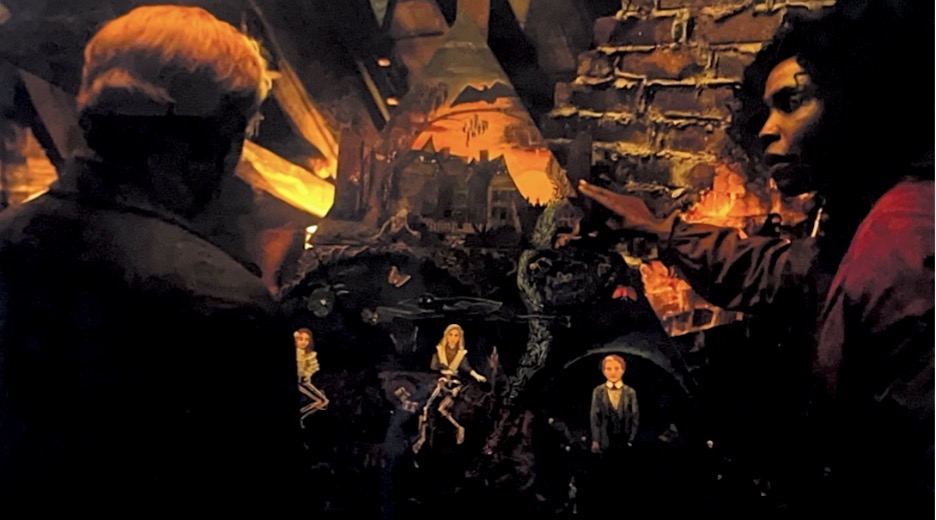
Walter Gilman (Rupert Grint) and Mariana (Tenika Davis) with the tetrapych predicting his death, and the fate of other dead characters. Copyright Netflix, 2022.
From my scholastic methods used to conduct this review, these three episodes—“Lot 36”, “Graveyard Rats”, and “Pickman’s Model”—did not manipulate sentimentality, nostalgia or fernweh effectively and sparingly used the dark, macabre, hyper temporalities and realms that lies at the heart of del Toro’s work. This is evidenced from the episodes’ near-unison clamor on the locus of the archive—be it a storage unit (“Lot 36”), cemetery underground (“Graveyard Rats” or even an art gallery (“Pickman’s Model”)—these are dangerous places that will eat you alive if given the chance. From a theoretical point of view, Fisherian hauntology may offer some potential answers as to how and why the hauntings are constructed and conceived.
Alice Fulmer (she/her) is an MA/PhD student at the University of California, Santa Barbara, educator, and poet. She is pursuing a Medieval Studies emphasis, and planning a prospectus on disability and gender in the Canterbury Tales. Her debut collection Faunalia (2023), is available from Ritona Press. Aside from reviews in SFRA Review, other academic publications include an article on Sir Launfal (c. 1400) in UCLA’s Comitatus. In February 2025, an arts & comedy podcast co-hosted by her and graduate students, Cunterbury, will debut on all major podcasting platforms.


 SFRA Review