Finding Missing Pieces of the Jigsaw Puzzle: A Survey of Japanese Science Fiction Studies in China


SFRA Review, vol. 51, no. 2

Symposium: Chinese SF and the World


Finding Missing Pieces of the Jigsaw Puzzle: A Survey of Japanese Science Fiction Studies in China

Jin Zhao

1

China’s first encounter with science fiction dates back to the end of the 19th century to the beginning of the 20th century. At that point, science fiction, as a genre of literature, like science and technology and modern industry, was extensively influenced by Japan. A lot of western science fiction classics were translated into Chinese from the Japanese versions rather than from the originals. Many of the translators were Chinese students who were studying in Japan, among whom were Lu Xun and Liang Qichao, to name just a few. For instance, Lu Xun, who at the time was studying at Kobun Institute in Tokyo, translated Jules Verne’s From the Earth to the Moon (1865) into Chinese from Tsutomu Inoue’s Japanese translation, and renamed it Journey to the Moon. This book was later published in China in 1903. Meanwhile, a number of Japanese science fiction works were introduced to China, which also played an important role in the early development of Chinese science fiction. In a sense, we can regard Japanese science fiction as an early mentor of Chinese science fiction.

Academia believes that Japanese science fiction began in the second half of the 19th century. Perry’s Expedition[1] not only ended Japan’s 220-year-old policy of isolation, but also brought about the beginning of Japanese science fiction. Gesshu Iwagaki’s Seisei Kaisin Hen (1857) , which was stimulated by this event, is considered to be the first work with science fiction nature in Japanese history. Forty years later, Shunro Oshikawa wrote Undersea Warship: A Fantastic Tale of Island Adventure (1900), which marked the real birth of Japanese science fiction. Although Japan suffered unprecedented failure in World War II, the post-World War II period witnessed a rapid recovery and development in its industry and economy. At the end of 1960s, Japan became the second largest economy in the world. In the meantime, its science fiction too experienced rapid development that later brought about the golden age of Japanese science fiction. Entering the Heisei era[2], along with the Japanese economic recession, Japanese science fiction went through a long period of decline. Since then, Japanese science fiction, while extending its traditional forms of literature, film and animation, has tried to expand into new areas such as games and art, presenting a more diverse look. Today, when we look closely at Japanese science fiction, while observing its rise and fall, we can also clearly see the development of Japanese science fiction studies in China that intertwined with it.

Many years after the founding of New China, studies focused on science fiction were rare. Considering the political reasons, this scarcity of scholarship is understandable. Along with the reform and opening-up in China, Chinese scholars and critics began to pay attention to Japanese science fiction. Even before Japanese science fiction works could be extensively translated into Chinese, some far-sighted scholars began to make their first attempts at Japanese science fiction. In 1980, Tong Bin published The Recent Developments of Japanese Science and Fantasy Literature, expounding systematically on the development of science fiction in Japan, which can be regarded as the beginning of Japanese science fiction studies in China. Thereafter, large numbers of Japanese science fiction works were translated into Chinese. Translators like Li Dechun, Meng Qingshu, and Li Youkuan have made valuable contributions to the popularization of Japanese science fiction in China. 

Today, science fiction has gained unparalleled development in China and has gradually become a mainstream culture. Meanwhile, scholars have published numerous articles, and Japanese science fiction scholarship is thriving. It is high time that we looked back upon the endeavors we had made to explore Japanese science fiction and, on some level, reexamined the de facto relationship between Chinese science fiction and Japanese science fiction. This article intends to outline Japanese science fiction studies in China in the past 40 years, and offer a brief account of the major studies which dominated Japanese science fiction studies in China at one time or another.

2

First of all, it is essential that we review the insightful opinions of some prominent Chinese scholars made to explore the nature of Japanese science fiction. 

One of the most important Chinese writers of popular science and science fiction after the founding of New China, and the foremost pioneer of science fiction studies in China, Ye Yonglie was also among the first to communicate with the Japanese science fiction community. In 1982, he wrote Japanese Science Fiction in China, exploring the history of communication between the two nations’ science fiction by detailing the translation and appreciation of Japanese science fiction in the early period of reform and opening-up. When this article was later translated into Japanese and published in Japan, it immediately attracted wide attention of the Japanese science fiction community. According to Ye Yonglie, Japanese science fiction is a completely unique existence in that most works are not confined to a scientific framework. It emphasizes the literariness and social responsibility of its themes, while paying great attention to the fantastical nature of its works. He notes that Shinichi Hoshi’s short-short science fiction stories, being a unique Japanese literary genre, resemble the classical Chinese novel Strange Tales from a Chinese Studio (1740) in both content and form. Ye Yonglie’s view provides an explicit reference to the intrinsic connection between the two nations’ science fiction.

Wu Yan, one of the most influential science fiction scholars in China, offers us insights based on his close observation of Japanese science fiction. Wu Yan emphasizes that Japanese science fiction, as a genre, is all encompassing. It includes not only adventure, detective, grotesque and political propaganda in the early period of Japanese science fiction, but also deductive, horror, myth, disaster and so on, which can be often seen in Japanese science fiction today. On the other hand, thanks to its unique geographical, historical, and cultural background, the national character inherent in Japanese science fiction has been significant ever since its birth at the beginning of the 20th century. When Shunro Oshikawa’s Undersea Warship: A Fantastic Tale of Island Adventure, the pioneering work of Japanese science fiction, was published, Japanese people were greatly stimulated by its expression of nationality. Henceforth, Japanese science fiction has always embraced implicit faith in this distinctive trait. After World War II, Japanese science fiction was sent on a solitary pilgrimage, in which many familiar themes that once seemed to dominate the Japanese science fiction world were abandoned, intentionally or unintentionally. Some writers began to imitate Western science fiction works. But the nationality which is deeply rooted in writers’ belief and creativity would not easily disappear. Thus, it is quite safe for us to say it is the persistence of this tradition which has passed down from generation to generation that offers the possibility of restoration to Japanese science fiction in the 21st century.

Han Song, one of the most prominent Chinese science fiction writers, holds that Japan has brought profound inspiration and influence to Chinese science fiction. As early as the late Qing Dynasty, western science fiction was introduced to China via Japan, which literally planted and spread the seed of science fiction on the ground of China. Lately, Japanese scholars have also begun to show their interest toward Chinese science fiction in the late Qing Dynasty, which can be perceived as an intriguing response to that interactive period of time in history. Today, Japanese science fiction studies is trapped in a somewhat awkward situation. Despite the fact that Japanese science fiction is widely read and appreciated by Chinese readers, as an independent scholarly subject it has not received proper respect from the academic world.

In addition, many scholars have devoted themselves to the study of representative Japanese science fiction writers and their works. By reviewing their studies, we may have a glimpse of some evident characteristics of Japanese science fiction studies in China.

Shinichi Hoshi was the first Japanese science fiction writer that Chinese readers got to know after the reform and opening-up. His works were translated into Chinese and published in China as early as 1982. At roughly the same time, he visited China and started to correspond with Ye Yonglie, to exchange views on the actual situation and developing prospect of science fiction in both countries. It was extraordinary and inexplicable that Shinichi Hoshi’s works were the only ones to survive the Anti-Spiritual Pollution Campaign[3], by which almost the whole science fiction world in China got shattered. Some interesting clues might be discovered by reviewing some of the early interpretations and evaluations Chinese scholars made on his works. Han Fenghua, believed that the sole aim of Shinichi Hoshi’s works was to attack capitalist society, economy and culture; similarly, Cui Xinjing and Tao Li, regarded Shinichi Hoshi’s works as a reflection of the social evil inherent in capitalist society. Obviously these devoted scholars in the 1980s, almost without exception, strove for a definition of Shinichi Hoshi’s works in terms of the socialistic perspective peculiar to that period of time in China. However, the stories’  science fiction aspect, which is vital to the works, was relentlessly ignored.

To this day, Sakyo Komatsu has maintained a pivotal position in the history of Japanese science fiction. Accordingly, he is also regarded as one of the most popular subjects of study among Chinese scholars. As early as 1975 when the Cultural Revolution was still enthusiastically going on in China, as a target of criticism, Japan Sinks (1973) was translated into Chinese by Li Dechun, and thus made Sakyo Komatsu the first Japanese science fiction writer introduced to Chinese people after the founding of New China. Actually, Japan Sinks is so well-known that when people talk about Japanese science fiction, the first thing that pops into their head will be Japan Sinks. Over the years, the interpretation of the novel from the perspectives of disaster culture and crisis awareness has been particularly favorable for scholars. Wang Zhanyi, by analyzing the multiple contexts of Japan Sinks, defines the nature of the disaster culture implied in Japan Sinks as the crisis awareness peculiar to the Japanese people. Alternatively, Di Fang proposes that geographical characteristics, Buddhist thought, and the impact of foreign culture are the internal elements that cause the formation of the Japanese crisis awareness. Zhang Huishu believes the ultimate aim of the direct depiction of disaster in Japan Sinks is to call for an awakening and restoration of the Japanese national spirit from the 1960s to 1970s. Even today, one may still find these scholars’ understanding of crisis awareness meaningful. But the truth is, studies like these abound. According to CNKI[4], there are a total of 14 scholarly articles on Japan Sinks, among which 11 articles with the theme of disaster culture and crisis awareness are listed. Of these 11 articles, the earliest one was published in 1986, while the latest one was published in 2019. Even the newest studies are not that much different from those from decades ago. 

However, there are still many crucial problems left to be solved. In fact, ever since the success of Japan Sinks, the Japanese science fiction community has witnessed the publication of a large number of science fiction works about disasters. However, if we review all the relevant studies of the past 35 years, we will find there are no science fiction scholars willing to commit themselves to the comparative reading and interpretation of these works. It is desirable that we clarify the dynamic interaction between disaster culture and science fiction, and indicate the uniqueness that distinguishes Japanese disaster novels from western disaster novels. It is worth noting that some scholars consciously attempt to compare Japan Sinks with the works by Chinese science fiction writers on similar subjects. Tan Yanhong, by contrasting the different historical and cultural background between China and Japan, offers a penetrating analysis of the similarities and differences between Red Ocean (2004) by Han Song and Japan Sinks.

We are not surprised at all to learn that Yasutaka Tsutsui, another one of the “Big Three”,[5] has been the center of attention, too. Lin Lan attempted to define a literary tendency established and represented by this science fiction master, namely, as she analyzed, a profound social thinking combined with serious scientific assumption and logical inference. Wang Minxi, by reviewing Yasutaka Tsutsui’s literary career and writing theory, aimed at summarizing and categorizing the surrealism expression in Yasutaka Tsutsui’s literary works chronologically. Zhao Haitao proposed an outline of Yasutaka Tsutsui’s style and the theme of works in different stages by offering a detailed analysis of Yasutaka Tsutsui’s works in terms of background, writing and literary evaluation. Apparently such scholars were eager to establish Yasutaka Tsutsui’s position as a literary master. Yet once again, we have no choice but to be confronted with the desperate situation: the science fictional perspective is missing from their studies.

Sixty years have passed since the “Big Three” became the dominant force in the Japanese science fiction world. Today, scholars still revere their works as sacred. This, in a sense can be understood as our long-lasting fascination for these classics. However, exclusive and excessive focus on the classics will inevitably lead to the neglect of new writers and new works. Thus, we are seriously confined in a static environment, which is by no means conducive to the healthy development of Japanese science fiction studies as a whole. We need something new and original. Something just like Xu Jinghua’s attempt on Genocidal Organ (2007) by Project Itoh, to interpret the novel from the perspective of ecological ethics. 

3

Concerning science fiction studies, it is important to concentrate on literature at the same time paying equal attention to visual expressions. And this seems particularly remarkable when we talk about Japanese science fiction. A retrospection of Japanese science fiction will inform us of the fact that since its babyhood, great importance has been attached to visual expressions such as film, manga, and animation. Thus, it is safe for us to say that Japanese science fiction has been endowed with a distinctive diversity, which is embodied in its indestructible and intimate kinship with various forms of visual expression.

However, Japanese science fiction film studies are not comparable to American science fiction film studies in terms of both quantity and quality. In the past few decades, the Chinese film market has been flooded with dazzling American science fiction films. Meanwhile, studies of American science fiction films are booming. If we search CNKI with American science fiction films as keywords, we will find more than 300 scholarly articles on American science fiction films, covering a variety of themes such as science fiction film industry, textual analysis of science fiction films, and science fiction film theories. Clearly, these scholars strive to grasp the current situation of American science fiction films in a comprehensive and dynamic way. On the contrary, Japanese science fiction film studies show a relatively static state. According to the statistics of CNKI, there are only about 20 scholarly articles with Japanese science fiction films as keywords. Moreover, these studies are often relatively isolated and unconnected to each other, which makes Japanese science fiction film studies severely deficient of a comprehensive system. Obviously, Japanese science fiction films have not received the due scholarly attention. 

As a major feature, Japanese science fiction films often treasure the individual feelings of ordinary man when being confronted with sudden and desperate disasters. Here we have to mention Japan Sinks (1973) again. Like its literary original, the film adaptation is regarded as the distinguished representative of Japanese science fiction films, that even in recent years, scholars are still reluctant to give up the subject, and thus makes Japan Sinks long-drawn-out studies for devoted Chinese scholars. According to CNKI, there are a total of 26 scholarly articles on Japan Sinks, of which as many as 22 scholarly articles take disaster culture and crisis awareness as their subject of study. For a long time, most Chinese scholars have repeatedly interpreted Japan Sinks solely from the perspective of either disaster film or crisis awareness,which makes our subject inevitably monotonous, stale and outdated.

Nevertheless, some scholars are able to propose new perspectives. Xi Xia, by clarifying the subtle relationship between science fiction film and disaster film, states that Japan Sinks has completely abandoned the cliché happy ending in most western disaster films. The real disaster in the film is by no means the disaster of nature but the deprivation of nationality and self-identity in the face of great disaster. He believes that the real intention of the film is to achieve a spiritual sublimation by means of material destruction. It is the disaster poetics and Japanese spirit that the film endeavored to express. In a sense, the film is more than a science fiction entertainment film. Consequently, the nature of this masterpiece is not a disaster film, but on the contrary, an inspirational one. 

In contrast to the studies of Japanese science fiction film, studies of Japanese science fiction animation show a comparatively colorful picture. Being an important part of Japanese culture, animation has always been loved and appreciated by Chinese audiences. Studies of Japanese science fiction animation started relatively late in China. According to CNKI, the earliest scholarly article was published in 2002. In recent years, studies of Japanese science fiction animation show a comparatively colorful picture.

The studies revolving around Hayao Miyazaki and his works are among the most notable and enduring. In particular, Hayao Miyazaki’s Nausicaä of the Valley of the Wind (1984), a product of Japanese thinking during the Cold War, carries in its genes the flavor of western literature and science fiction classics such as The Odyssey (720 BCE) and Dune (1964). Xi Xia sees this masterpiece as a spiritual support for the Japanese people during the economic recession of the 1990s. On the one hand, the work depicts the survival of the people of Earth after the nuclear disaster, and its imagination of the post-apocalyptic world is directly derived from the collective memory of the Japanese people brought by the nuclear explosion. On the other hand, the work has a political subtext that clearly distinguishes it from other works of its time: how should a small, peaceful country without a formal army survive in the midst of the struggle between the two hegemonic powers? This strongly hints at the difficult position Japan found itself in during the Cold War. While expressing pacifism, Hayao Miyazaki strives to manifest a spirit of Yamato, that is, the courage to die with enemies and to be proud of it. This all shows that Nausicaä of the Valley of the Wind has gone beyond the general sense of the theme of peace and embodies a philosophy thinking of harmony between man and nature similar to the advent of Jesus Christ in Occidental culture. Qin Gang holds a similar opinion. By giving a thorough interpretation of wind, which has been generally recognized as the theme throughout Hayao Miyazaki’s works, he endeavors to find the hidden clue in Hayao Miyazaki’s whole career as a great animation master, that is, the harmony between man and nature. Actually, the simple but unique motif of man and nature in Hayao Miyazaki’s works echoes a great deal with the early theme of Japanese science fiction. It is perhaps fair for us to say that it is the persistent pursuit of this motif that leads to Hayao Miyazaki’s success both as a well-known animator as well as an outstanding science fiction storyteller. 

Mamoru Oshii’s Ghost in the Shell (1995) is recognized as the most important Japanese animation since Akira (1988) as well as a monumental science fiction masterpiece in the 1990s. Most of the studies revolving around the film focus on cyborgs. Xi Xia indicates that the phenomenon that Japanese animation is replete with robots and cyborgs, in essence, originated from the national acceptance and tolerance of robots in Japanese culture. On the other hand, he holds his own interpretation of the pornographic and violent depictions that pervade the film. He believes that it is the ambitious yet serious philosophical exploration hidden behind the seemingly complex plot, interspersed with violence and eroticism, which enables Ghost in the Shell to establish an oriental aesthetic paradigm completely different from that of occidental science fiction animation. Deng Yachuan and Cai Song, by analyzing the identity changes of cyborgs in science fiction film, pose the ultimate question that if the distinction between man and cyborg is an ambiguous and obscure one, in which ways could the right to life be defined?

Regrettably, the studies revolving around great animators such as Osamu Tezuka, Fujiko F. Fujio, Katsuhiro Otomo, and Satoshi Kon failed to be put in the context of science fiction. Either focusing on the techniques and artistry or on the aesthetics, current discussions have, almost with no exception, completely ignored the valuable science fiction aspect of the works. For instance, Satoshi Kon, being regarded as a genius of visual narratives skilled in obscuring the boundaries between fantasy and reality as well as technology and humanity, undoubtedly deserves scholarly examination from the perspective of science fiction. Unfortunately, his works never won the favor of our conservative scholars. Indeed, this situation is both embarrassing and frustrating.

We are placing mecha anime (robot anime) and tokusatsu (special filming) at the bottom of our article not because they are the least in importance. It is because these two genres stand alone, representing very distinctive categories in Japanese science fiction. Fortunately, scholars have started to take hints of the importance of mecha anime and tokusatsu. Being the expression of the Japanese dream for space exploration, mecha anime stages a space opera in its own unique Japanese way. Liu Jian perceives mecha anime as a product that integrates traditional Japanese culture into modern science and technology in that on one hand, mecha anime is inherited from the Japanese mask culture, and on the other, it embodies Japanese enthusiasm for future science and technology. While tokusatsu, represented by Godzilla (1954) and The Ultra Series (1966), the long-lasting genre is so well-known that some of its most popular series have been remade in other countries. Huang Tao and Liu Jian have done relevant studies respectively. The former focuses on the interpretation of the monster image in Japanese science fiction film, and the latter proposes that by showing the process of Japanese re-modernization during the post-war period, the Godzilla series reflects the anxiety of contemporary Japanese people in urban life.

In fact, Japanese science fiction encompasses not only the above fields of literature, film, and animation, but also science fiction comics, science fiction art, and science fiction games. However, in our careful examination of the papers and dissertations on Japanese science fiction studies on CNKI, we find no research in these related fields. It is these gaps that make it difficult for us to grasp Japanese science fiction as a whole.

4

We are now looking at an interesting jigsaw picture, in which Japanese science fiction studies is gradually moving from the edge to the center of scholarly attention. Over the past 40 years, its reputation has been continuously enhanced. It is indisputable that Japanese science fiction studies has gained its solid position as a flourishing subject of studies. Thoughts both insightful and penetrating have been expressed in the form of well-written academic articles, which endeavor to offer a comprehensive, profound, and science fictional interpretation of Japanese science fiction in the presence of a Chinese sociocultural context.

Each year, various institutions and universities hold academic conferences and colloquia aimed at providing a platform for scholars to exchange views on Japanese science fiction. Besides, there are a number of academic projects. For instance, Contemporary Japanese Science Fiction Studies (2019) , a project led by Meng Qingshu, which is sponsored by the National Social Science Fund of China, focuses on the connotations and characteristics of Japanese contemporary science fiction works; while Studies of Translation and Influence of Science Fiction in Mainland China (2017), another project led by Yao Lifen, endeavors to offer an overview of the translation of Japanese science fiction in China from 1975 to 2016.

However, we should be aware of the fact that there are still some pieces missing from our jigsaw picture.

First, many studies appear monotonous and repetitious. This feature is particularly striking in science fiction literature studies. Scholarly focus was, is and probably will be firmly placed on the science fiction masters in the golden age, to be precise, on the “Big Three.” Valuable studies of influential rising stars are scarce and unattainable. Some articles offer only superficial analyses of the works and are short of meaningful views; others are devoted to the repetition of former articles, in both subject and method, and in some cases even in opinion. For instance, according to CNKI, 40 scholarly articles and theses focused on Japan Sinks were published from 1986 to 2019. The most favored perspective are, as we may imagine, about disaster culture and crisis awareness, with a total of 33. It is difficult for us to imagine when a number of similar studies have already piled up, how to submit a truly innovative article. Excellent articles are few and far between. The situation is both discouraging and alarming.

In addition, not realizing the fact that Japanese science fiction is an inseparable unity consisting of literature, film, animation and many other forms of popular culture, some scholars fail to perceive Japanese science fiction as a whole and exhibit its distinctiveness in their studies, and thus fail to master the core of Japanese science fiction. In fact, a large number of scholars do not have adequate Japanese language skills, and some of them do not even know Japanese at all, so they are not able to read works in the original. As a result, they have to rely on the Chinese translation, which is sometimes, if not always, obscure and misleading. Ultimately, their field of vision is confined to the Chinese translation.

Moreover, instead of speaking in the context of science fiction, many scholars tend to restrict their topics to form, technique, artistry and aesthetics. Necessary academic knowledge is missing in the essential prerequisite as a qualified science fiction scholar. On the other hand, blind to the fact that science fiction is related to humanities such as philosophy, art, anthropology and so forth, many scholars focus so exclusively on their own professional fields, that they are reluctant to cultivate the above knowledge. Admittedly, owing to the fact that effective interpretations of Japanese science fiction are greatly limited by the lack of knowledge of the humanities, we are unable to bring Japanese science fiction studies to a theoretical level.

In spite of all these problems, we should not be pessimistic about the future of Japanese science fiction studies in China. Undeniably, China still needs more time to develop a deeper understanding of Japanese science fiction. However, it is about time that we asked ourselves the simple but vital question: what academic attitude should we adopt to deepen and broaden our study field? Obviously, by answering it, we will be able to find the missing pieces of the jigsaw puzzle, which hint at a possibility for the future of Japanese science fiction studies in China. 


NOTES

[1] The Perry Expedition was a diplomatic and military expedition to the Tokugawa Shogunate, involving two separate voyages by warships of the United States Navy which took place during 1853-1854. The expedition was commanded by Commodore Matthew Calbraith Perry, under orders from President Millard Fillmore. The Perry Expedition led directly to the establishment of diplomatic relations between Japan and the western Great Powers, and eventually to the collapse of the ruling Tokugawa shogunate and the restoration of the Emperor.

[2] The Heisei era is the period of Japanese history corresponding to the reign of Emperor Akihito from 8 January 1989 until his abdication on 30 April 2019.

[3] The Anti-Spiritual Pollution Campaign was a political campaign spearheaded by left-wing conservative factions within the Communist Party of China which lasted from October 1983 to December 1983. During the Anti-Spiritual Pollution Campaign, science fiction was administratively characterized as “spiritual pollution” and was criticized. The publication of science fiction was banned, and related magazines were suspended for rectification.

[4] CNKI (China National Knowledge Infrastructure) is a key national research and information publishing institution in China, led by Tsinghua University, and supported by PRC Ministry of Education, PRC Ministry of Science, Propaganda Department of the Communist Party of China and PRC General Administration of Press and Publication. Today, CNKI has become the largest and most accessed academic online library in China. The data and scholarly articles used in this paper were obtained from databases of CNKI, including academic journals and dissertations.

[5] The “Big Three” refers to three of the most influential science fiction writers of the golden age of Japanese science fiction in the 1960s, namely, Sakyo Komatsu, Shinichi Hoshi, and Yasutaka Tsutsui.


WORKS CITED

Cui, Xinjing. “The Artistic Characteristics of Shinichi Hoshi’s Short-short Stories.” Japan Studies, vol.4, 1988, pp.79-83. CNKI.

Deng, Yachuan, and Cai Song. “A Modern Fable: Identity Changes of Cyborgs Amid Anxiety Towards Science.” Movie Literature, Feb. 2020, pp.50-53. CNKI.

Di, Fang. “Analysis of Japanese Crisis Awareness Based on Japan Sinks.” Journal of Liaoning Teachers College (Social Sciences Edition), vol.1, 2016, pp.30-31. CNKI.

Han, Fenghua. “Analysis of Shinichi Hoshi’s Short-short Stories.” Foreign Literature Studies, vol.4, 1987, pp.65-70. CNKI.

Han, Song. “Science Fiction and Modernity of Oriental Nations.” China Reading Weekly, 26 Sep. 2007, C1.

Huang, Tao. “Studies of Supernatural Images in Japanese Films.” Fujian Normal University, 2018, pp.13-16. CNKI.  

Lin, Lan. “Meditation After Laughing: Review of Tsutsui Yasutaka’s Psychology, Sociology.” Journal of Foreign Studies, vol.1, 1991, pp.37-39, p.36. CNKI.

Liu, Jian. “Study on the Source of the SF Mecha Animation Cultural Theme.” Journal of Jilin University of Arts, vol.4, 2017, pp.64-70. CNKI.

—–. “Japan’s Post-war Social Transformation in Godzilla Films.” Journal of Beihua University (Social Sciences), Jun. 2017, pp.128-136. CNKI.

Nagayama, Yasuo. “The Beginning of Japanese Science Fiction.” A History of Japanese SF Spirit: From the Late Bakufu / Early Meiji Period Until the Post War Era, Nanjing University Press, 2012, pp.5-8. 

—–. “Around the New Century.”A History of Japanese SF Spirit: From the Late Bakufu / Early Meiji Period Until the Post War Era, Nanjing University Press, 2012, pp.73-75.

—–. “Days of Controversy and Festivals.”A History of Post-war SF Event: 70 Years of the Japanese Imagination, Kawade Shobo Shinsha Publishers, 2012, pp.104-127.

Qin, Gang. “General Introduction: Hayao Miyazaki, the Wind Catcher.”Hayao Miyazaki the Wind Catcher: Depth of Hayao Miyazaki’s Films, SDX Joint Publishing Company, 2015, pp.3-25.

Tong, Bin. “The Recent Developments of Japanese Science and Fantasy Literature.” Foreign Literature Studies, vol.3, 1980, pp.142-143. CNKI.

Tan, Yanhong. “ Cosmologist Writing of Ocean: A Comparison Between Red Sea and Japan Sinks.” Contemporary Literary Criticism, vol.2, 2012, pp.134-137. CNKI.

Tao, Li. “Shinichi Hoshi and His Writing.” Appreciation of Famous Literary Works, vol.3, 1984, pp.102-105. CNKI.

Wang, Minxi. “Surrealism in Tsutsui Yasutaka’s Works.” Shanghai International Studies University, 2007, pp.11-27. CNKI.

Wang, Zhanyi. “Crisis Awareness in Japan Sinks: Analysis of Japanese Disaster Culture.” Northeast Normal University, 2013, pp.13-28. CNKI.

Wu, Yan. “Global Laggard Writers Cluster.” Thesis on Science Fiction Literature, Chongqing Publishing Group, 2011, pp.157-168.

Xi, Xia. “Japan Sinks or Something Else Rises.” How Long are the Fingers of E.T., Sichuan Science and Technology Press, 2016, pp.104-111.

—–. “The Unseen Nausicaä of the Valley of the Wind.” How Long are the Finger of E.T., Sichuan Science and Technology Press, 2016, pp.148-157.

—–. “Soul Possession or Out of Body, That is the Question.” How Long are the Finger of E.T.,  Sichuan Science and Technology Press, 2016, pp.186-195.

Xu, Jinghua. “The Alarm of Genocidal Organ by Project Itoh: Based on the View of Reconstructing Existentialism in the Oriental Context.” Journal of Heilongjiang College of Education, Dec. 2017, pp.106-108. CNKI.

Ye, Yonglie. “Open the Door of Communication.” Capital Ship Sinks, Sichuan People’s Publishing House, 2017, pp.209-240.

Zhang, Huishu. “Crisis Awareness in Japanese Disaster Culture: A Case Study of Japan Sinks.” Literature Education, Oct. 2016, pp.173-175. CNKI.Zhao, Haitao. “The Discovery of Fiction in a Different World and a Different Reality: On Tsutsui Yasutaka’s Literary World.” New Perspectives on World Literature, vol.4, 2015, pp.77-82. CNKI.


Jin Zhao is a science fiction enthusiast, science fiction scholar, science fiction translator and science fiction writer-to-be. For many years, she has devoted herself to the comparative study of Chinese and Japanese literature and culture, and the study of science fiction literature. Currently, she is working a dissertation on the study of Japanese science fiction culture.

China’s Pluralistic Studies of English Science Fiction: Doctoral Dissertations as Examples


SFRA Review, vol. 51, no. 2

Symposium: Chinese SF and the World


China’s Pluralistic Studies of English Science Fiction: Doctoral Dissertations as Examples

Chan Li

In globalized sf culture, sf in English has been dominant ever since the birth of modern sf in the 19th century. As a popular genre, sf development relies heavily and inevitably upon the marketplace, where academic studies would help explore and establish the values obscured by commercial shrouds. In the field of English-language sf study, Chinese scholars have published numerous significant papers, many of which are extracted or extended from their doctoral dissertations, which have got or would be published in book form, constituting in turn the major part of the book publishing in this field. And in terms of academic strength, in China Master’s theses are incomparable to doctoral dissertations, due to their different program requirements. The brief review of this paper thus focuses on doctoral dissertations, together with relevant academic books, as they stand out not only as crystallization of existing relevant research interests, but representing the most comprehensive and highest level of standards.

Searching science fiction or sf as the keyword in the ChinaInfo (万方) thesis database, the results are 293 Master’s theses, 12 doctoral dissertations and 1 post-doctoral report from 2001 to 2019. The results of the same word as the subject in the CNKI (中国国家知识基础设施) thesis database show that, from 1992 to 2019 there are 641 Master’s theses and 45 doctoral dissertations. The results combining these two major academic engines are by no means complete, as studies in Hong Kong, Macao, and Taiwan are not included, and even in the mainland some dissertations choose non-disclosure for up to 5 years upon submission, which means they could only be accessed via university internal libraries. For these inadequacies  in statistics, the survey tries to compensate with the author’s knowledge. Generally, studies of English sf in China involve scholars not only of English literature, but also of Chinese, art, and history, presenting an overall picture of interdisciplinary study, and highlighting the increasingly widened academic attention to the genre.

Studies on SF Translation

Among the search results, many have low or no relevance to the subject. For example, the earliest result of doctoral dissertations is the one by Wang Hongqi (王宏起) in 2002, which is a study of Mikhail Bulgakov’s writing, just mentioning there is influence from H. G. Wells’ books. The earliest dissertation with high relevance appears in 2006, details as below: [1]


This debut is not overdue, as the first doctoral dissertation on Chinese sf by Wang Weiying (王卫英) is completed in the same year. And translation study is a proper beginning, as sf appears in China first as Western import in the early 20th century. The dissertation takes a descriptive mode of translation studies, the main part including an introduction of the genre and its developmental phases in China, the case study of the translation of five sf stories, three being English, and their impact on the selection and translation of sf, and subsequently upon Chinese sf writing. The analysis centers on the socio-cultural, literary, and translation norms of different historical periods, confirming  the turn from linguistic to cultural approach in China’s translation studies since the late 1990s. During that period, some scholars have turned to the translation of Western popular fictions since the late Qing Dynasty and focused on the working of translation in the target culture, including Kong Huiyi (孔慧怡) from Hong Kong Chinese University, Yang Chengshu (杨承淑) from Fu Jen Catholic University, and Guo Jianzhong (郭建中) who has co-edited with James Gunn the Chinese six-volume The Road to Science Fiction (1997-1999) and published the monograph Translation of Popular Science Works and Science Fiction: Theory, Technique and Practice (2004). Guo is Jiang’s MA supervisor and one advisor of her Ph. D. dissertation.

Studies with Focus on SF Utopianism

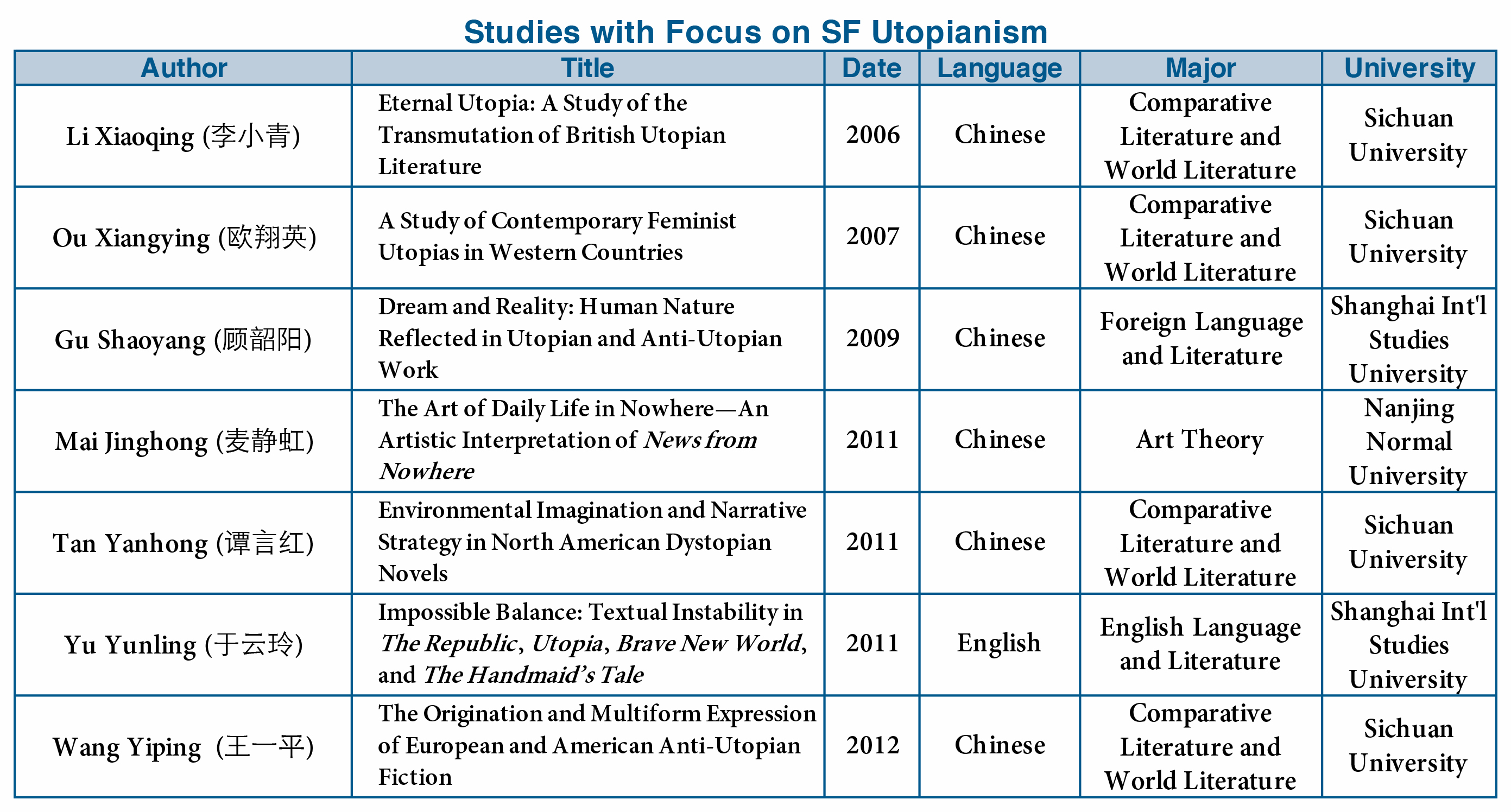
As utopia, dystopia and anti-utopia are significant classic achievements in intellectual and literary history, quite a few dissertations have taken these angles to cut in sf studies, as listed below:


As Sargent identifies the three broad directions of utopianism as “utopian thought or philosophy, utopian literature, and the communitarian movements”(222), a lot of dissertations with the keyword utopia are theoretical studies of utopian philosophy, and even the literary study of Utopian Thought in Some British and American Fiction (2008) by Niu Hongying (牛红英) is actually a study of utopian thought in some classical non-sf writers, and thus they are not included in Table 2. Mai Jinghong’s dissertation, though included in the table, has weak relevancy to sf, as it interprets Morris’s work as a daily artistic theory.

Li Xiaoqing’s dissertation was completed several months earlier than Jiang Qian’s, but its focus is on establishing and sorting the British tradition of utopian literature, with no awareness of the overlapping and converging of sf and utopia. It mainly outlines the development and variation of this tradition, tracing its origin back to the ballad The Land of Cokeygne in the 14th century, and including not only many proto- and modern sf works, but many classical works like William Black’s poetry, Philip Sidney’s pastoral romance, and William Shakespeare’s drama into the tradition. For the representative works of eutopia, dystopia, critical utopia, and female utopia, it offers brief interpretations mainly in terms of their historical contexts.  

Ou Xiangying’s dissertation takes the feminist utopian sf in Europe and America between 1950s and 1990s as its subject, and its method is an integration of literary criticism and cultural studies with a focus on political critique aided by content and form analysis. After expounding how the second wave of feminism influenced utopian writing, and how feminist utopias reformed sf tradition, it goes to a systematic account of significant feminist utopias in terms of single-sex worlds, two-sex worlds, and feminist dystopias, and then sums up the views of science and ethics, political design, and female subjectivity in those feminist utopias. 

Gu Shaoyang discusses some utopian and anti-utopian literature, but the differences are simply relegated to the abstract opposites of ideal and reality, freedom and bondage, good and evil. Tan Yanhong studies the environmental narratives of Oryx and Crake, The Year of Flood, The Hunger Games and Uglies, all published in the 21st century in the US and Canada, and her approach is more a literary criticism than Ou’s with one focus upon the point-of-view narratives in those “dystopias.” Tan generally regards dystopian fiction as a subgenre of sf, but she equals dystopia to anti-utopia. About the notoriously controversial disagreement over the uses of utopia, dystopia and anti-utopia, etc., under the umbrella term utopianism, Yu Yunling and especially Wang Yiping have made detailed clarifications based on discussions of some prominent utopia scholars like Lyman Sargent, Darko Suvin, and Krishan Kumar, which makes their argumentation more solid and forceful. They both follow the specific definitions of the several textual forms of the literary utopia made by Sargent in his famous “The Three Faces of Utopianism Revisited” (1994), and hold that literary anti-utopia is a parody of utopia, depicting a nightmare world with utopian agenda put into practice, while dystopia is not necessarily a negative extension of the previous utopia. Accordingly, Wang regards Atwood’s The Handmaid’s Tale as a dystopia, the same as Yu does, while classifying her Oryx and Crake, which Tan labels a dystopia, as an anti-utopia in the tradition set by Brave New World.

Wang Yiping’s dissertation aims to study anti-utopian literature as an independent tradition as she deems that in the 20th century it has become the mainstream imagination of the future, replacing utopia with its alerting attitude to “social progress.” In order to establish such a tradition, she first expounds the transition from utopia to anti-utopia, and defines the responses to the scientific and high-tech world state by H. G. Wells as tide-turning, then goes on to explore the multi-development of the basic themes established in the early 20th century. For literary studies as a whole, doctoral dissertations in China are usually combinations of historical, theoretical, and textual studies to different degrees, and the latter two approaches are foregrounded respectively by Wang’s and Yu Yunling’s dissertations. Wang finds that the anti-utopian writings are congruent with modern anti-utopian thought, and she draws upon the anti-utopian philosophy, political science and sociology of Karl Popper, F. A. Hayek, Isaiah Berlin, and J. L. Talmon for her fiction analysis. Yu Yunling focuses on the devices intended to achieve textual stability including allegories, authoritative text, monolithic text and patriarchal text, and the counteraction in the process of interpretation which ultimately leads to textual instability. Whilst Tan Yanhong makes use of narrative strategies in her textual analysis, Yu intends to explore some general narrative principles underlying utopian and dystopian writings, which is more narratology oriented. It is not accidental as Yu’s supervisor Qiao Guoqiang (乔国强) is a renowned scholar of narratology in China. 

Yu Yunling’s study represents one tendency in contemporary narratology studies, scholars in this field being increasingly interested in sf especially when addressing issues of postmodern narratives, world building, possible worlds, unnatural narratives and narratology itself. One example is David Wittenberg’s Time Travel: The Popular Philosophy of the Narrative (2012), which argues that time travel fiction can be viewed as “a narratological laboratory,” literalizing many of the basic theoretical questions of storytelling (2). Among many reviews of this book, the renowned sf scholar Adam Roberts made several harsh but pertinent criticisms, one of which is that “Whilst Wittenberg engages with a good spread of primary texts, his knowledge of the secondary criticism of science fiction is thin,” since he positions Bellamy’s Looking Backward as the first time travel fiction, born of Darwinistic prognostication of utopian romances, but his Darwinian thesis “relates less to the ‘utopian’ and rather more to the ‘scientific romance’ mode of the late century” (732-733). Insufficiency in comprehensive knowledge of sf and its criticism, if I might say so not without prejudice, is not uncommon in some narrative studies of sf, as most of their concerns fall ultimately on narrative norms or theories, which likely results in using SF texts as simple exemplifications for their argumentation as well. [2] But still, such studies would benefit sf studies by offering different perspectives. 

Studies with Focus on Science and Technology Narratives in SF

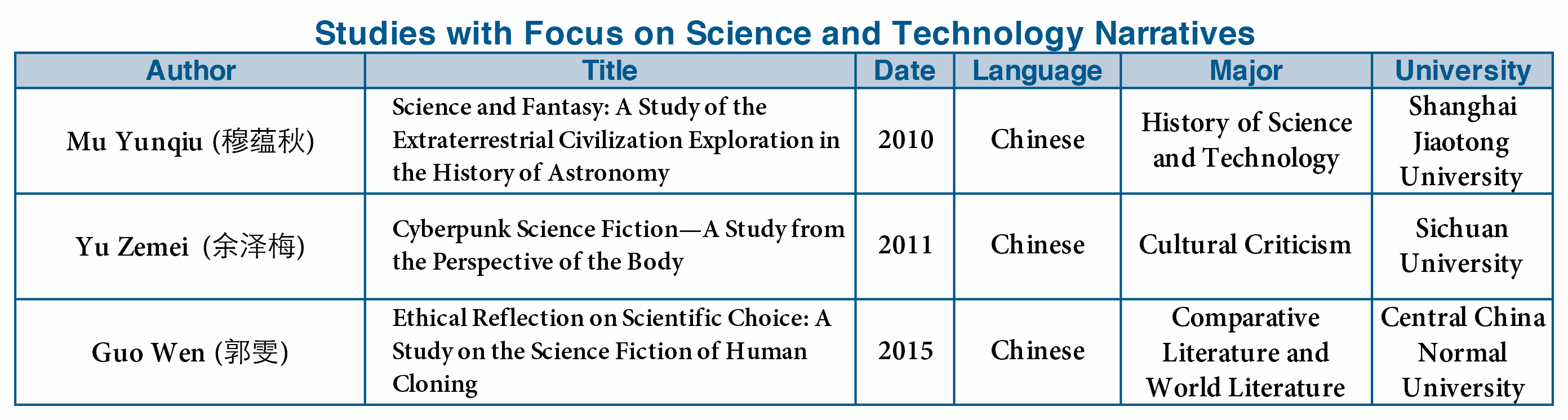
The third type of English SF studies highlights science and technology narratives, as the following table shows:


Mu Yunqiu’s dissertation holds that sf could be regarded as a part of scientific activities because of extraterrestrial exploration constantly involving interstellar fictions, some astronomers having authored sf works, and some astronomical theories containing imaginary content from the 17th to the early 20th century. The underlying position of re-establishing a new history of science based on cultural narratives, is expanded in her postdoctoral report The Study of Science Fiction in the Perspective of the History of Science (2012), which focuses on the narratives about Mars and the Moon, and sf works on the journal Nature. Mu’s cultural perspective of science comes from her supervisor Jiang Xiaoyuan (江晓原), who has published Are We Ready: Science in Fantasies and Reality (2007) and co-authored with Mu A New History of Science: A Study of Science Fiction (2016). In terms of sf study, they explore major themes through the lens of scientific discourse construction.

Yu Zemei’s dissertation argues that cyberpunk fiction is the convergence of SF writing in a postmodernist context and a theoretical turn to body concern. Its five chapters deal with two major issues, the postmodernist characteristics of cyberpunk fiction, and the ideological change of human subjectivity and selfhood brought about by the hybrid fusion of body and technology. Its merit and demerit are equally noticeable. It is a hard-edged study with an extensive literature review of the academic scholarship on cyberpunk. In 2012, Fang Fan (方凡) of Zhejiang University also published a literary study on cyberpunk titled American Postmodern Science Fiction, which is relatively weak in its theoretical grounding compared with Yu’s dissertation. But alongside Yu’s acute observations, there exist some mistakes of negligence. For example, she makes the inaccurate statements “Science Fiction is the genre of technological impact,” and “Body starts occupying increasingly important status in SF since the 1950s” without supportive argument or notes (2-3). 

Guo Wen’s dissertation is quite lucid in language and thinking. She has noticed science and technology has changed the traditional definition of the human, but unlikeYu Zemei focusing on posthumanism and cyborgism, she is mainly concerned with the ethical reflections of technological alienation and human materialization in 16 sf works on cloning from Europe, America and Asia, including Never Let Me Go, Cloud Atlas, Brave New World, etc.. After elucidating the relationship and influence between the development of biotechnology, genetic engineering, and sf writing, her dissertation addresses three ethical situations: individual clones’  copy-of-the-origin status, group of human cloning with individual clones reduced to simulacra and signs, and the failure of utopias of human cloning to solve technological and ecological crises. Her main methodology is “ethical literary criticism”, a paradigm of literary criticism grounded in Western ethical criticism and Chinese moral criticism, first proposed by her doctoral supervisor Nie Zhenzhao (聂珍钊) in 2004. Recently Liu Xiaohua (刘晓华) of Cangzhou Normal University, has published Science and Technology Ethics in Anglo-American Science Fiction (2019), which discusses ethical problems in sf depictions of life intervention, cloning, cyberspace, robots, cyborgs, and the environment, on a much broader scale. 

Studies on Individual SF Writers

The fourth type of studies is on sf writings of individual writers. Among the search results, quite a few studies on George Orwell, William Golding, Kurt Vonnegut, Doris Lessing and Margaret Atwood are not relevant to their sf writings. The below table shows the studies of high relevance to sf:


Studies on individual sf writers start with Ursula K. Le Guin, who has contributed admirably to the genre development, and who, far from denying connection to sf by some writers of similar literary prestige like Vonnegut and Atwood, had a deep sense of identification with the genre. In 1981, “The Dairy of the Rose” (1976) is translated in the namesake collection of sf short stories, and in 1982, an sf introductory anthology translated from the 1978 Japanese original includes introductions to the Earthsea trilogy and The Left Hand of Darkness. [3] During the 1990s, translations of her short stories and novel excerpts appear in the magazine Science Fiction World (《科幻世界》). The first full-length translations of her novels are in mainland China the Earthsea stories in Jan. 2004, and in Taiwan The Left Hand of Darkness Dec. 2004. Le Guin starts to attract academic attention in the late 1990s. Ye Dong’s doctoral supervisor Yang Renjing (杨仁敬) includes sf into classic literary history in A History of Twentieth-Century American Literature (1999), and offers a special part on Le Guin in the co-authored A Concise History of American Literature (2008) (Ye 16-17) .

Ye Dong and Liu Jing both take some sf and fantasy stories of Le Guin as their subjects, though Liu’s title calls it sf inaccurately. Both hold the basic claim that Taoism constitutes one constant influence on Le Guin’s thought and writing, and she is unique in using distinctly Western art forms to communicate primary tenets of Taoism, such as Non-action (无为),Mutual Generation (相生), Balance (均衡), Yin and Yang(阴阳). Liu discusses representations of Taoist influence from man-nature relation, political ideology, and individual life value, whilst Ye from gender relation, social collective relation, and human-nature relationship. Two out of three their discussions roughly overlap in terms of perspectives, but Ye Dong argues with more clarity and force, in that she consciously discusses Taoist influence in interaction with feminist sf, utopianism, and ecocriticism. And to further fortify her proposal, she adds a chapter on Le Guin’s translation of Tao Te Ching (《道德经》) against the background of the Western understanding of Taoism. 

Wang Shouren (王守仁), Cheng Jing’s doctoral supervisor, devotes a chapter to elucidate the contemporary development of popular literature such as western fiction, crime fiction, sf, and high-tech thriller in The New History of American Literature Vol. 4 (2002), where he mentions that Le Guin is one representative of the  New Wave Movement. This might be one reason for Cheng Jing to choose the subject, since research subjects usually have to be permitted or supported by supervisors. Compared with Ye Dong and Liu Jing, Cheng Jing limits her study to Le Guin’s sf writings, and proposes that Le Guin opposes techno-determinism, technophobia or misuse of technology and advocates for a Taoist deference to the natural development of technology. 

Doris Lessing is introduced and translated in China as early as in the 1950s, with full translations of Hunger (1953), The Grass is Singing (1950) and A Home for the Highland Cattle (1953) published respectively in 1955, 1956 and 1958, and academic study mainly starts in the early 1980s (Wang 172). There are 20 doctoral dissertations or so on her writings since 2005. 

All three in Table 4 focus on Lessing’s five space fictions. Tao Shuqin thinks, somewhat simplistically, that Lessing claims colonization as the real drive of and path to civilization, and the genre “Space Fiction” itself is also a failure, since historical narrative, critical realism, and science fiction are contradictory to one another. Zhang Qi also takes postcolonialism as her major approach, and interprets Lessing’s depiction of the colonial, the female and the diasporic Other as profound revealing of identity crises, which are influenced by her traumatic family experience, life in Africa and identification with Marxism. As she discovers, Lessing’s attention to S&T, her reading of sf works, and conscious adapting sf for social criticism, would explain why she writes those space fictions (180-181).

Generally, Zhang Qi reads those space stories mainly as reflections of power operation in politics, military affairs and culture in the 20th century, and this implicit interpretation strategy is clarified and defined by Yin Bei as allegorical metaphors, a position foregrounding and also conforming  the thought-experiment features of Lessing’s space fictions especially compared with her earlier writings. Yin Bei focuses on Lessing’s innovative use of sf for cultural and philosophical pondering over the historical interaction of language, cognition and reality, and accordingly she draws on the conceptual metaphor theories proposed by George Lakoff and others. Yin Bei goes deep to explore Lessing’s sophisticated thought-experiments. For example, after examining the two metaphoric paradigms on morality of “The Strict Father Model” and “The Nurturant Parent Model” in Chapter Three, she goes on in Chapter Four to analyze two overlapping but different rationalist ethical views derived from the first paradigm, namely, the Lamarckian Evolutionary Metaphor and the Social Darwinistic Evolution Metaphor. And she concludes that Lessing has revealed  some metaphoric paradigms once derived from concrete life experiences have become entrenched in subconsciousness and cultural norms.

Graduating together with Yin Bei, Li Chan mainly studies H. G. Wells’s sf  against the contemporary culture and the sf tradition. Her dissertation is built up on the basis of Wellsian studies, Western Marxist sf criticism, and literature and science studies, with the main body addressing the evolutionary imaginations in Wells’s sf, the historical isomorphic imaginations of anthropology and Wells’s sf, the two-dimensional depiction of the machines as the symbol of technology and that of mechanism, and the cultural development of Well’s dynamic utopia and its failure. One merit of her dissertation is that the textual analysis is embedded in the discussion of (pseudo-)scientific and cultural construction of evolution discourses and their transmutation into a diachronic model of progress.

Theoretical Studies of Sf

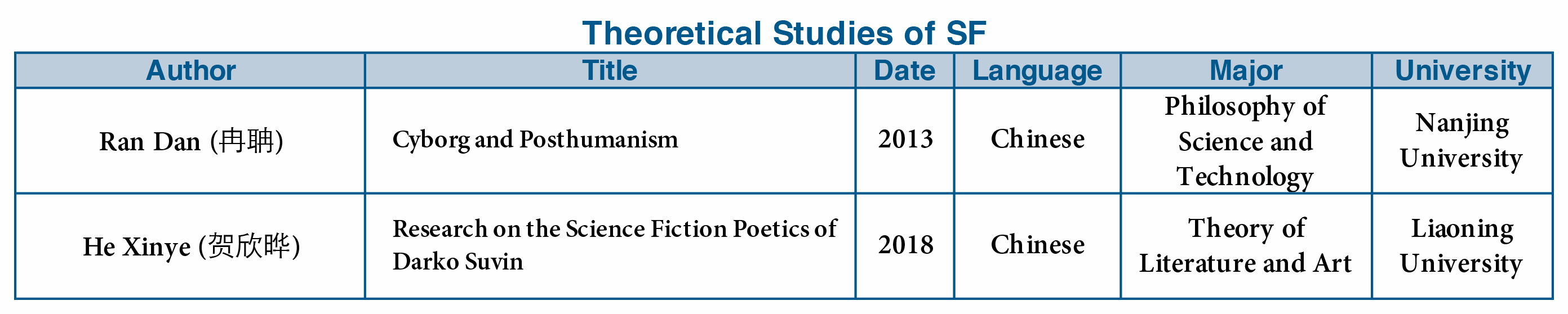
The fifth type is theoretical studies of or related to sf, with two dissertations as listed below:


Ran Dan’s research is a philosophical study, and it is included here as it could help to  understand  the broad context of related discussions. Ran thinks cyborgism has become one of the most influential cultural thoughts in Western academic circles, and it enters the field of posthumanism with its breaking of dualism and challenging of the ontological purity of human subject. The main body discusses the theories of Andrew Pickering, Donna Haraway, and N. Catherine Hayles with an attempt to establish an internal logical connection among them. He Xinye focuses solely on the sf poetics of Darko Suvin, as she finds Suvin is widely referred to but in China there is no in-depth and systematic expounding of his theories. Actually the first chapter of Li Chan’s dissertation interpretes three key concepts of Western Marxist SF study, namely, utopia, estrangement, and cognition, for which Suvin is the cardinal representative. Li’s discussion doesn’t enter He’s investigation, because, as explained earlier, the author chooses non-disclosure. One chapter might be sufficient for the study of Suvin’s theories in relation to sf writing, but it needs a full dissertation to establish its position in the related theoretical history. For example, one section of He’s dissertation is on Suvin’s continuation and development of the classical Marxist concept of cognition, truth and practice. 

In the aspect of theoretical study, Wu Yan (吴岩) has made significant contributions in spite of the fact that  his major concern is Chinese sf. Under his national research project, he has organized the translation of sf theories by Suvin, Brian Aldiss, and Isaac Asimov, and published Literary Theories and Discipline Construction of Science Fiction (2008) and An Outline Study of Science Fiction (2011). The first book offers a comprehensive review of basic theories, critical perspectives and practices, teaching methods and resources of sf study, and the second studies major sf groups of different identities and argues the genre’s legitimacy arises from its cultural marginality.

In this brief survey of doctoral dissertations and related books on English sf in China, we can find the overall research evolves with increasing force. With profound and innovative studies along with some mistakes and limits, what could be strengthened, in the author’s view, is first studies of more significant sf writers. The present studies all engage in those writers canonized in mainstream literary history, but it will take time to expand the scope. Secondly, sf narratives of S&T could be further explored based on more pertinent  theoretical study. For in the contemporary techno-scientific world, S&T is no longer restricted to laboratories or factories, but in Bruce Sterling’s words, pervasive and utterly intimate (xiii), and sf is almost the only genre of abiding interest in S&T embedded in value-loaded social life. Besides, with such studies, the academic stereotype of sf as minor and idiosyncratic might get dispelled.

Academic study is never independent of its institutionalization, as shown here by how Jiang Qian, Yu Yunling, Mu Yunqiu, Guo Wen, Ye Dong and Cheng Jing were guided or inspired by their supervisors in their writing. Most of the doctors discussed in the paper have gained the positions of associate professor or professor at universities, and are supervising graduate students now. With years of intensive research on sf for their dissertations, they have laid a sound foundation in the field and most probably developed genuine devotion to the genre. With these advantages, a promising future of study might be reasonably expected.


NOTES

[1] For the dissertations and books discussed, I follow their original English titles or translate the Chinese when there are no English ones.

[2] Another typical example is Jan Alber’s Unnatural Narrative: Impossible Worlds in Fiction and Drama (2016). According to Alber, the unnatural narrative in sf becomes “a bona fide concern,” different from the postmodernist “illusion-breaking” unnatural narrative, and the conventionalized sf impossibilities could be explained “through technological progress or simply by associating them with a potential future.” See Jan Alber. Unnatural Narrative: Impossible Worlds in Fiction and Drama. University of Nebraska Press, 2016, pp. 42-43, p. 107.

[3] See Shao Bo (邵柏) and Fu Shen (符申) eds. Meigui Riji 玫瑰日记 [The Diary of Rose]. Chongqing Branch of Science and Technology Literature Press, 1981, pp.1-30; Takashi Ishikawa, Norio Ito eds. Shijie zhuming kexue huanxiang xiaoshuo xuanjie 世界著名科学幻想小说选介 [An Introductory Anthology of World’s Science Fantasy Masterpieces]. Trans. Gao Qiming (高启明), Pan Liben (潘力本), Wang Lian’an (王连安), Shan Yang (山杨), Su Zhengxu (苏正绪), Jilin People’s Press, 1982, pp. 204-208, pp.341-345. This information is gained from Wang Wen (王文), a big sf fan, who is currently building a comprehensive Chinese sf database.


WORKS CITED

Roberts, Adam. “Time Travel: The Popular Philosophy of the Narrative.” Textual Practice, vol. 28, no. 4, 2014, pp. 730-734.

Sargent, Lyman Tower. “The Three Faces of Utopianism.” Minnesota Review, vol.7, no. 4, 1967, pp. 222-230.

Sterling, Bruce. “Preface.” Mirrorshades: The Cyberpunk Anthology, edited by Bruce Sterling, Ace Books, 1986. 

Wang, Jiaqi (王嘉琦). Duolisi laixin zuopin de fanyi ji yanjiu zongshu多丽丝·莱辛作品的翻译及研究综述 [“A Brief Review of Translation and Research of Doris Lessing”]. Heilongjiang shizhi [《黑龙江史志》], no. 21, 2013, pp. 172-173.

Wittenberg, David. Time Travel: The Popular Philosophy of the Narrative. Fordham University Press, 2012.

Ye, Dong. Ursula K. Le Guin’s Quest for Tao in Her Science Fiction and Fantasy World. Xiamen University Press, 2017.

Yu, Zemei (余泽梅). Saibopengke kehuan wenhua yanjiu—yi shenti wei shijiao 赛博朋克科幻文化研究——以身体为视角 [“The Culture of Cyberpunk Science Fiction—A Study from the Perspective of Body”]. Diss., Sichuan University, 2011.

Zhang, Qi (张琪). Lun duolisi laixin taikong xiaoshuo zhong de wenhua shenfen tanxun论多丽丝·莱辛太空小说中的文化身份探寻 [“On Cultural Identity in Doris Lessing’s Space Fictions”]. Diss., Xiangtan University, 2014.


Li Chan, Ph. D. of English language and literature, associate professor at College of Foreign Languages and Cultures of Sichuan University, China. Her research interests include modern and contemporary literature, literary theories and sf study. She has published “The Utopian Vision of the Marxist Science Fiction Criticism” (2013), “On the Characteristics of the Unnatural Narrative in Science Fiction” (2018), Estranged Cognition: A Study of H. G. Wells’s Science Fiction (2019), and “The Rise of Techno-culture Criticism in SF Theories” (2021). 

Sci-Fi Film Studies in Mainland China


SFRA Review, vol. 51, no. 2

Symposium: Chinese SF and the World


Sci-fi Film Studies in Mainland China

Xin Wang

European and American films had long dominated the Chinese market (until the “movement to clear away Hollywood films” in the early 1950s) since their entry in the late 19th century. Like other genres, sci-fi films, born and initially developed in Europe and the United States, were at the same time shown and spread in China’s big cities. In the 1920s and 1930s, Fritz Lang’s Metropolis and Frau im Mond, and James Whale’s Frankenstein were well-received in China. According to Jia Liyuan, Chinese filmmakers produced such films as Visiting Shanghai after Sixty Years and Exchanged in 1939, modeled on European and American counterparts (Jia 32-35). The discourse around sci-fi films, however, was absent from China then in spite of the fact  that several of them were already made . Phrases like “fantasy blockbusters,” “science blockbusters,” “scientization” and “idealist schools” were frequently combined with words such as “sensuality,” “sentiment,” “mystery” and “horror” in cinematic advertising in the 1930s and 1940s. In other words, “sci-fi films” saw no formalized production modes, conventions, or cultural implications. They were regarded as a genre or form only after the founding of the People’s Republic of China. 

In the 1950s and 1960s, the Chinese market that just banned Hollywood films greeted a number of Soviet sci-fi films including Flight to the Moon (Полёт на Луну), Battle Beyond the Sun (Небо зовет), Roads to the Stars (Дорога к звездам), and I Was a Sputnik of the Sun (Я был спутником солнца), and Czechoslovak ones including Journey to the Beginning of Time (Cesta do praveku) and The Deadly Invention (Vynález zkázy). These films were translated by Shanghai Film Dubbing Studio and Changchun Film Studio.

In 1955, the translator Yu Guantao, and Zheng Wenguang, later known as “Father of Chinese Sci-fi Literature,” presented Journey to the Beginning of Time and Flight to the Moon as “kexue huanxiang yingpian” [科学幻想影片science fiction films] in Dazhong dianying (G. Yu 30 ; Zheng 18). The former, a combination of puppet show, animation, and live-action shots, was made by Karel Zeman, a puppeteer from Czechoslovakia. The latter, produced by Soyuzmultfilm, was the first sci-fi animation of the Soviet Union. The two films opened up the imagination about time and space and explored new techniques, which exactly characterized the genre when it was thus named and introduced to the Chinese audience. In October 1957, the Soviet Union launched its first artificial satellite. Since then, the related Soviet sci-fi films had been considered as “a solemn herald of journeys into the universe” and sort of documentaries in China (Permyak 50-53). On November 26, 1959, Xi Zezong’s article “The Great Dream – On the Soviet Science Fiction Film Battle Beyond the Sun was published in Renmin ribao. Xi is an academician of the Chinese Academy of Sciences and the pioneer in China’s history of science. He linked the Soviet Union’s achievements in space exploration in the last two years with the story in the film about a flight to Mars. To him, sci-fi films represented the technological prospect of a socialist society, the Soviet Union in particular, and a rehearsal for a near future. He commented, “Human beings will step on the moon, Mars, and Venus within this century. (Xi 8)”

Different from Xi who saw sci-fi films as a record and prospect of science and technology in the Cold War era, Yang Xianyi, a professor in foreign literature, analyzed the Czechoslovak sci-fi films from an aesthetic stance and treated them as a medium. The article “Outstanding Achievement in Science Fiction Film – Comment on the Czechoslovak Feature Film The Deadly Invention”, published in Film Art in 1960, set a precedent for sci-fi film studies in China in its true sense. He pointed out that Karel Zeman’s Journey to the Beginning of Time and The Deadly Invention are based on the novels by Jules Verne, the former adapted from Journey to the Center of the Earth (Voyage Au Centre de La Terre), and the latter from Facing the Flag (Face Au Drapeau) and Seabed 20,000 Miles (Vingt Mille Lieues sous les Mers). In Yang’s opinion, Karel Zeman endowed the works with greater relevance to reality, unlike other western directors who dealt with these novels in an excessively realistic manner or as shoddy spectacles. In Zeman’s films, “Puppets worked well with real people. Scenes were inspired by the original illustrations. The fantastic air of novels was, therefore, recreated in the films” (Yang 48). Yang touched on the core issues in sci-fi film studies, namely, the difference between science fiction novels and sci-fi movies (given their limitations as different media), and how science fiction novels should be adapted and transformed into sci-fi movies.

It was also during this period that calls for making China’s own “science fiction films” were heard. In 1961, Film Art published “Talking about ‘Science Fiction Films’,” a short review by a worker named Lan Wei. Revolving around the Soviet films I Was a Sputnik of the Sun and Battle Beyond the Sun, the author stated that sci-fi movies evinced the desire to conquer nature, depicted a communist future, and helped young boys and girls to nurture a thirst for knowledge, and thus encouraged Chinese film artists to start trying (Lan 42-43). As a response, Shanghai Scientific and Educational Film Studio made Little Sun, with Wang Minsheng as the scriptwriter and director.

Literary and artistic studies in China were suspended during the Cultural Revolution. Only after its end were sci-fi film studies revived. Capitalist sci-fi films (from the US, Europe, and Japan), especially those made by Hollywood, aroused the interest of Chinese scholars and researchers. Stills from Star Wars and Close Encounters of the Third Kind, along with the article “Western Sci-fi Movies and Prevailing Craze for the Galaxy,” came out in the first issue of A Collection of Translations about Film Art (later renamed as World Cinema). It is worth noting that despite the term “Meiguo kexue huanxiangpian” [美国科学幻想片US science fiction movie] was still seen beside the stills,  the abbreviation “kehuanpian” [科幻片sci-fi] already used in the article, which indicated the recognition of “sci-fi movie” as a general concept and a specialized research field in Chinese society. The article made the first systematic review for sci-fi movies and discussed the historical connection between sci-fi movies and science fiction stories, and between sci-fi comics and cartoons, the impact of the Cold War and nuclear threats on sci-fi movies, the fusion of disaster movies and sci-fi movies, and the “craze for the galaxy” that Star Wars produced  in the past year (Hanbo 273-287). George Lucas’s Star Wars caused an unprecedented sensation in the United States and Europe (which changed the film industry on the whole, and even marked a “big event” in the western world), and forced a demand for sci-fi movies in China that just launched the reform and opening-up policy and became curious about the Western popular culture. It was against such a background that Shanghai Film Studio made Death Ray on a Coral Island in 1980.

From the late 1970s to the early 1980s, Movie Review and other publications introduced to readers various domestic and foreign sci-fi movies such as Star Wars, Futureworld, The Empire Strikes Back, and Death Ray on a Coral Island. Xiao Mei held in “Fantasy – Soul of Sci-fi Movies,” published in Film Art in 1980, that fantasy is the core of sci-fi movies and should be free of political, artistic, or technological censorship. The fantasy in sci-fi movies should not only be about natural science, but refer to the influence of technology on human thinking, psychology, and ethics. It should also serve to expose defects in reality and explore the future (Xiao 34-36). Unlike previous ones, the article no longer focused on how sci-fi movies functioned as the mouthpiece for bourgeois ideology. Liu Lizhong divided the popular science films into several types in “A Preliminary Study on the Style of Popular Science Films” in 1981. He proposed that the sci-fi film is a kind of popular science film in a fictional form. He opined that Little Sun produced in 1963 is a sci-fi film, and that popular science films (including the science fiction form) prospered during 1958 and 1963 (Liu 59-61). This view laid a foundation for later writings in the academic circles of China on the history of sci-fi movies. Although David Lynch’s Dune was premiered in Beijing on November 9, 1984 (Chen 35), the “movement to clear away mental pollution” that began in 1983 dealt a heavy blow to sci-fi creators and sci-fi film studies in China, which were restored in the late 1980s. Luo Huisheng’s “A New Synthesis of Science and Art” that was published in Film Art in two issues deserves a mention. By analyzing the synthesis commonly seen in film giants including the Soviet Union, Japan, the United States, and Europe, it proposed a theory and possibility of integrating art films, documentaries, and popular science films into a whole. Susceptible to the prevailing “system theory, cybernetics, and information theory,” Luo emphasized the synthesis and integration of “scientific aesthetics” and “artistic aesthetics,” for which Nine Days in One Year (Девять дней одного года), Taming of the Fire (Укрощение огня) and Poem of Wings (Поэма о крыльях) directed by Soviet filmmaker Daniil Khrabrovitsky, Kaikyô by Japanese director Shirô Moritani, The China Syndrome and Silkwood made in the United States, and even sci-fi movies by George Lucas, Steven Spielberg and Peter Bogdanovich were shoveled under the same analytical umbrella (Kexue shang 28-28; kexue xia 54-62). The paper presented a large picture of worldwide cinemas and was an unprecedentedly ambitious theoretical gem, (although it aimed to structure a “science-art film” as different from the commercially valuable feature film and did not deal with existing sci-fi movies.)

China Film Press translated and published Der Science Fiction Film by East German scholar Christian Hellmann in 1988, following which child-oriented sci-fi movies such as Wonder Boy, The Ozone Layer Vanishes, and Magic Watch came out. The World Science Fiction Convention was held in Chengdu in 1991, where the academic circles expressed their desire for sci-fi movies (Zhu 63). In 1992, Shen Dong at China Film Art Research Center wrote a master’s thesis, the first of its kind on sci-fi films in China, entitled “On Sci-Fi Film Writing Patterns,” in which sci-fi stories unfold following four modes – robot/Frankenstein, utopia/anti-utopia, interstellar war/extraterrestrial, and space exploration/time machine. Each movie has a motif, that is, the conflict between individuals and groups, or personal desires and social regulations (Shen 25). Sci-fi film studies has since become an academic subject.[1] Chinese versions of contemporaneous theses on sci-fi films were published such as Postmodernism as Folklore in Contemporary Science Fiction Cinema (Landy 57-62). For a long time afterwards, domestic academia vigorously advocated for the production of Chinese sci-fi films, and at the same time followed up on those made in the United States and Europe.. Among them, the exposition of movies inherently as spectacles based on sci-fi films by Georges Méliès and the United States (J. Yu 66-68), the study of the relationship between sci-fi films and teenagers (Zeng 40), and the analysis of the skeleton of Hong Kong sci-fi movies stand out (Xu 51). Some scholars argued that Hong Kong sci-fi movies should be part of its greater Chinese family before Stephen Chow’s CJ7 was released in 2008, because Hong Kong had been handed over to China for many years by then. Those ranging from The Super Inframan produced by Shaw Brothers in 1975 to current sci-fi movies should all be included in the Chinese list (Jin 58). Wang Zhimin, Jiang Xiaoyuan, Wu Yan and other scholars wrote about sci-fi movies from the 1990s to the 2000s. The 2009 blockbuster Avatar triggered another round of sci-fi movie fervor and broad discussions in China’s academic circles.

The amount of articles and dissertations on sci-fi movies has increased dramatically since 2010. The phenomenal success of the Three-Body trilogy by Liu Cixin and the exponential growth of the Chinese film industry have further stimulated the demand for China’s own sci-fi movies. Chinese sci-fi film industry and its possibilities has become a hot topic in film research. Renowned film scholars such as Dai Jinhua and Chen Xuguang published wide ranges of papers on sci-fi movies. According to incomplete statistics, there were only 11 theses and dissertations on sci-fi movies in Mainland China from 1992 to 2009, but the number rocketed to over 170 from 2010 to 2019. Upwards of 1,500 articles were released in the past decade (far more than the sum of previous numbers), including both theoretical and historical studies of sci-fi movies, as well as critical practice on both classic and new films. The Wandering Earth and Crazy Alien, both on during the Spring Festival holiday in 2019 and based upon novels by Liu Cixin, scored a hit in China, for which the year of 2019 was reputed to be “the start of the Chinese sci-fi movie era.” For The Wandering Earth alone, hundreds of papers were produced. The sci-fi film studies in China has since shifted to thorough analysis on local sci-fi movie practice and further exploration into its history.


NOTES

[1] Mainland China has provided postgraduate education in film studies from the 1980s, and the first Masters of film studies graduated in 1985.


WORKS CITED

Chen, Fang (陈芳). Shaqiu zai Beijing 《沙丘》在北京 [Dune in Beijing]. Dianying pingjie [《电影评介》], no. 3, 1985, p. 35.

Hanbo (瀚波). Xifang kehuan dianying yu dangqian de “yinhere” 西方科幻电影与当前的“银河热” [Western Sci-fi Movies and Prevailing Craze for the Galaxy]. Dianying yishu yicong [《电影艺术译丛》], no. 1, 1978, pp. 273-287.

Jia, Liyuan (贾立元). Yijiusanjiu: Zhongguo kehuan dianying yuannian 一九三九:中国科幻电影元年 [1939: Start of the Chinese Sci-fi Movie Era]. Dushu [《读书》], no. 4, 2019, pp. 32-36.

Jin, Ziqi (金子琪). Li shijie conglai dou buyuan–jianjie Xianggang kehuan dianying 离世界从来都不远——简介香港科幻电影 [Never Far from the World – An Introduction to Hong Kong Sci-fi Movies]. Xibu guangbo dianshi [《西部广播电视》], no. 1, 2008, pp. 58-59.

Landy M. and S. Shostak. Dangdai kehuan dianying zhong zuowei chuanshuo de houxiandaizhuyi 当代科幻电影中作为传说的后现代主义 [Postmodernism as Folklore in Contemporary Science Fiction Cinema]. Trans. Peng Yun. Guowai shehui kexue [《国外社会科学》], no. 8, 1994, pp. 57-62.

Lan, Wei (蓝维). Tantan “kexue huanxiang yingpian” 谈谈“科学幻想影片” [Talking about “Science Fiction Films”]. Dianying yishu [《电影艺术》], no. 4, 1961, pp. 42-43.

Liu, Lizhong (刘立中). Kepupian yangshi chutan 科普片样式初探 [A Preliminary Study on the Style of Popular Science Films]. Dianying yishu [《电影艺术》], no. 9, 1981, pp. 59-61.

Luo, Huisheng (罗慧生). Kexue yu yishu de xinzhonghe (shang) 科学与艺术的新综合(上) [A New Synthesis of Science and Art (Part 1)]. Dianying yishu [《电影艺术》], no. 1, 1986, pp. 22-28.

—. Kexue yu yishu de xinzhonghe (xia) 科学与艺术的新综合(下) [A New Synthesis of Science and Art (Part 2)]. Dianying yishu [《电影艺术》], no. 2, 1986, pp. 54-62.

Permyak, E. Zai tongwang xingji de daolu shang–ping kexue huanxiangpian “qu xingji de daolu” 在通往星际的道路上——评科学幻想片《去星际的道路》[On the Road to Stars – Comment on the Science Fiction Film Roads to the Stars]. Trans. Gong Yixiao. Guoji dianying [《国际电影》], no. 1, 1958, pp. 50-53.

Shen, Dong (沈东). Lun kehuan dianying de juzuo moshi 论科幻电影的剧作模式 [On Sci-Fi Film Writing Patterns]. MA thesis. China Film Art Research Center, 1992.

Xi, Zezong (席泽宗). Weida de lixiang–kan sulian kexue huanxiangpian “tiankong zai zhaohuan” 伟大的理想——看苏联科学幻想片《天空在召唤》 [The Great Dream – On the Soviet Science Fiction Film Battle Beyond the Sun]. Renmin ribao [《人民日报》], 26 Nov. 1959, p. 8.

Xiao, Mei (肖梅). Huanxiang–kehuan dianying de linghun 幻想——科幻电影的灵魂[Fantasy – Soul of Sci-fi Movies]. Dianying yishu [《电影艺术》], no. 11, 1980, pp. 34-36.

Xu, Le (许乐). Xianggang kehuan dianying qianlun 香港科幻电影浅论 [A Brief Discussion on Hong Kong Sci-fi Movies]. Guizhou daxue xuebao (yishuban) [《贵州大学学报(艺术版)》], no. 2, 2006, pp. 51-53, 56.

Yang, Xianyi (杨宪益). Kexue huanxiangpian zhong zhuoyue de chengjiu–ping jiekesiluofake gushipian “huimie de faming” 科学幻想片中卓越的成就——评捷克斯洛伐克故事片《毁灭的发明》 [Outstanding Achievement in Science Fiction Film – Comment on the Czechoslovak Feature Film The Deadly Invention]. Dianying yishu [《电影艺术》], no. 5, 1960, pp. 46-49.

Yu, Guantao (虞关涛). Youxiu de kexue huanxiang yingpian “shiqian shidai de lvxing” 优秀的科学幻想影片《史前时代的旅行》 [Excellent Science Fiction Film Journey to the Beginning of Time]. Dazhong dianying [《大众电影》], no. 116, 1955, p. 30.

Yu, Ji (虞吉). Dianying de qiguan benxing–chongshen meiliai yu meiguo kehuan dianying de lilun qishi 电影的奇观本性——重审梅里爱与美国科幻电影的理论启示 [Spectacular Nature of Movies – Re-examination of Theoretical Inspirations from Mélière and American Science Fiction Movies]. Dianying yishu [《电影艺术》], no. 6, 1997, pp. 66-68.

Zeng, Qun (曾群). Kehuan dianying yu qingshaonian 科幻电影与青少年[Sci-fi Movies and Teenagers]. Dangdai qingnian yanjiu [《当代青年研究》], no. 1, 1998, pp. 40-43.

Zheng, Wenguang (郑文光). Jiekai le feixiang yueliang de mimi–jieshao kexue huanxiangpian “feixiang yuegong” 揭开了飞向月亮的秘密——介绍科学幻想片《飞向月宫》 [Unveiling the Secret of Flying to the Moon – Introduction to the Science Fiction Film Flight to the Moon]. Dazhong dianying [《大众电影》], no. 117, 1955, p. 18.Zhu, Lixin (朱立新). Yiwang de kongbai–dui kehuan dianying de huhuan 遗忘的空白——对科幻电影的呼唤 [The Forgotten Blanks – Calling for Sci-Fi Movies]. Dianying xinzuo [《电影新作》], no. 2, 1991, p. 63.


Xin Wang is a postdoctoral researcher at the School of Arts & Communication, Beijing Normal University. He holds an M.A. in Arts from China Film Art Research Center and a Ph.D. in Literature from Peking University. His main research interests include film studies, cultural studies and science fiction literature. He has published over a dozen articles and essays in core film and literature journals in mainland China, and has served as a jury member for several film festivals including the Beijing International Film Festival, FIRST Youth Film Festival, and the Chinese Film Media Awards.

Chinese Science Fiction in the Arabic World


SFRA Review, vol. 51, no. 2

Symposium: Chinese SF and the World


Chinese Science Fiction in the Arabic World

Linyao Ma

In recent years, Chinese science fiction authors have been internationally awarded many times. Among them, Chen Qiufan won the gold award for best novel in the fourth Nebula Award for Global Chinese Science Fiction for The Waste Tide in 2013, Liu Cixin’s The Three Body Problem, was recognized by the Hugo Awards as Best Novel at the 73rd World Science Fiction Convention in 2015, which made the author the first Asian winner of this prize. In 2016, Hao Jingfang won the 74th Hugo Award for Best short story for Folding Beijing. During this time, the Chinese-American science-fiction novelist Ken Liu played an important part, for he translated Liu Cixin’s “Three Body” trilogy and other works of Chen Qiufan as well as Hao Jingfang, etc. into English. These English translations of which he is in charge could be regarded as the first step of Chinese science fiction toward the international literary field and worldwide recognition. 

The Chinese science fiction novel in the Arabic world 

Take the currently most well-known Chinese science fiction work “Three Body” trilogy as an example. It has been translated into more than 20 languages including English, French, German, Spanish, Italian, Japanese, Korean, Thai, Turkish, etc., thereby accumulating readers from diverse regions. Nevertheless, this translation hasn’t reached the Middle East and North Africa region, as none of the novels has been translated into Arabic yet. However, this does not mean that there are no readers of Chinese science fiction novels in the Arab world. First of all, due to the widespread bilingualism/multilingualism in the Arab world, Arab readers can read Chinese science fiction through English translation, French translation, or any other translation according to their language proficiency. Meanwhile, Arabic media’s report on Chinese science fiction can be found amongst our references. In August 2016, the site of al-Ṣīn bi-l-ʿarabī (China in Arabic) reprinted from Xinhua News in Arabic the news that Hao Jingfang had won the Hugo Award. The electronic daily newspaper Elaph (Īlāf ) published in 2019 an annual science fiction review in which was mentioned Broken Stars, an anthology of Chinese science fiction short stories selected and translated by Ken Liu, which also included three review articles on Chinese science fiction. Furthermore, the Arab International Tourism site published an article pinpointing that Chinese science fiction is going through a golden period. It introduced briefly Liu Cixin’s “Three Body” Trilogy and Hao Jingfang’s Folding Beijing. Then it attempts to explore contemporary Chinese society in order to illustrate China’s dual attitude towards foreign countries (especially western countries and capitals) reflected by the characters in the novel when they encounter extraterrestrial creatures.  

Moreover, the Arabic version of Xinhua News also promotes the circulation of Chinese science fiction in the Arab world by covering not only awards-winning news but also popularity gained by this genre in other countries. For example, it reported in 2019 the success achieved by Chinese science fiction in Japan. In addition to news, it also published in Arabic a dialogue with Liu Cixin that allows Arab readers to deepen their understanding of Chinese science fiction and to not only understand the novels themselves but also to understand the author’s implicit intentions.

Chinese science fiction film in the Arab world

Besides novels and short stories, films can be seen as another important way for the Arab world to know Chinese science fiction. The Wandering Earth adapted from Liu Cixin’s novel of the same name was screened in theaters around the world in 2019 and is now streaming on Netflix (availability on every Arab-speaking country Netflix is to be verified). Undoubtedly, this allowed the film to accumulate a certain number of audiences worldwide including Arab subscribers. Meanwhile, the phenomenal success made by the film attracted the attention of some Arab journalists who are based in China. On February 20th, 2019, al-Yawm al-Sābiʿ covered the film with an article entitled “ʿindamā taḫdim al-sīnamā l-siyāsa.” (When cinema serves politics), which argues that the film is different from the mainstream Western science fiction that usually advocates fleeing the earth in order to survive, while The Wandering Earth argues for saving the earth because it reflects Chinese patriotism and a unique Chinese sense of romance. Furthermore, the article also points out that the film embodies China’s political ideals of protecting the one earth as well as the relationships with Russia and the United States. Middle East Online also reported on the film emphasizing the rapid development of Chinese science fiction films and its outstanding North American box office. Hānī Muḥammad believes that the film is compatible with Hollywood sci-fi blockbusters and speaks highly of the shooting of the film and its post-production technology. In addition, the author also points out that the film embodies cooperation between China and Russia. 

Chinese science fiction and Arab science fiction 

Facing the success achieved by Chinese science fiction, the Arab-speaking journalists begins to review and reflect on their own science-fiction creation. For example, Middle East Online published in 2018 an article entitled “Al-ṣīn wa-l-ḫayāl al-ʿilmī wa-ʾayna l-ʿarab?” (“China and science fiction, where are the Arabs?) that pinpoints the status quo of the marginalization of Arab science fiction at the beginning, and interrogates when shall the Arab countries pay enough attention to sci-fi creation that can affect the development of science and technology and the difference that Chinese government’s promotion has made in this process. Then the author takes China as an example to argue that the importance attached to science fiction by the Chinese government is of long vision decision and uses the “Three Body” trilogy as an example of success. In one word, the author hopes that Arab sci-fi can see Chinese sci-fi as a model and find its own path rapidly, so as to catch up with the increasing development of science and technology around the world. 

Generally speaking, Chinese science fiction has had a certain influence in the Arab world, either with the help of novels translated into a third language or through pop culture movies adapted from the novels. At the same time, some Arab people make a positive evaluation of China’s science fiction and affirm the achievements of China’s science fiction on an international scale. Some of them believe that the Arab world should learn from China, encourage the creation of science fiction and provide authors with policy guidance and support. However, we must acknowledge the fact that no Chinese science fiction novels have been translated into Arabic. We look forward to the imminent publication of “Three Body” trilogy, of Folding Beijing and other novels’ Arabic version, and hope sincerely that Chinese science fiction will find its Arab readership and become a new cultural bond for the Sino-Arab relations.


WORKS CITED

ʿAbd allāh Maǧīd. “Fāntāziyā wa-ḫayāl ʿilmī : riwāyāt tuṣdar fī 2019.” (“Fantasy and science fiction: novels published in 2019”) elaph 6 June 2019, https://elaph.com/Web/Culture/2019/01/1233360.html. Accessed 17 January 2021.

ʿĀdil Ṣabrī. “Kātiba ḫayāl ṣīniyya tafūz bi-ǧāʾizat hūgū”(Chinese science fiction writer wins Hugo Award) al-Ṣīn bi-l-ʿarabī  22 August 2016, http://www.chinabelaraby.com/. Accessed 17 January 2021.

Arabic world tourism group (Admin). “Al-ḫayāl al-ʿilmī l-ṣīnī huwa taǧribat al-ʿaṣr al-ḏahabī al-ǧadīd” (“Chinese science fiction, the new golden age experience”) Arabic world tourism group date unknown, https://ara.worldtourismgroup.com/chinese-science-fiction-is-experiencing-new-golden-age-44532. Accessed 17 January 2021. 

Hānī Muḥammad. “ʿindamā taḫdim al-sīnamā l-siyāsa.” (“When cinema serves politics”) al-Yawm al-Sābiʿ 20 February 2019, https://www.youm7.com/story/2019/2/20/عندما-تخدم-السينما-السياسة-فيلم-الأرض-المشردة-خيال-علمى-بنكهة/4145920. Accessed 17 January 2021.

Middle East Online (Admin). “Al-ḫayāl al-ʿilmī l-ṣīnī yunāfis fī sibāq al-faḍāʾ.” (“Chinese science fiction competes in the space race”) Middle East Online 21 February 2019, https://middle-east-online.com/الخيال-العلمي-الصيني-ينافس-في-سباق-الفضاء. Accessed 17 January 2021.

Middle East Online (Admin). “Al-ṣīn wa-l-ḫayāl al-ʿilmī wa-ʾayna l-ʿarab ?.” (“China and science fiction, where are the Arabs?”) Middle East Online 05 January 2018, https://middle-east-online.com/الصين-والخيال-العلمي-وأين-العرب؟. Accessed 17 June 2020.

Xinhua (Admin). “Al-ḫayāl al-ʿilmī l-ṣīnī yabhar al-qurāʿ wa-l-nuqād fī l-yabān”(“Chinese science fiction dazzles readers and critics in Japan”) arabic.people.cn 30 July 2019, http://arabic.news.cn/2019-07/30/c_138269398.htm. Accessed 17 January 2021.

Xinhua (Admin). “Muqābala : al-kātib al-ṣīnī Liyū Tsī Šīn : al-ḫayāl al-ʿilmī yaǧʿal al-nās akṯar infitāḥan.” (“Interview: Chinese writer Liu Cixin: science fiction makes people more open”) arabic.people.cn 11 March 2019, http://arabic.people.com.cn/n3/2019/0311/c31657-9554783.html. Accessed 17 January 2021.


Linyao Ma, formed at Shanghai International Studies University for B.A. and M.A. of Arabic language and literature and Sorbonne University for M.A. of Arabic studies, is currently a doctoral student under the supervision of Frédéric Lagrange at the Sorbonne University focusing on contemporary Arabic literature and preparing a thesis on the Arabic dystopic fiction during the Post-Arab Spring period.  

Chinese Science Fiction in Contemporary Russia


SFRA Review, vol. 51, no. 2

Symposium: Chinese SF and the World


Chinese Science Fiction in Contemporary Russia

Jinyi Chu

In 1998, Russian literary scholar Evgenii Viktorovich Kharitonov wrote, “though the popularity of science fiction is growing exponentially in China, China’s own science fiction is still not a solid phenomenon. The time of a serious conversation on Chinese science fiction has not arrived yet” (Kharitonov). The rising global fame of Chinese science fiction today certainly has rendered Kharitonov’s statement outdated. Kharitonov, who surveyed the history of Chinese literature with fantastic elements from the Zhou dynasty to 1970s, must be glad to witness the recent development of Chinese science fiction. How do Russian readers, critics, and scholars today interpret Chinese science fiction? What are the available editions on the Russian market? 

While I do not attempt to enumerate all Russian translations, reviews, and studies of Chinese science fiction, in what follows, I highlight three aspects of burgeoning Russian interest in contemporary Chinese science fiction. First, the existing English translation plays an intermediary role in the Russian reception of Chinese science fiction. To my knowledge, the majority of Russian publications of Chinese science fiction is translated from English. Second, Russian readers tend to focus on the social critique in Chinese science fiction in which they find an alternative to the Western counterpart. Third, while there is still a paucity of Russian scholarship on contemporary Chinese science fiction, the recent publication of the Russian translations of the works of major Chinese science fiction writers suggest that the situation will be improved in the foreseeable future. 

In 2015, the Estonian journalist, writer, poet, and cartoonist Nikolai Karaev took over what Kharitonov left behind. Karaev published a short history of Chinese science fiction on the Moscow-based journal Mir fantastiki (The World of Fantastic Literature). Karaev’s article is entitled “Fantast v Kitae bol’she, chem Fantast. Istoriia nauchnoi fantastiki Podnebosnoi” (Fantastic Writer in China is more than a Fantastic Writer: A History of Science Fiction in the Celestial Empire). The title implies that Chinese writers offer an alternative vision of the role of science fiction in a society. Karaev laments that Russians barely know anything about Chinese science fiction, apart from Lao She’s Cat Country, the Russian translation of which was published in 1969 by Molodaia Gvardiia (Young Guards) in the series of Biblioteka sovremennoi fantastiki (Library of Contemporary Fantastic literature) (Karaev 7). In this well-written and comprehensive account, Karaev introduces Russian readers to celebrated Chinese science fiction writers, e.g., Zheng Wenguang, Ye Yonglie, Wang Jinkang, Liu Cixin, Han Song, Chen Qiufan, and other names rarely known by the Russian public. He seeks to place that contemporary Chinese science fiction in the Chinese literary tradition, e.g., the works of Pu Songling, Lu Xun, Lao She, with which Russian readers are more familiar. 

This 2015 issue of Mir fantastiki also features Nikolai Karaev’s extensive interview with Liu Cixin. Though the content of this interview may resemble what Liu Cixin has expressed elsewhere, it still presents an image of Chinese science fiction in the eyes of Russophone readership. Karaev’s main interest lies in how Liu Cixin sees himself and his Chinese peers in the global genealogy of science fiction. The eleven questions that Karaev asks Liu Cixin are all about “How Chinese is Chinese sci-fi?” and “How sci-fi is Chinese sci-fi?” It seems that Karaev seeks for a statement on the Chineseness of Chinese science fiction in Liu Cixin’s answer. However. Liu Cixin stresses that contemporary Chinese science fiction is more influenced by the Western science fiction than Chinese national tradition. Karaev becomes a little disappointed, thus he follows up by asking “but what about your story ‘The Cloud of Poetry’ in which feature Tang-dynasty poet Li Bai and other mythological figures?” Liu Cixin simply answers that “The Cloud of Poetry” was an exception. 

Karaev’s advocation of translating more Chinese science fiction soon became reality. It was in this issue of Mir fantastiki that Il’ia Sukhanov’s Russian translation of Liu Cixin’s “Shanyang shangdi”《赡养上帝》(“Taking Care of God”) was published (Liu Cixin). The editors of Mir fantastiki also introduced Russian readers to the Chinese journal Kehuan shijie 科幻世界 (The World of Science Fiction), which they called the Chinese Mir fantastiki. From this perspective, readers who are more familiar with contemporary Chinese science fiction can also see Mir fantastiki as the Russian Kehuan shijie

The survey, interview, and translation published on Mir fantastiki in 2015 are only preludes to a new wave of Russian translations of Chinese science fiction. In recent years, the Russian publisher “Fanzon” has been actively promoting and publishing Chinese science fiction. Fanzon was established in 2016. The editor-in-chief of Fanzon Natal’ia Gorinova sees the mission of the publisher as “reestablish the status of science fiction as grand and serious literature (Bol’shaia literatura),” rather than as merely genre fiction (Fantlab). Fanzon’s ardent promotion of contemporary Chinese science fiction is motivated by its aspiration to revitalize the Russian interest in global science fiction. The description of Fanzon’s series Sci-fi Universe indicates, “this is a series that includes contemporary science fiction and space opera. In the framework of this series, we publish the cult texts (kul’tovye texty) in the West that previously have not yet appeared in Russian before, and those loud debuts which won the recognition of critics and readers. We recommend you to read Stanley Robinson, Liu Cixin, Nile Stevenson, and etc.” (Fanzon). 

Since 2017, Fanzon has published eight volumes of Russian translations of Chinese science fiction in the series Sci-fi Universe. All of these volumes are available in the formats of hard copy, digital version, and audiobooks. In December 2017, Fanzon released the Russian translation of the first two instalments of Liu Cixin’s trilogy Diqiu wangshi 《地球往事》 (Remembrance of Earth’s Past): Olga Glushkova’s translation of Santi 《三体 》(The Three Body Problem) under the title Zadacha trekh tel and Dmitrii Nakamura’s translation of Heian senlin《黑暗森林》 (The Dark Forest) under the Russian title Temnyi les. Glushkova and Nakamura collaborated on the translation of the third volume Sishen yongsheng《死神永生》(Death’s End) which was released in February 2018 under the title Vechnaia zhizni smerti (The Eternal Life of Death). The popularity of these separate editions led to the publication of the single-volume edition of Liu Cixin’s trilogy under the title Vospominaniia o proshlom Zemli. Trilogiia (Rembrance of Earth’s Past: A Trilogy) in early 2019. This edition also includes two separate forewords by the Russian translators Glushkova and Nakamura, and the Russian translations of the two different afterwords by author Liu Cixin and English translator Ken Liu. The Russian translation of the anthology of Liu Cixin’s shorter works Qiuzhuang shendian《球状闪电》(Ball Lightning) under the Russian title Sharovaia molniia was also published in 2019. 

The popularity of Liu Cixin’s works led to more Russian publications of other splendid contemporary Chinese science fiction. In November 2019, Fanzon published the Russian translation of Chen Qiufan’s Huangchao 《荒潮》(Waste Tide) under the title of Musornyi priboi. Following this trend, in 2020, Fanzon published the Russian translation of Baoshu’s Santi X: Guanxiang zhi zhou 《三体X:观想之宙》(The Redemption of Time) under the title Vozrozhdenie vremeni (The Rebirth of Time). In July 2020, the popular American anthology of Chinese science fiction Broken Stars edited and translated by Ken Liu will be published by Fanzon under the title Slomannye zvezdy (Broken Stars). These eight books introduce Russian readers to the science fiction of Chinese authors Liu Cixin, Chen Qiufan, Baoshu, Xia Jia, Tang Fei, Han Song, Cheng Jingbo, Hao Jingfang, Fei Dao, Zhang Ran, Wu Shuang, Ma Boyong, Gu Shi, Wang Kanyu, as well as a scholarly essay by Song Mingwei. The Russian translation Xia Jia’s short story “Baigui yexing jie” 《百鬼夜行街》(“A Hundred Ghosts Parade Tonight”) under the title “Ulitsa prizrakov” (“The Street of Specters,” translated by Il’ia Sukhanov) was included in the anthology Stranstvie trekh tsarei (The Journey of Three Kings) edited by Vladimir Arenev published in Kharkiv, Ukraine (Arenov). Not long after this publication, Ukrainian scholars L. S. Pikhtovnikova and A. I. Motrokhov chose Xia Jia’s story as a case study for the “composition and style” of contemporary Chinese prose (Pikhtovnikova and Motrokhov 24-28).

Top Left: Russian cover of Chen Qiufan’s Waste Tide; Top Right: Russian cover of Liu Cixin’s
Three Body Problem; Bottom: Anthology edited and translated by Ken Liu, Broken Stars

To my knowledge, the majority of the Russian editions of contemporary science fiction is translated from English. However, this does not indicate that Russian translators do not care about accuracy. Russian translators also consult with Russian Sinologists in the process of translation. Ol’ga Glushkova wrote in the translator’s foreword to the Russian edition of The Three Body Problem, “When I first finished reading the English translation of the novel The Three Body Problem by Chinese writer Liu Cixin in 2014, especially after he won the Hugo prize in 2015, I came up with the idea of translating it for the Russian readers. I do not know Chinese, so I translated it from English” (Glushkova). Using Ken Liu’s “remarkable” translation, Glushkova worked with Sinologist Al’bert Krisskoi, on the final draft of the Russian translation of The Three Body Problem. In the translator’s foreword to The Dark Forest, Dmitrii Nakamura also remarked that working with Sinologists, he and Glushkova even reconstructed some excerpts omitted in the English translation (Nakamura).

Unsurprisingly, Russian readers tended to use Western and Russian science fiction as a frame of reference in their interpretation of Chinese science fiction. Scholar E. Iu. Potapchuk compared Liu Cixin’s Three-Body Problem with Stalnislaw Lem’s “The Star Diaries.” (Potapchuk 72) Karaev found the parallel between Han Song’s Ditie 地铁 (Subway) and Russian writer Dmitrii Glukhovskii’s Metro 2033 a little far-fetched (Karaev 16).  However, when the two writers met each other in 2013 in Beijing, they told journalists of Chinese magazine Xinzhoukan 新周刊 (New Weekly) that many aspects of Chinese Ditie and the Russian Metro 2033 were comparable, especially, their political allegory. (Zhang) After reading Chen Qiufan’s Waste Tide in Russian translation, Russian writer Zhanna Poiarkova wrote, “Chinese science fiction has its own characteristics, the most important of which is that they are always social novels, not genre fiction as a simple person would understand it. Thus, it is very interesting to read how it addresses the economic problems of silicon island and the spread of digital narcotics… I don’t see the calls for rebellion which is quintessential in their western counterpart” (Fanzon). Reading Liu Cixin’s Three Body Problem, Sergei Sirotin found “the social” element strikes him the most. Sirotin wrote, “Liu Cixin’s fantastic plot, similar to all the good social science fiction e.g., the works of the Strugatsky brothers, follows the concerns in reality. The portrayal of aliens is not an idle imagination of the writer, but an attempt to sharpen the terrifying realities that reign on Earth.”  These accounts show that Russian readers seek to find an alternative possibility of science fiction in China.   

Contemporary Chinese science fiction still remains an understudied field in Russian Sinology, compared with the consistent scholarly interest in Chinese fantastic literature since the early twentieth century. In the 1910s, when the young Russian Sinologist Vasilii Alekseev was conducting research in China, he faced criticism from his Chinese xiansheng (teacher). They told this future Russian academician that one should focus on the Confucian canons rather than the low-brow texts, e.g., Pu Songling’s Strange Stories. However, Alekseev believed that fantastic literature was “the literature of the people,” and later published four volumes of Russian translations of Pu Songling which had become popular books since the Soviet era. Russian Sinologists of later generations, e.g., Pavel Ustin and Boris Riftin carried on studying classical Chinese fantastic literature. I believe that the publication of the aforementioned translations will certainly foster more academic projects on contemporary Chinese science fiction in Russia.


WORKS CITED

Arenev, Vladimir ed. Stranstvie trekh tsarei. Kharkiv: Klub semeinogo dosuga, 2016. 

Fantlab. https://fantlab.ru/publisher7276. Accessed 19 Jun 2020. 

Fanzon. https://fanzon-portal.ru/portal/about/ Accessed 13 Jun 2020.

Fanzon. “Prochitat’ stoilo:” Heresy Hub o romane “Musornyi priboi” Chenia Tsiufania, 9 June 2020. https://fanzon-portal.ru/press-center/news/knigi/prochitat-stoilo-heresy-hub-o-romane-musornyy-priboy-chenya-tsyufanya/ Accessed 13 Jun 2020. 

Glushkova, Olga. https://knizhnik.org/lju-czysin/zadacha-treh-tel/1 Accessed 13 Jun 2020. 

Karaev, Nikolai. “Fantast v Kitae bol’she, chem Fantast. Istoriia nauchnoi fantastiki Podnebosnoi,” Mir fantastiki, no.3, 2015, pp.6-19.

Kharitonov, Evgenii. “Za velikoi stenoi: (Fantastika v kit. lit),” Esli, no.1 (1998): pp. 247-260. http://www.fandom.ru/about_fan/haritonov_09.htm Accessed 19 Jun 2020.

Liu Tsysin’ “Zabota o Boge,” Mir fantastiki, no.3, 2015, pp.116-124.

Nakamura, Dmitrii. https://knizhnik.org/lju-czysin/temnyj-les/1/ Accessed 13 Jun 2020.

Potapchuk, E. Iu. “Dialog fantastov Kitaia i zapadnoi Evropy v sovremennoi literature,” Tendentsii razvitiia nauki i obrazovaniia vol. 50, 2019, pp. 70-73.

Pikhtovnikova, L. S. and A. I. Motrokhov, “Kompozitsiia i Stil’ fantasticheskogo rasskaza Sia Tsia 《百鬼夜行街》(«Ulitsa prizrakov»), Visnik Kharkivs’kogo natsional’nogo universitetu imeni V. N. Karazina 89, 2019, pp. 24-28. 

Sirotin, Sergei. “Kitaiskaia fantastika. Liu Tsysin’ Zadacha trekh sil,” Ural, no.3, 2018. http://noblit.ru/node/3578. Accessed 19 Jun 2020.
Zhang, Dingge, https://www.cdstm.cn/theme/khsj/khzx/khcb/201710/t20171012_614661.html. Accessed 19 Jun 2020.


Jinyi Chu is assistant professor of Slavic languages and literatures at Yale University. He received his PhD from Stanford University. He is completing his first book project, Russian Modernism’s China. He is a member of the advisory board for the World Science Fiction Book Series, Peter Lang. 

Sino-American SF: Trans-National Participatory Culture and Translation


SFRA Review, vol. 51, no. 2

Symposium: Chinese SF and the World


Sino-American SF: Trans-National
Participatory Culture and Translation

Nathaniel Isaacson

A certain set of clichés, especially in popular discourse, has emerged in discussions of Chinese sf–namely, the notion that China’s ascendance to global prominence in the realms of science, technology, economy and politics explains the rise of Chinese sf. To put it more simply, China has mastered science and technology, and these are the necessary conditions for the genre to flourish. This is doubtlessly true, and as the global COVID-19 pandemic progresses, this process seems to intensify the feeling that real life is stranger than fiction, and to trouble long-standing figurations of authoritarian states as irrational dystopias and western democracies as utopian bastions of freedom and reason. At its most strident, this discourse conflates national strength and literary creativity, using the vocabulary of weaponry to hail a flourishing genre. Henry Jenkins has suggested that the anxieties of media imperialism that anticipate the threat of cultural homogenization brought about by the ubiquity of American media, “[blur] the distinction between at least four forms of power: economic (the ability to produce and distribute cultural goods), cultural (the ability to produce and circulate forms and meanings), political (the ability to impose ideologies), and psychological (the ability to shape desire, fantasy, and identity)” (156). A similar blurring informs the discourse of Chinese sf as a sign of national might, eclipsing the significance of fan cultures. Behind the rise of Chinese-language sf, other critics have pointed to the complementary roles of corporate entities and the political organs of the PRC. While this too is indisputably an important aspect of the present visibility of Chinese sf, I would like to encourage consideration of how shifts in American culture and global fandom have also played a role, often at a very personal level and with rather unforeseen consequences. 

As a trans-national genre in a world of instantaneous global communication, translation and global fan cultures have made important contributions to the global popularity of Chinese sf. I argue that contemporary Chinese sf and sf studies have been profoundly shaped by trans-national circulations of knowledge in the digital era. Second, I argue that the position of Chinese sf in the American cultural field differs from Chinese sf in the PRC, and that points of contention in American political and popular culture have helped shape the global reception of the genre. Henry Jenkins’ discussion of “pop cosmopolitanism” is useful in understanding how Chinese sf resonates in academia and popular culture in the United States and beyond. Jenkins argues that, “global convergence is giving rise to a new pop cosmopolitanism. Cosmopolitans embrace cultural difference, seeking to escape the gravitational pull of their local communities in order to enter a broader sphere of cultural experience. The first cosmopolitans thought beyond the borders of their village; the modern cosmopolitans think globally” (Jenkins 155-156). Examples of this phenomenon include cultural products like Japanese anime and manga, south Asian films and music, and Hong Kong action films. Chinese sf could well be included as a new wave in this phenomenon. This cosmopolitan media landscape is characterized by “the rapid flow of images across national borders in an age of media convergence, a flow that is facilitated by commercial strategies… and by grassroots tactics…those media flows are apt to be multidirectional, creating temporary portals or ‘contact zones’ between geographically dispersed cultures” (154). In the case of Chinese sf, personal networks of communication between authors and translators, and ease of publication online constitute one such set of “contact zones” and “grassroots tactics.” This essay offers a preliminary consideration of how academic knowledge, cultural production, and fandom are part of this trans-national cultural ecosystem. 

Alongside what is to me the “new” approach of examining sf fandoms and networks of translation, this paper would not have been possible without the generous participation of a number of translators and authors, including Ken Liu, Regina Kanyu Wang, Andy Dudak, and Emily Jin. Their observations were vital to my argument, and in many cases, because I have found their observations and opinions about Chinese sf to be more novel or quite different from my own, I have included their thoughts, occasionally quoting them at great length. Outside of a few instances where I found those I interviewed had interesting critiques of the genre to share, I limit definitions and discussion of sf as a genre or form to a few comments offered by those I interviewed for insight into how Chinese sf is perceived in the US. 

In an interview with author and translator Ken Liu, he suggested that grassroots efforts in promoting sf as a global genre have been more impactful than the corporate and national models alluded to above. Liu argues, 

I want to draw a distinction between the effort to promote Chinese SF in the PRC by (1) various governmental entities; (2) commercial interests; and (3) fandoms. I think (1) and (2) have largely not been all that impactful, for reasons that should be obvious to anyone involved in the arts. Three is something I’m genuinely interested in and happy to see. But only time will tell if this interest is sustainable and can generate more interesting works. (Ken Liu) 

The PRC has been hard at work engineering its own version of the Korean Wave-a pop-cultural engine for exporting soft power and a sense of global cool that complement its national standing in science, technology, military and economic might. Observing that states and corporations can only do so much in terms of promoting the arts, Ken Liu argues that the more inspiring (if potentially also unsuccessful) aspect of this occurs outside of commercial or official channels. Sf seems to have more cachet than ping-pong and pandas, but it is the fans who decide if they are interested, not corporations or bureaucracies.  

Jenkins argues that “grass roots intermediaries” profoundly influence the ways in which Asian cultural goods are transplanted and translated into Western markets (162). Jenkins names “the role of the South Asian diasporic community (the “desi”) in preparing the way for Bollywood films and Bhangra music, and the role of western fans (or the “otaku”) in insuring the translation and circulation of Japanese anime and manga” as examples of such intermediaries. In the case of both, Jenkins argues that informal networks of translation brought these cultural products to American audiences before they were seized upon as potential sources of profit by any corporate entity. Initially through diasporic fans, and later pop-cosmopolitan cultural outsiders served as conduits through which new cultural forms and linguistic competencies took hold in US consumer culture (Jenkins 162-166). A similar process has taken place with the rise of Korean popular culture in the form of serial television dramas and popular music. This could also be identified in the “kung-fu craze” with the popularity of Hong Kong martial arts cinema in the 1970s, and is well underway in the introduction of Chinese sf to American audiences. 

In the case of Chinese sf, one of the most important relationships, and clearest examples of a grass roots intermediary would be Chen Qiufan’s relationship with translator and author Ken Liu. I quote him at length here, because his reflections on how his original work came to be published in Chinese, and how he began to translate contemporary sf into English speak to the deeply personal nature of the global circulation of Chinese-language sf: 

Chen Qiufan reached out to me because I was gaining some international attention for my fiction, and he had read some of my stories on the web. He liked them and wondered if I might be interested in having them translated into Chinese and published in China in the world’s biggest sf magazine, Science Fiction World…. He put in so much effort just to help another writer reach a new audience. I was deeply moved. It was, I think, not just a demonstration of his selfless character, but also an act that encapsulated the warmth, generosity, and dedication of sf writers and fans across the world in helping one another to gain access to more literature of the fantastic.

When I found out that he was a writer, I asked to read some of his stories.

I was immediately struck by Chen’s unique voice and powerful imagery, and how he was making Modern Standard Written Chinese do things that I hadn’t thought was possible. This impression would later be further enhanced as I read his other stories that sought to stretch and redefine the potential of writing, including a story written in Classical Chinese and stories that showed the full polyphonic range of contemporary Chinese vernaculars. Moreover, he was making so many keen observations about futurism, about our uneasy relationship with technology, about our struggles as actors of conscience against impersonal authority… I felt like I had found a kindred soul, a writer who was passionate about the same things I was, but was doing so from a different perspective.

I wanted to help Chen find readers outside of China, and especially wanted to introduce his work to my fellow Anglophone readers. Such beauty must be shared! So I offered to help translate his story into English and find a market. Since I had no prior interest or experience with literary translation, I had to cram translation theory and apprentice myself to skilled experts to learn the craft until I learned enough to do his story justice. (Ken Liu)

Two of the most important voices in contemporary Chinese sf found a connection over the world wide web, and resonances in one another’s fiction. Other academics and fans-myself included- were working on translation at roughly the same time, but Ken Liu’s translation is acknowledged as some of the most capable, and he has been by far the most prolific and popular translator of the genre into English.  

In his request for financial backing from fans, editor Neil Clarke’s Kickstarter campaign for the Clarkesworld Chinese science fiction translation project stated, “Clarkesworld Magazine has always aspired to publish stories from a global pool. It’s our opinion that different perspectives make the genre stronger” (Neil Clarke, Kickstarter). Clarke notes on the Clarkesworld editor’s notes page, “In August 2011, we published our first translation, “The Fish of Lijiang” by Chen Qiufan, translated by Ken Liu. Over the next few years, we published a few more, thanks to Ken and John Chu. Unknown to us, those translations were generating some attention in China and one day, I woke to find an email from StoryCom in my inbox…with StoryCom and our Kickstarter supporters, we launched our translation project exactly five years ago this month. Since then we have featured nearly fifty works of Chinese science fiction” (Clarke, Editor’s Desk: A Bucket…). Once the deal with StoryCom was reached, the team of consultants was broadened to include Liu Cixin, SF World editor Yao Haijun, educator and author Wu Yan, and China Film Group scriptwriter Zhang Zhilu. 

Among these many translations, the most significant is doubtlessly Liu Cixin’s Three Body, which won the 2015 Hugo Award for Best Novel. Liu Cixin winning the Hugo Award represents a seismic shift in American sf fan culture at a moment of profound contention about access and inclusion in genre fiction and fandom. This was the first time a Hugo Award was given to an author from outside of the US, Canada, or Great Britain. The Hugo Awards, hosted by the World Science Fiction Society Convention, have selected the “best” in sf since 1953, but these awards have been by default Anglophone, American, white and male (Aidan Walsh, “Whose Rocket”). A statistical analysis by James Nicoll in 2015 found that Hugo Award finalists and winners are predominantly male, and American (Nicoll). 

In the tumultuous early decades of the United States’ 21st century, fan communities have become a site for political struggle resulting in, for example, “a strong connection between the men’s rights movement and fan communities” (Wilson 431). Originally conceived as a fan site, platforms like 4chan grew into internet subcultures, and influential in the spread of political movements like the alt-right and Anonymous. Fan consumption and criticism of popular culture is imbricated in the United States’ contemporary contestation of the legacies of social inequality. In the wake of Three Body being named Best Novel, African American author N. K. Jemisin won the award three years in a row, in 2016, ‘17, and ‘18. Jemisin, whose works deal directly with themes of cultural conflict and oppression, was notably the first African American woman to win the award (she is also the first author to win three years in a row). Her successes seem to represent the end of a backlash among aggrieved Hugo Award voting fans anticipating the loss of what they perceived as the exclusive provenance of a de-facto white male space that decried multiculturalism and politically critical writing beginning in 2013.  

I contend that the rise of Chinese sf outside of East Asia can be understood in part as the product of a serendipitous development (and minor victory) from within the confines of the ideological contradictions of the United States. Acknowledging that this argument is highly problematic, potentially conflating fiction written originally in Asian languages with English-language fiction by American authors of Asian descent, I would like to suggest that the success of Chinese sf and recent successes of minority-written genre fiction in the US are part of an overlapping cultural shift. This shift has taken place in the context of a fierce debate in fan culture regarding the value of diversity in representation and political messaging in popular culture. This is visible in the Sad Puppies-a contingent of Hugo voters emerging in 2013 and led initially by Larry Correia, an author who opposed the political content of what he saw as “heavy-handed message fic” (quoted in Wilson 441). The Sad Puppies were soon joined by the more strident Rabid Puppies who made no bones about their racism, misogyny, and homophobia. Another debate along similar cultural lines was Gamergate, a term of “used as a rallying point for a few different movements,” accusing game developer Zoe Quinn of trading sexual favors for positive reviews, and attacking blogger and gamer Anita Sarkeesian for her vlog “Feminist Frequency,” which criticized misogynistic representations of women in video games from a number of different perspectives (Wilson 439-440). It is in large part because of an American fan backlash against perceived favoritism for diversity and political correctness that Liu Cixin’s novel was even able to win the award. The entire slate of nominees the year prior was notable for its unprecedented diversity, 

In 2014, more women were nominated than men than ever before. Among the winners were Ann Leckie’s novel experimenting with an alien race that does not distinguish between males and females (Ancillary Justice), John Chu’s short story celebrating homosexuality (“The Water That Falls on You from Nowhere”) and Kameron Hurley’s essay on women in science fiction (“We Have Always Fought”). More than in any previous year, the 2014 Hugos honored people of color, LGBTQ people, and women. (Schneiderman) 

Distancing himself from the politics of the moment, and wanting to be judged purely on the merits of his novel, Kloos wrote, “the presence of Lines of Departure on the shortlist is almost certainly due to my inclusion on the “Rabid Puppies” slate. For that reason, I had no choice but to withdraw my acceptance of the nomination. I cannot in good conscience accept an award nomination that I feel I may not have earned solely with the quality of the nominated work” (Kloos). Wanting to avoid association with the affair entirely, author Marko Kloos withdrew his novel Lines of Departure from the best novel category, allowing Liu Cixin’s Three Body to replace it. Deirdre Saoirse Moen’s “puppy-free Hugo Award voter’s guide” helped those opposed to the puppy agenda overcome the attempted manipulations of the Sad Puppies voting bloc. At the same time, vote manipulation and voters electing to vote for no winner meant that “many of the Hugo Award categories for 2015 did not name a winner and the awards went unclaimed” (Wilson 441). This is not to detract from the quality of Liu Cixin’s work, but to contextualize the political climate in which it was assessed in the United States. 

The affirmation of the Hugo Award led to increased sales of Liu Cixin’s work in the PRC, such that his novel was one of the top sellers in hard copy and e-books for 2013-2018, a full decade beyond its original publication. The success of Liu Cixin and Hao Jingfang in the Anglophone market in turn led to increased interest in Chinese sf, part of a circulation of cultural capital by which China’s national literature operates in the context of national language, but is often concerned with its validation as world literature. Private investment has led to further efforts to promote Chinese sf in translation and to capitalize on the push for multiculturalism in publishing in the US. Regina Kanyu Wang states that, “foreign magazines/publishers are in need of stories, led by the ‘diversity’ needs of the US market, followed by other language markets” (Wang). Wang adds that later media coverage identifying Barack Obama and Mark Zuckerberg as fans also played a role in helping recirculate the image of Chinese sf as a member of the clique of global cool. 

The Chinese publishing industry is definitely happy to see Chinese sf being translated into other languages. In one aspect, if it’s a state-owned publisher, it’s a way to do cultural exportation, which is usually occupied by non-fiction books. In another aspect, if the book is translated into other languages and even win some awards, it will bring more attention to the book and the author domestically, like the saying: “出口转内销 chukou zhuan neixiao” – exportation turns into domestic sales. (Wang)

Paradoxically, Chinese literature and cinema have long sought the affirmation of the international market but these same works may be accused of pandering to foreign audiences. Ken Liu states that this, “to me is emblematic of the problematic ways in which aspects of contemporary China’s self-narrative is enmeshed in and codependent on external validation” (Ken Liu). It would seem that even as American diplomatic, military and economic influence wane, American consecration of popular culture continues for the moment.   

Chinese sf in translation is a very different entity occupying a very different cultural field than its original ecosystem. Translations made for Anglophone audiences occasionally alter the stories to reflect contemporary American sensibilities regarding gender and political correctness, and some of these edits have made their way back into the Chinese-market versions of the books. In my communications with translators, many questioned the coherence of Chinese sf as a genre, and noting that beyond sharing a common source language, they represent a highly diverse category of fiction. Ken Liu interrogated the value of the label Chinese sf, pointing out differences between authors, arguing that their works “have different political, social, and aesthetic stances and engage with Power and Privilege from different vantage points. I don’t see any value in trying to lump them in together and make claims about them collectively” (Ken Liu). Andy Dudak likewise noted, “the Chinese view of their own sci-fi must be way more nuanced and complex than the American view seeking common defining Chinese sci-fi characteristics” (Dudak). 

Although I personally have chosen to avoid a lengthy genre definition in this essay, I find Ken Liu’s thoughts on the question of Chinese sf and its popularity among American audiences refreshing and challenging: 

I’m not convinced that “Chinese sf” is a coherent category (analytical, marketing, or otherwise), and neither am I convinced that there’s a coherent, sustained interest among Anglophone readers for the category. I tend to resist all generalizations and categories, and this ideological commitment drives my analysis.

I don’t think “Chinese SF” is as useful a description of a marketable category of literature the way a genre label is (though as I’ve often said, I don’t even think genre labels are helpful and use them only reluctantly and under protest). “Chinese sf” basically seems to mean speculative fiction written in China by Chinese writers. But just as no one can coherently claim that all speculative fiction written in the US by American writers all adhere to some model, no one can claim such a thing for “Chinese sf” either.

Rather, I’ve always approached Chinese sf as a diverse collection of individual works by individual authors, with no interest in pushing some collective label or uniform analytic framework on them. (Ken Liu)

Liu goes on to enumerate a number of authors he has translated, noting that despite their vastly different literary styles and thematic content, many have moved him to tears. Which is to say, regardless of the specific nature of the genre, he translates what resonates with him.  

Nevertheless, Chinese sf has resonated with American fans. This is perhaps because sf is an inherently global genre, born in an era of intense economic and technological globalization; one that speaks even more strongly to a set of struggles shared globally in the present moment. Regina Kanyu Wang, author and Market Director and StoryCom-a startup that helps sell Chinese sf to foreign publishers-posits that this global appeal is based in globalized interests and concerns, pointing to “artificial intelligence, psychological diseases, climate change, electronic wastes, alien invasion” as themes that resonate beyond national borders (Wang). Like literature more broadly, good sf will presumably transcend the ideological confines of the nation state, speaking to a universal human condition. 

French translator, editor and professor of Chinese studies Gwennael Gaffric has explained how Liu Cixin’s Three Body series “has now been translated [either in whole or in part] into some fifteen languages. The vast majority of them-with the exception of the Korean translation-were done after the English release of the first volume” and that the novel being awarded the Hugo Award had “undoubtedly contributed to a massive editorial impulse […] In addition, the English-language version of the novel (or novels) continues to serve as a reference for literary agencies that hold the translation rights of Liu’s trilogy, whether in terms of the content of the translated version or the paratextual architecture […] The Italian translation was thus made from the English version. [It is]notable that in several translated versions, (French, German, Spanish, Italian, Portuguese and Turkish), the name of the extraterrestrial planet located on Alpha Centauri and which is at the core of the trilogy has been translated as “Trisolaris,” as in the English version.” Gaffric goes on to note other instance of paratextual standardization included reusing the English-language cover design, and transcribing Liu Cixin’s name surname last, contravening editorial policy for translated work in German, Italian, and Spanish that preserves author’s names like Yan Lianke as they appear in Chinese (Gaffric 118-119). 

This activity takes place in the context of a vibrant atmosphere of translation and scholarship that I am ill-equipped to address in any comprehensive form. To my knowledge, this includes PhD students, scholars, and research groups funded by national programs in the UK, France, Belgium, and Switzerland. This also includes numerous conferences, fan magazines, podcasts and blogs in Germany, Italy, the UK, and the Czech Republic. Finally, this also includes concerted efforts in translation by publishers in many of the above countries. As the field of Chinese sf studies grows in global prominence, further consideration of the role of fan communities will play a vital role in understanding its global significance.


WORKS CITED

Booth, Paul. A Companion to Media Fandom and Fan Studies. Hoboken NJ: Wiley Blackwell, 2018.

Clarke, Neil. “Clarkesworld” Chinese Science Fiction Translation Project.” Kickstarter.com Updated 29 Jan 2019. Accessed 16 Jun 2020. 

—–. “Editor’s Desk: A Bucket of Things.” Clarkesworld, Issue 160, Jan. 2020. Accessed 15 Apr. 2021. 

Dudak, Andy. “Interview – Chinese SF Translation.” Received by Nathaniel Isaacson. 11 May 2020. Email Interview.

Jenkins, Henry. “Interactive Audiences? The “Collective Intelligence” of Media Fans.” Fans, Bloggers and Gamers: Exploring Participatory Culture. New York and London: NYU Press, 2006. 134-151. 

Kloos, Marko. “A statement on my hugo nomination.” Markokloos.com. 15 March 2015. https://www.markokloos.com/?p=1387 accessed 15 Apr. 2021.

Liu, Ken. “Interview Questions.” Received by Nathaniel Isaacson, 28 Apr. 2020. Email Interview. 

Nicoll, James Davis. “Gender and the Hugo Awards, by the Numbers.” Tor.com. 9.10.2019. https://www.tor.com/2019/09/10/gender-and-the-hugo-awards-by-the-numbers/ accessed 15 Apr. 2021.

Schneiderman, Miles. “Sad Puppies, Rabid Chauvinists: Will Raging White Guys Succeed in Hijacking Sci-Fi’s Biggest Awards?” OpenDemocracy, 21 Aug. 2015.

Stanfill, Mel. “The Unbearable Whiteness of Fandom and Fan Studies,” in Booth, 305-317.

Walsh, Aidan. “The Rocket Crew.” Aidanrwalsh.com, 17 Apr. 2015. https://aidanrwalsh.com/2015/04/17/the-rocket-crew/ Accessed 15 Apr. 2021.

—–. “Whose Rocket?” Aidanrwalsh.com, 16 Apr. 2015.  https://aidanrwalsh.com/2015/04/16/whose-rocket/ Accessed 15 Apr. 2021. 

Wang, Regina Kanyu. “Your paper on Chinese SF studies.” Received by Nathaniel Isaacson, 31 May 2020. Email Interview. 

Wilson, Katie. “Red Pillers, Sad Puppies, and Gamergaters: The State of Male Privilege in Internet Fan Communities,” in Booth, 431-445.


Nathaniel Isaacson is an Associate Professor of Modern Chinese Literature in the Department of Foreign Languages and Literature at North Carolina State University. His research interests include Chinese science fiction, Chinese cinema, cultural studies, and literary translation. Nathaniel has published articles in the Oxford Handbook of Modern Chinese Literatures, and journals including Osiris and Science Fiction Studies, as well as translations of non-fiction, poetry and fiction in the translation journals Renditions, Pathlight and Chinese Literature Today. His book, Celestial Empire: the Emergence of Chinese Science Fiction, examines the emergence of science fiction in late Qing China and the relationship between science fiction and Orientalism. 

The Wind of the Future Blows from China


SFRA Review, vol. 51, no. 2

Symposium: Chinese SF and the World


The Wind of the Future Blows from China

Francesco Verso

For years science fiction seemed to have lived in a suspension state, even a slow death, an agony of ideas caused by the fact that it has come mostly from a single market, a single language, a single lifestyle and thus a limited point of view to represent the immense diversity of the future. Then, all of sudden, 5 years ago, Liu Cixin’s Hugo Award (the first ever Non-English speaking author to win in more than 70 editions) changed the situation. Still, nobody knew about Chinese sf and at conventions in the West people were commemorating the death of sf and complaining about the rising of fantasy (except for commercial sales claims and big-industry blurbs which don’t necessarily mean quality of books).

I’ve come across Chinese SF thanks to Ken Liu’s translations in English on the magazine Clarkesworld, and then to Chiara Cigarini and Professor Wu Yan, who have introduced me to this “new futuristic world.”

Indeed, it was a true revelation, mostly because I was scouting non-English stories for my small press Future Fiction and because I wanted to prove that science fiction doesn’t belong to any culture but it emerges as a social necessity and a tool to imagine possible scenarios to tackle human problems through imagination and creativity even before technology and politics in all the countries of the world. 

Reading Chinese sf gave me a feeling of freshness and cautious optimism–even among the shadows and pitfalls of the incredible transformation and acceleration the country has experienced during the last 30 years–but in general a unique “sense of wonder” permeated many of the stories I’ve read: from climate-change, intergenerational scenarios in Liu Cixin’s “Yuanyuan’s Bubbles” to android caregivers employed to support an aging population in “Tong Tong’s Summer” by Xia Jia to the blessing app Buddhagram developed by a stressed marketing geek in Chen Qiufan’s “Coming of Light” or the use of a sign language to express what is missing from the Web in Zhang Ran’s “Ether.” All these ideas are coming straight from a rapidly-changing society that is living them on its own skin, sucking the essence of the future from a privileged point of view. To paraphrase Han Song, “you simply need to open a window in China to see a preview of the future.”[1]

These stories were too good and innovative–blending cutting-edge innovations developed by Chinese tech-companies with old traditions, philosophies, spiritualism and a popular folklore that dates back to more than 3000 years ago–not to appreciate them.

No other country can benefit from such a rich past and an innovative present like China. 

No other country–from fandom to scholars, from conventions to academic meetings–is investing so much energy and passion in science fiction like China. 

No other country has the level of support–including public sector grants and private institutions funding–like China.   

That’s an incredible leverage to use for boosting the storytelling of a huge, highly populated  country that has come to realize the power it holds in its hands and imagination to shape the future awaiting the whole world. 

Science fiction writers are well aware of this; that’s their virtue and vice, like fortune tellers they are sometimes praised for their intuitions and wild guesses while most often, like Cassandras, they are ignored or criticized. The old generation of Chinese sf writers were shyly trying to imitate Western canons, ashamed to represent their reality and to offer their own identity to the judgment of the outside world, while the new generation–namely “balinghuo” – speaks English, has travelled or studied abroad, reads books in original language and is proud to sit among the so-called developed countries. 

Nowadays Chinese sf writers can speak for themselves and don’t need to look at the West to produce excellent ideas and contents. 

I even think they could lead the way to show what’s behind the corner for humanity in the stories of the latest generation of writers, called “linlinhuo,” born in the new millennium: geo-engineering projects, socio-technological mass experiments, biotechnological breakthroughs, the raising of AIs and algorithms biases, Big Data-driven virtual relationships, a self-sustainable industry running on solar energy and renewable resources, a 5G low-latency and environmentally friendly metropolis of 20 million people… In China these concepts are science fiction and mainstream at the same time, and are being used to build future case scenarios and matrixes for projecting long-term policies into the future of mankind.

I’ve visited China 6 times in 3 years and I’ve published in Italy three anthologies of Chinese sf(in Chinese and Italian language), Nebula (星云), Sinosfera (汉字文化圈) and Artificina (赛博格中国) and collections of stories by Han Song, Xia Jia, Chen Qiufan, Regina Kanyu Wang and soon Mu Ming. 

China has welcomed me with interest and generosity. I have been invited to many sf cons, I have been appointed as Honorable Dean of the Chongqing Fishing Castle Workshop of Science Fiction, I’ve signed contracts–as writer and editor–for Guangzhou Blue Ocean Press for an anthology of international sf called “What’s the future like?” and Bofeng Culture to publish two of my novels, Nexhuman and Bloodbusters, and a series of books about sf in translation. 

I believe we need to include as many futures as possible to embrace more realistic visions of the direction where the world might go. 

I believe we need to diversify voices, backgrounds and cultures to be sure that we will not leave something relevant behind. 

I believe the evolution of the genre passes from its ability to mingle with the “other,” wherever it comes from, however it looks like, because sf is fiction of transformation and it’s about overcoming barriers and limitations, often posed by language, politics and economy. 

The future is like the wind, it blows in all directions. Now it’s blowing from China and we should welcome it and enjoy it.      


Notes

[1] Science Fiction Studies, v. 40, March 2013, p. 18.


Francesco Verso is a multiple-award Italian Science Fiction writer and editor. He has published: e-Doll, Livido, Bloodbusters and I camminatori (made of The Pulldogs and No/Mad/Land). Livido and Bloodbusters – translated into English by Sally McCorry – have been published in the USA, UK and soon in China. He also works as editor and publisher of Future Fiction, a multicultural project, publishing the best SF in translation with authors like James P. Kelly, Ian McDonald, Han Song, Ken Liu, Liu Cixin, Pat Cadigan, Vandana Singh, Chen Qiufan and many others. He may be found at www.futurefiction.org.