Review of Lavie Tidhar’s The Violent Century


Review of The Violent Century by Lavie Tidhar

Jeremy Brett

Lavie Tidhar. The Violent Century. Tachyon, 2019. (Originally published Hodder & Stoughton, 2013.) Paperback. 316 pp. $16.95. ISBN 9781616963163.


Tachyon’s reissuing of older works (as well as the publication of new ones) by Israeli-British author Lavie Tidhar is an incredibly welcome gift. Tidhar’s concern with shifting perceptions of history is increasingly relevant in an age where an objective chronicle of facts seems increasingly like an outdated product of a more innocent age. In his 2011 World Fantasy Award-winning novel Osama, he told the story of a world in which the 9/11 mastermind is a fictional character. In the masterful 2014 A Man Lies Dreaming, World War II never happened because Adolf Hitler was never made Chancellor of Germany and fled to Great Britain, where he ekes out a noirish life as a ratty private detective. Tidhar’s most recent novel, Unholy Land (2018), is set in a Jewish state planted in East Africa (reminiscent of the real-life Uganda Plan of the early 1900s) where settlers clash with the natives they have violently displaced and which turns out to be only one of multiple potential realities. In Tidhar’s hands, history is a set of alternatives and reality is fluid; it’s an atmosphere that seems downright sensible, even oddly comforting, in a world where many of us would welcome potential different avenues for history to take.

Tidhar is certainly one of our more noirish sf writers working today, given his concern with investigating dark conflicts carried out in the shadows of the world (Dark both literally and metaphorically—the first line in the novel is “A gunshot in the fog,” and one of the opening scenes features a man walking along London’s South Bank, alone on a foggy night, in search of an obscure, out-of-the-way pub: quite noir, indeed). This also might very well earn him the title of SF’s John Le Carre, especially with The Violent Century, which has all the hallmarks of a Le Carre work—espionage carried out by world-weary veterans, shifting loyalties, and desperate attempts to remain human in a tense atmosphere of clashes among faceless international powers. Part of Le Carre’s genius has always been to show the deeply human, deeply ordinary side of espionage, and Tidhar matches him well in Violent Century (adding a dollop of superheroism to give it some spice).

The Violent Century is almost entirely set (except for a few flashbacks and a few scenes set in the present day) in an alternate World War II, fought in the aftermath of a 1932 experiment by German scientist Dr. Joachim Vomacht. That quantum experiment resulted in the creation, all across the world, of people imbued with superpowers. Naturally enough these heroes (or Ubermenschen) are brought into the worldwide conflict by the warring powers, fighting both on open battlefields and in the shadow realm of wartime espionage. This situation may seem similar to, for example, that depicted in the DC comic book series Watchmen (and its 2019 television sequel) or the George R.R. Martin-created and co-edited Wild Cards shared universe, both of which depict the political and social effects of superheroes on a “real” world. And those similarities are, indeed, present. However, those works—despite their frequent moments of bitterness and cynicism—are still rooted in a very American sense of colorful costumed personalities battling each other and who are larger than the ordinary lives around them. Tidhar’s protagonists, though, are, despite their powers, small people rooted very much in the ordinary.

The novel’s ‘heroes’ are British operatives who work for an MI6-like agency called the Bureau for Superannuated Affairs (no Avengers or Justice League here!). British superheroes are dull, with aliases that are stunning in their uncreativity. The two main characters are given the names Fogg (his power is, shockingly, generating fog) and Oblivion (whose power is to negate things and make them vanish forever); their colleagues include Spit (who emits saliva that can fly strong and hard like a bullet), Blur (super speed), and Tank (big and strong). The names are direct and uninspired, as gray as the declining British Empire they serve. By contrast, American heroes are right out of comic books, with bright costumes and names like Whirlwind, Tigerman, and the Green Gunman; Soviet heroes bear equally dramatic names like the Red Sickle and Rusalka, and German ones are called Schneesturm (Snowstorm) and Der Wolfsmann (The Wolf Man).

This very British understatement is part of the plan: as Fogg’s superior ‘the Old Man’ says to him, “We need men like you. Do not be tempted by the Americans, the loudness, the colour. We are the grey men, we are the shadow men, we watch but are not seen” (134). The word shadow is telling, and it recurs throughout the novel: Fogg and his colleagues are “the shadow men of a shadow war” (106). Fogg is called “the shadow man” by his great love, a German woman named Clara (which means “clear” or “bright”) whose power is to, essentially, bring things into the light. And the postwar period is only a pale reflection of that shattering conflict: “Everything else is a shadow of that war” (229). Tidhar’s use of the word stresses that his characters are only obscured reflections of some deeper reality, unlike traditional comic book heroes and villains that bring light and noise and thunder to their worlds. While they will never be mistaken for merely human, Tidhar’s characters are nothing but.

And therein lies the sadness and the fear at the heart of The Violent Century. Why is the century so violent? Because regular human beings have made it so, without the need for superheroes, who are almost afterthoughts to the struggles of real people. Because, as Cory Doctorow notes in his introduction to the novel, “[t]hat’s the real terror, after all: that our lives are tossed around not by the brilliant, all-powerful supermen, but rather by people whose pettiness, fears, and weaknesses are as bad as our own” (v). The real Hitler, the real Mengele, are more monstrous than any supervillain, and the inhumanity that ordinary men can wreak on each other is more powerful than any superpower. That may seem cliché, but it is no less true, as Tidhar works to make clear.

The traditional comic book hero has little place in Tidhar’s world, as the traditional James Bondian superspy has no place in Le Carre’s. There is a wonderfully meta scene set during Vomacht’s 1964 trial (based on Adolf Eichmann’s real-life 1962 trial), in which an American historian of superheroes, Joseph Shuster (in real life the co-creator of Superman), testifies to the definition of a hero, in the process setting apart characters like Fogg and Oblivion from Tigerman and Whirlwind.

Those of us who came out of that war, he says. And before that. From pogroms and persecution and to the New World. To a different kind of persecution, perhaps, But also hope. Our dreams of heroes come from that, I think. Our American heroes are the wish-fulfilment of immigrants, dazzled by the brashness and the colour of this new world, by its sheer size. We needed larger-than-life heroes, masked heroes to show us that they were the fantasy within each and every one of us. The Vomacht wave did not make them. It released them. Our shared hallucination, our faith. Our faith in heroes. This is why you see our American heroes but never their British counterpart. Ours is the rise of Empire, theirs is the decline. Ours seek the limelight, while their skulk in shadows…We need heroes. 

227

It is a beautiful, heartfelt statement about the importance of heroes. However, as Tidhar shows, it is also completely wrong. American heroes help the CIA conduct its secret war in Laos and Vietnam. Russian heroes succumb to alcoholism and are considered abominations by the mujahedeen in Afghanistan who fight Soviet occupation. Former Nazi ubermenschen are reborn in the US as advertising shills for children’s breakfast cereals. And no hero anywhere flies out of the sky to stop the crashing of two planes into the World Trade Center on September 11, 2001. “That day we look up to the sky and see the death of heroes” (229). The Violent Century recognizes the very human emotional need for superheroes but hammers home the idea that those same heroes ultimately have little effect on history’s onrush. In the latter part of the novel, Tidhar provides brief passages concerning historical events: despite the existence of heroes, nothing really changes. Atomic bombs are dropped on Japan, the Vietnam War grows and rages, the Berlin Wall is built, the Soviet Union invades Afghanistan. In a particularly telling passage, the comic book industry establishes the Comics Code Authority in 1954—just as it did in our world—which chains the very notion of superheroes to suburban, middle-class respectability. In any world, it seems, heroes can be tamed. Someone from our world dropped into Tidhar’s universe would see very little difference between the two.

The Violent Century, like much of Tidhar’s output, is an excellent addition to the literature of shifting perceptions of reality, most obviously represented by Philip K. Dick. It is also an effective counterexample to the artificiality of “genre”—the novel is at once an alternate history, a spy novel, a story of superheroes, and a war novel. Fitting many boxes and at the same time none at all, Tidhar’s novel (indeed, his entire literary career) demonstrates the imaginative power of fluidity to give us insights into the complex nature of our historical reality.
Review of Lavie Tidhar’s Unholy Land


Review of Unholy Land by Lavie Tidhar

Amandine Faucheux

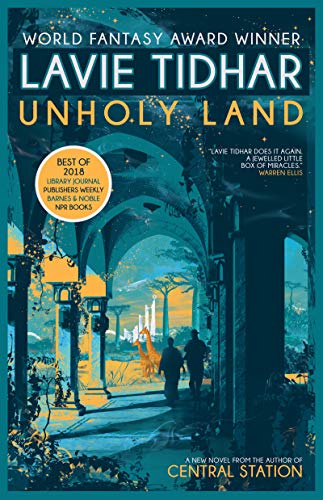
Lavie Tidhar. Unholy Land. Tachyon, 2018. Paperback. 264 pp. $15.95. ISBN 9781616963040.


The protagonist of Lavie Tidhar’s Unholy Land, Lior Tirosh, is a science fiction/detective fiction pulp writer who leaves his home in Berlin to visit his sick father in Palestinia, the Jewish state nestled between Uganda and Kenya, before getting involved in an increasingly complex plot of parallel universes. The story’s narrator, gradually revealed to be Special Investigator Bloom, addresses a mysterious second-person character named Nur, who turns out to be an agent trained to move in between the worlds. Bloom follows both Tirosh and Nur from afar, although at times the narrator takes on omniscient powers, as it becomes clear that in travelling from Europe Tirosh has crossed more than international borders, but the border to another world.

The novel’s mirror frame—an author-surrogate protagonist to whom Tidhar attributes his own novels, including Osama (2011) and Unholy Land itself—invites the reader to lose herself into its composite worldbuilding, in which walls and borders and identities both possess the same meaning they do in the real world, and at the same time don’t. Tidhar bases his what-if thought experiment in a real historical moment, the early 20th century Uganda Program, which proposed to create a Jewish nation in East Africa (a land “unholy” but a land all the same), but in his novel, like in the best sf stories, it is our own world’s reality that suddenly appears strange. Like Tirosh, the reader must follow along without ever being securely anchored in either reality or fantasy, history or alternate history, the past or the present. In this country, too, Palestinians (a noun Tidhar no doubt uses ironically) erect a wall to keep out the indigenous people that were forcibly removed from the land; in this story, too, the PDF (Palestinian Defense Force) brutally harasses refugees and uses surveillance against young revolutionaries. But this is also a story in which ‘only’ a “Small Holocaust” happened (since European Jews moved to Palestinia before the rise of the Third Reich) and in which Hitler was assassinated in 1948. Tidhar’s incredibly vivid worldbuilding unveils a wealth of intriguing details: Palestinians speak Judean (at the end a character calls modern Hebrew “archaic” by comparison); old European Jewish families have become diamantaires; children read the story of the Judean Tarzan. 

This is also a novel that, at least when it focuses on Tirosh, develops complex and piercing emotional realities. Throughout the story, Tirosh is haunted by the (never quite described) death of his young son Isaac. His constantly resurfacing grief through memories of simple moments with the toddler showcases the talent of Tidhar’s prose. This is not the only thing that haunts Tirosh. His brother Gideon was killed in the war; his father is ailing and Tirosh is so reluctant to visit it only happens at the end of the novel; his niece Deborah is missing and her mysterious disappearance drives the action; and Tirosh’s memories are also increasingly conflicted as the story progresses.

Tidhar’s novel is a powerful, labyrinthine story reminiscent of China Miéville The City and The City (2009) and, in a much more subtle and controlled way, some of the best of Philip K. Dick. With its careful and intelligent treatment of some of the most difficult questions arising from the Israel-Palestine conflict, it will undoubtedly become a staple of postcolonial science fiction courses. Its straightforward prose and short format will provide for a productive introduction to discussions about border conflicts, nationality, nationalism, and imperialism while also allowing teachers to outline some of the key features of the best of sf. As Tirosh himself explains during a reading at a bookstore: “What we do [when writing stories of alternative realities] is literalise the metaphor…We construct a world of make-believe in order to consider how our own world is constructed, is told.” (113-4). 

Some of the novel’s shortcomings could come from Tirosh’s own pulp detective stories. When Bloom ceases to be the narrator in the background and acts as a character especially, the plot turns cartoonish and awkward. To give an example, when Bloom and fellow soldiers storm a refugee camp and harass a family, Bloom reflects to himself: “I did not enjoy humiliating [the woman]. I was merely carrying my duties. I was a professional” (148). The missing-girl plotline of Deborah, with its stereotypical mobster characters, ends up leading nowhere. It is actually quite hard to pinpoint, even by the end of the novel, why certain scenes took place (like the different assassination attempts on Tirosh or his search for the theodolite) or why some characters are introduced (like Melody, a woman who seems to be here simply for Tirosh to sleep with). Overall, Tidhar’s beautiful, almost poetic prose and the fascinating worldbuilding propel the reader to keep reading on in spite of some of the story’s somewhat vulgar plot points, and some of the transition scenes between the worlds have a Ubik-esque quality that I will not forget any time soon.

Review of LOVE DEATH + ROBOTS, season 1 (2019, TV)


Review of LOVE DEATH + ROBOTS, season 1

Michael Pitts

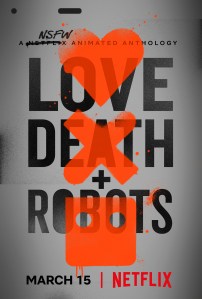
LOVE DEATH + ROBOTS. Blur Studio, distributed by Netflix, 2019.


Currently in production of its second season, LOVE DEATH + ROBOTS is an anthology series produced by Netflix. Bringing together the talents of different casts and creative teams, the series consists of standalone episodes exploring diverse themes of the science fiction genre. These episodes, which do not exceed 20 minutes in length, reflect disparate genres such as cyberpunk, alternate history, and dystopia while covering themes from AI and transhumanism to colonization. They raise, for example, questions concerning the future of humankind, the destructive consequences of colonial expansion and capitalism, the threat of a nuclear holocaust, the privatization of space travel, and the dilemmas of robotic consciousness. Yet, while the series offers some interesting explorations within each of these fields of interest, it is problematic in its traditional framing of issues related to sex and, more specifically, its catering to the male gaze.

A re-imagining of Tim Miller and David Fincher’s initial plan to remake the animated science fiction anthology film Heavy Metal (1981), Love, Death & Robots continues its predecessor’s efforts of legitimizing adult-oriented animation and genre fiction. Like Heavy Metal, it utilizes advanced and diverse animation techniques, pushing the genre into new territory. Led by Miller’s Blue studio, which is known for its hyper-realistic, video-game style aesthetics, and produced using a variety of animation tools, the show is characterized by vivid, realistic details and cutting-edge animation. Uniting the disparate aesthetic styles of the episodes is their depiction of tropes common to the underground comics of the 1970s, which in turn influenced the production of Heavy Metal. Like the 1970s adult-oriented graphic fiction that skirted censorship rules, LOVE DEATH + ROBOTS centers explicit content including sexuality and violence.

It is this intermingling of sex and violent content that makes the series, like its comics and Heavy Metal predecessors, problematic. Like Heavy Metal, the program caters to heteronormative male viewers through its presentation of sex and the female body. Though it occasionally presents non-normative sexuality, for example, these portrayals of queer characters frame female bodies within patriarchal conceptions of desirability. Each female character populating these episodes acts, as Laura Mulvey puts it in her influential essay “Visual Pleasure and Narrative Cinema,” “as an erotic object for the spectator within the screen story, and as erotic object for the spectator within the auditorium” (62). Women in LOVE DEATH + ROBOTS are therefore predominantly portrayed in accordance with the desires of a heteronormative male audience. Also, like Heavy Metal, the program frequently depicts violence towards women and emphasizes gratuitous sexual and violent details. Female characters, for example, are brutally hunted and murdered, such as in “The Witness,” or brutalized and mutilated, such as in “The Secret War.” Other episodes, such as “Beyond the Aquila Rift,” are suddenly interrupted by sex scenes clearly developed and included to appease heterosexual male viewers. While the program caters to the male gaze and includes toxic portrayals of women and violence, a few episodes do divert from this patriarchal framing of sex and gender. “Good Hunting,” for example, follows the plight of a female huli jing or fox spirit as she escapes sex slavery and mounts an attack upon the patriarchy in early 20th-century Hong Kong. Another episode, “Helping Hand,” similarly diverts from this catering to heteronormative male viewers in its centering of a female protagonist who demonstrates incredible courage and strength in the face of eminent danger. Overall, however, though it includes these limited, non-patriarchal presentations of female characters, Love, Death & Robots problematically frames women, sex, and violence.

To a limited extent, the show also comments on other issues such as colonialism and capitalism. “Good Hunting,” for example, emphasizes the legacy of colonization and its effect upon women through its portrayal of women sold as sex slaves as a result of colonialism. “Suits,” on the other hand, undermines traditional stories of American individualism and self-reliance by revealing that the farmers upon which the episode centers are actually colonizers attacking the indigenous alien species of the planet they desire to control. “Helping Hand” imagines the consequences of corporate space exploration upon astronauts whose labor is exploited at great cost. As these examples illustrate, the series builds upon pre-existing trends and themes of science fiction and occasionally offers interesting insights into topics pivotal to the future of humankind such as environmental concerns, space travel, labor practices, the expansion of human civilization, and transhumanism. Overall, then, while LOVE DEATH + ROBOTS offers occasional commentary on issues common to science fiction, the brevity of its episodes, its patriarchal framing of issues related to sex and violence, and its catering to the male gaze limit its potential as an innovative work of SF.


WORKS CITED

Mulvey, Laura. “Visual Pleasure and Narrative Cinema.” Feminism and Film Theory, edited by Constance Penley, Routledge, 1988, pp. 57-68. 

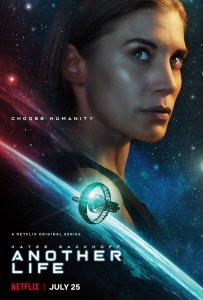
Review of Another Life, season 1 (2019, TV)


Review of Another Life, season 1

Marta F. Suarez

Another Life, season 1. Halfire Entertainment, distributed by Netflix, 2019.


Another Life is a Netflix series currently awaiting the release of its second season. Its first season, released in 2019, consisted of ten 60-minutes episodes. The plot is quite straightforward and moves between a narrative on Earth and a narrative in space. In an unspecified year in the future, a mysterious alien device arrives on Earth and settles on an open field in the US. Six months later, the scientists are still looking for the purpose of the artifact, only establishing that it emits code to Pi Canis Majoris. Not wanting to wait any longer, the government sends an interstellar ship to the signal’s objective, hoping to make direct contact with the alien civilization. The expedition is led by Niko Breckinridge (Katee Sackhoff), newly appointed captain of the Salvare. Meanwhile, on Earth, her husband Erik Wallace (Justin Chatwin), continues to lead the research to decipher the code.

The series often nods to other sci-fi screen media, moving between echoing popular scenes, emulating genre styles, and replicating familiar narratives. Its serialised structure converges with an episodic approach that gives the series a pastiche feeling. Whereas the overall plot has striking similarities with the decoding plot of Contact (1997), Interstellar (2014), and Arrival (2016), the individual episodes approach a variety of styles, narratives, and sub-genres. For example, nods to sci-fi horror take inspiration from the aesthetics of Nightflyers (2018) and Prometheus (2012), including arachnids reminiscent of those in Starship Troopers (1997) or Lost in Space (1998). Alien (1979) is echoed several times throughout the series. Not only is the chestburster scene almost replicated, but the first scenes in the Salvare evoke those in the Nostromo, yet with a darker atmosphere. If in Alien the crew wakes up in a quiet and serene ship, emphasized by the soundtrack and long shots (as if not to disturb), in the Salvare, Niko wakes up alone and weakened, in close-ups that emphasise the discomfort and dutch angles that suggest that not all is well. As it turns out, the ship is not where it should be and the events will only take it further from Earth in a plot reminiscent of Event Horizon (1997), Star Trek: Voyager (1995-2001), Stargate Universe (2009-2010), or Lost in Space (2018-). By the end of the season, Niko discovers that the alien race who sent the artifact, the Achaia, are decimating civilizations and implanting chips into hosts, connecting with core elements of The Mind Snatchers (1972) and the Goa’uld in the Stargate universes. The references are many and varied, making the series a kind of kaleidoscope where well-known tropes change shape but are still recognizable.

The originality of the series does not come from the plot. Indeed, some of it might result in clichés, and some of the characters are flat archetypes, with minimal internal conflict or character evolution except for Niko, Eric and the ship’s AI, William (Samuel Anderson). One of the key differences between this and other sci-fi crews assembled to go into space is their very young age, their diversity and the YA feel to the character-driven drama that they create. If in The 100 (2014-) the choice to depict younger characters is supported by the plot, in Another Life this decision brings a level of incoherence to the narrative, which suffers for it. The explanation, although given, contrasts with other aspects of the narrative. A member affirms that they have been chosen because their youth gives them the readiness to act, as opposed to a cautious disposition, which would characterize older crews. For the same reasons, space crews have abandoned uniforms, seen as outdated, and now are able to make their own fashion choices. Nevertheless, on Earth the military is still wearing uniforms, and all decision-makers are significantly older, which in a way contradicts the provided reasoning. It is also unclear why the crew only meet each other for the first time upon embarking on their voyage or why the former captain of the Salvare is part of the crew when he clearly is resentful of the change. The crew always questions the captain’s decisions, and actions are often rushed or merely illogical. The audience is left to wonder why the government has sent such an inexperienced group to make first direct contact with the alien life, whose intentions are unclear. The series’s focus on young and attractive characters and their interpersonal conflicts create narratives conventional in YA fiction, which contrasts with the space given to the internal conflicts of older characters.

The only other older member of the crew is First Officer Ian Yerxa (Tyler Hoechlin), the previous captain of the Salvare, who is killed almost immediately and replaced by his girlfriend, Cas Isakovic (Elizabeth Faith Ludlow). Michelle Vargas (Jessica Camacho) is the Communications Officer. Meanwhile, the engineering team is composed of lead engineer August Catawnee (Blu Hunt), Oliver Sokolov (Alex Ozerov) and computer engineer Javier Almanzar (Alexander Eling). The Salvare’s medic is Zayn Petrossian, a non-binary member of the crew portrayed by JayR Tinaco. Joining him in the medical bay is microbiologist Bernie Martinez (A.J. Rivera). Finally, accompanying the crew as a diplomat is the son of the US Secretary of Defence, Sasha Harrison (Jake Abel). On Earth, Eric looks after their daughter, Jana Breckinridge-Wallace (Lina Renna), and is often seen working alongside Dr Nani Singh (Parveen Dosanjh). The journalist Harper Glass (Selma Blair) provides conflict and creates tension. Overall, the characters among the young crew lack the depth of characterization that we see in Eric, Harper, Niko, or William. The dynamics between the latter two are probably the best element of the show at the narrative level. Designed not only to feel but also to combine the characteristics most appreciated by Niko, William becomes affectionate towards the captain in a relationship evocative of Her (2013). The dynamics in this relationship leads William to create another AI in search of love, complicating the matter further. For the rest of the crew, we are given little to no background story, being mostly differentiated by the way they dress and speak. There is a tendency to exposition and the dialogue often lacks subtext, breaking the script-writing rule of “show, don’t tell”. However, some of these characters have great potential. The show engages with issues of diversity, sexuality and gender in almost every episode. The guilt of the absent mother permeates Niko’s reflections about family, the engineers soon become a threesome, the non-binary medic has sexual relationships with the microbiologist, and questions of love and free will are part of a critical sub-plot with the ship’s AI. The ethnicity and cultural background of the characters is diverse, and although this does not materialize (yet) beyond the character design and into the plot, it is undoubtedly promising.

Audiences looking for a series with a robust scientific approach might be disappointed. The plot has some basic inaccuracies from the start. For example, they indicate that they miscalculated the distance to the objective because of dark matter, shown on screen as a dense thick grey cloud. Using high radiation in the ship kills alien life but is said to only impact the crew with infertility. Other elements that might feel incongruent relate to the dynamics in the ship, particularly concerning compliance to rules and following authority. The episodic structure puts the characters in situations that, for the most part, are a consequence of their own wrongdoings. We see members of the crew starting a mutiny, removing helmets in alien caves, smoking alien plants, or not using hazmat suits because the air is breathable. Because the transgressions towards leadership and regulations are so common and widespread, the audience might be left wondering how they have all been chosen for such a critical mission.

The series, therefore, is eclectic in its influences and genre, combining elements of sci-fi space travel, sci-fi horror, and teen drama, though it has issues regarding narrative coherence and scientific background. Nonetheless, the episodes could be used in a classroom environment for discussions surrounding race and gender representation, the portrayals of authority (and its failures), and moral “what would you do?” situations, of which there are plenty. For research purposes, the series might be of interest to those working on intertextuality, the portrayal of the female action hero, the ambiguity of the alien other, the fear of the unknown, reflections over the humanity of AI, the dangers of AI, and the intersections of gender and sexuality. Another Life is due to release its second season in Summer 2020. While receiving very low reviews for its narrative incoherence, these issues might yet be addressed in the new episodes. Maybe, after all, Another Life will get itself another life.

Review of Rick and Morty, season 4


Review of Rick and Morty, season 4

Max Suechting

Rick and Morty, season 4. Adult Swim, 2019–2020.


The least interesting thing to say about season 4 of Rick and Morty is that it is, generally, both good and bad in the ways that the show’s previous seasons have been good and bad. At its best, it is smart, tightly-written, and searingly funny, alternately experimenting with and lampooning the devices of science-fiction and advancing simple but compelling characters along a series of wildly imaginative conflicts. The breadth of literary and cultural history it simultaneously draws from and skewers is impressive and probably as enjoyable for the seasoned SF stalwart as the novice or newcomer, with this season variously digesting Indiana Jones, Ernest Hemingway, Batman-esque acid vats, Akira!, heist movies, Edge of Tomorrow, and more. At worst, the season is so loaded with references it becomes difficult for even the conscientious viewer to piece each episode together. Luckily, though, the episodes move at such a breakneck pace that this turns out mostly not to matter very much. Once the viewer settles into the experience, Rick and Morty becomes a kind of gamified television, unspooling familiar or almost-familiar references every few seconds.

Of course, this referentiality has been the series’ all-but-explicit subject matter since its inception. Rick and Morty has always been self-consciously about itself—or rather, about its own reflexive relationship with science fiction as a genre as well as the conventions of medium, character, plot, and so forth. The formula of a typical episode goes something like this: begin with a well-known media property or fictional trope, jam it together with a handful of other references, lay them out along an archetypal SF plot, and season heavily with complex, depressive, and/or fourth-wall-breaking metahumor. If the show’s aesthetic architecture is an improvisatory jumble of pastiche, reference, and imitation, its narrative engine is fueled by recursion, repetition, and intertextuality. Indeed, much of Rick and Morty’s charm comes from its celebration of its own intellectual indebtedness, genially rearranging its own source code with the bottomless delight of a child immersed in a Lego-and-Erector-set playworld. The result is a show which delights in endlessly plumbing its own increasingly reflexive relationship to its forebears, obsessively showing its work while at the same time acknowledging that work as at least partially meaningless.

What is novel about this season in particular, however, is that its metafictional churn is applied most strenuously not only to SF as a genre but also to the show itself—or, more specifically, to the tension between its status as both a piece of art and a commercial media product. For example, the season’s sixth episode, “Never Ricking Morty,” finds the titular pair trapped aboard a “Story Train” running along an endlessly looping track—a direct reference to series co-creator Dan Harmon’s famous story circle. While aboard the metaphor, the pair must puzzle their way through a variety of literalized narrative devices to “break the fifth wall” with their “story potential.” The episode concludes with grandpa and grandson happily zapped back to the Smith family home, entranced with what we see now to be not an extradiegetic prison but rather a simple toy train Morty purchased for Rick, who rhapsodizes:

You did the most important thing: you bought something. . . . Your only purpose in life is to buy and consume merchandise, and you did it. You went into a store, an actual honest to God store. … And you bought something. You didn’t ask questions or raise ethical complaints. You just looked straight into the bleeding jaws of capitalism, and said, “Yes daddy, please.” I’m so proud of you. I only wish you could’ve bought more.

But when the suddenly train derails, Rick’s mood sours:

Didn’t you hear what I said?! Consume, Morty! Nobody’s out there shopping with this fucking virus!

The episode thus concludes with an elaborately-constructed meditation on the relationship between commodity status, narrative logic, and audience satisfaction—with a character all but shouting the conclusion at the audience in the final thirty seconds—built atop an impossibly contemporary reference.

Such moments are par for the Rick and Morty course: speedrun absurdism maintaining its forward momentum by ruthlessly undercutting its own sentiment. Of course, it is not surprising that an “adult cartoon” should aim to soothe its audiences’ own neuroses by layering bleak cynicism, one-degree-shy-of-treacly moralizing, and wide-ranging pop culture knowledge (BoJack Horseman works in much the same way). Yet, despite its restless oscillation between desire and disdain for true feeling, Rick and Morty mostly manages to remain entertaining and lighthearted rather than slipping into pointless nerd solipsism.

This is not to say that solipsism is absent, of course, although it’s less a property of any specific part of the show itself and more the cumulative impression the series leaves on your brain. In the show’s best and most pleasurable moments, it plays like a hyperdrive version of A Thousand and One Nights (a comparison which the characters all but make themselves). Four seasons in, however, Harmon’s relentless equation of anti-social cynicism with sophistication and intelligence has started to wear through the show’s adventure-of-the-week format in a way that is harder and harder to ignore. In those moments, Rick and Morty feels less like a lighthearted romp through SF history and more like asymptotically performative snark, an affectation which unfortunately registers less as scandalous or risqué and more as vaguely annoying. (For instance, the season’s fourth episode includes an incestuous dragon-powered “ten-slut soul-orgy,” a phrase which is as tiresome to comprehend as it was to write.)

When all is said and done, however, the show’s most important assets aren’t its willingness to offend or the breadth of its references, but rather its creators’ pairing of witty inventiveness with a complex take on media and intertextuality. Hopefully Harmon and his collaborators can keep drawing from them for years to come.

Review of The Platform (2020, film)


Review of The Platform

Emrah Atasoy

The Platform. Directed by Galder Gaztelu-Urrutia, Basque Films, distributed by Netflix, 2019.


The Spanish director, Galder Gaztelu-Urrutia’s Spanish-language thriller on Netflix, The Platform (El Hoyo, 2019) is set in a dystopian future in a “Vertical Self-Management Center.” It is a prison-like building referred to as “The Hole,” consisting of over 300 levels, with two inmates to a cell. A platform full of food descends every day from the highest level to the bottom to feed these incarcerated inmates, which is closely concerned with food distribution and rationing. The inmates at the highest level get to decide whatever and how much they desire to eat, after which the food is taken one level down. The leftovers of the inmates above become the food those below. People are randomly moved to another level after each month. The film illustrates the protagonist, Goreng’s physical and metaphorical journey which gradually reveals the brutal reality behind the Hole through his experiences with his cellmates and other people in the prison.

The movie has numerous dystopian characteristics, which may lead one to label it a dystopian movie, whereas some others may categorize it as a horror movie or science fiction horror thriller. Generically speaking, it bears certain similarities to the structural pattern of literary dystopias or dystopian movies. The film starts in medias res, as we find the protagonist Goreng (Ivan Massague) waking up on Level 48 in his cell, staring at his inmate, Trimagasi (Zorion Eguileor), an old man imprisoned due to his accidental murdering of an immigrant. The main character is initially confronted with the foil, Trimagasi, who expounds on how the system in the Hole functions, which starts his transition from a state of naivety to a state of knowledge and experience. He is gradually exposed to the reality of the system through external factors such as Trimagasi, Miharu, and other inmates. Miharu, whose name stands for “open one’s eyes wide” plays a significant role in his journey (Ishida 106).

The dystopian protagonist starts to comprehend the internal mechanics of the system and resists against the system. Goreng, who takes Cervantes’s book, Don Quixote with him as his only item, struggles hard both to understand how the Hole works and to promote fair food rationing so that everyone can have something to eat. When the protagonist does not find support from other characters, his determination is partially vitiated. The protagonist manages to stay alive and reach the symbol of hope, a girl in this case. The girl who is implied to be Miharu’s daughter ultimately becomes the token of hope that may have the potential to change the current structure. Although the blame is not explicitly put on a political body, or rather, there does not exist a political body suppressing its citizens on a holistic level, the projected world remains highly dystopian.

It is possible to approach the movie from numerous perspectives that relate to the larger intellectual and philosophical questions and concerns raised. With its strong dystopian undertones, the movie engages itself with themes such as suppression, greed, cannibalism, corruption, surveillance, empathy, self-centrism versus altruism, violence, survival, Maslow’s hierarchy of needs, control, loss of individualism, social class, inequality, capitalism, the fluidity and fragile nature of borders in between different social classes, socialism, and racism. The Platform highlights how people do serious harm to others in order to survive and to climb up the ladder before them—a strong critique against capitalism. These points, illustrated on differing levels in the movie, can be introduced as relevant to research on science fiction films, dystopian films, science fiction in literature and media, as well as utopian and dystopian narratives and their cinematographic representations.

It is no surprise that The Platform has immediately become one of the most viewed movies in Netflix during the time of COVID-19. It has many similarities to the current pandemic and the new “normal” lifestyle it has brought, as social distancing and individual physical existence seem to occupy an instrumental role in both situations (emphasis added). Survival becomes the chief objective of inmates in the pit, which is followed by the desire to be on the level above, creating a dichotomy between those below and those above. Although there may be the possibility that food is sufficient for everyone, inmates eat as much as they wish instead of rationing. Therefore, people on the lower levels resort to cannibalism when they are unable to feed themselves. The self-centered approach has become clear and palpable even within the context of the COVID-19 pandemic, the concrete parallel of which can be people’s hoarding toilette papers, not caring for the needs of others.

In conclusion, The Platform with its unique texture, rich content and idiosyncratic characteristics suggests avenues for analysis from numerous angles in the light of its themes and features, argumentation, and scholarly discussions. It represents topics that can be discussed within the context of various disciplines, suitable for the interdisciplinary nature of dystopian studies. The search for an ideal system, the nature of humans, and the need to disrupt dichotomous thinking in order to engender a non-binary approach would further discussion within literature, political science, and environmental humanities, which all reflect the strong potential of the movie in contributing to scholarly, academic and pedagogical approaches.


WORKS CITED

Ishida, Priscilla. “Corpus Data and the Treatment of Idioms in Japanese Monolingual Dictionaries.” Research on Phraseology in Europe and Asia, edited by Joanna Szerszunowicz, Bogusław Nowowiejski, Takaaki Kanzaki, Katsumasa Yagi, University of Bialystok Publishing House, 2011, pp. 101-127.

Science Fiction and Technoculture Studies Book Prize 2019


Science Fiction and Technoculture Studies Book Prize 2019

Natanie Meeker and Antónia Szabari
Awardees


Awarded by the Science Fiction and Technoculture Studies program at the University of California, Riverside, The Science Fiction and Technoculture Studies Book Prize honors an outstanding scholarly monograph that explores the intersections between popular culture, particularly science fiction, and the discourses and cultures of technoscience. The award is designed to recognize groundbreaking and exceptional contributions to the field.

This year’s awardees are Natania Meeker, Associate Professor of French and Comparative Literature at the University of Southern California, and Antónia Szabari, also Associate Professor of French and Comparative Literature at the University of Southern California, for their Radical Botany: Plants and Speculative Fiction (Fordham University Press, 2019). 

The judges recognize as runners-up Kara Keeling’s Queer Times, Black Futures (New York University Press, 2019) and Xiao Liu’s Information Fantasies: Precarious Mediation in Postsocialist China (University of Minnesota Press, 2019).


Committee Statement

Paweł Frelik (chair), Aimee Bahng, Steven Shaviro, Elizabeth Swanstrom

The Science Fiction and Technoculture Studies Book Prize honors an outstanding scholarly monograph that explores the intersections between popular culture, particularly science fiction, and the discourses and cultures of technoscience. The award is designed to recognize groundbreaking and exceptional contributions to the field. Books published in English between 1 January and 31 December 2019 were eligible for the award. The jury for the prize were Aimee Bahng (Pomona College), Steven Shaviro (Wayne State University), Elizabeth Swanstrom (University of Utah), and Paweł Frelik (University of Warsaw), who served as jury chair. 

After intense deliberations the jury announce that the eighth annual SFTS book award has been won by Natania Meeker, Associate Professor of French and Comparative Literature at the University of Southern California, and Antónia Szabari, also Associate Professor of French and Comparative Literature at the University of Southern California, for Radical Botany: Plants and Speculative Fiction (Fordham UP 2019). From Aristotle’s notion of the vegetal soul to the century’s plant-centered philosophy of Julien Offray de la Mettrie to the 20th-century’s fascination with carnivorous plants and alien pods, the study provides a wide-ranging and stimulating examination of all things vegetal.

One of the judges described the monograph as “a lucid and fascinating history of the representation of plant life in speculative fiction and philosophy,” which demonstrates “just how intricately such representations—like clematis on a trellis—are interwoven with the evolution of Modernity.” Another judge, calling the study “totally brilliant,” found it “also quite thought-provoking theoretically, for the way that it forces us to think about vegetative vitality in a somewhat different (and more disturbing way) than much recent neo-vitalism and new materialism has done.”

The judges also decided to recognize, as particularly strong runners-up, Kara Keeling’s Queer Times, Black Futures (New York University Press 2019) and Xiao Liu’s Information Fantasies: Precarious Mediation in Postsocialist China (University of Minnesota Press 2019).


Awardee Statements

Natania Meeker
University of Southern California / USA

I am truly honored to be a recipient of the 2019 SFTS Book Prize, in no small part because writing about science fiction at all meant, for me, taking a risk. As an early modernist, I felt like an interloper in a genre that had long been important to me personally but had never been part of my scholarly profile prior to undertaking work on Radical Botany. If I was able to make this leap into a new field and a new topic of research, it was thanks to my co-author, Antónia Szabari, who convinced me that together we could do (almost) anything. Given my initial hesitation, it is all the more gratifying, then, to have found such a generous reception from the scholars and critics at the SFRA. This award is validating in so many different ways. It inspires me to continue taking risks in my research and thinking; it gives me renewed confidence in the critical generosity and receptivity of my colleagues; and it encourages me to imagine an academy in which collaborative research can be the norm for humanists rather than the exception.

At the same time, this award is meaningful to me in my personal as well as my professional life. I have nurtured a love of fantasy, speculative fiction, and science fiction since I was a little girl. It has been such a pleasure to bring the joy and wonder (to use an early modern category!) that I have long found in this kind of reading into my scholarship, teaching, and writing. Delving into these genres forged by modernity has also given me a renewed sense of the vitality of early modern writing and thought, so often animated by the sheer enjoyment of speculation. Receiving an award for following where my pleasure leads is indeed a dream come true. I will remain grateful to all the colleagues at SFRA—including the members of the prize committee, Aimee Bahng (Pomona College), Steven Shaviro (Wayne State University), Elizabeth Anne Swanstrom (The University of Utah), and Chair Paweł Frelik (University of Warsaw). whose collective hard work and service should be acknowledged—for this incredible honor. Thank you also to Sherryl Vint and Sean Guynes for their graciousness and collegiality. I hope one day to be able to attend the SFRA conference and express my heartfelt thanks to all in person. 

Antónia Szabari
University of Southern California / USA

In Radical Botany, my co-author, Natania Meeker, and I set out to reveal a modern history of botanical research by underscoring the involvement of speculative thinking in this endeavor, which is usually treated within the narrower field of the history of science. With this gesture, we hope that we have not only contributed to the pre-history of science fiction but have also shown the vital role of a speculative tradition which, while existing on the margins of more robust naturalist and empiricist practices, is capable of animating them. It is a special honor to be a recipient of the 2019 SFTS Book Prize because today the role of speculation, imagining novel forms of the social and the political, from gendered and racial justice to new energy futures, is as vital as ever. At the same time, the history of botanical speculation shows us how to care for those distant or unlike us. I am especially excited to be recognized by the Science Fiction and Technoculture Studies Association because our book is joining the work that a large and diverse community is already carrying out in this field.

Last but not least, I thank our colleagues at SFRA, the members of the prize committee, Aimee Bahng (Pomona College), Steven Shaviro (Wayne State University), Elizabeth Anne Swanstrom (The University of Utah), and Chair Paweł Frelik (University of Warsaw) as well as Sherryl Vint and Sean Guynes.

SFRA Book Award 2019


SFRA Book Award 2019

Xiao Liu
Awardee


The SFRA Book Award is given to the author of the best first scholarly monograph in SF, in each calendar year.

This year’s winner, the inaugural winner of the award, is Xiao Liu of McGill University for her Information Fantasies: Precarious Mediation in Postsocialist China (University of Minnesota Press, 2019).


Committee Statement

Keren Omry (chair), Pawel Frelik, Graham Murphy, Ida Yoshinaga

It has been a particular honor and a unique challenge judging the inaugural 2019 SFRA Book Award for the best first scholarly monograph in SF. On behalf of the award committee, I am delighted to announce that Xiao Liu’s Information Fantasies: Precarious Mediation in Postsocialist China (University of Minnesota Press) has been unanimously selected as this year’s winner.

Information Fantasies locates the origins of contemporary China’s pervasive information economy and digital media in more than the technology itself. Instead, Liu maps out a history of techno-cultural imaginations and practices that develop alongside postsocialism. To do this, she recovers a stunning array of long forgotten, neglected, and/or underexamined science fiction, films, theories, and cultural practices, and brings them to the fore.

While science fiction is only one of several fields to which the book contributes—Liu delves into the emergence of new media, she combines media, politics, philosophy, and textual production as her subject matter, and she offers insights into a much larger socio-historical context—Information Fantasies is remarkable in its relevance to science fiction scholarship. Adding nuance and sophistication to the growing body of work in Chinese SF, the book places science fiction at the center of a rhizomatic system of ideas, technologies, and politics.

Aside from solid scholarship and writing, Liu’s pathbreaking work integrates the SF subject matter into a theoretically challenging framing of an area and an era that is largely unknown to Western readers and academics. Information Fantasies effectively expands the boundaries of what we are increasingly recognizing as the science fictionality of our world.

I’d like to take this opportunity to send warm thanks to my fellows on the committee, Pawel Frelik, Graham Murphy, and Ida Yoshinaga, whose hard work, commitment, and sense of humor, are hard to overstate.


Awardee Statement

Xiao Liu
McGill University / Canada

I’d like to express my deep appreciation to the SFRA book award committee for such a great honor. At a time of unpredictability, nothing stands as a more powerful narrative than science fiction in envisioning possibilities, and offering deep insights on human aspirations and dreams, and ultimately, what makes us human when life per se can no longer be separated from the technical.

I am fortunate to be continuously inspired by the imaginations and the empathy towards human life of the global SF community, whose unfading curiosity towards and genuine respect for unknown others foster a culture of true diversity and open great possibilities for life that is often curtailed and constrained by ignorance and bigotry. I am also grateful to generations of Chinese science fiction writers, as well as scholars, particularly translators, who always stand at the frontier of communicating across borders, and with whose efforts Chinese science fiction has become accessible to global audiences.

Finally, with media and technology having been turned into the machine of disinformation and manipulation, science fiction is more “real” than ever in revealing the powers of control, and the lines of flight.

SFRA Student Paper Award 2019


SFRA Student Paper Award 2019

Conrad Scott
Awardee


The Student Paper Award is presented to the outstanding scholarly essay read at the annual conference of the SFRA by a student.

This year’s awardee is Conrad Scott for his paper “‘Changing Landscapes’: Ecocritical Dystopianism in Contemporary Indigenous SF Literature.” 

Erin Cheslow received an honorable mention for her paper “The Chow that Can Be Spoken Is Not the True Chow: Relationality and Estrangement in the Animal Gaze.”


Committee Statement

Peter Sands (chair), David Higgins, Kylie Korsnack

The SFRA Student Paper Award Committee is pleased to recognize Conrad Scott’s “‘Changing Landscapes’: Ecocritical Dystopianism in Contemporary Indigenous SF Literature” as the winner of the 2020 SFRA Student Paper Award. We would also like to recognize Erin Cheslow’s “The Chow that Can Be Spoken Is Not the True Chow: Relationality and Estrangement in the Animal Gaze” as honorable mention.

There were a number of exceptional papers submitted for this year’s award, but these two papers immediately caught the attention of the committee. Scott’s paper offers readings of Harold Johnson’s Corvus (2015) and Louis Erdrich’s Future Home of the Living God (2017) through the lens of “ecocritical dystopianism.” The committee found Scott’s readings and especially his articulation of a new form of dystopia to be impressive and persuasive. The committee also wishes to recognize Erin Cheslow for her unexpected and original reading of cognitive estrangement in relation to the animal gaze. The committee found Cheslow’s reading of human and non-human relationships through the Suvinian lens to be a refreshing and creative redeployment of science-fictionality. 

Congratulations to both Conrad and Erin on their exceptional work!


Awardee Statement

Conrad Scott
University of Alberta / Canada

Greetings from Treaty 6 and Métis Territory along the North Saskatchewan River in what is now called Edmonton, Alberta, Canada — the place that the Cree people named Beaver Hills House (ᐊᒥᐢᑿᒌᐚᐢᑲᐦᐃᑲᐣ or Amiskwacîwâskahikan). It was such a pleasure to present my paper, “‘Changing Landscapes’: Ecocritical Dystopianism in Contemporary Indigenous SF Literature,” in the welcoming and thoughtful atmosphere of the 2019 SFRA conference on “Facing the Future, Facing the Past: Colonialism, Indigeneity, and SF” in Honolulu. This timely conference offered valuable perspectives and conversations that continue to resonate strongly in light of ongoing work to advance reconciliation efforts and pursue sovereignty questions in the face of elements like hyper-extractive resource projects and other environmentally-destructive threats to not only traditional ways of life, but also contemporary living for many peoples. My paper focused on parsing such topics as they appear in recent Indigenous SF fiction, and it is such an incredible honour to have then been awarded the SFRA Student Paper Award and follow in the footsteps of previous winners, such as my friends and colleagues Grant Dempsey (2019) and Josh Pearson (2018). Congratulations as well to this year’s honorable mention, Erin Cheslow. Thank you very much to the adjudicators for their time and consideration, and also to my fellow Dystopian Ecologies panelists and the panel audience. I very much look forward to being part of the SFRA community for what I hope are many years to come, and to both learn from others and continue to contribute as we explore vital topics like those we shared at SFRA 2019. 

Thomas D. Clareson Award for Distinguished Service 2019


Thomas D. Clareson Award for Distinguished Service 2019

Wu Yan
Awardee


The Thomas D. Clareson Award for Distinguished Service is presented for outstanding service activities-promotion of SF teaching and study, editing, reviewing, editorial writing, publishing, organizing meetings, mentoring, and leadership in SF/fantasy organizations.

This year’s awardee is Wu Yan of Southern University of Science and Technology.


Committee Statement

Pawel Frelik (chair), Veronica Hollinger, Sherryl Vint

Wu Yan is professor and director of the Science and Human Imagination Research Center of the Southern University of Science and Technology in Shenzhen, China. He is China’s leading voice in science-fiction theory and criticism, the first scholar in China to introduce courses in science fiction at the university level, and a tireless contributor to China’s participation in the global science fiction community. He has been actively engaged in international collaborations and research projects for decades, including attending several SFRA conferences. He is also an award-winning science-fiction author, winner of both the Chinese Nebula Award and the Galaxy Award. From 2010 to 2017, he served as President of the World Chinese Science Fiction Association. 

Wu Yan was based for many years at Beijing Normal University, where he began offering courses in science fiction in the early 1990s. He established both MA and PhD programs in science fiction before moving, nearly three decades later, to Shenzhen to establish the Science and Human Imagination Research Center.

Wu Yan’s main works of sf theory and criticism include Introduction to Science Fiction Literature (2006), Theory of Science Fiction Literature and Construction of Disciplinary Systems (2008), Science Fiction Literature Outline (2011), How to Read Science Fiction Literature (2012), Six Science Fiction Lectures (2013), and Meditations on Chinese Science Fiction Literature (2020). In the past year alone, he published a new edition of Meditations on Science Fiction Literature: Wu Yan’s Academic Selection; a children’s sf novel called China Orbit; and a new edition of Science Fiction Literature Outline. He is editor-in-chief of The History of Chinese Science Fiction in the 20th Century and of Introduction to Historical Materials of Chinese Science Fiction in the 20th Century. Incredibly, he has also found time to produce sf teaching materials for elementary and middle-school students, launching a program called “Science Fiction: Imagination and Scientific Innovation Training Course for Primary and Secondary School Students.”

Wu Yan’s passion for science fiction has resulted in many generous and productive international collaborations and exchanges. In 2013, for instance, he was the lead editor for a well-received special issue of Science Fiction Studies on Chinese science fiction; in 2016 he organized the “International Conference on Utopian and Science Fiction Studies” in Beijing, a wonderful two-day event that brought together scholars and writers from the US, Canada, China, Hong Kong, and Taiwan. Over the years, he has generously hosted international scholars in both Beijing and Shenzhen and he has mentored many young writers and academics who continue to extend his work. 

It is impossible to think of anyone who has done more than Wu Yan to promote the field of international science-fiction scholarship. At this moment when the west is finally discovering the science-fiction writing of what he has called (after Brian Aldiss) “the Great Wall planet,” it is more than time to honor a decades-long career that has tirelessly promoted and expanded the reading, writing, teaching, and critical engagement with the field that we all love. We are honored in return to present this year’s Clareson Award for Distinguished Service to Professor Wu Yan.


Awardee Statement

Wu Yan
Southern University of Science and Technology / China

I’d like to thank the SFRA for giving me the Thomas D. Clareson Award in 2020. In July 1983, while I was still in college, I met a delegation of American science-fiction writers in Shanghai. That year, the SFRA President, Elizabeth Anne Hull, visited China with Frederic Pohl, Roger Zelazny, William F. Wu, and Charles N. Brown of Locus Magazine. They were welcomed to Shanghai by the famous writer Ye Yonglie. I went along to listen to their conference, and I was profoundly moved by what I heard. At that time, we did not know that American writers were so interested in science fiction. We tended to associate sf with the French (Jules Verne), the Russians (Alexandr Belyaev), and the British (Arthur Conan Doyle). That there were so many science-fiction writers in the US truly surprised me.

I have been an sf fan since I was very young. This might sound like nothing today, but at that time it was very difficult. I was only four years old when the Cultural Revolution began in 1966. During the next ten years, novels, popular science books, sf books, and even science textbooks were all banned from publication. Revolution was the most important thing. At that time I found old yellowed science-fiction books, some from the closed library where my father worked, others from the houses of my close friends. Secretly, I read these books and I fell in love with science fiction. After the Cultural Revolution, science fiction in China recovered and I was very excited. I wasn’t only looking for books to read, but boldly I was also trying to write. I published my first sf book review in 1978 and my first short story in 1979.

But the development of science fiction in China has been very uneven. When the wave was rising, everyone chased it; but during periods of criticism such books could not be published. It was only in 1991 that my first collection of stories was published. At the same time, at Beijing Normal University I introduced China’s first university-level sf course in Chinese, titled “Science Fiction Review and Research.” During the next 29 years, I developed my undergraduate courses into Masters and PhD programs. In 2017, I left Beijing Normal University and established the Science and Human Imagination Research Center in Shenzhen’s Southern University of Science and Technology; it focuses on the development of imaginative psychology, future exploration, and science-fiction works. This year (2020) my publications have included my collection, Meditations on Science Fiction Literature: Wu Yan’s Academic Selection; a children’s sf novel called China Orbit; and a new edition of Science Fiction Literature Outline. I am also editor-in-chief of The History of Chinese Science Fiction in the 20th Century and of Introduction to Historical Materials of Chinese Science Fiction in the 20th Century. I have also been producing sf teaching materials for elementary and middle-school students. Science-fiction creation, research, and promotion has become my life’s career.

The SFRA is no stranger to me. In 1994, while I was a visiting scholar at Wright State University in Dayton, Ohio, Elizabeth Hull invited me to attend the SFRA conference in Arlington Heights. In 2001, I participated again at SFRA, this time in Schenectady, New York. I still remember a panel at the 1994 meeting devoted to teaching science fiction. Upon arrival, the host asked everyone to make their syllabi available to everyone else. After I submitted mine, I received dozens of different syllabi from other teachers. The content and methods of the lectures were very inspiring. I have even contributed to the SFRA Newsletter in the past.

For me, the SFRA is not only a source of new ideas, but it is also the home of researchers from all over the world. Through SFRA I have met many colleagues, including Veronica Hollinger, James Gunn, Takayuki Tatsumi, Janice Bogstad, and scholars from Denmark, Russia, Israel, and elsewhere. The SFRA directory is also my important assistant. In December 2016, with the help of the SFRA Directory, I invited international scholars to Beijing to commemorate the 500th anniversary of More’s Utopia at the International Symposium on Utopian and Science Fiction Literature. 

I would like in particular to thank Professor Hull. If it weren’t for our meeting in 1983, my connection with the SFRA would not have happened so early. Since then we have met on many occasions and in many locations around the world. I remember she and Fred Pohl also brought Jack Williamson, David Brin, Suzy McKee Charnas, and other writers to China. I also want to thank the late Charles Brown, founder of Locus magazine. He often invited me to contribute articles to Locus and had always wanted me to visit his Oakland office. I also thank Veronica Hollinger, a long-time friend and my co-editor for the 2013 special issue of Science Fiction Studies on Chinese science fiction. I’d like to thank the writer David Brin as well. Every time he comes to China, I invite him to meet with local writers and to give lectures to my students. It was he who recommended that I meet Sherryl Vint at UC, Riverside and Sheldon Brown at UC, San Diego. Last year, I invited Professor Vint to visit China, not only to give lectures at Southern University of Science and Technology in Shenzhen, but also to introduce new developments in science fiction to students of sf writing at Tsinghua University in Beijing. Professor Brown contributed his art to the exhibit I curated for the 2019 Bi-city Biennale of Urbanism and Architecture in Shenzhen. Thanks to his excellent work, and the work of many others from both China and abroad, my exhibit, Nine Cities, Ten Thousand Kinds of Futures, won the biennial jury award. 

It has been an honor to live for the past forty years in an academic world of mutual exchange and cooperation. I am honored to be a member of SFRA, an organization that belongs to the whole world. I believe that my Clareson Award will contribute to the increasing interest in science fiction among writers, researchers, educators, and promoters in China. It will encourage more people to participate in the work and in the spirit of science fiction. 

On the occasion of this award, please allow me to wish all members of the association good health. My very best wishes to the SFRA.


Wu Yan is professor and director of the Science and Human Imagination Research Center of the Southern University of Science and Technology in Shenzhen, China. He began writing science fiction in 1978. His novels include Spiritual Exploration (1994), The Sixth Day of Life and Death (1994), and China Orbit (2020); his short stories include “Iceberg Adventure” (1979), “The Abyss of Gravity” (1981), “The Last Case of the Interstellar Police” (1991) “Mouse Pad” (2001), and “Print a New World” (2013). His main works of science-fiction theory and criticism include Introduction to Science Fiction Literature (2006), Theory of Science Fiction Literature and Construction of Disciplinary Systems (2008), Science Fiction Literature Outline (2011), How to Read Science Fiction Literature (2012), Six Science Fiction Lectures (2013), and Meditations on Chinese Science Fiction Literature (2020). In 2019, Wu Yan was co-curator of the “Science Fiction Ascending City Section” at the 8th Intercity Biennale of Urbanism and Architecture (Shenzhen), with Meng Jianmin and Fabio Cavallucci. With Chen Yu, he co-curated Nine Cities, Ten Thousand Kinds of Futures, which won the biennale jury award (the Organizing Committee Award). As a pioneer of science-fiction education in China, he introduced his first undergraduate sf course at Beijing Normal University in 1991, and the university has offered a PhD program in science fiction since 2015. In 2017, Professor Wu established the Research Center for Science and Human Imagination at Shenzhen’s Southern University of Science and Technology. In 2020, he launched the program, “Science Fiction: Imagination and Scientific Innovation Training Course for Primary and Secondary School Students.” He recently delivered science-fiction courses to more than 10 million elementary and middle-school students simultaneously through the Xueersi Online platform.