
Fiction Reviews
Review of Alliance Unbound
Edward Carmien
Cherryh, C J, and Jane S Fancher. Alliance Unbound. DAW Books, 2024.
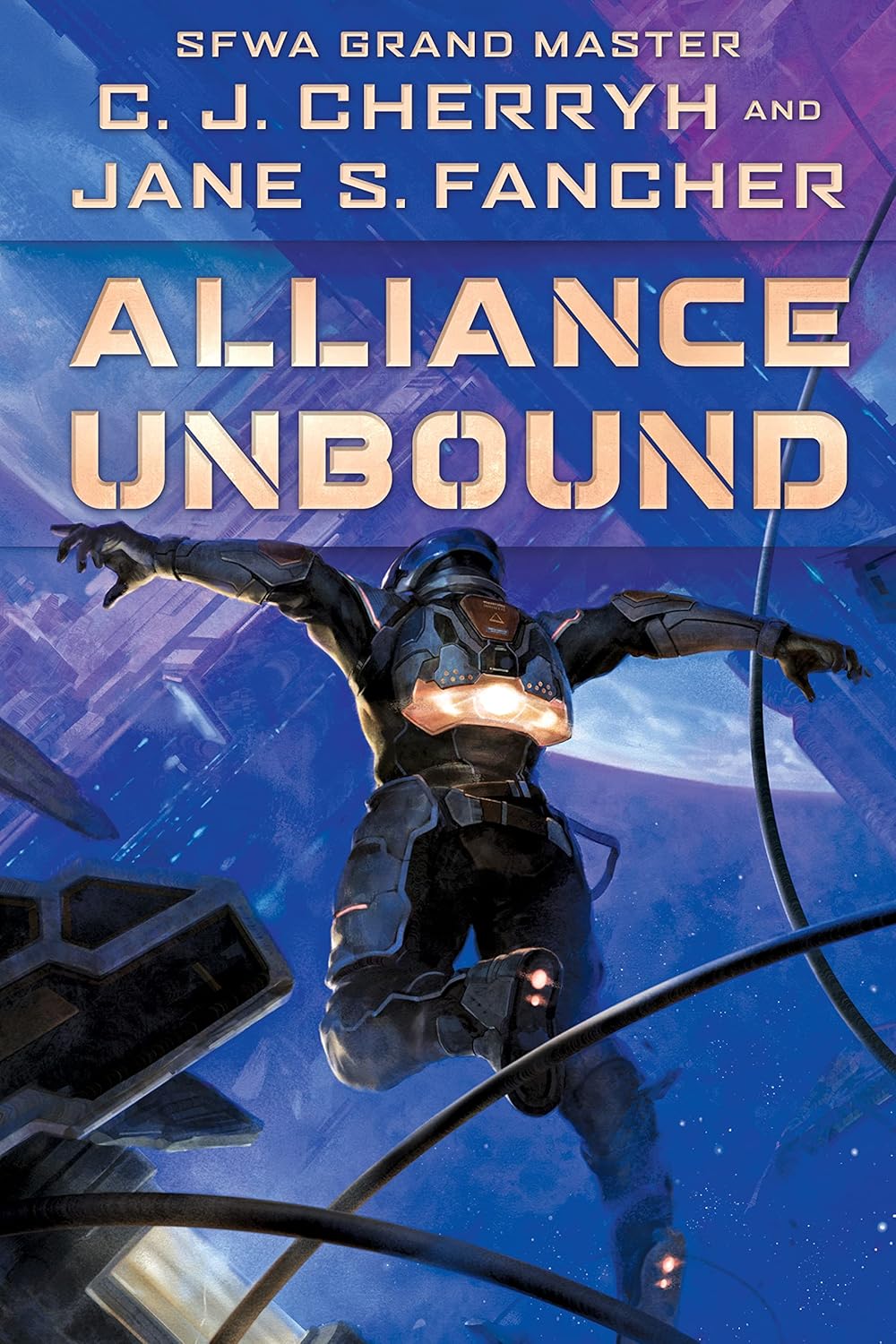
In this second book of the “Hinder Stars” sub-series, C.J. Cherryh and Jane S. Fancher pick up the story as the merchanter super-ship Finity’s End (with guests from Galway aboard) arrives at Pell, the star system home to Downbelow Station and a key location of future history told later in the timeline of the Company Wars. Readers wishing to skip directly to this novel find a thorough recapitulation of Alliance Rising early in the novel (62-77).
The Neiharts of Finity’s End embody merchanter royalty of unimpeachable lineage, descended from the pre-FTL crew of a famed sub-light “pusher” ship. They arrive to accustomed luxury at Downbelow Station, including shopping, extensive gardens, and even the “Downers,” a sapient humanoid species acting as part of the station’s workforce. Their guests from Galway experience the sights as “rustic cousins in the big city.” Their home station, Alpha, seems rustic by comparison. Ross Monahan, escapee of the Earth Company thugs who pirated Galway at the end of Alliance Rising, faces sensory disorientation as holograms, part of the theme-park atmosphere at the “sleepover” (hotel) where the spacers reside on station, cause issues of concern for the navigator.
One part vacation spree and one part investigation leads to fun but also an abridged stay as trade goods come to light that strongly suggest a trade route not among the known paths trade takes here in space far from Earth (Sol system). Finity’s End hands off its cargo duties to other ships and heads for the unknown, bringing to bear classic tropes of earlier Cherryh novels, such as the dangers and stresses of space travel found in Pride of Chanur. They collect an ally in the shape of another merchanter, and counting Galway crew onboard Finity’s End this constitutes a deliberative body for the new Alliance, a union of merchant ships devoted to the idea that ships trading among the various stars inhabited by humanity be crewed by merchanter families, not Earth Company employees or Azi (cloned humans) from Cyteen.
Dangerous FTL travel leads the Neiharts and their Galway guests to an abandoned station in risky space at a binary star system. But Olympus Station, no longer abandoned, hosts no fewer than four ships: two mystery merchanters (the remaining holdouts who haven’t signed with the Alliance), a pusher ship that took a decade or more to get to this station (which isn’t the first to have done so), and a mystery FTL vessel of unusual design, evidently hauled here at sub-light speed by the pusher ship, a vessel ominously named not after a famous Earth explorer as with previous pusher ships, but after the Wellington that beat Napoleon. And here Cherryh and Fancher drop a shoe familiar to longtime Cherryh readers: the family names of the two merchanters. Bellagio rings no bells for this reader, but Mallory certainly does.
Signy Mallory, the captain of the Earth Company carrier Norway, leads a storied existence in the years to come. As one of Cherryh’s standout characters, along with Morgaine, Emory, and Pyanfar Chanur, the simple mention of the name “Mallory” in this historical context raises hairs on the back of the knowing reader’s neck.
The crisis of the novel brings together the senior captains of Finity’s End, Ross Monahan, who is cosmically sensitive to the moods of stars and how they impact FTL travel, and his lady love, Jen Neihart. The mystery merchanters don’t sign on with the Alliance: to them, any connection with Cyteen is too much connection. Then, the captain of the pusher vessel attempts a coup de main independent of the otherwise non-violent “big meeting” that closes the novel. The mystery FTL ship undocks and Ross Monahan’s quasi-supernatural ability to hear the stars speak reveals much about that experimental ship’s fate. The novel closes as the Alliance ships head back to familiar ports with the extraordinary news of their discovery, and the Earth Company’s continued and expected treachery, in hand.
The obvious theme of “colonialism is bad” carries on in Alliance Unbound. The significantly named Rights of Man from the previous novel is invoked in the “big meeting” that closes this novel. Joined by the resonant phrase “Mother of Mankind,” meaning Earth, the ongoing demands of the Imperial Center toward the colonies remain clear. Between the “rights” Earth, or Sol holds dear, and the implied parental role illustrated by “Mother of Mankind,” no outcome appears possible other than war. This makes sense, as the history of that war, written and published decades ago, stands canonically in previous publications such as Downbelow Station. In Cherryh and Fancher’s “Hinder Stars” background, ownership posited as consequential to the origin of the colonies vies with theories of self-determination consequential to those who own the means of production.
That these works represent Space Opera seems obvious. Yet, Cherryh and Fancher’s evocation represents a pleasantly intellectual take on the genre. In exploring Downbelow Station’s gardens, which include actual trees, the authors convey the essential difference of humans adapted to life as merchanters, hauling essential cargos using FTL “jump” technology. Even more than humans adapted to life in space stations, these adaptations make Ross Monahan reflect how “He didn’t belong to this place, didn’t want to belong. It was beautiful… but as far from his experience as the void of space” (110). To this character these natural, organic elements alienate as much as fascinate. In this “history of the pre-war period” novel, weapons seem rare and on a human scale. When one ship wishes to damage another, it uses a tool meant for another purpose. Those hoping for a ripping space battle leave disappointed. Readers who enjoy bathing in well-reasoned science fiction rejoice.
Alliance Unbound reads better than the award-winning book that comes before it, but as a series novel (and not a standalone work, as many are in the larger Company Wars context) readers may find it difficult to see its qualities standing on its own. Characters do more interesting things in more interesting environments. Ross Monahan takes on qualities of damaged but interesting Cherryh characters from prior books such as Rimrunner’s Ramey, Sandor Kreja of Merchanter’s Luck, or Heavy Time’s Dekker, and his ability to hear the stars echoes the almost witchy abilities of Capella from Tripoint. As a text in a literature class, the connections relevant to Alliance Rising apply here: colonialism writ in the stars and a hint of the social stresses on human relationships among spacers who experience time-dilation as part of their ordinary working lives. If the human relationships in Alliance Rising were tamer than in other Company Wars novels, then in Alliance Unbound they are tamer still, if only because fewer pages carry such interactions.
“To our patient readers…you know why.” This dedication follows the previous novel’s dedication to editor and publisher Betsy Wollheim. It makes sense, then, that this second novel contains helpful inclusions such as a map and a list of stellar coordinates and lists of distances from sundry relevant stars in light years. Headed “For Our Fellow Nerds,” this material delights. In the text itself such distances rarely appear in the text: “It’s a long jump,” or “It’s a short jump” might, and the essential distance in light years between Earth and Alpha station represents a key plot point. Do readers need this information? No. The narrative provides all a reader needs. But this peek behind the curtain entertains nevertheless. Cherryh, and now Fancher, show us how it’s done. Immersive science fiction, with every speculative detail honed and clear and sharp, gifts readers with maybes, what ifs, and who-da-thunk-its, all done so realistically that after a few days’ immersion one looks around and carries the story in one’s own mind, guesses where it might go, or ponders elements not narrated. May we see ever more.
Edward Carmien, Ph.D. teaches writing and literature at Mercer County Community College in New Jersey. He started his academic journey as a member of the Popular Culture Association, but soon found a truer home in the SFRA. A lapsed poet, short story writer, game designer, and novelist, his first publications were game-related working as a freelancer for TSR, Inc. After appearing in the fiction anthology EARTH, AIR, FIRE, WATER he earned membership in the SFWA. He has won awards for his fiction and non-fiction, edited a volume of essays about writer C.J. Cherryh, and lives with his family near Princeton, New Jersey.


