
Fiction Reviews
Review of Alliance Rising
Edward Carmien
Cherryh, C J, and Jane S Fancher. Alliance Rising. DAW Books, 2019.
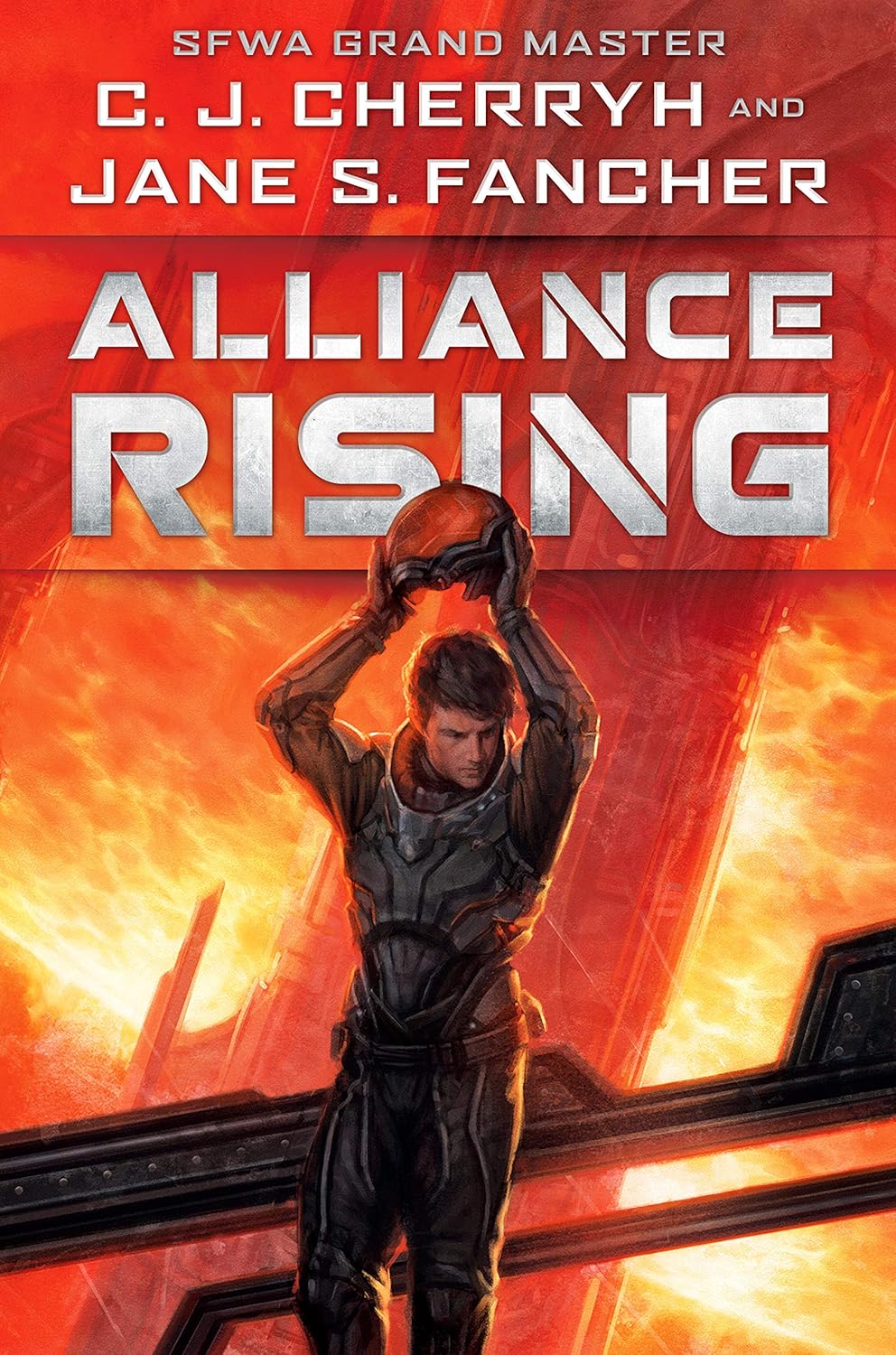
C.J. Cherryh, recipient of the Hugo, Nebula, Prometheus, Locus, and others, joins her spouse and longtime partner Jane S. Fancher, winner of the Prometheus Award, in a return to the Alliance-Union universe. In this set of dozens of novels, short story collections, music, and a tabletop wargame, Cherryh and Fancher recount a history over vast ranges of time and space. Humanity’s extra-planetary colonization and inevitable loss of control of these colonies makes up a significant focus of the series. Sequences of the narrative lacking a focus upon humans are common in these texts, which act as a variant of Larry Niven’s “known space” but include far greater detail and stylistic and content variety. Part of the Alliance-Union universe presents stories related to the Company War. These novels range from Devil in the Belt (in which Earth system asteroid belt miners are recruited into new Earth Company warships) and the much-awarded Downbelow Station to 1997’s Finity’s End. 2019’s Alliance Rising and 2024’s Alliance Unbound, dubbed the “Hinder Stars” sub-series, serve as prequels to the Company Wars.
Cherryh and Fancher’s world, always complex, focuses on socio-economic stresses in a system undergoing radical change. Centuries of commerce and exploration under control of the Earth Company using sub-light ships (an extensive history of ship comings and goings exists online) alter in mere years as Faster than Light (FTL) ships, invented far from Earth, increase the tempo of change. Earth, already isolated from colonies it no longer really controls (and some it never controlled), will in decades begin constructing a fleet of FTL warships… but those are other stories. Three factions vie for control over Alpha Station, Earth’s second extra-solar station: loyalists of the Earth Company (one inescapably thinks of the East India Company), a powerful faction of FTL merchanters, and local Alpha Station merchanters and administrators who understand the local economic environment and who are Earth Company only in theory.
The Earth Company officials want their expensive FTL ship The Rights of Man, a ship name redolent with symbolism as the thing does not work, to continue receiving maximal resources and be retained under the control of the Company. The merchanters seek signatories to a new treaty as they form an Alliance. Cherryh’s readers know what’s coming in the chronologically later Downbelow Station. Alpha Station merchants and executives seek a way forward in challenging economic times; at their “Hinder Star,” they stand to be bypassed like Radiator Springs or any of the dozens of real towns left high and dry by the Interstate system in the United States. The complexities of the three-way struggle play out in adminstrivia, in dockside brawls and assignations, and in the creation of a self-perpetuating merchanter culture, one which will in future forestall any challenge to their “families run ships, not governments” credo. In typical Cherryh, and now Cherryh and Fancher fashion, complexity heats until the pot bubbles over, all with the promise of future crises to resolve in later texts.
Is this Space Opera? Calling this and other books in the common background Space Opera does them some disservice. Here, spaceships do not make noise in space; if their engines quit, they do not coast slowly to a stop, and delta-V really means something. This is not Star Wars. Yet we are concerned at least in some part with the princes and chieftains, kings and queens, appointed administrators and ship captains, the elite of the societies enmeshed together here, a signal of the Space Opera genre. Cherryh appears in Hartwell and Cramer’s 2006 The Space Opera Renaissance and arguably strides across much of the definitional space it creates with her 80-odd book publications (17-18). That she often eschews the rippin’ space battle—her Merchanter’s Luck takes place at a time when the turncoat Signy Mallory takes on the remnants of the Earth Company fleet gone piratical and abandoned by Earth, but the battle on display is psychological and takes place inside the main character’s head—is well known, and Alliance Rising follows in those footsteps. There is drama aplenty, but at the human level, in the romance and bureaucratic infighting and let’s-make-a-deal venues, not in the maneuver and missile venues. Characters sweat their big decisions in bed, at their desks, or gathered together in a bar, not in glowing, high-tech nests of screens or Jefferies Tubes.
Liz Bourke ably reviewed this text in 2019 for Locus, noting some issues with diversity, that the book seemed rooted in an 80’s sensibility, with limited variety of perspective (“Liz Bourke Reviews Alliance Rising by C.J. Cherryh & Jane S. Fancher”). Certainly, the novel is less interpersonally adventurous than other work by Cherryh. Devil in the Belt stands as a clear inspiration to the Expanse books and series, with its polyamorous spacer humans (though as one might expect, given the publication date, without contemporary poly terminology) and matrilineal merchanter clans. The people of Alliance Rising form tamer relations, though the “sailors in port” aspect of the FTL ship crews is in full flow. Accidental or purposeful? The cultural markers of later books also come later in the in-universe chronology, making it possible for Cherryh and Fancher to gauge social evolution at a more traditional stage in the history they recount here.
The text could serve in a college-level literature course, particularly an advanced level course able to undertake the more advanced themes of colonialism, the rights of those who do the work vs. the rights of capital, and the matters William H. Stoddard raises in his appreciation of Alliance Rising, which won the 2020 Prometheus Award for best novel. “The rights of man, in a nonfigurative sense, are what this novel is about,” he observes (“Liberty, evolving self-government and the Rights of Man”). Whether undergraduates can be tempted by a work so focused on the internal remains to be seen. The dedication suggests why this novel exists at all: Cherryh and Fancher celebrate Betsy Wollheim, still at the helm of storied DAW Books (which, in days of yore, was a publisher of distinctive, yellow-spined paperbacks), reflecting a fifty-year plus friendship and professional association. May their work continue ever after.
Edward Carmien, Ph.D. teaches writing and literature at Mercer County Community College in New Jersey. He started his academic journey as a member of the Popular Culture Association, but soon found a truer home in the SFRA. A lapsed poet, short story writer, game designer, and novelist, his first publications were game-related working as a freelancer for TSR, Inc. After appearing in the fiction anthology EARTH, AIR, FIRE, WATER he earned membership in the SFWA. He has won awards for his fiction and non-fiction, edited a volume of essays about writer C.J. Cherryh, and lives with his family near Princeton, New Jersey.


