
Fiction Reviews
Review of The Hungry Gods
Zorica Lola Jelic
Tchaikovsky, Adrian. The Hungry Gods. Solaris, 2025.
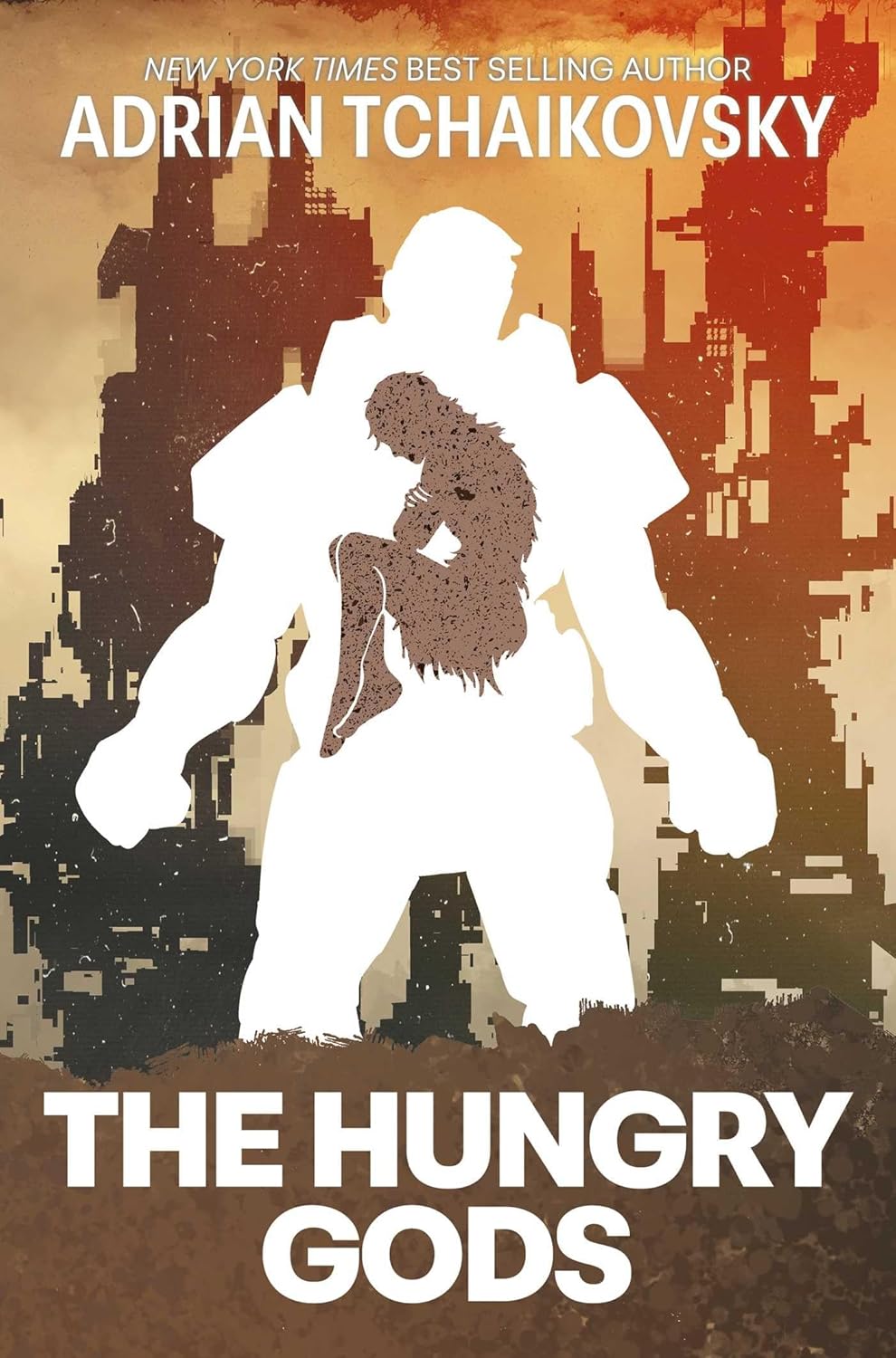
This novella is the first in the Terrible Worlds: Innovations series in which Tchaikovsky explores power, belief, and runaway technologies that seem to ultimately do more harm than good. The novellas are standalones, but they share themes, and they can be read out of order (at least that is the initial concept considering that only the first one is out). At first glance, The Hungry Gods evokes certain emotions and postcolonial themes found in Ursula K. Le Guin’s The Word for World Is Forest since humans with advanced technology play Gods in a world where people have no technology. Unlike the planet in Le Guin’s narrative, this is not some alien world but Earth in the distant future. At some point in the past, humans poisoned water resources, the ground, and the air. Then, when everything became barren, the brightest and the best left for a new planet, Utopia, to start a better life. They believed that nothing survived the harsh living conditions back home. However, people did survive. They live in primitive, divided, and hostile tribal communities scavenging for food, water, and other resources. The tribes are given animal names, and the weakest are the Rabbits. Their day-to-day survival is disturbed by the arrival of the Gods, the four main scientists who created Utopia. They are back to repopulate the Earth, each to his own vision and preference (overgrowth of plants, bugs, robots), and each one of them treating the humans as a means to an end. The fourth wants to stop the other three, but with his own agenda. Facing an inevitable extinction, the fourth God, Guy Westen, heads on a journey to unite the tribes and create an army to achieve his goals. Yet, there is a plot twist in the end that invites new questions and more discussions regarding the nature of humanity.
Tchaikovsky examines his favorite topics in this novella: ecology, advanced technology, and humans playing Gods. Relentless exploitation of the earth, which is something we are witnessing in our own time, will inevitably lead to an uninhabitable, desolate, and toxic environment. The what if? of this novella follows the thought that even if a new world is found and this one is abandoned, all human life might not cease to exist. What if some humans survive in such a toxic place? The people in this novella are sick and one of the elders is at the ripe old age of thirty-four. The ecological imbalance creates a hostile environment, and humanity has regressed to a “primitive” way of life, which is hunting and gathering for whatever is left. Yet, the “Gods” who had the technology to create a new, better world somewhere else, decide to use this advanced technology for extreme experiments. All four of them see humans as an expendable resource that can be utilized as a fighting force or biodegradable material. As in other novels, Tchaikovsky does not need to explain complicated and new technology. It is a means to an end, and it amplifies whatever emotions humans have in this distant future. Somehow, Tchaikovsky always comes to the conclusion that greed and power seem to prevail despite the possibility of developing better ethics and higher compassion. His logic, based on present humanity, always comes back to the dichotomy between science and ethics, which are presented as mutually exclusive. Therefore, the more technologically advanced a society becomes, the less compassion and morals people have. In Tchaikovsky’s fiction, exploitation is always driven by predatory power, which leads to the consumption of beliefs, resources and ultimately lives. According to Tchaikovsky, humanity is trapped in a vicious cycle of war, sacrifice, and conquests. This cycle is broken occasionally only to start from the beginning. This novella hints at that toward the end. His writing challenges the anthropocentric assumptions that humans are the most important entities in the universe by showing that humans more often than not tend to regress to a darkness that embraces the annihilation of many for the whims of the few.
This novella is appropriate for undergraduate courses since it is short and covers interesting topics that are worthy of discussion. Once the trilogy is out, it could be used for graduate work. The novella can also be useful for scholarly work. It is great for discussing ecocritical and postcolonial theories. The “Gods” are colonizers, and they return to Earth only to find humans alive, but they have no problem using them as resources or erasing their culture/s. They are the divine authority that can do that. By the same token, the “gods” behave as parasitic organisms who use and dispose of humans regardless of their desire to fight and live. The experiments are more important than people. What is the purpose of those experiments? Perhaps glory or just because they have nothing more to achieve. Science works toward goals and higher achievements until the final goal is some form of perverse destruction of life that will lead to a hypothetical new level of we did it because we could. Political theology is another theory that works well in this novella as well as Marxist theory or posthumanist theory. One of the scientists wishes to take all the consciousness of the people that existed and download it into robots. He is more interested in AI and preserving human thoughts than preserving life itself. The experiment focuses on nonhuman ethics while destabilizing human ethics. Tchaikovsky flirts with more theories in his writings, but he always comes back to the basics of science fiction and that is that humans can change planets and develop technology, but no good will ever come of that until we change ourselves.
Zorica Lola Jelic, Ph.D. is an Assistant Professor at the faculty of Contemporary Arts in Belgrade, Serbia. She teaches English as a foreign language, Business English, Shakespeare, and English Drama. She earned her degrees in Shakespeare studies, but she also loves to write about literary theory and science fiction. She has published scholarly papers, coursebooks, and enjoys attending professional conferences.

 SFRA Review