
Fiction Reviews
Review of In the Lives of Puppets
Patricia García Santos
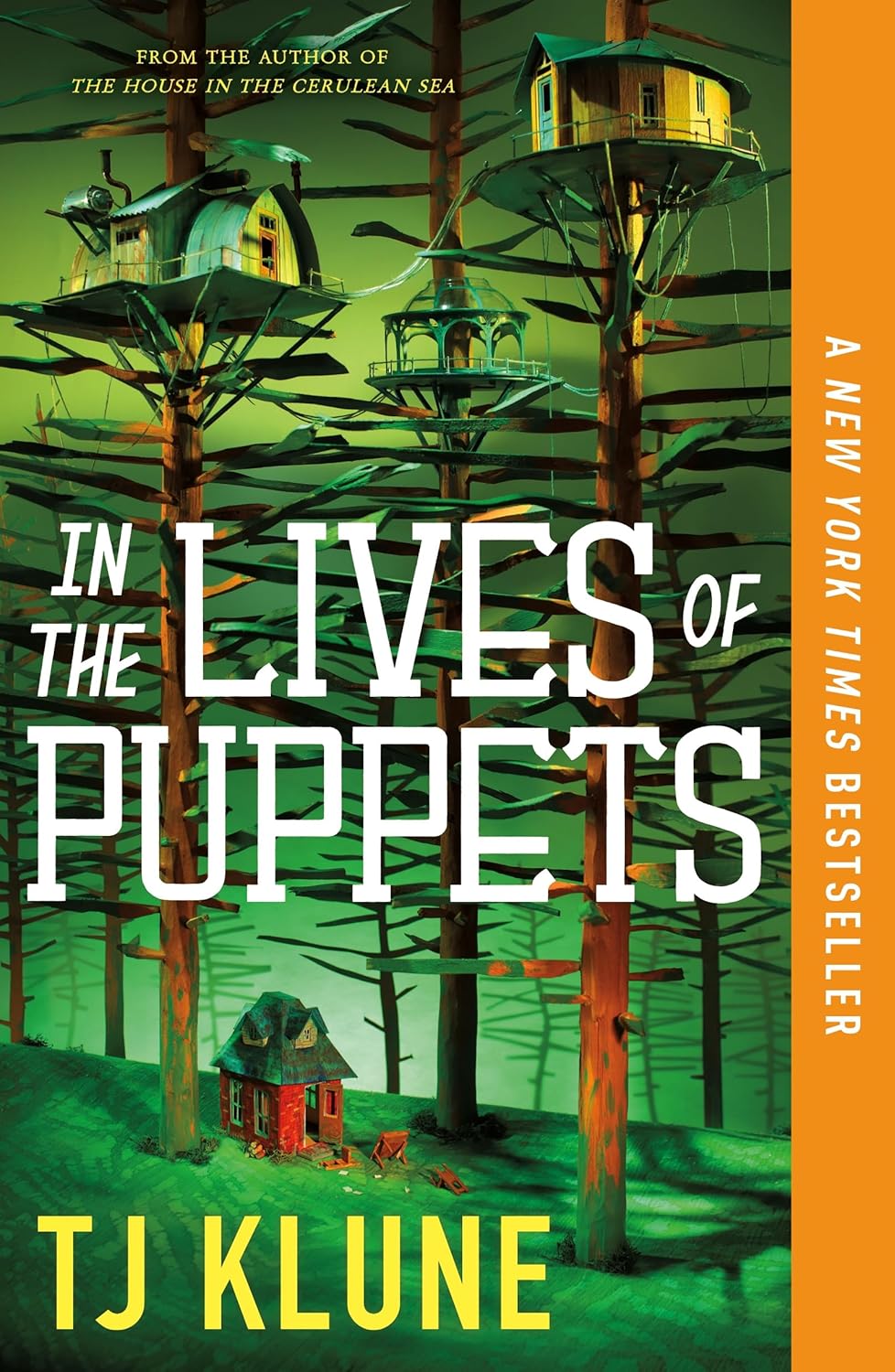
Klune, T. J. In the Lives of Puppets. Tor, 2023.
The saddest aspect of life right now is that science gathers knowledge faster than society gathers wisdom – Isaac Asimov
This quote by Asimov resonates with one of T. J. Klune’s most recent novels. In the Lives of Puppets, published in 2023 and roughly Klune’s fifteenth novel, offers a speculative reinterpretation of familiar science fiction and fairy tale tropes. In this novel Klune explores questions of care, kinship, and ethical responsibility in a posthuman world. The narrative, which is considered a retelling of Pinocchio (1883), is set in a future shaped by advanced artificial intelligence. It follows Victor Lawson, a human raised almost in isolation by a small community of robots, whose carefully constructed life is disrupted when he encounters a dangerous threat posed by technology in the past. Combining elements of science fiction, fantasy, and romance, Klune constructs a narrative that foregrounds emotional connection and moral choice over transformative technological advances in society.
The novel revolves around an unconventional chosen family. Victor lives with his adoptive father, Giovanni Lawson, an android inventor who is also an android himself, and two robots with different personalities that have been given distinct affective capacities. Their secluded existence in the forest presents an alternative to a wider world marked by violence, constant surveillance, and the abuse of technology. When Victor is captured by the AI that was responsible for past devastation in the human world, the narrative shifts into a rescue quest that forces this found family to confront both external threats and internal fears. While the plot follows a recognizable adventure plot, In the Lives of Puppets consistently returns to its core concern, which is how love, loyalty, and care operate across the human-machine worlds.
Klune, who is already well-known for character-driven speculative fiction as in his best-seller The House in the Cerulean Sea (2020), writes this novel within a tradition of science fiction that uses non-human and robotic figures to reflect on the human condition and what it means to be human. As anticipated, this work draws on Pinocchio, reinterpreting the fairy tale and bringing in current anxieties through the lens of artificial intelligence and posthuman ethics. The protagonist’s desire to protect and be protected, to belong to his non-human community and to choose his own path, echoes the wooden puppet’s longing for humanity, while the presence of sentient machines complicates any straightforward distinction between the human and the non-human. In this sense, the novel stands out as part of a long-standing SF conversation about artificial intelligence, agency, and morals, recalling earlier explorations by writers such as Isaac Asimov while shifting the focus from logic and control to dynamics of care and affect.
Within contemporary science fiction, In the Lives of Puppets aligns with an increasing body of work that prioritizes community, intimacy, and chosen family over conflict-driven narratives and complicated world-buildings. Rather than presenting AI as a potential threat or a tool for his characters, Klune uses it to imagine artificial beings that are capable of emotional development, ethical reasoning, and profound attachment as is the case of Rambo (a sentient small vacuum robot) and Nurse Ratched (a nurse android), who are Victor’s best friends. This resonates with recent speculative fiction that foregrounds community and mutual dependence in order to thrive, positioning the novel closer to relatively recent scholarly fields such as Community Studies or Hope Studies, far from traditional dystopian science fiction. At the same time, the text does not overrule the dangers of technological power as the antagonist AI embodies the consequences of uncontrolled authority, non-human reasoning, and the desire to control rather than to coexist.
Regarding the genre of the novel, it can be described as a conjunction of science fiction, fantasy, and romance. While its futuristic setting in a post-human world firmly locates it within SF, the narrative structure and emotional arc borrow heavily from the broad tradition of fairy tale and quest narratives. The emphasis on different kinds of love, from romantic and platonic to familiar, shapes both character development and plot progression. For some SF readers, this affective focus might feel at odds with potential expectations of extensive world-building that is typical of these novels. However, this mixture is central to the novel’s intervention as by foregrounding emotion and ethical choice, Klune reorients speculative inquiry towards questions of responsibility, vulnerability, and care in a technological world.
From a scholarly perspective, In the Lives of Puppets therefore offers rich material for discussions on posthumanism, community, and care ethics. The novel repeatedly challenges anthropocentric paradigms by giving robots emotional depth, thus inviting readers to reflect on where humanness begins and ends. The novel’s portrayal of non-human beings who can love, fear loss, and make sacrifices for one another complicates binaries such as human versus machine and the natural versus the artificial. These dynamics make the text particularly relevant to academic conversations around AI, affectivity in AI, and the ethics of invention and creation with technology.
The novel lends itself well to pedagogical use across different educational stages. In the classroom of secondary education, it could be productively paired with canonical texts concerned with AI such as Isaac Asimov’s I, Robot (1950) or Philip K. Dick’s Do Androids Dream of Electric Sheep? (1968). Reading Klune’s novel alongside these works may allow students to trace how representations of AI have changed over time. While earlier SF often frames AI through anxieties about control, autonomy, and threat against human life, Klune’s text reflects a contemporary, globalized context in which human-machine interactions are an everyday reality.
At the undergraduate level, the novel can be read alongside foundational theoretical work on posthumanism, such as Donna Haraway’s essay “A Cyborg Manifesto” published in 1985 in the Socialist Review or Rosi Braidotti’s influential book The Posthuman: A Theory of the Near-Future (2013), inviting students to explore how speculative fiction reworks traditional anthropocentric frameworks. Klune’s emphasis on chosen family and ethical responsibility provides a fertile ground for discussion on how agency, humanness, and moral obligation may be redistributed in posthuman contexts. The novel’s accessible prose and emotionally engaging narrative make it suitable for undergraduate courses, while its thematic engagement with responsibility, care, and power also makes it an insightful reading for more advanced critical discussion at the master’s level.
In conclusion, In the Lives of Puppets contributes to contemporary science fiction panorama by reaffirming the genre’s capacity to explore ethical and philosophical questions through emotionally grounded storytelling. Klune demonstrates with this novel how speculative fiction can successfully interrogate potential technological futures without sacrificing community or hope, positioning care, affection, and connection as vital to survive innovation and technological transformation. By revisiting familiar tropes through a posthuman lens, the novel invites readers to think about forms of community that transcend kinship and biological boundaries, offering a thoughtful and affecting meditation on what it means to choose love in a world governed by machines.
Patricia García Santos (Córdoba, 1999) is a predoctoral researcher in the Department of English at the University of Córdoba (Spain). She holds a dual degree in Translation & Interpreting and English Studies and has completed a Master’s in Secondary Education Teaching, which she pursued alongside a Master’s in Advanced English Studies. She is currently pursuing her PhD in Literatures in English, where she is a second-year student. She holds an FPI grant linked to the state-funded project The Poetics and Politics of Transparency in Contemporary English Literature (PID2023-146346NB-100). Her research examines the tension between contemporary demands for transparency and the inherent opacity of language and linguistic systems through the reinterpretations of the myth of the Tower of Babel.

 SFRA Review