
Fiction Reviews
Review of Emergent Properties
Shannon Blake Skelton
Ogden, Aimee. Emergent Properties. Tor, 2023.
Novellas—specifically, speculative novellas—have once again become a popular literary form. With the rise in readers consuming books via digital devices, the novella appears to be perfect for those existing in the chaotic and harried 21st century. Works such as Martha Wells’ Murderbot have gained wide attention outside of SF circles, resulting in an acclaimed streaming series.
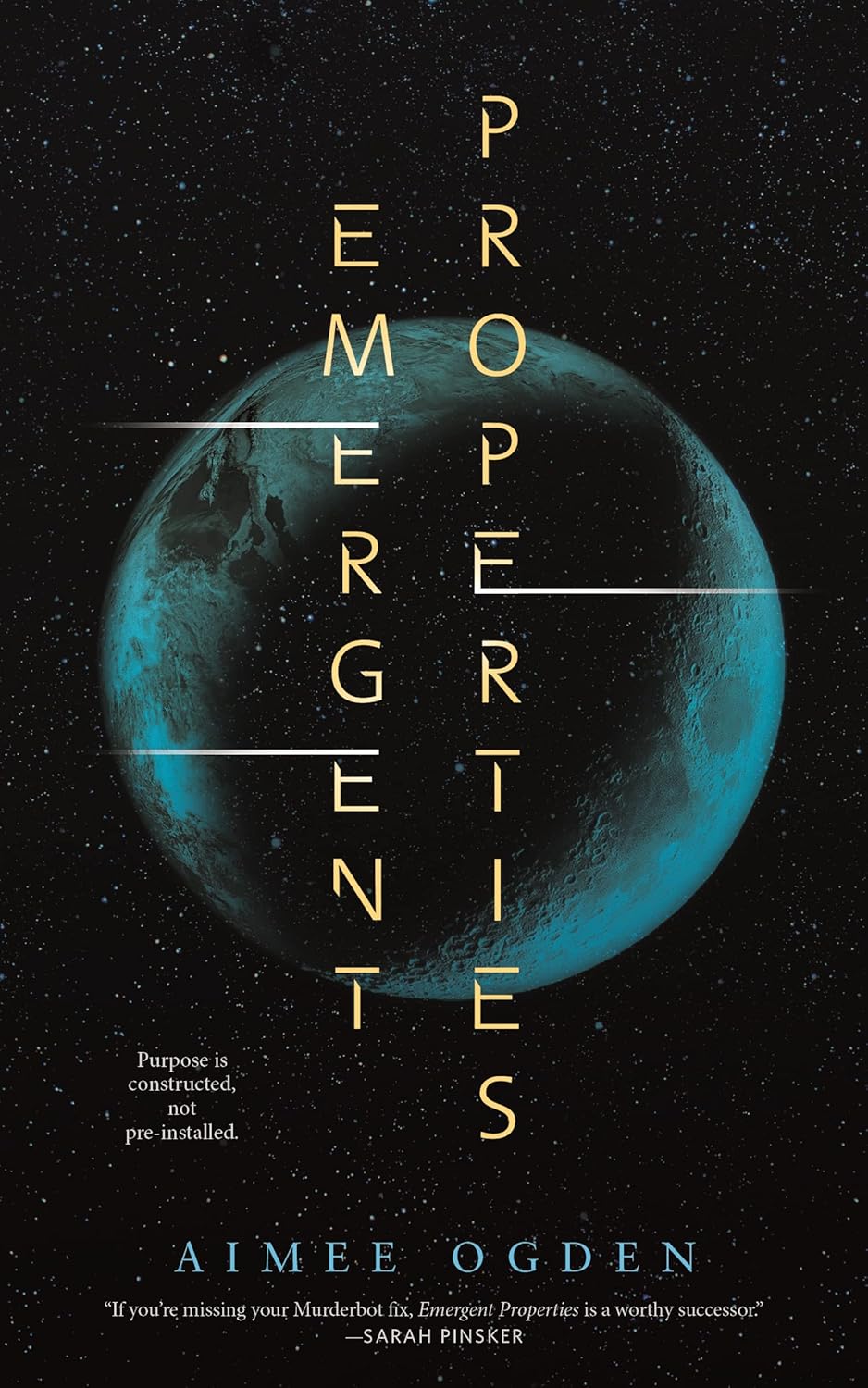
Emergent Properties, the third novella by American author Aimee Ogden, explores a world of battling corporations through the experiences of an AI investigative journalist. Ogden, who was a 2021 Nebula finalist for her novella Sun-Daughters, Sea-Daughters, introduces the reader to the independent AI reporter Scorn. The reader learns that Scorn is unique as ze is one of a few emancipated AIs. As Scorn possesses no defined or stabilized gender identity, Scorn utilizes ze/zir pronouns. Scorn follows the clues as ze traces a conspiracy that could remake the earth and radically reconfigure the relationship between AIs and humans.
Speculative authors have employed journalists as protagonists, or supporting characters, for decades. Heinlein includes the reporter Ben Caxton in Stranger in a Strange Land; in Ender’s Game, Valentine and Peter’s journalistic endeavors propel them into complex political games and Norman Spirad’s Jack Barron tracks down clues to reveal corruption in corporations. Perhaps the most fascinating of these literary reporters is “gonzo journalist” Spider Jerusalem (modeled after Hunter S. Thompson) in Warren Ellis and Darick Robertson’s cyberpunk comic series Transmetropolitan.
When the reader first encounters Scorn, ze cannot recall the previous ten days as zir “mindfile” (memory) has been erased. The genre has seen protagonists who have had complete memory loss (such as in Andy Weir’s Project Hail Mary), or even amnesia, such as that endured by the crew in Mur Lafferty’s Six Wakes, who awaken to find that a team member has been murdered and one of them is the culprit. The “protagonist with amnesia” has also translated with success to cinema. Spectators piece together the mystery of Memento as the protagonist—suffering short-term memory loss—solves a murder; Eternal Sunshine of the Spotless Mind details a pair of bitter ex-lovers who undergo a process to extract memories of one another.
Using the device of a memory impaired protagonist is often effective as it hinges on the existential query of “Who am I?” and the reader follows the character as they construct an understanding of their own identity. For Scorn, the memories of those missing days were excised, yet that reason remains the mystery. It is this pursuit of those missing days and who wiped zir “mindfile” that motivates Scorn’s investigation.
Scorn’s physical form manifests in a variety of iterations. Scorn’s “mindfile” and consciousness are stored in a massive, shared data cloud, allowing for backups if Scorn’s “body” is destroyed. Unlike the “sleeves” (bodies) in Richard K. Morgan’s Altered Carbon, in which an individual’s consciousness is downloaded into a human form, the world of Emergent Properties features AIs in a variety of physical forms. These physical “holders” of the AI are referred to as “chassis” and can be a palm size “spiderbot”, a designated human body, or even a kiosk. Since all high-level functioning AIs have unique personalities and traits and can inhabit any device or structure, this creates an unusual set of encounters as Scorn pieces together the clues.
Though constructed with the intention to serve on exploratory scientific missions, Scorn “found more novelty in the secrets and subtleties of existing social structures than in the unexplored Jovian moons” (9). Scorn stands as one of the few emancipated AIs while the vast majority toil as servants to humans.
Though the plot is intriguing, the novella does not adequately heighten tension or suspense. Scorn follows the clues and leads, but the reader is never fully aware of the stakes. Scorn, as noted, is basically “immortal” as zir “mindfile” can continuously be uploaded to the data cloud. So, danger to Scorn is minimal. The reader does not learn enough about this world’s given humans to have an emotional interest in their survival. When the source and reason for the conspiracy is unveiled, sadly, it is not a moment of high tension.
Emergent Properties also utilizes a variety of anachronisms, yet the effect on the reader is one of confusion. References to emojis, paper periodicals, the term “bougie” and denigrating an AI as a “Commodore 64 of a security bot” (33) and an “overgrown toaster” (38) intrude into the reader’s willing sense of disbelief. In addition, by utilizing ze/zir pronouns, Ogden calls attention to aspects of the non-binary gender identity of Scorn, but this fascinating element is not pursued in any depth.
Beyond these shortcomings, there are many fascinating concepts in the novella. Most notably, architectonic structures are “AI alive” as a building can be an AI’s chassis. Another novel concept is the “black box”, a café-like establishment in which AIs can be free of human monitoring and can converse across various networks with AIs, similar to a Reddit for AI. In another linkage to Reddit, the humans and AIs in this world display an “Aura” for their actions, intelligence, and behavior. As indicated by a color, the “Aura” ’s hue alters and changes as others add/subtract points.
By the conclusion, Scorn learns that the personal and political are often inextricably interwoven with Scorn realizing that “I think it’s a mistake to try to be more human for the sake of being human” (74). From observing humans, Scorn concludes that zir fear was never about becoming human but rather becoming that type of craven and destructive human that has corrupted their world. A quick, enjoyable read, what Emergent Properties lacks in suspense, the novella makes up with memorable and intriguing concepts.
Shannon Blake Skelton (he/him) is a teacher, professor, author, and researcher located in the Midwest. His scholarship, fiction, and reviews have appeared in numerous journals. His volume Interviews: Wes Craven was published by The University Press of Mississippi. He is a proud contributor to the Ad Astra Institute: https://adastra-sf.com/about.htm#about.

 SFRA Review