
Media Reviews
Review of The Silent Planet
Alfredo Suppia
The Silent Planet. Dir. Jeffrey St. Jules, Canada, 2024.
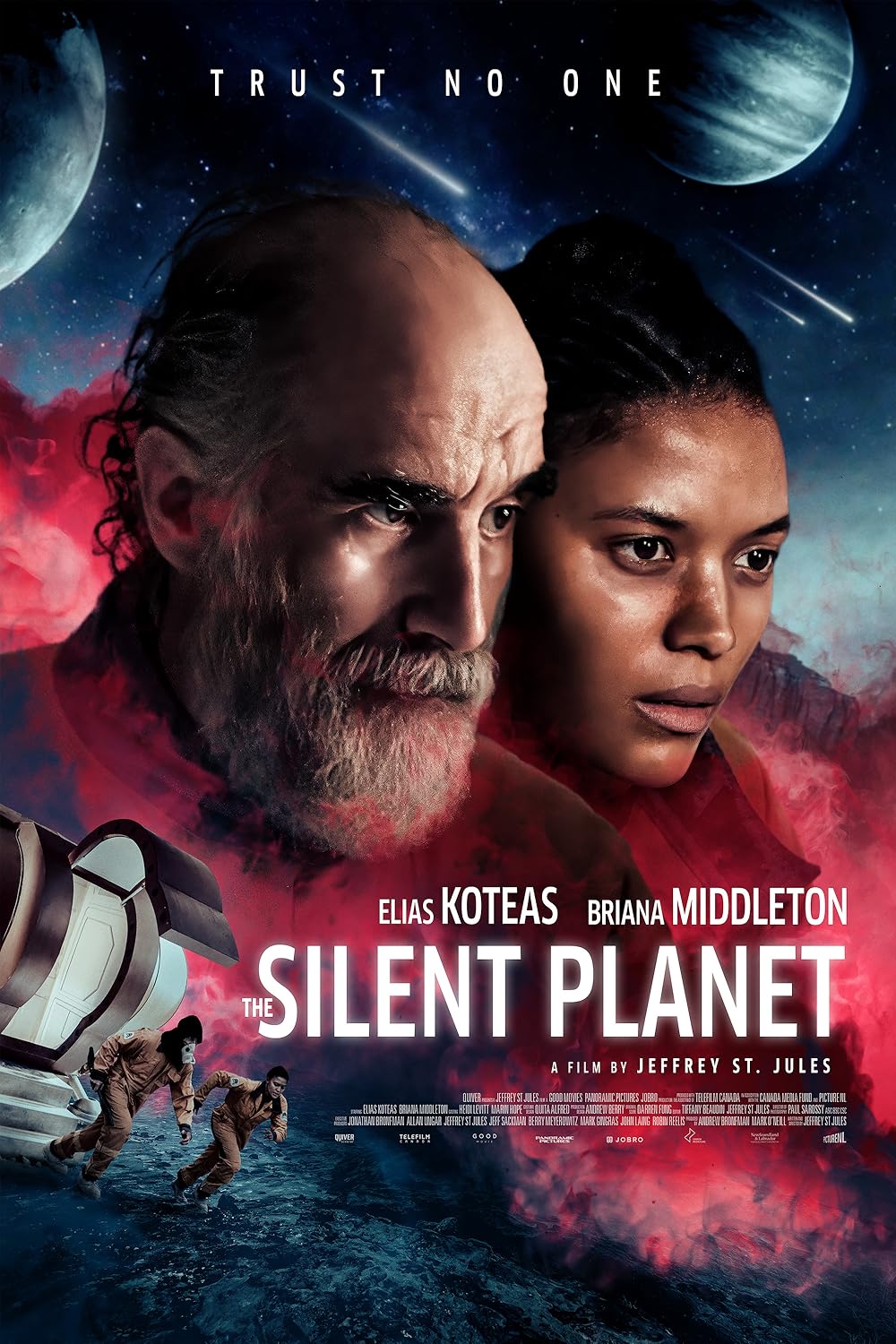
Screened at the 48th São Paulo International Film Festival in Brazil, The Silent Planet (2024), written and directed by Jeffrey St. Jules, provokes an intriguing nostalgia, whether literal or in Jamesonian terms. The film begins by evoking 1970s audiovisual aesthetics, from the off-screen TV news explaining the visit of an alien species, the Oeians, to the anachronistic visuals perceivable in the very “texture” of the initial scenes, the costumes of the characters, and the settings throughout the entire film.
The Silent Planet relies on a generally good, yet not entirely original, idea: that of a remote landscape serving as an (alien) setting for an intimate tale about loneliness, guilt, vengeance, and regret involving two extremely vulnerable human characters. Unfortunately, even a very good idea is not always enough to sustain an entire feature-length film, but the experience provided by The Silent Planet is worth watching.
Divided into five acts, The Silent Planet tells the story of two characters sentenced to life in prison on a distant, eerie planet. Initially, there is only one prisoner, Theodore (Elias Koteas), who serves his time alone, living in a tiny life-supporting pod and forced to extract a mysterious ore from the prison-planet. The ore is sent to Earth, though its true nature and value are not detailed in the film. Theodore is monitored by a device implanted in his chest. The first act begins with Theodore learning he is close to death from the body monitor. He cuts his chest, removes the device, buries it and keeps working, refusing to accept his condition. As time goes by, the aging Theodore suffers from the decay of his body due to working for so long in such unhealthy conditions. He also struggles against the decay of his mind in absolute solitude: the memories of his past on Earth become murkier as Theodore approaches the end of his life. Strongly attached to his memories of his beloved wife Mona, Theodore believes he was unfairly convicted of the murder of his wife’s lover—or at least that is the past he has created for himself.
Aware of Theodore’s final days, the Earth-based authorities dispatch a replacement to the prison planet—another condemned worker. This is the young Niyya (Briana Middleton), whose arrival in her pod on the planet’s surface is carefully observed by Theodore. Niyya was raised by an Oeian family on Earth. The Oeians are an alien species declared “illegals” and hunted by human authorities. After witnessing her Oeian parents’ murder by the military, Niyya joins a rebel group, is captured as an Oeian sympathizer, and exiled to the prison planet.
Theodore, the planet’s current prisoner, fears being replaced and breaks into Niyya’s pod to steal her Oeian journal. While he craves companionship, Niyya wants solitude. Both have lost faith in humanity through their experiences. Theodore eventually wins her over, leading to the film’s most powerful sequence: a dinner scene where they finally have a profound conversation over whisky and marijuana.
A generational and cultural clash emerges—Theodore longs for lost human relationships while Niyya identifies with the Oeians and feels betrayed by humans. However, Theodore reveals uncertainty about his identity, suggesting he might be Nathan Flanagan, the soldier who killed Niyya’s family. This revelation triggers paranoia in both characters, who come to believe only one can survive. Their suspicions lead to a violent skirmish across the silent planet’s landscape.
According to Jeffrey St. Jules, the story derives from a fantasy he had as a child: to live alone and unbothered on another planet. But the film also revolves around the long-lasting debate over humans’ frequent incapacity to communicate effectively, often failing to reach agreement or even accept otherness. In that sense, it is significant that the film employs variation in point of view at crucial moments. For instance, Niyya’s arrival scene is first shown from Theodore’s perspective in the first act and from Niyya’s perspective in the second act. By shifting the characters’ perspectives, St. Jules essentially creates not just points-of-views but “filters” for the audience—a cinematographic way of angling or distancing each character from the other. In doing so, he creates a communication disruption for the viewer that serves to echo the characters’ selfsame miscommunication. As they are “imprisoned” by their unique point-of-view so too is the viewer drawn into this imprisonment through the shifting angles. The Silent Planet may stand as a metaphor for countless conflicts in human history, up to the present day. The anachronistic undertone of the film, with its frequent nod to television culture (Theodore enjoys TIA, an artificial intelligence that creates a sitcom based on his life, and he watches it repeatedly), in addition to the apparently purposefully outdated design of the props and settings, evokes a series of 1970s/80s science fiction films from various countries. These include, but are not limited to Nicholas Roeg’s The Man Who Fell to Earth (1976), Douglas Trumbull’s Silent Running (1972), Richard Viktorov’s Per Aspera Ad Astra (1981), and first and foremost, Solaris—the 1968 TV adaptation of Stanislaw Lem’s 1961 eponymous novel more than Andrei Tarkovsky’s 1972 version. Geoff Murphy’s This Quiet Earth (1985), as well as Wolfgang Petersen’s Enemy Mine (1985), are also in this patchwork of films evoked by The Silent Planet. In lieu of Solaris’s sentient ocean, Jeffrey St. Jules creates an interesting purple haze or pinkish fog that drifts across the surface of the silent planet periodically to capture the humans’ memories and repeat their voices from the past. When this purple haze engulfs Theodore or Niyya, they can hear echoes from past prisoners.
In the fourth act, Theodore/Nathan and Niyya have an altercation, where she eventually attacks the old man, believing he is the murderer of her Oeian family. The fight takes place in a third “homepod,” one whose past inhabitant had committed suicide by hanging. Cryptic words and drawings are on the pod’s walls, some of which turn out to be identical to ones that Koteas himself had said or heard. It becomes evident, upon this discovery, that the two main characters are not the first to experience that terrible isolation and communication disruption. Instead, several previous prisoners (maybe generations of previous prisoners) coped with similar and even worse scenarios. The third homepod casts light on the main theme being developed throughout: that isolation and solitude blurs the lines between memories and “generations” of individuals. Indeed, all the dialogues in The Silent Planet seem to serve this purpose: the human mind and memories are tricky, and what we tell ourselves has more to do with our mental state and traumas than objective past reality. The “untrustworthy” Theodore, plagued by doubts, ends up guiding Niyya in her self-discovering journey. Memories are deceiving, words are pale, and perhaps only action and attitudes are truly meaningful.
According to producer Andrew Bronfman, the budget for The Silent Planet was nearly 4 million USD. This is low for a Western SF film. In addition to the intended anachronistic, nostalgic atmosphere of Jeffrey St. Jules’s film, The Silent Planet may have also been inspired by the aesthetics of lo-fi sci-fi and “Science Fiction from the South” or a more encompassing aesthetic often associated with SF from the Global South. Regardless, lo-fi sci-fi is clearly present in the minimal, understated visual effects that are overshadowed by the drama and clever story, based on solid plot points and twists.
The story does not unfold entirely fluently, and some blind spots might be perceived in the script or the film’s world-building. For instance: while Theodore’s initial attitudes and fears are comprehensible (he is dying, he is an outcast, he is somewhat delusional), the same does not apply to Niyya. Yes, she is traumatized by humans, but some flashback scenes show her in a close, even romantic relationship with another human. While she may have been betrayed by that woman (an undercover police agent), it remains unclear why there is no empathy or stronger inclination toward cooperation, given that she and Theodore are the only two prisoners left to die on this faraway planet. We must adopt a metaphoric mode of viewing to fully enjoy The Silent Planet, since there is no symmetry between the characters nor a more coherent assemblage of their motivations and psychological nuances (Koteas’s character is better designed in this sense, paradoxically because he is more mysterious and also due to his performance). In sum, all characters’ attitudes, fears, and actions are ultimately justified by humanity’s incapacity to truly communicate, as well as an innate instinct to suspect other people and resist cooperation. Viewed positively, the film can be understood as criticizing this feature of human nature, by testing hypotheses on how human a person can remain in solitude for years, living a miserable life on a faraway planet.
While the critique of the characters’ arcs and psychologies may reveal asymmetries that could annoy some discerning spectators, there is nothing inherently problematic about metaphor or allegory. Excessive criticism of characters’ psychology and verisimilitude, or cause-and-effect in storytelling, is oftentimes not only controversial and culture-dependent, but also sterile and pointless. However, concerning The Silent Planet, problems arise when spectators must constantly shift between metaphoric and literal viewing. In metaphoric mode, there is no reason to be too demanding of answers and explanations. But when viewing literally, verisimilitude and questions concerning cause and effect become important. For instance, the ore mined on that planet is seemingly useless, likely a MacGuffin or something to fill a gap. If it were valuable, there would be no reason to send just one or two prisoners to manually extract such a rare commodity. Why not settle an entire penal colony with drones, robot-miners, and nanorobots to optimize extraction? Here we may return to allegory and view Theodore as Sisyphus. When Niyya speaks to “Jane,” the “Alexa” of that world, while picking a meal, the meal comes packed inside an ordinary “take-away box” made of aluminum foil, with a cardboard lid. Since there’s no hint of agriculture or food production on that planet, do the prisoners get these supplies from Earth? The stowed meals, like take-away or in-flight meals, distracted and annoyed me somewhat. While most actions, props, and scenes are justifiable given the anachronistic world-building, lo-fi sci-fi, and low-budget, independent film style, some details could have been better designed or developed.
As it becomes evident, Niyya was sent to the planet to replace Theodore once Earth authorities knew about his health condition. Within days, perhaps hours, she lands on the planet. In the film’s final moments, Theodore dies with Niyya’s monitoring device implanted in his body so that she can live undetected. One may wonder how naive this futuristic monitoring technology is since we already have better tracking methods today. If it is so easy to tamper with the monitoring technology, why don’t prisoners do the same upon arrival? Simply get rid of the chest monitor and enjoy freedom.
Questions remain such as whether Niyya is “free” since Theodore died in her place. However, Earth authorities could easily uncover the trick, and she cannot escape from the planet since the transportation pods are launched into space immediately after arrival. Moreover, a substitute for Niyya is expected soon. The planet’s rarefied atmosphere makes exploration difficult. The film ends with Niyya on top of a mountain, looking at the horizon, with final credits rolling without showing an expected pod entering the atmosphere.
I find myself wondering what The Silent Planet’s impact might have been had Jeffrey St. Jules decided not to show the Oeians at all. We would have to imagine them completely. As a fan of the off-screen tradition (e.g. Jacques Tourneur’s 1942 Cat People, or Joseph Lewis’s 1950 Gun Crazy), I wonder about keeping the aliens unseen, perhaps only revealed in the small picture shown by Niyya to Theodore. Like the “overlords” in Arthur C. Clarke’s 1953 Childhood’s End, the off-screen—particularly in SF and horror—is often preferable. Yet I can understand if Jeffrey St. Jules intended to pay homage to 1950s SF films like Edgar G. Ulmer’s The Man from Planet X (1951), Joseph M. Newman’s This Island Earth (1955), or Jack Arnold’s Creature from the Black Lagoon (1954).
Nevertheless, The Silent Planet seduces through the nostalgia it provokes—from Elias Koteas’s presence (an actor familiar to veteran spectators), to the intricate web of SF evoked by St. Jules’s cinematic storytelling, visual style, and evident cinephilia. For spectators open to intimate, minimalist SF cinema, unpretentious and not entirely concerned with cohesion and coherence in world-building, The Silent Planet may signal renewed interest in SF scripts with good ideas that escape the tired infantilization of most American blockbusters, even though several points (especially world-building, settings and props) could have been better developed. Not presumptuous, hermetic, or overplayed, The Silent Planet delivers valuable “ore” to its spectator: humanist SF creatively based on atmosphere and good acting. From a scholarly perspective, the film offers significant value for academic study in two key areas: first, as a compelling case study in how contemporary low-budget science fiction cinema engages with and recontextualizes the aesthetic traditions of 1970s-80s SF filmmaking, demonstrating how nostalgia functions as both narrative device and visual strategy. Second, the film provides rich material for examining the persistent themes of communication failure and otherness in science fiction, particularly how the genre continues to use isolated settings and cross-cultural encounters to interrogate fundamental questions about human nature and xenophobia in an era of increasing global tensions.
Alfredo Suppia is an Associate Professor at the Universidade Estadual de Campinas (Unicamp), Brazil, where he teaches film history and theory, science fiction cinema and new media art at the Department of Multimeios, Media and Communications. He also coordinates the Graduate Program in Social Sciences at the same university.

 SFRA Review