
Fiction Reviews
Review of The Ministry of Time
Lena Leimgruber
Kaliane Bradley, The Ministry of Time. Simon and Schuster, 2024.
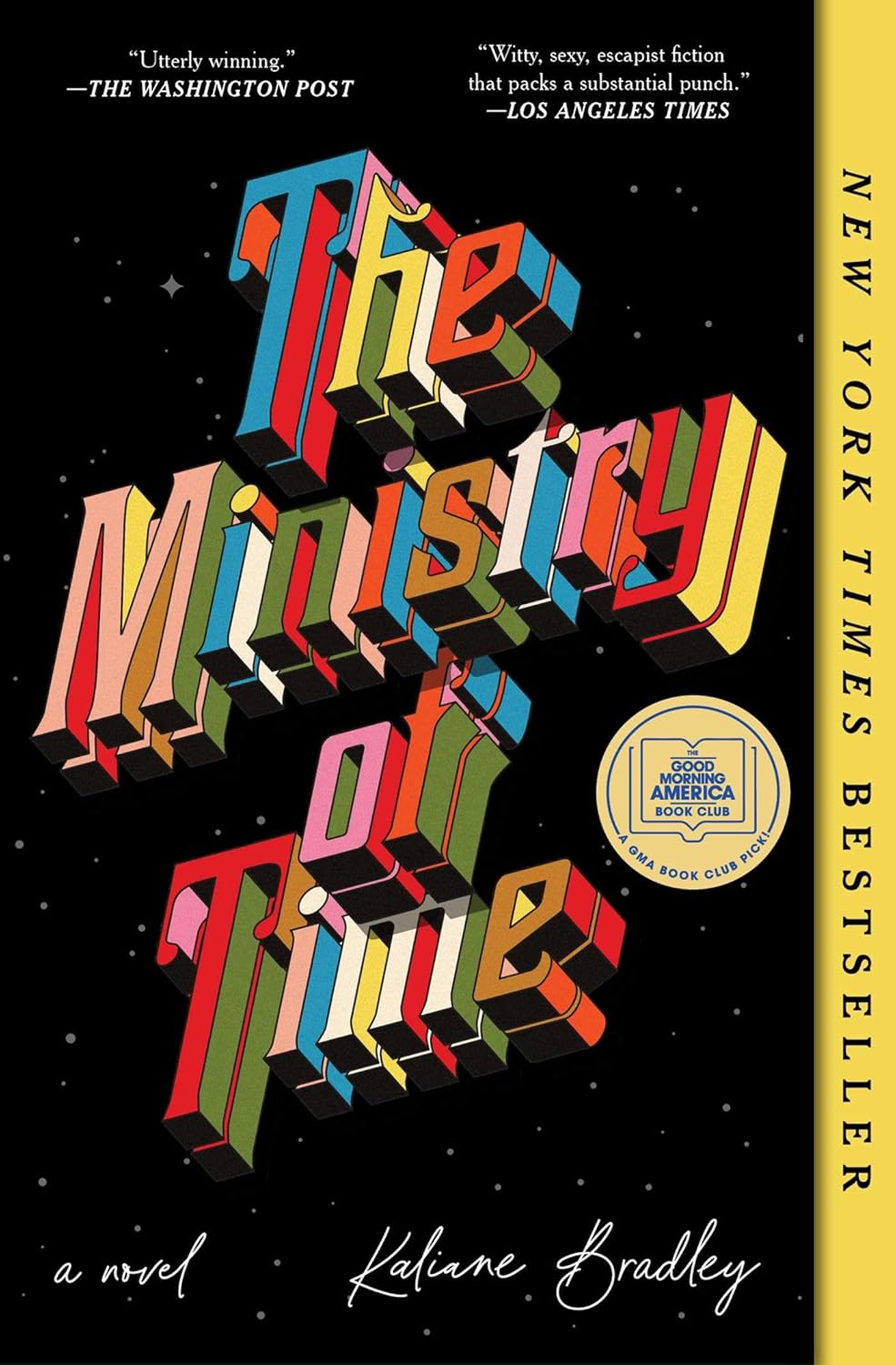
What does it mean to meet history face-to-face? In Kaliane Bradley’s The Ministry of Time, the past is not a distant tableau but a living presence, and the future is something to be negotiated. Bradley, a British-Cambodian author, constructs a novel in which temporal encounters become both deeply personal and ethically charged. The narrative alternates between two storylines: a near-future Britain, where the Ministry of Time, a secretive government agency, manages “expats from history”, and 1847, through the perspective of Commander Graham Gore, a naval officer aboard the ill-fated Franklin Expedition. The protagonist, an unnamed “bridge”, works at the Ministry’s Language Department, guiding historical figures as they navigate the modern world. The novel explores how people from different eras perceive and interpret one another, balancing the ethical and emotional challenges of cross-temporal interaction. Chapters in the contemporary timeline are numbered in Arabic numerals, while historical chapters employ Roman numerals, signalling shifts in perspective and highlighting the contrasts between past and present. The novel arrived with considerable anticipation, supported by an extensive marketing campaign and a wide distribution of advance review copies, which meant it had already generated significant discussion before its official release. Its reception was further boosted by its longlisting for the 2025 Women’s Prize for Fiction.
Placed within the broader history of SF, The Ministry of Time aligns with a tradition in which speculative devices are deployed to probe ethical, social and philosophical questions. Bradley’s use of time travel emphasises moral responsibility and cross-temporal understanding rather than adventure or spectacle. Her focus on romance across temporal and cultural divides situates the novel within a lineage of speculative love stories, while expanding the form to encompass postcolonial and environmental concerns. Even the historical elements (references to the Franklin Expedition) participate in a long-standing SF practice of revisiting the past to illuminate contemporary anxieties, although Bradley foregrounds intimate human connection rather than survival or horror. Through these combined strategies, the novel contributes to the interest in character-driven, ethically and politically engaged storytelling, demonstrating how speculative narrative can illuminate questions of identity, responsibility and the consequences of human action. Unlike many earlier works of SF, often celebrated for their focus on world-building, The Ministry of Time situates its speculative premise in a world that closely resembles our own. This allows the narrative to devote more energy to character, emotion and moral dilemmas, while leaving some readers wishing for a fuller exploration of the mechanics of time travel itself.
The title, The Ministry of Time, immediately evokes associations with speculative and political literature, notably Kim Stanley Robinson’s The Ministry for the Future. Both titles suggest governmental authority over temporal matters, positioning time as a domain requiring oversight and intervention. This framing aligns with Bradley’s exploration of a bureaucratic institution managing time travel and historical figures, emphasising the ethical complexities of such power. Additionally, the title may resonate with the Spanish television series El Ministerio del Tiempo, which similarly engages with time travel and historical encounters, though Bradley’s novel distinguishes itself through its focus on intimate, cross-temporal relationships and postcolonial themes. With some critics noting striking similarities between The Ministry of Time and El Ministerio del Tiempo, discussions around the novel have been complicated by a plagiarism controversy. While the publisher and author have denied any direct borrowing, the debate takes up questions of originality, adaptation and cultural borrowing.
It is also noteworthy how the novel has circulated internationally: while most translations retain a direct equivalent of The Ministry of Time, the Spanish edition avoids El Ministerio del Tiempo, the title of the TV series at the centre of the plagiarism controversy. Instead, it is published as Un puente sobre el tiempo (“A Bridge Across Time”), a striking shift that seems to signal both a distancing strategy and an attempt to reframe the novel for Spanish readers. This small but telling change does a lot: it raises questions of originality, intertextuality and ownership that shape the novel’s global reception.
It is also noteworthy how the novel has circulated internationally: while most translations retain a direct equivalent of The Ministry of Time, the Spanish edition avoids El Ministerio del Tiempo, the title of the TV series at the centre of the plagiarism controversy. Instead, it is published as Un puente sobre el tiempo (“A Bridge Across Time”), a striking shift that seems to signal both a distancing strategy and an attempt to reframe the novel for Spanish readers. This small but telling change does a lot: it raises questions of originality, intertextuality and ownership that shape the novel’s global reception.
While historical references appear, they primarily enrich the speculative backdrop rather than drive the plot. At its core, The Ministry of Time is a love story that explores the challenges and intimacy of relationships that span vast temporal divides. The bridge-narrator develops a profound connection with historical “expat” Graham Gore; through their story, the reader learns about both the dissonances and resonances that arise when individuals from very different times encounter one another. Through this central relationship, Bradley foregrounds questions of ethical responsibility, empathy and the consequences of human action: concerns that echo contemporary societal debates on postcolonial legacies and climate change.
Characterisation and emotional depth are central to the novel’s impact. Gore’s perspective conveys the physical and moral realities of nineteenth-century naval life, from survival and hierarchy to the assumptions embedded in imperial and colonial structures, while his encounters with the twenty-first century expose profound cultural dissonances and ethical tensions. The bridge-narrator reflects on her role with a mixture of fascination, care and responsibility: “It was so hard not to treat the expats like blank slates onto which I might write my opinions. […] Every time I gave Graham a book, I was trying to shunt him along a story I’d been telling myself all my life” (156). Her emotional engagement is inseparable from ethical reflection: in guiding historical figures, she must navigate the consequences of her influence, balancing empathy with moral responsibility. The romance between narrator and expat thus functions less as a conventional love story and more as a lens through which the novel examines moral agency, the ethical stakes of mediation across time and the lingering effects of colonial frameworks. By interweaving emotional intimacy with ethical and historical inquiry, Bradley demonstrates how SF can explore the complex interplay of personal connection, cultural understanding and human responsibility across temporal divides.
While The Ministry of Time clearly draws on SF and time travel tropes, its narrative structure owes just as much to the conventions of romance fiction. The novel is less invested in the technical details of time travel than in the emotional arcs that unfold around it. For many readers of SF, the absence of an explanation of the time-travel mechanism might be frustrating, but this absence also shifts the focus: relationships, intimacy and desire become some of the central motors of the plot. Reading the novel through a romance lens reveals how Bradley uses affect and attachment not only to anchor the speculative premise, but also to complicate questions of power, dependency and care across historical and cultural divides.
Bradley also engages thoughtfully with postcolonial and historical reflection. Gore’s nineteenth-century assumptions, his navigation of Arctic landscapes and encounters with Indigenous peoples reveal the legacies of imperial hierarchy and the categories imposed by colonial governance. The narrator reflects on this inheritance: “The great project of Empire was to categorise: owned and owner, coloniser and colonised… I inherited these taxonomies” (181). Through time travel, Bradley interrogates not only individual actions but the structures and epistemologies that shape historical events. Language again emerges as central: the act of naming, translating and interpreting carries moral and political consequences. By highlighting these stakes, the novel demonstrates how speculative narratives can illuminate the ethical and cognitive work involved in historical understanding and postcolonial critique.
A more troubling element lies in Gore’s attraction to the protagonist, which is explicitly linked to her resemblance to an Inuit woman against whom he has transgressed in the past. This “interchangeability” risks reproducing colonial logics, reducing both women to symbolic vehicles for Gore’s guilt and potential redemption. At the same time, it may be read as a deliberate narrative device to stress how thoroughly Gore remains trapped in the worldview of his own era: even as he is displaced into the present, he cannot shed the racialised and gendered assumptions that shaped him. Intentional or not, this aspect leaves a lingering feeling of unease with the reader and raises questions about the novel’s negotiation of colonial history through personal relationships.
Time travel (even though the novel could have done more in terms of explaining how it works) functions as a mechanism for ethical and philosophical exploration. The Ministry, ostensibly a bureaucratic institution, highlights the limits and responsibilities of human intervention across temporal contexts that are, by extension, social and environmental contexts. In this framework, language and cultural understanding become essential tools: “One of the many hypotheses coagulating in these early days of time-travel was that language infirmed experience — that we did not simply describe, but create our world through language” (56). This insight underscores the stakes of Bradley’s work as a bridge: guiding historical figures is not only a matter of translation but also of shaping their perception of the present, influencing how they act and how the world is subsequently understood. Bradley uses this premise to explore the ethical dimensions of mediation across time and, consequently, stresses the responsibility inherent in naming, interpreting and narrativising events. The language concerns that Bradley brings up also resonate with broader SF traditions, where language often functions as a lens to question the relationship between consciousness, society and reality itself. Ultimately, she links speculative narrative with philosophical inquiry and proposes that our engagement with the past carries both cognitive and moral weight.
The Ministry of Time resonates strongly with broader societal reflections on how nations reckon with their pasts. In Britain, debates around colonialism, restitution and reconciliation have intensified in recent years, and Bradley’s novel can be read as part of this cultural moment. By resurrecting a figure of imperial exploration and displacing him into the present, the novel forces readers to confront unresolved colonial legacies rather than allowing them to fade into comfortable amnesia. This mirrors wider movements, within Britain and globally, that insist on engaging critically with history, acknowledging its violence and considering possibilities for repair. At the same time, The Ministry of Time extends beyond national boundaries: it participates in an international literary conversation about the importance of grappling with the entanglement of past and present, recognising how colonial structures still shape today’s societies and futures. Similar questions are being asked in Canada, Australia and other (settler-)colonial contexts, where literature can become a key site for negotiating historical injustices and imagining new, more just futures.
Formally, the novel benefits from its dual timeline and alternating perspectives, which allow for nuanced explorations of temporal, ethical and emotional concerns. Vivid descriptions of Arctic landscapes and period detail provide texture and authenticity, while the focus on emotional and cognitive mediation ensures that the narrative remains both intellectually engaging and emotionally compelling. Bradley’s careful structuring, numerical versus Roman numeral chapters, reinforces the contrasts between past and present, which supports the thematic centrality of perception, interpretation and responsibility across eras.
While The Ministry of Time succeeds in its exploration of temporal ethics, linguistic mediation and emotional depth, certain narrative choices limit its impact in other areas. Readers with a particular interest in Arctic history or expedition narratives may find the historical sections comparatively brief and underdeveloped. The Franklin Expedition, though thematically resonant, serves more as a backdrop for cross-temporal ethical reflection than as a fully realised historical setting. This raises questions about why Bradley chose this particular historical context: the Arctic environment, survival challenges and the broader expeditionary framework are evocative but largely peripheral to the novel’s central concerns. While these choices are understandable given the novel’s focus on ethical mediation, language and cross-temporal encounters, the historical and geographic richness of the Arctic is not fully leveraged, leaving readers with the sense that the setting could have been more integrated into the narrative’s speculative and philosophical ambitions.
Beyond its literary and philosophical achievements, The Ministry of Time offers rich possibilities for scholarly engagement, particularly around the question of how understanding the past informs the present. The novel’s emphasis on cross-temporal mediation and responsibility encourages reflection on the ethical, environmental and social consequences of human action in the Anthropocene. Students and researchers could explore how Bradley’s narrative addresses the ongoing relevance of historical knowledge for contemporary challenges such as climate change, showing how interventions (temporal or societal) carry moral weight. Similarly, the novel’s attention to colonial hierarchies, historical encounters and the epistemologies inherited from empire invites analysis of how historical legacies continue to shape structures of power, cultural understanding and systemic inequities, including ongoing issues of racism. It is through the linking of speculative, historical and ethical inquiry that Bradley’s work provides a platform for discussions that span literature, environmental studies, postcolonial critique and social ethics. Doing so, she showcases how fiction can illuminate the stakes of grappling with history to better navigate present and future challenges.
Overall, The Ministry of Time is a richly imagined speculative romance that engages both the heart and the intellect. Bradley demonstrates how love across time can illuminate ethical, cultural and environmental stakes. Bradley shows that human connection, even across centuries, reflects ongoing societal concerns about climate, history and moral responsibility. The novel combines emotional resonance with intellectual rigor, making it a distinctive and compelling contribution to contemporary SF.
Lena Leimgruber is a PhD student in English Literature at Umeå University, Sweden. Her research examines representations of the Arctic in contemporary literature, with a particular focus on colonial histories, ecological crisis and more-than-human agency. Lena explores how speculative and environmental narratives challenge dominant cultural imaginaries and expose entangled legacies of imperialism and climate change.

 SFRA Review