
Fiction Reviews
Review of Shroud
Zorica Lola Jelic
Adrian Tchaikovsky, Shroud. Tor, 2025.
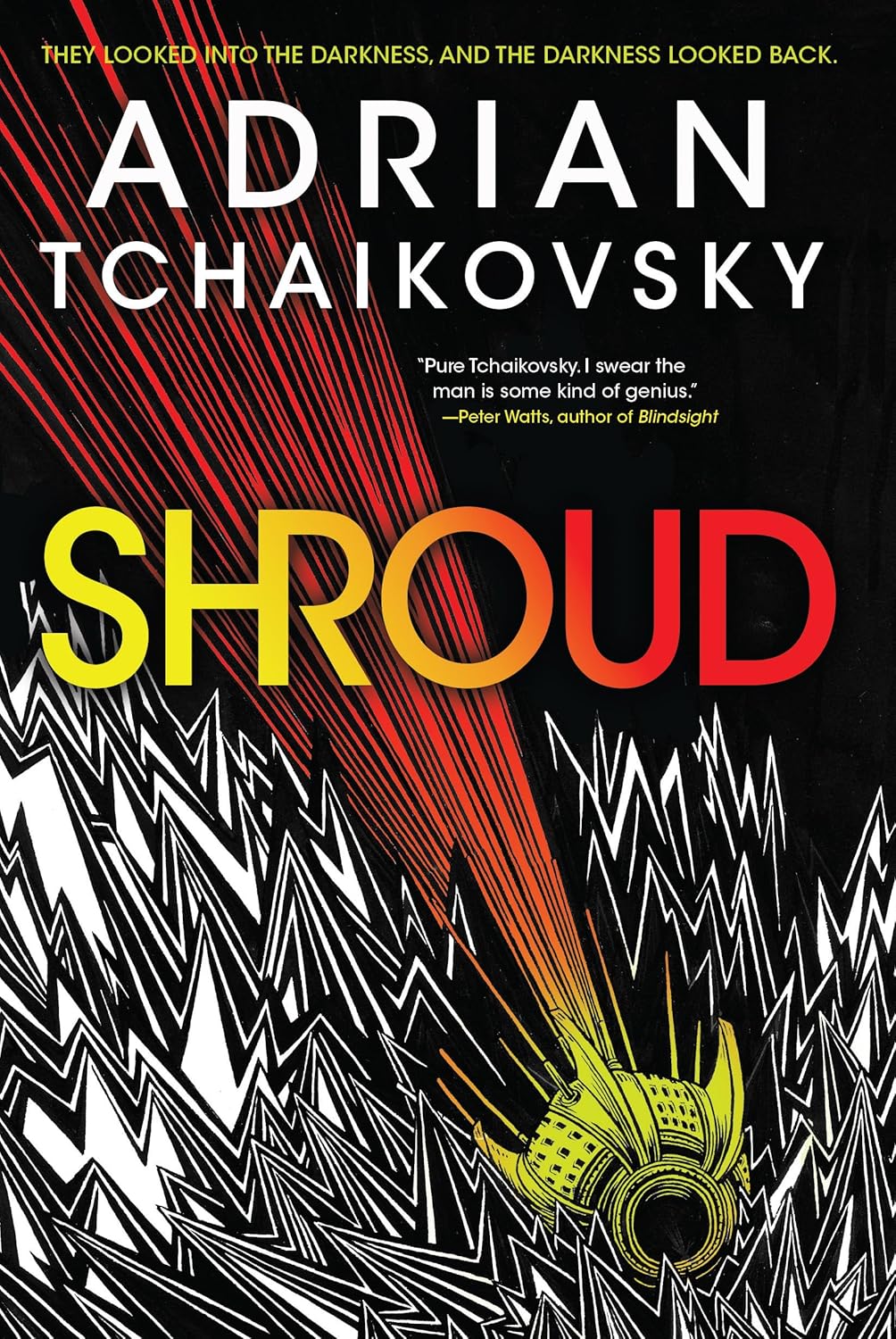
Adrian Tchaikovsky is possibly one of the best writers of science fiction today. In his novels, he imagines and creates futuristic worlds as soft dystopias. The problems that arise in his novels are a result of human greed and bad politics rooted in the everlasting campaigns of acquiring more commodities. With this novel, Tchaikovsky puts forth a premise: the possibility of intelligent life evolving in complete darkness. In some distant future, humans have exhausted Earth’s resources and have colonized other planets. Children live in impoverished and confined shared spaces (hubs) with little food and even less opportunities unless they prove themselves to be potentially useful workers on spaceships. They travel throughout star systems in search of ore and other materials with the same colonial zest that humanity has cultivated over the centuries. Their bodies hibernate while doing so, and if there is no need for their particular skills, they can stay “shelved” indefinitely. By the same token, life spans can be prolonged since people can be re-shelved many times. The Garveneer Composite Mission Vessel approaches a moon in the Prospector413 system, which is always on the dark side of a planet and is, therefore, forever hidden from light. Due to its pitch-black nature that is hidden under layers of gasses, it is named Shroud. What appears to be an easy mission of doing pre-excavational research turns into a first-contact mission. The entity inhabiting the moon is named Darkness, and the reader soon finds out that Darkness is rather loud and has quite a story to tell. Yet, Tchaikovsky expands his premise and stretches the readers’ imagination further; it turns out that Darkness is a fast learner.
As in his previous novels, Tchaikovsky plays with the limits of science and describes the unknown with scientific knowledge known to readers. In this case, he shows how creatures living with no light develop a complex system of deciphering and tracking sound as it is done with natural sonars. However, sound is also a learning and communicating tool, which turns out to be too evolved for humans to understand. Tchaikovsky goes back to the greatest downfall of humanity—dismissing what cannot be understood as primitive and unworthy. Per instructions, the crew cannot afford to admit that intelligent life exists simply because not acknowledging life legitimizes the destruction of the same. Turning a blind eye for the sake of plundering and the never-ending prosperity of mankind seems to be the go-to modus operandi even in the distant future. Nevertheless, like any good hard science fiction work, this one opens the discussion on what it means to be human. For every colonizer throughout history, the category of humanity is stripped down to the notion that white man’s superiority implies morality. Darkness proves more than once that it has higher moral standards of understanding the other and alien life than humans do. It wants to learn and communicate in order to share knowledge and acquire new ones. It recognizes that learning about a different life form can benefit its own existence. Yet, ruthless human behavior forces the alien entity to become shrewd and recognize people for the threat that they truly are. Once more, Tchaikovsky shows how alien life does not have basic human emotions; yet, it has appreciation and a fascination with the workings of other life forms, which puts them in a morally higher category than people are. The lack of morality and respect of all life on the Garveneer shows that humanity, even though it has the technology, has still not evolved enough to make first contact with unknown life. This seems to be the strongest criticism of present-day people that Tchaikovsky provides. He also creates Darkness as an entity that has a learning curve similar to AI, which brings the reader back to the present moment and the debate on whether we should create more sophisticated AI machines when we are morally so corrupt that we do not recognize the responsibility that goes with such an endeavor. In other words, man’s hubris blinds him from recognizing his inability to compete with and monitor the rapid pace of AI innovation.
Furthermore, Tchaikovsky returns again to the representation of genderfluid people as well as the use of the ever so popular pronouns they/them for some of his characters. This could be his giving into or supporting certain social trends, which according to his novels will undoubtedly survive and make it into the future, or it could simply mean that humanity in some distant future will forego strict male/female interactions in favor of more conformable relationships, bodies, or identities. Perhaps, in the distant future, affinities will be based on proximity, because one cannot choose with whom one will be joined while mindlessly going through space in a pod ad infinitum. Still, the use of these pronouns and strange names can be misleading at times, as it was toward the end of this novel. Empathy also seems to be an ability that Tchaikovsky likes to use and explore. In the novel, it is quite clear that the humans have barely any empathy (except for a few crew members), while Darkness has a level of curiosity that prevents it from destroying life. On the other hand, the readers are left with difficult choices regarding who the villain in this story will be. In the beginning, one empathizes with the lithe crew members who are dispensable to the owner (Opportunities). However, as one finds out about Darkness, empathy is slowly transferred to the entity, while leaving only vague sympathy for the humans. In his previous novel, Alien Clay, alien symbiotic life did not have intelligence, although it acted and reacted based on innate hyper altruism. Darkness shows that it prefers not to destroy, but once its existence is threatened it chooses to learn and outwit the aliens (humans). The outcome of the story is suggested and, considering the exponential learning curve of Darkness, the readers will figure it out on their own.
Shroud is a well-written novel intended to pique one’s interest into the possibilities of alien life and how it might interact with humans. As a novel, anyone interested in science fiction will have a good time reading it. For science fiction courses, it is a good example of hard science fiction writing with an emphasis on space exploration (and excavation), space travel technologies, alien encounters, hive minds, and a fascinating concept of an alien species that processes learning as AI does. This novel can be used in undergraduate and graduate courses. I also find it as a valid work for scholarly explorations of narrative empathy, the aesthetics of peace, corporate exploration, and the evolution of consciousness and how humans can/cannot keep pace with it.
Zorica Lola Jelic, Ph.D. is an Assistant Professor at the faculty of Contemporary Arts in Belgrade, Serbia. She teaches English as a foreign language, Business English, Shakespeare, and English Drama. She earned her degrees in Shakespeare studies, but she also loves to write about literary theory and science fiction. She has published scholarly papers, coursebooks, and enjoys attending professional conferences.

 SFRA Review