
Fiction Reviews
Review of Navola
Ian Campbell
Bacigalupi, Paolo. Navola. Alfred A. Knopf, 2024.
This competently written pseudo-historical fantasy novel is a textbook example of essentially everything that’s wrong with book publishing under late capitalism. I’m going to thoroughly spoil the novel here and also likely make it appear that Bacigalupi is my primary target, but he’s not: it’s the industry, the structure, not the individual. The story is set in an alternate-world version of the Italian Renaissance. Davico di Regulai is the only son and heir to a great and powerful banking house. The first three-quarters of the text centers around Davico’s being simply too nice and decent a person for the role that has been chosen for him by his patrimony. He’s kind, sensitive, naïve and open in a culture that values viciousness, indifference, cynicism and duplicity. He rather wishes he could become a physician and help people: he’s quite aware that he’s a bad fit for what he’s supposed to be. This is in no way a terrible setup for a good story. Either Davico is going to find a way for someone else to replace him so he can go pick mushrooms and heal people, or he’s going to grow into the role, lose just as much of his naïveté as he needs to in order to thrive, and take the banking house one step closer to domination. Or he’s going to grow into the role of patriarch/CEO but do it in a kinder, gentler fashion. But none of this happens; in fact, by the end of this 200k-word novel, we only get to the first couple of scenes of Act Two of how this sort of story typically works. I found myself nearly finished, thinking “well, this is all going to need to get wrapped up in a hurry, here”, and then it… doesn’t, really.
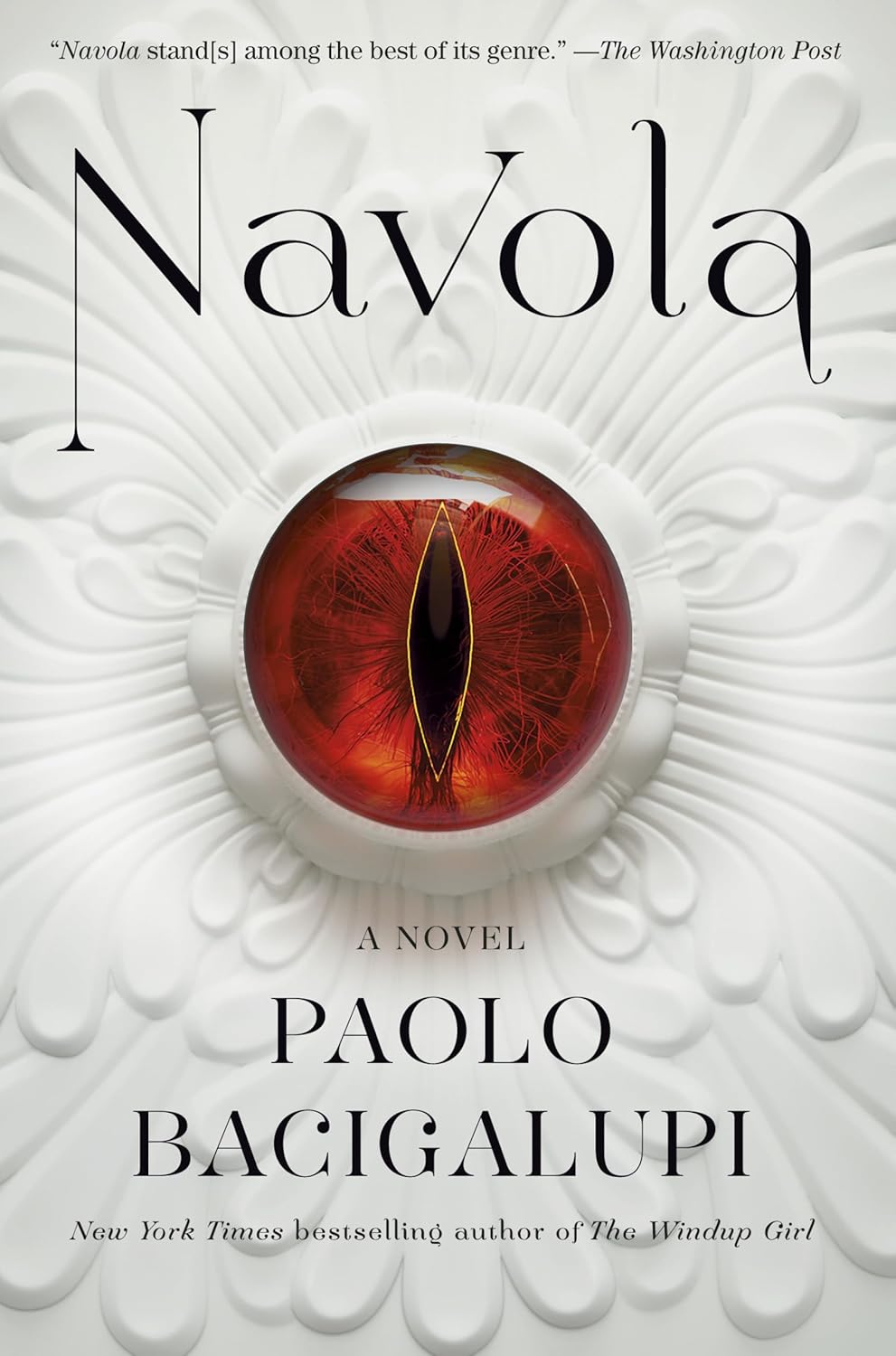
The initial chapters foreground a magical artifact in this otherwise non-magical world. Davico’s father has acquired at tremendous expense the eye of a long-dead dragon and has placed it on his desk as a symbol of his power and wealth. Davico comes to view the eye differently: he can sense the dragon’s dormant power and consciousness and is constantly fascinated by the glowing orb. The text does not explain why Davico in particular senses power through the eye, when neither his father nor any of the minions, allies, and rivals who sit across the desk from his father look at it as anything more than a trophy. We’re to infer, I suppose, that his sensitivity is the reason for why the eye reacts differently to him, but like many things in this story, we don’t get a clear explanation. Were I feeling charitable, I’d argue that Davico’s general head-in-the-clouds demeanor prevents him from looking too closely into the matter, and this is reflected in the text. The eye does enter into the final act of the story, or rather, what would be the final act were it a complete story.
Yet, aside from the eye, this world is mundane. Herein lies the true problem with Navola: it is much too close to our own world and yet too different to be literature worth the name. When I first picked up the book, I flipped to the first pages of actual text and so missed that there was a map before the first chapter. As I worked my way through the first third of the text, I kept thinking “this is a pastiche of our own world”. I was willing to accept pseudo-Italian city-states separated by rough terrain, on the premise that this was going to be an estrangement of the Italian Renaissance, and the developments in the book were going to defamiliarize me just enough with our own world to give insight into… any number of aspects of the time and place, such as how and why art flourished so much or how modern banking arose, etc. Compare Navola to, e.g., Neal Stephenson’s Baroque Cycle, which hews closely to our own world save for a few characters and does real work in not only telling a banger of a story but also providing a great deal of food for thought about how attitudes toward science and economics shifted during the late seventeenth and early eighteenth centuries.
Bacigalupi’s story takes so very long to get going, and is so filled with endless, loving detail about how this society functions, that an experienced reader of SF or fantasy is going to expect a similar payoff, only maybe with a dragon. But “the Italian Renaissance was real cutthroat” doesn’t justify a buildup this long. Why was it cutthroat? What was it about the city-states’ relative freedom from domination by larger imperia or kingdoms that produced such an environment? How did the flourishing of arts and culture dovetail with politics and economics? None of these questions is answered or meaningfully addressed by the text.
It was at this point that the kingdom of “Cheroux” to the northwest is introduced, and some part of my eyeroll made tangible led me to finding the map in the front material. Oh, look: it’s the Mediterranean, only some catastrophic event, distant enough in the past to be mostly legendary, has erased Greece, Turkey and the Balkans and left empty sea in their place. The city-states look more or less like Italy; Cheroux is in the place of France. Navola is simultaneously too close to and too uninvolved with our own world to function as a work of literature. The first three-quarters of the text is constantly filled with pseudo-Italian words for things. I’m proficient enough in Italian to be able to read a book or hold a conversation in the language, and nearly everything was just the regular Italian word but with one or two letters different: this was both very distracting and, like most of the rest of Navola, fundamentally very lazy writing, though in fact the sentences are lovingly constructed and very smoothly edited.
There are two effective ways to write a fantasy novel that estranges the Italian Renaissance and makes us rethink what we understand about the time and place. One of them is to do what Stephenson did with northwestern Europe during the Baroque period: carefully research everything, get the times, dates and personalities right, then insert fictional characters through whose points of view the action takes place, all as a means of showing us what it was like for the dominant paradigm to shift from ancien regime to something approaching the Enlightenment. There are ample sources on the events and personalities of the Italian Renaissance and the long history of French meddling in the affairs of northern Italy for Bacigalupi to have done this. The other way to write such a novel would be to give us some completely different world, mundane or magical, that reproduces the conditions of existence of the Italian Renaissance: geography gives rise to city-states whose main source of income and power is trade and banking rather than production, and while their internal rivalries usually dominate, they can unite to fend off larger powers. They might even have dragons. Consider, for example, the Song of Ice and Fire series, which Martin has stated has its roots in the real-world Wars of the Roses, but is its own, internally-consistent world (with dragons) that can be read as its own world without reference to its estrangement of English politics of the era, but which becomes that much better if you’ve read too many of Shakespeare’s history plays.
Yet, Navola does neither of these; rather, it’s a (very) thinly disguised version of our world without the depth, and it’s one that doesn’t give us any meaningful insight as to what the Italian Renaissance was really like. The real Renaissance gives us all kinds of vivid, three-dimensional people about whom quite a bit is known, but in Bacigalupi’s text the only person we get to know is Davico, who in fairness is a carefully drawn and internally consistent character. His father is a caricature; he has friends who each have one trait; the family’s household is generic but perhaps for the spymaster. The actual de’ Medicis were much more interesting. The text makes constant reference to the Navolese being “twisty” people, always concealing their true plans, but the novel doesn’t go anywhere with this: there’s no reflection on what it means to be twisty other than that Davico can’t pull it off, and the text isn’t twisty in form nor content, either.
For example, one way in which this world does differ significantly from ours is that it’s a fundamentally pagan society. There’s a monotheistic church, but it’s more first-among-equals than truly dominant: there’s also a whole pantheon of gods that have magisteria and mythology that is both detailed within the text and referenced by the characters. And to Bacigalupi’s credit, this is all done quite well. It just doesn’t go anywhere. The real Italian Renaissance was dominated from top to bottom by Catholicism: look at the intrigues of the Borgias to make one of their own the pope. Look at the art. If a fantasy novel that is a work of literature is going to change this and make its analogue of Italy polytheistic, that needs to tell us something about the role of monotheism in the events and paradigm of the time and place. But it doesn’t: it’s just lore and worldbuilding. It’s actually interesting and plausible, but irrelevant to any estrangement value the novel might have. The same goes for the giant gaping hole where Greece, Turkey and the Balkans used to be, which is not detailed with the same care as the polytheism. Remove those lands from the world, and then the novel can estrange how much of the Italian Renaissance had to do with refugees from recently conquered Constantinople fleeing to Italy. Guy Gavriel Kay’s Children of Earth and Sky series actually does this, though it too suffers from being both too close and not close enough to our world. But in Navola, the Italian traders and bankers just do business with the lands on the periphery of the sea.
There’s also a long subplot in the novel where Davico grows up with a “sister”, Celia, who is in fact the daughter of a family his father has removed from the power structure. It’s never clear quite why his father brings her into the family: is she a hostage, or the natural child of the father? Throughout the first three-quarters of the book, we consistently see that Celia is far better at twisty intrigue than Davico is. It’s easy to think “oh, they’re going to get married, and Davico can be the genial patriarch while Celia is the power behind the throne with a knife up her sleeve”, or else have the two of them think this and then we find that they’re actually half-siblings.
But none of this happens at all: the novel plays with our expectations, but very poorly. At the three-quarter point, Davico’s father’s adversaries pull off a surprise plot, and nearly every character we’ve met gets killed, including the father. Celia pulls a Villainous Heel Turn out of nowhere and blinds Davico, then completely disappears from the book. The adversaries put Davico in the oubliette, from which he gradually plots a way to get close enough to the dragon eye and use it to see through to effect his escape. The novel then ends rather abruptly with his riding off into the woods to plot his revenge. And it becomes clear that Navola is not a story at all, but rather the first installment in a cash-cow million-word series.
This is what I mean when I say that this novel represents everything that’s wrong with modern publishing. Somewhere out there, an unpublished writer has meticulously researched the Italian Renaissance and written a wonderful stand-alone historical fantasy about it: Lorenzo de’ Medici, Action Hero. Somewhere else, a different unpublished writer has written a wonderful fantasy novel with city-states and bankers and so forth, set in its own world that doesn’t look like Italy. I want to read both these books. Yet they won’t be published, because their authors have no track record and those two novels are both outside the bounds of easily-categorizable marketing copy. Rather, the publishing industry, concerned only with shareholder value, has let Bacigalupi publish a long prologue, and then marketed it with “by the Hugo and Nebula award winner.” I’ve read The Windup Girl, and while it evidently gets some details about Thai culture wrong, it’s a remarkable text that deserved the awards. I’ve taught it to undergrads three times now, and it’s a real, complex estrangement of colonialism, climate change and a host of other things. So, when I needed a beach book a couple of weeks ago, I thought “this will be good”, and it’s… not. It’s not bad, per se, but it’s basically the notes for an undergrad’s D&D campaign. I want to be clear here that I don’t blame Bacigalupi. It’s difficult to write award-winning literature, and were I such a writer, I’d absolutely jump at the chance to write something much easier and know I’d make a lot of money from it because of my past writings. I blame the industry that only answers to the profit motive and puts sales over quality.
Ian Campbell is the editor of SFRA Review.

 SFRA Review