
Fiction Reviews
Review of Alien Clay
Zorica Lola Jelic
Tchaikovsky, Adrian. Alien Clay. Tor, 2024.
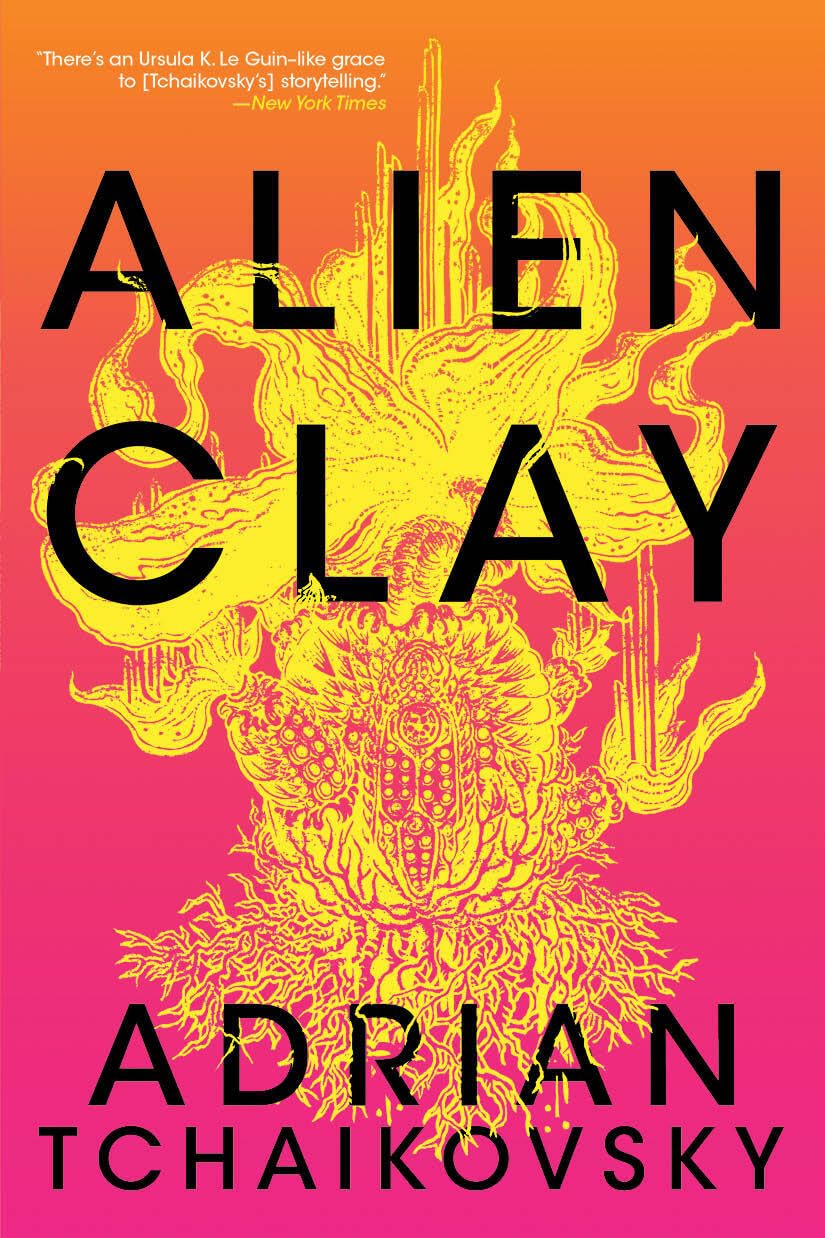
Adrian Tchaikovsky is an award-winning science fiction and fantasy writer whose series The Tyrant Philosophers and recent novels Service Model and Alien Clay are among the 2025 Hugo Award finalists. Alien Clay is a dystopian vision of future Earth. This is a work of science fiction that falls within the subgenre of exploration. Dr. Arton Daghdev lives in a country that is ruled by a totalitarian regime called the Mandate. Tchaikovsky traverses not only through alien space and biology, but he also pushes the boundaries of the human capacity to let go of individual freedom for the prosperity of the group or humanity as a whole. Admittedly, this novel was written in the aftermath of the COVID-19 pandemic, and it is difficult to avoid making that connection while reading it since the narrator is a scientist. Nevertheless, the reader embarks on this strange journey across time and space guided by Daghdev, an ecologist who researches exoplanets and alien life forms (albeit theoretically). However, Daghdev finds it difficult to conform to the Mandate’s one-minded political agenda. Therefore, he is forced to become an underground rebel who is, ultimately, convicted of high treason, imprisoned, and shipped to a penal colony located on planet Kiln, which is located fifty light years away from Earth. The beginning of the novel tugs at the readers’ political strings, challenging them to think about how far they would go to defend their beliefs. Furthermore, Tchaikovsky entertains the notion that suppressing academic freedom will undoubtedly lead to an Orwellian future.
As all admirable authors of science fiction do, Tchaikovsky introduces not one but two nova in order to lure the reader into the interestingly crafted Kilnish world. The first novum is the process of dehydrating the body in order to create body husks that are preserved for the remainder of the journey. Once the ship reaches its destination, the husks are re-hydrated and dropped in pods to the planet’s surface. This first novum is very much reminiscent of the old science fiction novels in which the technology is not exhaustively explained, and the workings and details are left to the reader’s imagination. The second novum is planet Kiln. Tchaikovsky uses his imagination, skills, and abundance of biological knowledge to describe an alien world that builds, destroys, and rebuilds itself. The Kilnish microorganisms and macroorganisms are by far the most amusing part of the novel. The world building is done in a satisfying way and is better developed than the characters. Even though the focus of the writing in the novel is on the object, as it should be in science fiction, Tchaikovsky does not leave his characters flat, and the readers are able to empathize with Daghdev and his companions as they endure the perils on Kiln. The readers do not have a problem with sympathizing with Daghdev during his plight; still, the last chapters of the novel oscillate between sympathy and empathy. At certain points, it is simply impossible for the reader to feel what the main character is feeling and emotionally going through.
Tchaikovsky writes the novel in such a way that every part of the journey, every day of life on Kiln is a game of Russian roulette, and the prisoners are, regrettably, less fortunate if they win. For the most part, the story unfolds in chronological order, while the last third of the novel is different since it presents current events in the camp with frequent flashbacks of the last seven days the group spends in the Kilnish wild. The flashbacks also show the Kilnish ecosystem in more detail, how life works on the planet, and how and why it slowly assimilates human biology into its own. Evolution on Kiln does not follow the Darwinian pattern, but this is not uncharted territory for Tchaikovsky since he already experimented with the merging of alien and human biology in Cage of Souls and simian and alien biology in Children of Time. This hybridization introduces an unachievable utopian thought because it is not in human nature to willingly submit to complete altruism. In the end, all of humanity may be assimilated by the Kilnish civilization. Daghdev’s utter elation is juxtaposed with the reader’s sheer horror of such a possible outcome and the unparalleled devastation that could happen to people on Earth. Tchaikovsky leaves it as a possibility; although, it seems that there is little to doubt when it comes to Daghdev’s determination to free humanity and give it the ultimate gift any scientist can bestow upon his people—the gift of infinite knowledge.
Tchaikovsky addresses some of the topics that he has written about in his previous works: rationality, volition, freedom, and individualism. He also addresses the posthuman in the biological sense, which differs from the traditional writings of posthuman technology. In this novel, readers can see an example of complete altruism and what it means to willingly let go of all individuality and any sense of personal freedom for the greater good. He challenges readers to let go of their anthropocentric arrogance and envision a world in which becoming a part of the Kilnish civilization means embracing collective life, thinking, and purpose. When it comes to literary theory, Alien Clay is also presentist even though it happens in the future. One cannot read it without thinking about various “mandates” that exist in today’s world, political hypocrisies, and all the freedoms that democratic societies promise but somehow fail to truly deliver. Toward the end, the reader circles back to establish answers to the elementary musings of science fiction (and philosophy) concerning what it means to be human and free. Finally, it is worth mentioning that the most appealing part of this novel is that Tchaikovsky adhered to the basic rule of this genre and took the “what if” and, just for a moment, let it become a “why not.”
Zorica Lola Jelic, Ph.D. is Assistant Professor at the faculty of Contemporary Arts in Belgrade, Serbia. She teaches English as a Foreign Language, Business English, Shakespeare, and English Drama. She earned her degrees in Shakespeare studies but also loves to write about presentism as a hermeneutical approach and science fiction. She has published scholarly papers, coursebooks, and enjoys attending professional conferences.

 SFRA Review