
Fiction Reviews
Review of Once Upon A Time In The Future: 2121
Özgür Çalışkan
Once Upon A Time In The Future: 2121. Dir. Altın, Serpil. Serpil Altın Film. 2022.
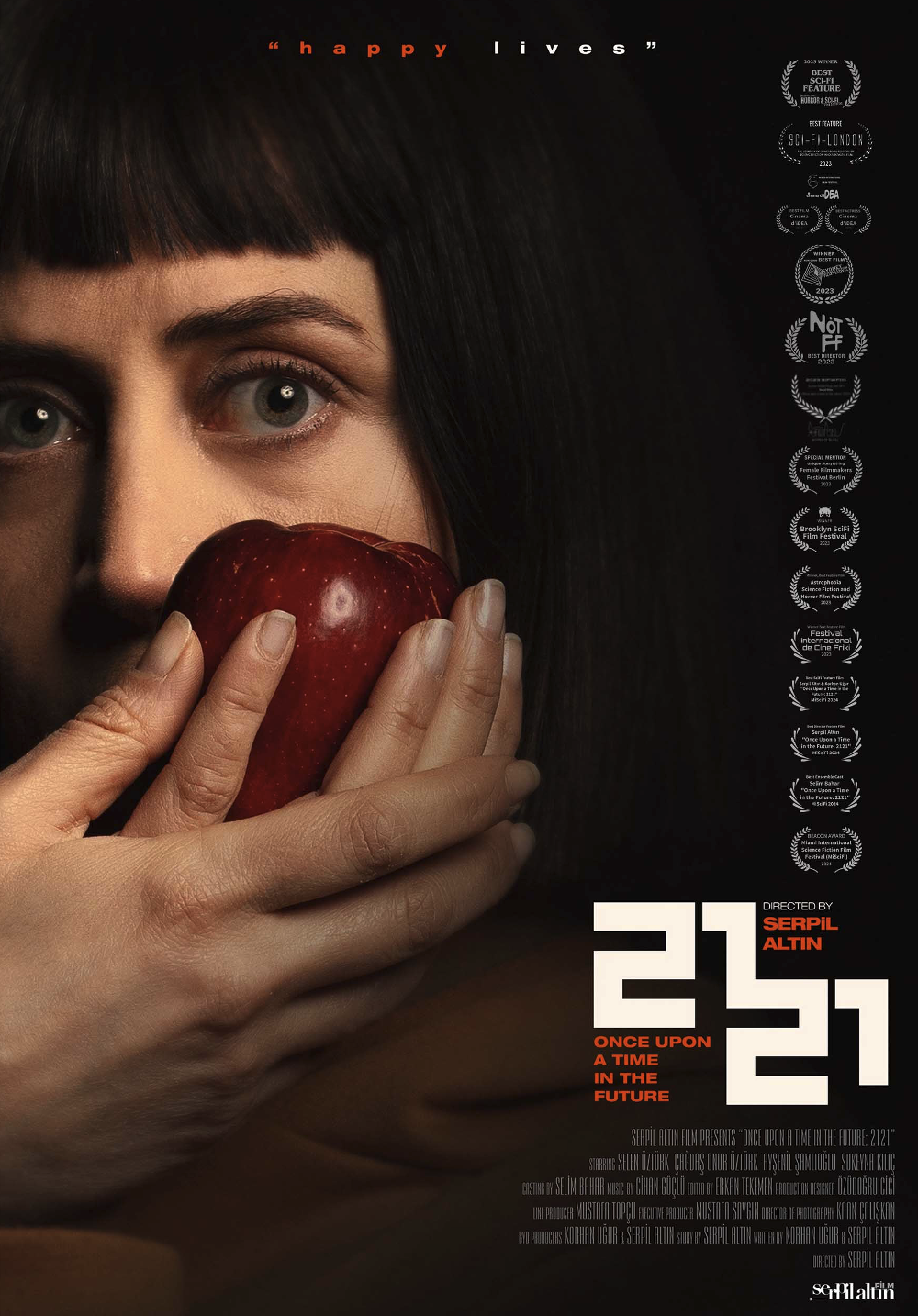
Once Upon A Time In The Future: 2121 (2121), directed by Serpil Altın—regarded as the first woman science fiction director in Turkey—presents a poignant exploration of a future Earth devastated by environmental decay and extreme scarcity. Against the backdrop of an uninhabitable surface, survivors reside in underground colonies ruled by the dystopian “Young Administration,” a government implementing “The Scarcity Laws” that demand the removal of older generations to ensure resources for the young. Through the lives of a family faced with an impending birth, Altın’s film probes complex questions around generational sacrifice, ethical choices, and survival under eco-authoritarianism. This ambitious Turkish science fiction film balances thematic weight with visual sophistication, marking a pivotal moment for both Turkish cinema and sustainable filmmaking in the science fiction genre.
The story centers on Zeynep (Selen Öztürk) and her husband Onur (Çağdaş Onur Öztürk), who live in one of these underground colonies with their young daughter (Sukeyna Kılıç) and Onur’s elderly mother (Ayşenil Şamlıoğlu). Zeynep is pregnant with their second child, a development that brings both joy and tension, as the government’s population control measures become more invasive and threatening. The family’s young daughter adds another layer to their struggle, embodying innocence and hope amid a repressive environment, and forming a strong bond with her grandmother despite the regime’s harsh policies.
As Zeynep’s pregnancy progresses, the family is forced to confront the brutal laws that threaten the grandmother’s life, torn between obedience to the regime and their commitment to one another. The young girl’s presence intensifies the family’s determination to preserve their unity, even as they weigh the risks of protecting their elderly matriarch in a world that has sacrificed empathy for survival. Together, they must navigate a series of moral and existential choices, challenging the regime’s authority in their bid to protect each other.
Serpil Altın explains her motivations behind 2121, calling it a “documentary of the future” that reflects her mounting concerns over humanity’s environmental impact. Inspired by questions from her daughter about the planet’s future, Altın wrote the script alongside Korhan Uğur during the pandemic, using the atmosphere of that period to shape the film’s narrative. Altın discusses her motivation for creating 2121, focusing on climate change concerns and her desire to explore what the world might look like 100 years from now. As Turkey’s first “green film,” it reflects Altın’s commitment to eco-friendly practices on set, such as minimizing waste and using sustainable materials, recycled materials, digital scripts, and energy-efficient lighting to minimize environmental impact. Altın also addresses the film’s themes of generational power dynamics and the hypothetical scenario of young people ruling over older generations. Her commitment aligns with industry trends where environmentalism influences both the film’s message and its production methods, showcasing how cinema can promote sustainability in practice as well as theme.
One of the film’s most unique features is its focus on generational sacrifice, an idea that is uncommon even within dystopian sci-fi. This adds a provocative ethical layer, inviting comparisons to Kazuo Ishiguro’s Never Let Me Go (2005), where characters’ lives are valued solely for their utility. By requiring that older generations sacrifice their lives for the younger, Altın critiques not only environmental neglect but also the tendency to devalue past generations’ wisdom, positioning her narrative as a reflection on the costs of generational inequality. The family’s decision to bring new life into a world that prohibits it represents a hopeful defiance, asserting a belief in resilience and humanity’s will to persist.
In 2121, environmental collapse and authoritarian control echo themes found in Logan’s Run (Michael Anderson, 1976) and THX 1138 (George Lucas, 1971). In Logan’s Run, citizens are sacrificed at age 30 to maintain balance; both it and 2121 explore resistance against population control, however, 2121 emphasizes the moral dilemmas of a family’s choice to protect their elderly, underscoring intergenerational bonds. Similarly, THX 1138 portrays a sterile, authoritarian society suppressing individual emotions, and 2121 shows a government that places control over compassion, threatening family unity. Together, these films critique dehumanizing societies prioritizing order and resource management over human connection, but 2121 uniquely explores the resilience of family loyalty and ethical decision-making in a world where survival clashes with empathy.
The film’s choice to center on a family facing generational conflict under authoritarian policies places it in the lineage of dystopian stories like Children of Men (Alfonso Cuarón, 2006) and the Hunger Games (2012-2015) film series, yet with the intimacy and moral complexity of Turkish storytelling. While the Mad Max (1979-2024) franchise and Snowpiercer (Bong Joon Ho, 2013) portray futuristic societies with intense action sequences to reflect chaos and scarcity, 2121 conveys urgency and tension through subtle, measured pacing and human connection. This juxtaposition between global sci-fi conventions and Turkish sociopolitical motifs adds a fresh dimension to the genre. Altın’s approach is introspective and intimate, framing the conflict around human values and familial bonds, allowing the film to resonate emotionally while exploring grand ecological themes.
For Turkish cinema, this film is a milestone, demonstrating how local filmmakers can address global issues through culturally resonant narratives. 2121 has garnered multiple awards and screenings at international film festivals, furthering its impact globally. Additionally, the film has attracted the interest of an American distributor, signaling its resonance beyond Turkish borders and contributing to the international conversation on climate change and human resilience. In doing so, 2121 not only carves a path for Turkish eco-science fiction but also calls on viewers to reconsider their relationship with nature, urging us to act before today’s hypothetical dystopias become tomorrow’s realities. 2121 takes an activist stance, critiquing contemporary society’s detachment from nature and reliance on unsustainable consumption. Altın’s willingness to confront these issues brings Turkish cinema into a more active role in the global eco-cinema movement. 2121 doesn’t shy away from tough questions, but instead cloaks them in the ironic echo of “Happy Lives”—a haunting slogan that serves as both warning and lament for a future we can still change.
WORKS CITED
Altın, Serpil. “Serpil Altın ile: Sürdürülebilir Film Yapmak Üzerine.” Interview by Halil Şimşek. The Magger, 21 March 2023. https://www.themagger.com/serpil-altin-roportaj-surdurulebilir-film-nedir/. Accessed 15 Oct 2024.
—. “Serpil Altın – Director of Once Upon a Time in the Future: 2121.” Interview by Davide Abbatescianni. Cineuropa, 18 Sep 2023. https://cineuropa.org/en/interview/449988/. Accessed 16 Oct 2024.
—. “Bir Zamanlar Gelecek: 2121’in yönetmeni Altın: İklim krizi şaka değil!” Interview by Deniz Ali Tatar. 24 Saat, 08 Jan 2024. https://www.24saatgazetesi.com/bir-zamanlar-gelecek-2121in-yonetmeni-altin-iklim-krizi-saka-degil. Accessed 16 Oct 2024.
Mack, Andrew. “Once Upon A Time In The Future: 2121 Trailer: The First Turkish Sci-fi Directed by a Woman Presented at AFM.” Screen Anarchy, 02 Nov 2023. https://screenanarchy.com/2023/11/once-upon-a-time-in-the-future-2121-trailer-first-turkish-sci-fi-directed-woman-afm.html. Accessed 15 Oct 2024.
Özgür Çalışkan, Ph.D., is an associate professor in Anadolu University’s Department of Cinema and Television. He completed his BA in Cinema and Television at Bahçeşehir University, his MA in Digital Culture at the University of Jyvaskyla, and his Ph.D. at Anadolu University. He has participated in exchange programs at the University of Ulster and the University of Ljubljana and served as a guest lecturer at the Polytechnic University of Valencia. An Executive Board member of the Eskişehir International Film Festival, Çalışkan publishes and lectures on cinematic narrative, screenwriting, film genres, science fiction, identity, and digital technologies.

 SFRA Review