
Fiction Reviews
Review of Agatha All Along
Jeremy Brett
Schaeffer, Jac, creator. Agatha All Along, Marvel Studios, 2024.
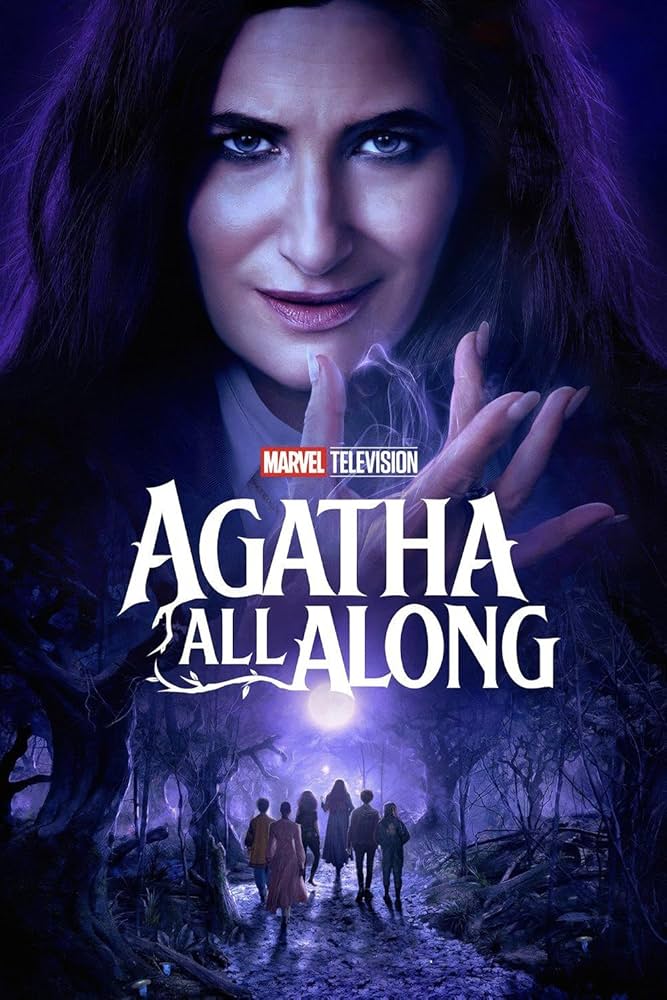
At the heart of Agatha All Along (and its 2021 prequel WandaVision) lies the fundamental truth that the worlds we construct for ourselves are often the ones that help us manage, or indeed survive the most unbearable situations. These psychological constructions allow us spaces in which we confront our fears and our traumas, develop and play out scenarios for overcoming the myriad stresses that weigh heavy on us—our guilt, our grief, our anger—and sometimes create fantasy lives marked by denial and avoidance. These alternate realities can be seductive beyond the telling of it, allowing occupation of a happy, hopeful imaginative space; at the same time, though, they can hinder emotional growth and our acceptance of, among other things, the ultimate experience that is death. The process is natural enough in the real world, but these fantasies take on monstrous and destructive new significance when fueled by magical abilities that transform the psychological interior into the physical exterior. In WandaVision we watched the dehumanizing consequences of this transmutation when out of bottomless grief and anger Wanda Maximoff/Scarlet Witch (Elizabeth Olsen) warped an entire town into a bubble of domestic sitcom-shaped fairyland in which she could live a life with her (non-deceased) husband Vision (Paul Bettany) and the two sons she created from nothing. In the process, she enslaved the innocent people of Westview, New Jersey, by puppeting them into characters for Wanda’s new life. The series was an extended meditation on the damage that grief and unexamined psychological suffering can render on both trauma’s original victim and those around her. And among the lessons that WandaVision offered was the time-honored warning about the corruptive nature of great power, especially when power begins to perceive and use people as mere tools.
Agatha All Along continues along the road that its predecessor series first laid down, this time centering on WandaVision’s secondary antagonist, legendary witch Agatha Harkness (Kathryn Hahn), and her own struggles against the tragedies of her past. At series opening, Agatha is still in Westview, living out the fading ramifications of Wanda’s now-distorted spell that imprisoned Agatha in a false past and identity—she believes herself a hard-nosed cop in a small-town police procedural. When a mysterious red-haired woman turns up dead and snarky FBI agent Rio Vidal (Aubrey Plaza) arrives on the scene dropping enigmatic hints about the truth of Agatha’s situation (early on she asks Agatha, “Is this really how you see yourself?” and later, “Do you remember why you hate me?”), Agatha’s constructed world begins to crack. The appearance of a young man (Joe Locke) asking questions about Agatha and chanting in Latin becomes the catalyst for the walls to finally collapse and Agatha to reassert her true identity in the real Westview (albeit now without her Wanda-removed witching powers). Now back in control of her faculties, Agatha discovers at once that Rio is a sister witch (and former lover) come for revenge against her, that she is being pursued by the children of the Salem witches Agatha murdered in 1693, and that the young man (whom she names “Teen”) has his own agenda requiring Agatha’s assistance. Teen seeks the legendary Witches’ Road, a magical pathway that promises the fulfilment of one’s deepest desires to whomever can survive the Road’s various trials. Both Agatha and Teen are in search of power, something Teen senses he had but is now missing and something that Agatha knows she once wielded. The two bring together a coven, each member marked by a desire for liberation from their own traumatic pasts: Divination Witch Lilia Calderu (Patti LuPone), Potions Witch Jen Kale (Sasheer Zamata), and Protector Witch Alice Wu-Gulliver (Ali Ahn), with Rio herself eventually joining as the coven’s Green Witch. In addition, Agatha dragoons her Westview neighbor and fellow victim of Wanda’s magic Sharon Davis (Debra Jo Rupp) along for the perilous journey as the original Green Witch, an early sign of Agatha’s willingness to pitilessly use other people for her own selfish ends. The Road is conjured (via a haunting ballad which recurs throughout the series), and the trials begin.
Much of the series centers on the inability to control the chaos that imbues the world, and a concomitant desire for agency. Just as Wanda—scarred not only by Vision’s death but by those deaths she accidentally caused during her tenure as an Avenger—temporarily wrested the order of time and space into an emotionally satisfying frame, so Agatha throughout the series continually struggles for control, or at least be seen to have the semblance of control. She frequently and expertly deploys sarcastic confidence as a defense mechanism when her agency comes into question, even during her own Road-caused trial as she dares to taunt the spirits that come to punish her for her transgressions. Agatha is a figure determined to shape her own destiny—she accomplished this (gaining a noxious reputation among her sister witches) by serially murdering her covens and stealing their power. These killings were accomplished through Agatha’s careful, elaborate construction of a psychologically seductive narrative. In short, we learn Agatha invented the concept of the Witches’ Road, its generative ballad, its rituals and trials, and its possibilities for revelation and recovery—all framed as an ancient mythos to attract desirous witches into her trap. Over time her invention assumes an imaginative life of its own and becomes a fundamental part of witch lore despite its objective nonexistence—the emotional and psychological significance of story and its value as a mechanism of human control are key facets of the series (as they were in WandaVision).
The power of narrative formation reveals itself with the existence of the Road; Agatha is as shocked as the rest of the coven, whom she planned to murder for their magic, to see her fictional creation appear from nothing as the ballad is sung (though she covers her surprise as part of her elaborate façade of omniscience). A competing story has suddenly emerged to force Agatha’s own into reality, as “Teen” turns out to be Wanda’s conjured son Billy, whose spirit entered the body of a recently dead teenager. Billy struggles throughout the series with his own identity, being unsure who he really is; that identity crisis fuels the recognition of the vast power of creation he inherited from his mother. Seduced by the idea of the Road, he unconsciously wills it into existence and sets the coven upon the path but within this larger storyworld there emerges the potential for individual autonomy. We see Lilia, Jen, and Alice face down their own past regrets and fears: for Lilia, the trauma of the death of her coven and loved ones; for Jen, the binding that separated her from her magic; and for Alice, the generational curse that destroyed her mother. In the process, each witch gains a certain measure of liberation—unlike the toxic, dehumanizing stories of Wanda and Agatha, in which people are merely characters to be cast or instruments to be used, Billy’s more empathic narrative allows for agency and emotional progress. For example, at one point, an angry Billy protests to Agatha that coven members should look out for one another and that “people can’t be replaced.” Agatha replies characteristically and drily, “Can’t they?”
The root of Agatha’s nonchalance about others and ease of taking life, however, lies, as did Wanda’s actions, in deeply buried personal tragedy. Flashbacks show how in the 1750s Agatha had a son, Nicholas (Abel Lysenko), with whose six years of life she bargained for with Death (revealed to be Rio’s true identity). At Nicholas’ death, he had begun to work on Agatha’s conscience, proposing another way to live beside preying on other witches. A traumatized Agatha then develops the mythology of the Road as a psychological defense for her toxic grief, with tragic results. However, Agatha’s exposure to Billy’s capability for compassion and empathy, as well as her fatal embrace by Rio and subsequent reemergence as a ghost, marks a potential change in Agatha’s behavior and the ways in which she chooses to see the world. Agatha All Along proposes that the true power of narrative construction lies in its malleability and the many ways that stories and their narrators may exchange toxicity and trauma for emotional and personal renewal. It is no coincidence that the series centers on witches—a class of people marked by traditions of undergoing harsh injury, suffering, misogyny, and persecution—hoping to inject into this troubled historical legacy the potential for hope, escape, and recognition.
Jeremy Brett is a librarian at Cushing Memorial Library & Archives, where he is, among other things, the Curator of the Science Fiction & Fantasy Research Collection. He has also worked at the University of Iowa, the University of Wisconsin-Milwaukee, the National Archives and Records Administration-Pacific Region, and the Wisconsin Historical Society. He received his MLS and his MA in History from the University of Maryland – College Park in 1999. His professional interests include science fiction, fan studies, and the intersection of libraries and social justice.

 SFRA Review