
Fiction Reviews
Review of The Mountain in the Sea
M.E. Boothby
Nayler, Ray. The Mountain in the Sea. Picador, 2023.
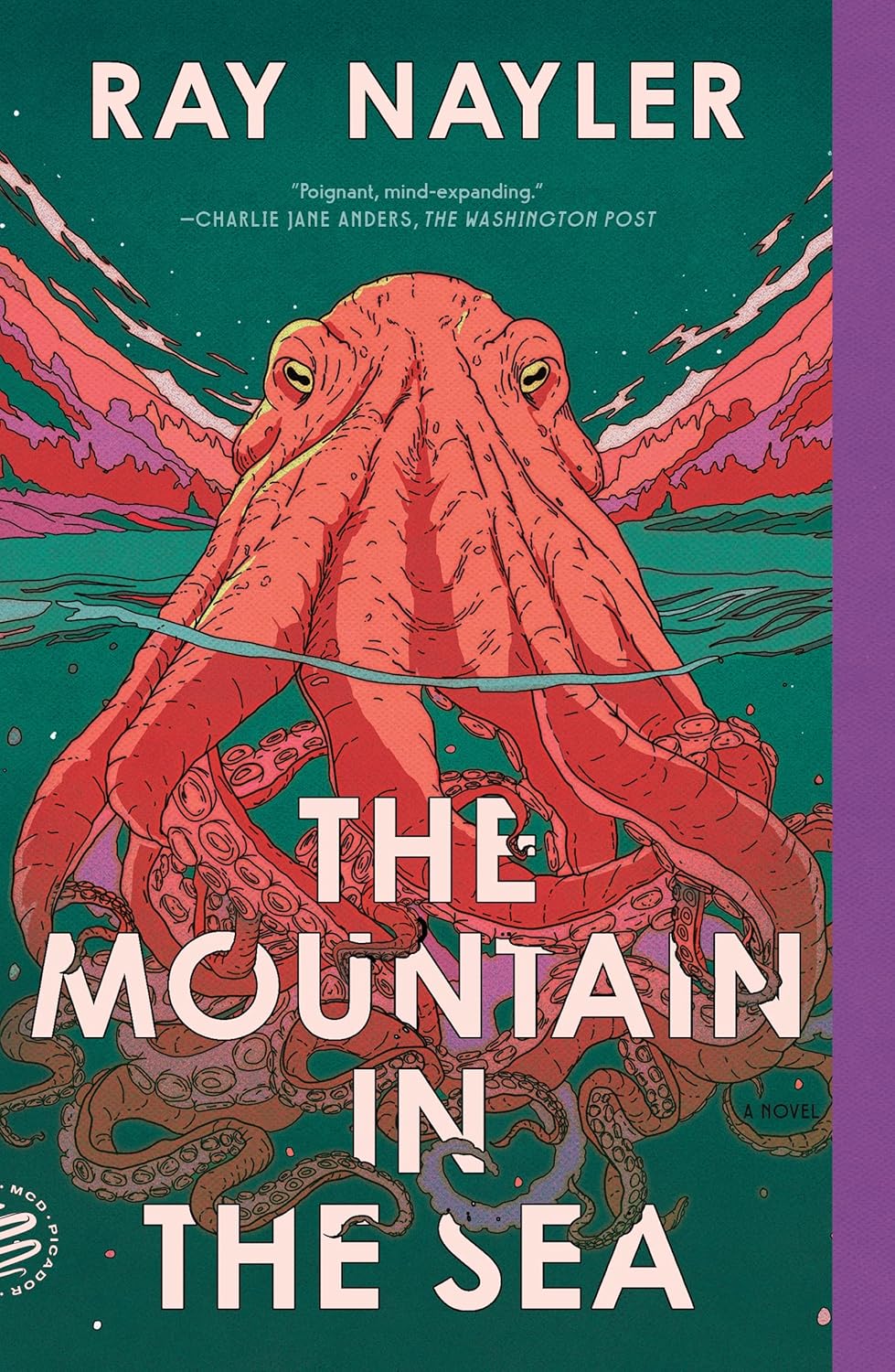
The Mountain in the Sea presents a powerful, risk-taking shift in what a novel can be. As some reviewers on Goodreads complain, it is more like a thought experiment than a story, constantly “philosophizing on sentience and semiotics.” Personally, I was thrilled by this thought-provoking, profound element, but even recognizing my own bias, I do think that readers who are disparaging Nayler’s novel (for not being the sci-fi thriller that the blurb on the back misleadingly implies that it is) are perhaps not the intended audience, or are missing the point. The Mountain in the Sea is a dazzling, wondrous book, but it is also a narrative built on academic research. It is a long-form question, not meant to provide the reader with any answers, only a dual sense of impending capitalist-and-climate-change dread and radical more-than-human hope. It is by turns objectively scientific and achingly beautiful, and its goal is just as much about introducing non-academic readers to phenomenological and semiotic theories as it is about finding awe in artificial and animal intelligence. Some readers, especially those who are already well-versed in the abilities of the octopus or the concept of the Umwelt, may dislike feeling preached to, and that is a fair reaction to this divisive book. Still, as scholars of SF, I believe it is a critically important text for us to mark, because it challenges what readers and publishers of SF are willing to explore and expand into. As a complex integration of philosophy and plot and a fragmented, multicharacter narrative that is consistently more interested in internal theorizing than external action, The Mountain in the Sea crafts a sort of academic-fiction treatise, what we might call research-creation without Nayler ever explicitly declaring it as such.
The Mountain in the Sea is set in a speculative near-future that is even further destroyed by capitalist greed than our present world; it is ravaged by climate change, and global corporations control the majority of the world’s money and power. Natural resources are increasingly slim, and wars and trade deals have reshaped our borders and nationalities. It is a world that feels increasingly plausible in 2025, if not already partially here, and some of its brutal realities are what contribute to the sense of sickening dread and despair that the novel does not shy away from.
Two side plots weave the wider storyworld together. Rustem, an elite Russian hacker, is hired by a rival corporation of DIANIMA’s and tasked with trying to remotely hack into Evrim’s artificial mind. Eiko, a young man kidnapped and sold into enslavement, is trapped aboard an AI operated fishing trawler and forced, alongside many others, to perform the physical labor that the computer cannot, while the trawler pillages protected waters. All three plot threads meditate meaningfully on what it will mean to be human—or, more specifically, to be deserving of the rights of personhood—in an increasingly capitalistic and technological future.
Between chapters, Nayler inserts quotations from two academic texts he has invented: protagonist Ha Nguyen’s How Oceans Think, which is directly lifted from Eduardo Kohn’s pivotal text How Forests Think: Toward an Anthropology beyond the Human (2013), and Building Minds, a fictional autobiography by Evrim’s creator, the brilliant but coldly obsessive Dr. Arnkatla Mínervudóttir-Chan. These fictional nonfiction excerpts are where Nayler writes his most academic musings, a strategy that works well. As mentioned, his ideas are situated in an intersection between phenomenology, bio- and zoosemiotics, and recent shifts in human understandings of cephalopod biology. Bio- and zoosemiotics, broadly, are fields concerned with the reading of the natural world as signs with communicative potential, whose originators include Thomas A. Sebeok, Jesper Hoffmeyer, Gregory Bateson, and Jakob von Uexküll. Even the four parts of the novel are named after concepts in these fields: Qualia, Umwelt, Semiosphere, and Autopoiesis. Nayler explores these concepts not just as theory, but as applied to the human condition and our relations with the more-than-human world in peril around us. Consider the following excerpt:
Communication is communion… Perhaps it is this thought that makes us so nervous about the idea of encountering cultures beyond the human. The thought that what it means to be human will shift… Or that we will finally have to take responsibility for our actions in this world. (301)
In one scene, Rustem also expounds philosopher Thomas Nagel’s 1974 essay “What is it like to be a Bat?” The novel asks consciousness-related questions consistently, introducing readers to the Umwelt concept, which asserts that each species can only experience the world through their own unique sensory and perceptive abilities, therefore making it impossible for us to truly know what it is like to be a bat—or an octopus, for that matter. It would be beyond the scope of this review to explain and detail each theory that Nayler incorporates into his novel. I can only recommend reading it yourself and allowing yourself to be transformed by it. In conclusion, Nayler speaks quite aptly for The Mountain in the Sea through Ha’s book excerpts, inhabiting both the fictional scientist and the SF author when he writes:
I will be accused of many things by those who criticize this book… I will be accused of having created from nothing a vast, speculative archaeology of a possible future, in which we discover that while we are the only species of Homo there may be, in fact, another sapiens.
I do not apologize. I want to help my readers imagine how we might speak across an almost unbridgeable gap of differences, and end forever the loneliness of our species—and our own loneliness. (447)
WORKS CITED
Jennifer. Review of The Mountain in the Sea by Ray Nayler. Goodreads, 17 Dec. 2022, https://www.goodreads.com/book/show/63233677-the-mountain-in-the-sea.
M. E. Boothby is a Ph.D. candidate at Memorial University of Newfoundland, Canada, where their research explores intersections of queerness, neurodiversity studies, material ecocriticism, and zoosemiotics in speculative fiction. They write both academically and creatively about apocalyptic fungi, sentient cephalopods, and more-than-human communication. Their work has been published in Horseshoe Literary Magazine, Untethered Magazine, Paragon, Gothic Nature, and Fantastika Journal, and their debut novel is forthcoming from Penguin Canada.

 SFRA Review