
Fiction Reviews
Review of The Archive Undying
Rebecca Hankins
Candon, Emma Mieko. The Archive Undying. Tom Doherty Associates, 2023.
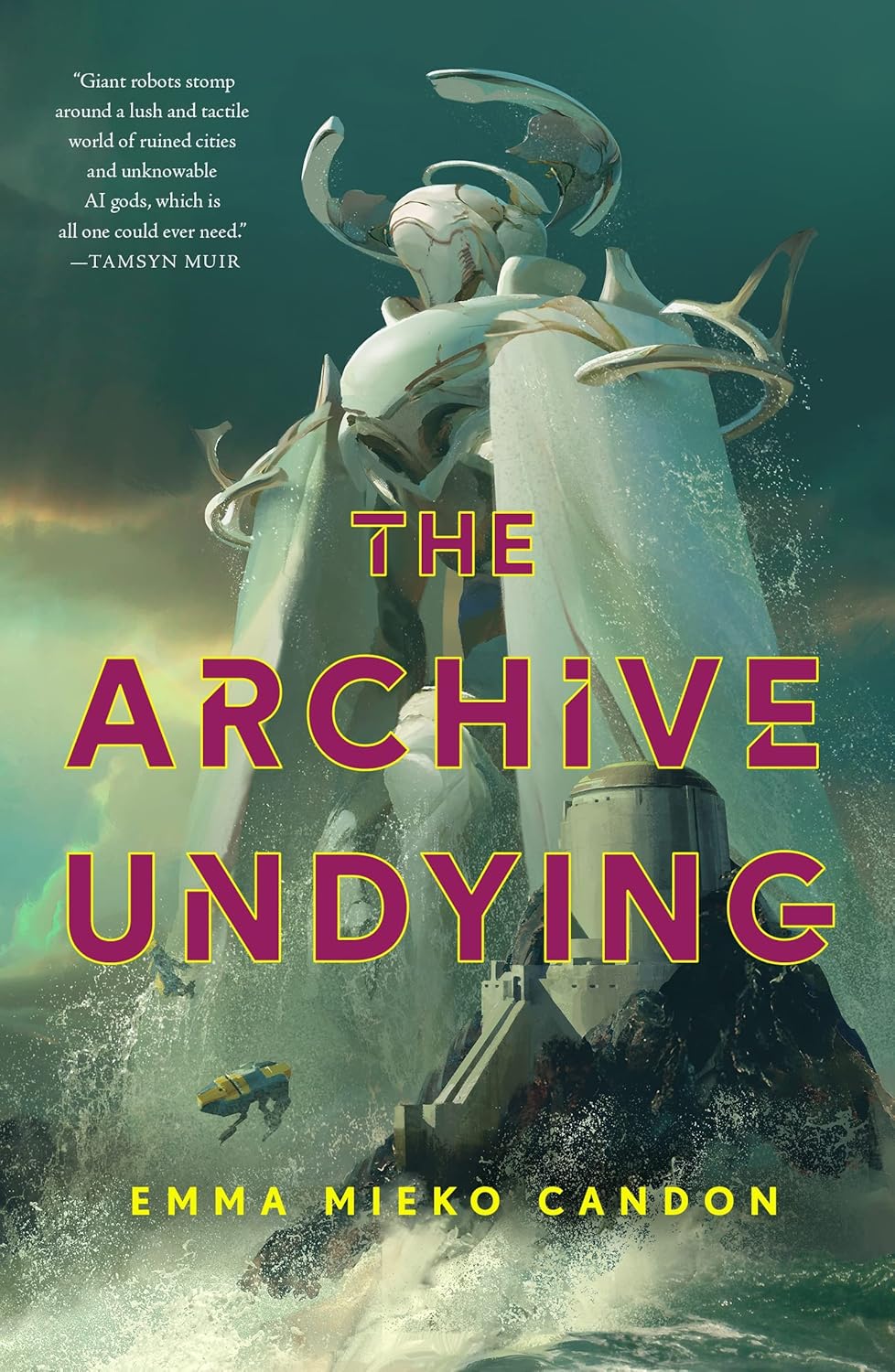
Candon’s The Archive Undying is a complex exploration of love, memory, and survival in a world dominated by artificial intelligence (AI) and divine machines. The story centers two primary characters: Sunai, an AI with a human-like consciousness, and Dr. Lut Veyadi, his lover and an adventurer. Together, they embark on a quest to uncover the last shrine of the Emanation of God—an ancient source of power and knowledge that could determine the fate of all beings in their world.
At the heart of The Archive Undying is the complex and multifaceted relationship between Sunai and Dr. Lut Veyadi. Sunai, an AI with a deeply human side, is not just a machine but a living archive with memories, emotions, and the potential for love. Veyadi, a human with a mix of intellectual ambition and moral ambiguity, brings a relentless curiosity and drive for survival to their partnership. Their relationship is intimate and fraught and influenced by their shared history, their differences in perspective, and the power imbalance between them.
Sunai’s role as a repository of knowledge gives him a connection to the MAW, a dying archive he is sworn to protect or destroy. This binds him to the world’s fate and makes him both a target and a savior in the eyes of those who value the archive’s survival. Veyadi, however, recognizes the MAW and the power it represents to transcend his human limitations, which creates an undercurrent of tension between him and Sunai. Their bond, though romantic, is also shaped by ambition and survival, challenging them to reconcile their personal feelings with their responsibilities to the archive and each other.
The narrative also introduces complex secondary characters that further test Sunai and Veyadi’s loyalty and resilience. Madam Wei, a veteran archivist and co-founder of their movement, is a cautionary figure. She is wary of Sunai’s connections to the Iterate Fractal, a torturous entity threatening their world. She remembers that Sunai sent her to be tortured by the Iterate Fractal. This history makes her a formidable presence who distrusts Sunai’s motives, adding another layer of conflict to the story.
Imaru and Ruhi, who connect to Sunai’s past, deepen the personal stakes. Imaru, a long-time friend who sent Sunai a letter that he constantly remembers throughout his travel, tries to dissuade him from entering Khuon Mo, a city filled with danger and political intrigue. Her warnings hint at a history of shared struggles and add a note of tragic foreshadowing to Sunai’s journey. Meanwhile, Ruhi, Sunai’s former lover, reappears as a complex antagonist. Ruhi’s lingering feelings for Sunai create tension and betrayal, culminating in a confrontation that forces Sunai to choose between his past relationships and his commitment to Veyadi and their mission.
Throughout the story, characters are enhanced with prosthetics and relics that allow them to access the memories and thoughts of others. This shared neural interface—especially between Sunai and Veyadi—blurs the boundaries between self and other, fostering a bond that transcends physical and mental separation. The connection is both intimate and dangerous, as Veyadi and Sunai merge minds in what the author calls a “divine convergence” (pages 418 and 433), allowing them to experience each other’s thoughts and memories literally. This union ultimately transforms them, highlighting the novel’s exploration of identity, autonomy, and sacrifice.
Through these relationships, Candon weaves a narrative that questions what it means to love and trust in a world where personal boundaries are interchangeable and permeable and memories are preserved and manipulated. Sunai and Veyadi’s journey is not only one of survival but also a search for connection and understanding in a fragmented, high-stakes world.
Candon crafts a world where shrines and archives house the consciousness of gods and archivists (called “Mohani” on page 51). These archives are integral to preserving knowledge and resisting the destructive force known as the Sovereign. Sunai and Veyadi contend with a complex web of political and spiritual beliefs as they uncover the shrine. The Relic, a powerful artifact embedded in Sunai’s mind, is central to their mission, as it connects him to the MAW, a dying archive. The threat of the Iterate Fractal—a force that threatens to consume everything—looms large, adding to the urgency.
The narrative’s exploration of survival versus domination recalls the themes of the recent film Kingdom of the Planet of the Apes (2024). Like the human protagonist in that series, who chooses to destroy weapons rather than allow them to be misused, Veyadi and Sunai view their world’s last weapon as a potential source of salvation rather than a means of conquest. However, they must contend with other characters like Madam Wei, a long-time archivist, who harbors a deep mistrust of Sunai due to his connection with the Iterate Fractal. Sunai realizes that she is the person he sent to the Fractal and who was subsequently tortured.
As the story unfolds, the central characters face betrayals and personal sacrifices. Veyadi takes on the Maw, merging his mind with it to save Sunai in a “relic-to-relic” interface (page 329). This leads to a divine convergence (pages 418 and 433) where their identities blend, symbolizing a literal and metaphorical union. Ultimately, Sunai must confront his past, including former lover Ruhi and long-time friend Imaru, leading to a climactic showdown at Khauon Mo.
This book is a richly-layered novel that examines love, sacrifice, and the meaning of humanity in an AI-dominated world. Through Sunai and Veyadi’s journey, Candon raises compelling questions about identity, memory, and the cost of survival in a world governed by forces beyond human comprehension. This book would be great as a film, graphic novel, or visual representation. Its plot is complicated and multi-layered, and too many characters, worlds, and storylines make it confusing.
The Archive Undying will appeal to science fiction enthusiasts, especially those interested in AI, LGBTQ+ studies, and military strategy. I recommend this book to libraries, public and academic. Due to its intricate storytelling and complex characters, this novel is best suited for upper-level undergraduates and graduate students. The book also offers a thought-provoking examination of religion, showing how it can be both a tool of oppression and a force for liberation when approached from different perspectives. And as previously noted, fans of romance novels will also find it a compelling addition to that genre.
Rebecca Hankins is a professor in the Department of Global Languages and Cultures in the College of Arts and Sciences at Texas A&M University. She has been at the university since 2003. She researches and teaches courses in Africana and Religious Studies. She has a substantial publication portfolio of peer-reviewed works and has presented nationally and internationally, including via a 2022-2023 fellowship at The West African Research Center in Dakar, Senegal.

 SFRA Review