
Fiction Reviews
Review of Fractured Fairy Tales: A Mirror Mended
Michelle Anya Anjirbag
Harrow, Alix E. Fractured Fairy Tales: A Mirror Mended. Tor, 2022.
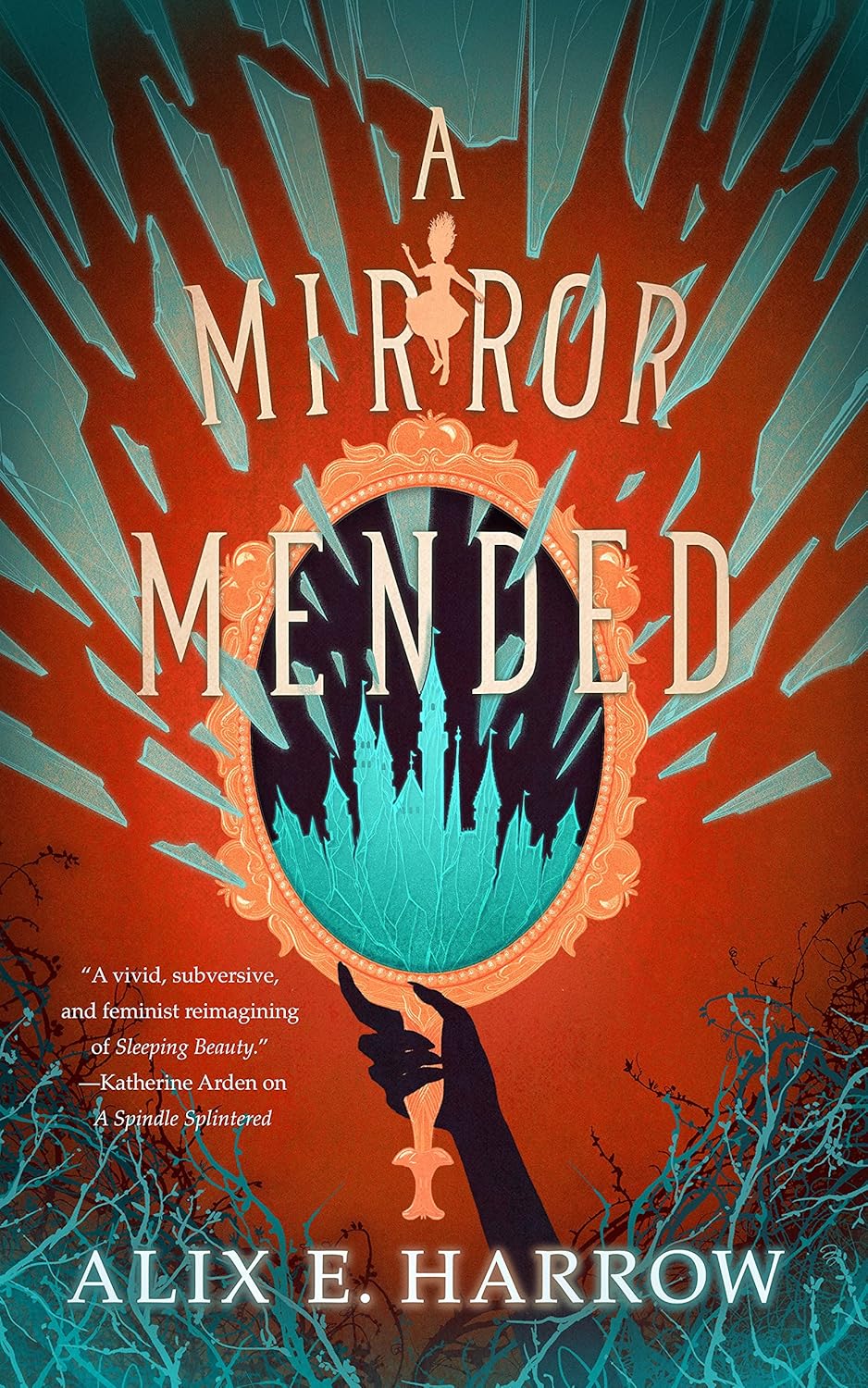
In A Mirror Mended, Zinnia Gray returns five years after the events of A Spindle Shattered, or as she puts it, 48 or 49 stories and happy endings, or five years of missed appointments regarding her chronic illness later. At 26, she is still running from story to story, giving other “Sleeping Beauties” other options than the stories that they were written into, always fleeing into another version just before the final resolution of happily ever after plays out in front of her. But when she gets pulled into a completely different fairy tale marked by apples and mirrors, by a queen who found out how her story is supposed to end and wants a different option, she has to figure out more than just her way back into her own story: Zinnia needs to figure out where it is that she belongs, while also challenging some of her own preconceptions about other fairy-tale figures and characters.
In a preface to the omnibus edition, Harrow states that this duology was born out of a ‘fairy tales go multiverse’ idea that sparked for her after seeing Spiderman: Into the Spiderverse (Persichetti, Ramsey, and Rothman, 2018). While this is certainly not the first take on colliding fairy tales or fairy-tale realms (see: Once Upon a Time [ABC, 2011-2018], The 10th Kingdom [NBC, 2000], for example) or even interlocking stories (Disney’s Villains novelization series plays with this idea with specifically Disney IP, as do a variety of fairy-tale mash up and remix series for children and young adult readers), Harrow’s duology wields both fairy-tale scholarship and an intimate knowledge of multiversal worldbuilding in a way that stands out from other fairy-tale interpolations. A Mirror Mended surpasses its predecessor in terms of tapping into the impulses of multidimensionality that underpin the way characters move between worlds, while also playing with the latent potentials embedded in the multivocal plurality of the fairy tale form as generated in European traditions of retelling the literary fairy tale.
Harrow’s protagonist is framed as not only a “sleeping beauty” but as a folklorist in her own right, and so her engagement in fairy-tale worlds is not a matter of wishes and wonder but a knowledgeable foray underpinned by an understanding of the ways that stories can resonate with or even against each other. Through this construction, and the eventual problems of world-jumping that Zinnia is forced to confront, Harrow challenges assumptions about fairy-tale interventions, what it means to save people from their fates in unique ways. A Mirror Mended, in particular, complicates the resolution found at the end of A Spindle Shattered.
The two volumes together would make for interesting case studies in a graduate class, especially considered alongside recent scholarship that considers justice and reimagines how the world could be conceived alongside disability scholarship, two recent impulses in scholarly work that echo in the field of fairy tale and folklore studies Brian Attebery’s conceptual questions about “how does fantasy mean” (Fantasy: How it Works, 2022) as well as what the “affordances of fantasy” (“Affordances of Fantasy,” Attebery 2024) might be. For example, the work of Heidi Kosonen, Veronica Schanoes, and Marek Oziewicz, among other essays, in the collection Just Wonder: Shifting Perspectives in Tradition (2024) edited by Pauline Greenhill and Jennifer Orme, could provide interesting points of departure for discussion. A Mirror Mended also invites considerations of villainy and agency, and the continued role of gendered constructions in tales even when they are being actively remade from within the context of the larger narrative. While there might have been a tacit recognition that the postmodern fairy tale has already been fully explored, as well as gendered biases within these stories, Harrow’s Zinnia and other characters such as Zellandine, Eva, Charm, and Primrose complicate how we do see these figures: as characters or as symbolic echoes who cannot escape proscribed roles. A seminar might explore how having the majority of agentic, speaking character roles belonging to not just women but queer women might complicate the larger conception of contemporary fairy-tale adaptation.
Short fantasy or fairy-tale adaptation is almost a relief in a publishing marketplace of mega-novels, trilogies, and extended volumes, and short fantasy done deftly and with complete narratives and skillful, complex worldbuilding is simply a joy to read. Harrow’s A Mirror Mended and the Fractured Fairy Tales make up a masterclass in genre-bending while once again remaking these stories for new generations of both readers and critics.
Michelle Anya Anjirbag is an affiliated researcher at the University of Antwerp where she completed a postdoctoral fellowship with the Constructing Age for Young Readers project. Her research interests include adaptation, fairy tales and folklore, Disney, magical libraries, the intersection of literature, media, and culture, representations of gender and age, and cross-period approaches to narrative transmission across cultures and societies. Her work has appeared in a variety of journals and edited collections. She currently teaches a course on the intersections between fantasy media and sociological questions for international study abroad students in London.

 SFRA Review