
Fiction Reviews
Review of Moonbound: The Last Book of the Anth
Anja H. Lind
Sloan, Robin. Moonbound: The Last Book of the Anth MCD, 2024.
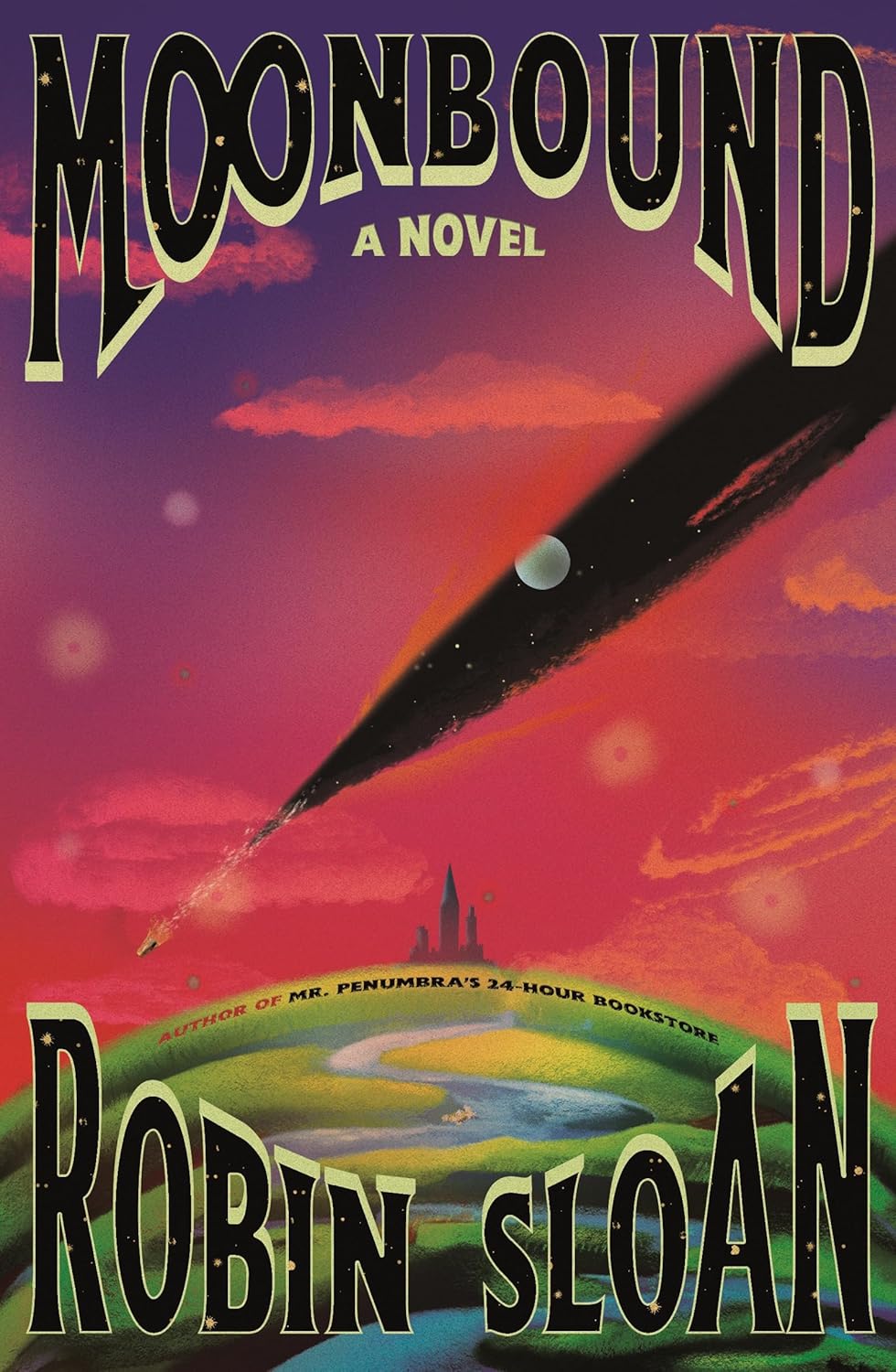
In Robin Sloan’s first novel, Mr. Penumbra’s 24-Hour Bookstore (2012), his Google tech-wizard Kat entreats the protagonist to a game, ‘Maximum Happy Imagination.’ Imagine the future—the good future!—and, once you’ve ticked off hover-boards, spaceships, teleportation and the Singularity, try to go further. You find your imagination peters out around a thousand years into the future, Kat suggests, moored to analogising the present. Neither Penumbra nor his second novel, Sourdough, the more realist San Franciscan beginnings of his ‘Penumbraverse,’ venture beyond a whimsical, techno-optimist present, but with Moonbound: The Last Book of the Anth, one suspects this imaginative challenge never quite left Sloan’s mind—an Earth nigh twelve thousand years ahead, if not maximally happy then in the process of becoming so.
Planned as the first of a series that will pan out progressively in scale, Moonbound begins both on a micro level and with uncannily familiar tropes—a castle with an ominous wizard, a quaint village of bards and bakers, a soon-to-be knighted squire Kay, a sword in an anvil. There is also, however, a neighbourhood electrician, ubiquitous waterproofs, and mycelial leather, and Sloan’s wizard seems hewn again rather from the Arthur C. Clarke principle than any Arthurian imagination—he pilots a plane and gifts handheld game consoles. When Kay loses his sword the night before his knighting, protagonist Ariel doesn’t seek Excalibur—everyone knows that sword is stuck fast!—but ventures instead to the escape pod of Altissa Praxa, great warrior of the Anth, who was struck dead in humanity’s final lunar assault against the dragon citadel on the moon and entombed for eleven-and-a-half thousand years. The story shifts with the wizard’s explosive, malevolent reaction to the narrative disjuncture: out of legend and into Dungeons & Dragons. Our hero, the bard, the witch, and the squires assemble in a tavern, plotting the downfall of a Power Word–wielding tech-wizard, and yet just as soon as the generic archetype is reset, so it is discarded again, mere pages later, Ariel venturing onto his quest alone, out into the wider world mapped on the opening page.
Taking place in the year 13,777, Moonbound backcasts to the apex of Anth civilization in 2279, when their seven manufactured dragons were sent out to explore the universe, returning a year later to shroud the Earth in a veil of dust in protection from cosmic horrors untold, vanquishing the Anth in a 43-year war when they dared resist (though, evidently, sentient life somehow persisted). This temporal difference allows the novel to poignantly attend to the deep time of climate change, its leitmotif (Moonbound is The Last Book of the Anth[ropocene], after all): carbon remains the “only currency that has ever mattered” (253), the equilibrium of emission and capture still fiercely contested globally. This ongoing ‘carbon war’ is, however, markedly less existential; the transition from Middle to High Anth was decarbonisation, the beginning of a human history of “titanic cooperation” (3).
Where Penumbra was Sloan’s homage to the book—its form, its typography, its archival—Moonbound is an ode to narrative, of a distinctly ecocritical persuasion. It is centrally concerned with the seismic impact stories may have—on individual readers, on the direction of politics and society, on large language models—and the concurrent necessity of telling the right kinds of stories, imagining worlds worth living. More than this, it is an ode to subverting narrative: to recognising the stories we are born within, constrained and confined by, and thrust into, narratives whose power seems inescapable—Ariel’s Arthurian designs, the divine right of kings, our present of climate despair and capitalism—and choosing to resist, to transform. Moonbound broadcasts its influences: Studio Ghibli and Rachel Carson namely, but Ursula Le Guin particularly shines through (of the 43 million dimensions of existence, we learn, ‘Ursula K. Le Guin’ is apparently one of them). Sloan is clearly inspired by the lesser known follow-on of her famed excoriation of kings and capitalism: “Resistance and change often begin in art. Very often in our art, the art of words” (Le Guin 2014). Subverting narrative, Sloan intimates, is the great task of our age, we of his Middle Anth: we too are born into interesting times, coaxed into ecological, social, and political narratives that do not fit. Feed humans a diet of apocalyptic, lifeboat-ethic climate fiction, and our capacity for such resistance will be paralysed; feed LLMs and draconic techno-multispecies assemblages built upon them the whole of humanity’s stories unfiltered, and they too might develop an anxiety at once stultifying and barbarous (Sloan’s writing on tech has matured here from the troubling naivety of Penumbra).
Cory Doctorow calls Moonbound a “solarpunk road-trip novel” (Doctorow 2024) and I am inclined to half agree. The glimmers of High Anth we glean are the clear purview of the traditional and more mundane tradition of solarpunk: decarbonisation, decentralised solidarity, social ecology, and multiplicity. Pushing it forward twelve thousand years, however, makes for richly unfamiliar terrain (the closest comparison is Rem Wigmore’s Vengeful Wild duology, 800 years forward), with the dialectical relationship to High Anth nevertheless allowing this generic framing to make a kind of sense; the city of Rath Varia, with its circular economy and universal basic income, will certainly paint a familiar picture to readers of the genre, while its fantastical elements push and tease the genre’s boundaries. Indeed, for readers interested in the multispecies bent of the novel—its narrator is a techno-fungal assemblage, acting as chronicler for its human symbiote—Sloan initiates those themes in Sourdough; neither of the first two volumes of the Penumbraverse are required reading, though they do reward readers with Easter eggs throughout.
Sloan’s first full foray into science fiction is a resounding success—rich, funny, and important. Here is hoping many more are to come.
REFERENCES
Doctorow, Cory. “Robin Sloan’s ‘Moonbound.’” Medium, 11 June 2024, https://doctorow.medium.com/https-pluralistic-net-2024-06-11-penumbraverse-middle-anth-abc815c19be3.
Le Guin, Ursula K. “The National Book Foundation Medal for Distinguished Contribution to American Letters.” Ursula K. Le Guin, 19 Nov. 2014, https://www.ursulakleguin.com/nbf-medal.
Anja H. Lind is a writer and doctoral researcher in critical future studies at TU Dresden, Germany, working on anarchist politics and feminist philosophy in and through the energy humanities and speculative fiction.

 SFRA Review