
Media Reviews
Review of 3 Body Problem
Abhinav Anand
3 Body Problem. Dir. David Benioff, D.B. Weiss, Alexander Woo. Netflix, 2024.
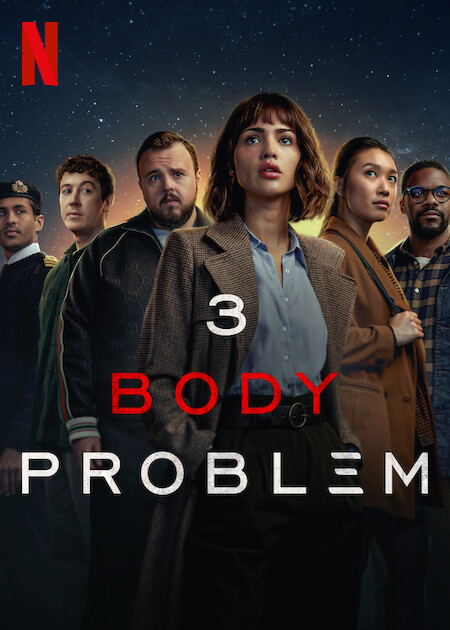
Based on the Chinese author Cixin Liu’s 2008 novel of the same name (originally published in 2006 in serialized form), which won the prestigious Hugo award, 3 Body Problem is part quest narrative, part science fiction, and part detective fiction. The series is primarily set in China and the United Kingdom. It opens with the depiction of the cultural revolution in 1966 China, specifically focusing on Tsinghua University. The series straddles between present-day Britain and China during the 1970s. In modern-day Britain, a group of scientists witness several mind-rattling phenomena that the existing laws of science fail to explain. Simultaneously, as a further complication, many world-renowned scientists commit suicide, a situation which not only jeopardizes the scientific community but also poses a challenge to science as a knowledge system.
The adaptation stages the struggles of these protagonists, who are mostly scientists, vying to resolve the “3 body problem” while simultaneously striving to understand the almost supernatural occurring, which goes back to a contact established with an alien species, who now plans an attack that can wipe off humanity from the face of the earth. Ironically, the key to the former problem i.e., the “3 body problem” lies in the scientific advancement that humans have made—and perhaps will make in the future. The earth, unlike this other alien planet, is a stable unit. Still, the reason for the possible annihilation of the human species is the very same scientific advancement which facilitated contact with the alien species, who now pose a threat to humanity.
The “problem” posed in the title is the presence of three suns in an alternate solar system, which alters the climatic conditions in a way that makes survival impossible for a sustained period. The connection between this system and Earth was established by one of the Chinese scientists who lost her father to the cultural revolution and started firmly believing in the need for an external intervention to save human beings from themselves. This alien intervention, she believed, would also counter the cynicism of the governments across the world who undertook various projects under the pretense of progress and development. However, establishing a connection with this technologically advanced but highly unstable system comes at its own risk: the ultimate risk being wiping out humankind.
3 Body Problem employs various tropes and themes associated with the traditional definitions of science fiction as a genre. However, the first scene establishes that science cannot provide all the explanations, for instance, why the protagonist’s father, who himself was a scientist, was brutally murdered by young revolutionary students while being cheered on by a group of frenzied crowds. The scene distinguishes between what is scientific and everything else that can be done under the guise of science. This also invokes the idea of “revolutionary” and “counter-revolutionary” science, which points to the politics that science is implicated in, showing that science no longer remains an innocent quest for “truth” but becomes a tool to reaffirm one’s version of truth. When the revolutionary students ask their professor about science’s verdict on the existence of God, he says, “it does not deny it”. The revolutionaries take it as the acceptance of god’s existence by science/scientists and end up killing that science/scientist, while his wife, who is also a scientist and incidentally is on the same stage, is left alive.
The scene sets the tone for the most crucial aspect that is focalised throughout the series: the constant questioning of the relationship between science and politics and understanding science’s politics, which is both dynamic and contextual. Unlike the conventional trope of “good scientist versus bad scientist” often used in science fiction, the first scene underscores the idea that scientists are political beings and they can either be anti-establishment or pro-establishment. Science has been shown as a contested territory that is enmeshed in power relations. The series captures Lewontin’s idea of scientists being “social beings” and, subsequently, science being a “supremely social institution.”
For instance, the social aspect of science comes to the fore when one of the characters, who is in direct touch with the alien species, builds a ship akin to Noah’s ark, highlighting its resemblance to Christian mythology. The man also treats these alien creatures as God—addressing them as my Lord and himself as their servant. The advanced science of the alien species makes them god-like figures who get to decide the fate of humanity and pick and choose the ones to be saved and the ones to be damned. The turn comes when the species realizes that humans are capable of lying and deception and decides to annihilate the entire species because of it. Thus, science is shown to be deeply intertwined with the social, religious, and humane aspects of the world.
In order to combat this situation, the three people are selected by the United Nations, two military personnel and one scientist. This reiterates the connection between politics and science—where international organizations take over and assume complete authority to make decisions about the entire humanity. The military personnel and scientist are brought together on several other occasions where violence is justified in the name of saving the entire species. However, ironically, the unrest and violence among humans caused by the “bug” message, where every screen in the world is made to display the cryptic message, “You are bugs” by the alien species, highlights the hollowness of human society that just needs a nudge to disintegrate. This also shows that an alien invasion isn’t necessary for the wiping off of the human race, who are very much capable of self-annihilation.
The series’ emphasis on the fragility of human existence, despite excelling in the field of science and technology, gains renewed significance in the light of wars erupting across the globe. Despite being a relatively stabler system without a planetary crisis like 3 Body Problem,the unrest and violence that surrounds human beings make us question whether we ourselves consider some humans amongst us as “bugs” that can be terminated and wiped off the face of the earth. 3 Body Problem does what the New-Wave of the 1960s and 70s promised, where the focus was on mapping the effect of emerging science and technology on human beings (Stableford) while adhering to accurate scientific descriptions. According to Judith Merril, a key theorist of New Wave SF, science fiction is “required to be about things that happened to people, rather than just to have people in them.”
The series focuses on characters and shows their development, be it their moral, psychological, or philosophical development, which itself is enmeshed in the science of the times. Thus, it uses the embedded nature of science to carve characters whose lives are enmeshed with their times, which in turn is enmeshed in the science of that time. The series depicts scientists as social beings with emotional vulnerabilities, philosophical skepticism, political leanings, and, most importantly, human flaws. This results in a piece of science fiction where the quest includes understanding both the outside world and the inner workings of the human mind and how science permeates both the inner and outer worlds, as an epistemology and as a social institution of knowledge respectively.
REFERENCES
Lewontin, Richard C. Biology as Ideology: The Doctrine of DNA. CBC Massey Lectures Series, 1990.
Merril, Judith. “Judith Merril’s definition of SF (Science Fiction)”. SF: The Year’s Greatest Science-Fiction and Fantasy. Gnome Press, 1959. https://www.bl.uk/collection-items/judith-merrils-definition-of-sf-science-fiction
Stableford, Brain. “Science fiction before the genre.” The Cambridge Companion to Science Fiction edited by Farah Mendlesohn and Edward James. Cambridge University Press, 2003.
Abhinav Anand is a Ph.D. candidate at the Indian Institute of Technology, Kanpur, India. His Ph.D. research analyses the relationship between science and social justice in contemporary Indian English fiction. He has worked as a Research Assistant for the GOTHELAI project on gender mainstreaming in Higher Education. He is the recipient of the 2020 Sahapedia-UNESCO Fellowship, where he worked on the intersection of gender and caste in Bihar’s “Naach” folk theatre tradition. He is interested in the areas of Science Fiction Studies, Science and Technology Studies, Indian Literature, Feminist theory and activism, and critical theory.

 SFRA Review