
Fiction Reviews
Review of Rabbits
Brianna Best
Miles, Terry. Rabbits. Del Rey, 2021. Hardcover. 432 pg. $9.49. ISBN-10 1984819658.
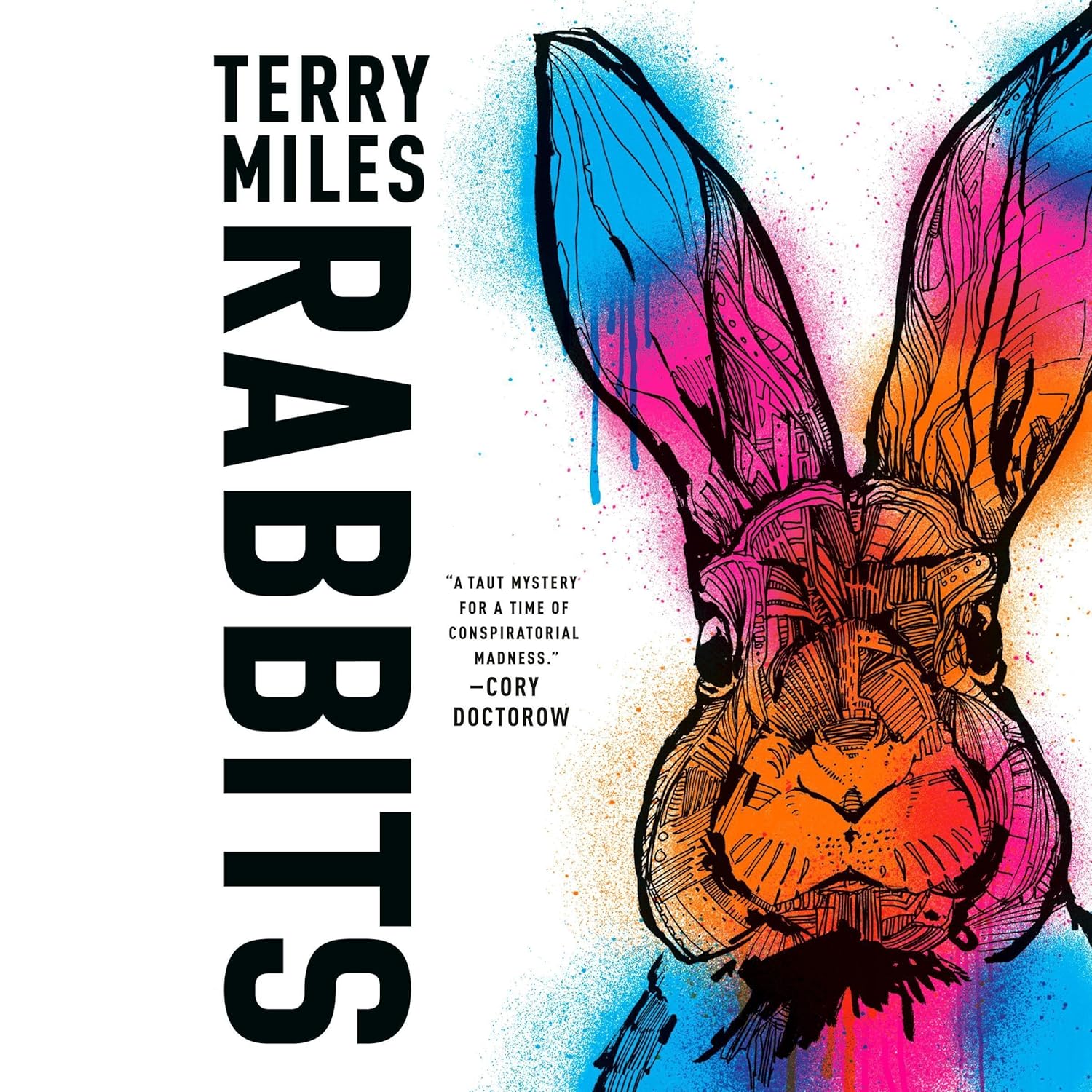
Rabbits by Terry Miles builds off Miles’ podcast by the same name, picking up where the podcast ends: at the beginning of a new iteration of a recurring alternate reality name, or ARG. This ARG, unofficially known as Rabbits, involves finding patterns in the world that supposedly allow the player to see the true texture of the universe. While the book is technically a standalone addition to the world of Rabbits, it’s probably better to come to it after listening to the two seasons of the podcast. The novel features a cast of characters who already know a bit about the game and there is somewhat of a presumption that the reader will, too. In the first scene, our main character K is hosting a Q&A about Rabbits in an arcade; the first sentence of the book is a question K poses to the audience: “What do you know about the game?” (5). This is also a direct address to the reader: are you new, or do you already know what’s going on here? While there is some exposition, it’s hard for me to say whether someone completely unfamiliar with the podcast would find the introduction to the world sufficient.
As the novel begins, the game has been dormant for years, since the tenth iteration ended. At least that’s what K thinks. At the end of this Q&A, they are approached by Alan Scarpio, a billionaire rumored to have won the sixth iteration of Rabbits. He asks for their help because he believes something is wrong with the game. After this meeting, and after conveniently promising K more information “tomorrow,” Scarpio is declared missing. K only has Scarpio’s phone to figure out what has happened to him.
So how do you play the game? You find patterns and follow them until it starts to seem like the very threads of reality are unraveling. After K gets hold of Scarpio’s phone, they start to follow the trail: the wallpaper on Scarpio’s phone is a dog, but Scarpio is allergic to dogs, so they suspect this picture is a clue. While examining the photo, K notices that the tag on the dog’s collar says “Rabarber,” rhubarb in Danish. This reminds K that during their first meeting, Scarpio ate rhubarb pie and referenced an audio file on the phone of rhubarb growing. The file on the phone seems to be a complete dead end at first. There are no hidden messages in the audio itself. However, when they transfer the file to K’s laptop, they realize that it is larger than it should be for what it is. They find a hidden, extracted video that beings with the text “Jeff Goldblum does not belong in this world,” and then goes on to depict a gruesome event that, according to everyone they subsequently interview, did not and could not have happened in this world (67). Now, they are playing Rabbits. Oscillating between present-day events and flashback narration, Rabbits takes its characters on a search for the ultimate truth. Rabbits is for those who want to take off the blindfold and see the truth of reality, the universe, everything.
While the novel and the world of Rabbits is addictive, it suffers from the same narrative problem as Miles’ podcasts. Like the others, The Black Tapes and Tanis particularly, Rabbits asks what deep, ancient, unknowable mysteries really exist under the veneer of everyday reality. These texts set up intriguing mysteries that promise world-shattering answers. But all three also fail to deliver a satisfying answer. In this case, the end of the book is a confounding mess of events that may or may not have happened. Because the answer to the questions pitched in the very first episode of the podcast has to do with the meaning and structure of the universe, each text either has to defer the answer or revisit the same answers repeatedly. The novel, while offering a couple of small resolutions to the larger mystery, does the same. The sequel to Rabbits, The Quiet Room, does finally offer some satisfying concrete resolutions. You will eventually get answers there. Maybe not all of them, but maybe enough.
So, what keeps fans coming back? The alluring thing about Rabbits is the game and the conspiracies that it spawns. K says in the very first few pages, “This was the thing that itched your skull, that gnawed at the part of your brain that desperately wanted to believe in something more. This was the thing that made you venture out in the middle of the night in the pouring rain to visit a pizza joint-slash-video arcade….You came because this mysterious ‘something’ felt different” (5). There is something about a mystery, particularly one that promises to reveal the truth behind the curtains, that draws people in. These texts speak to the deep disconnect that many people feel with modern, everyday life and come from a desire to find something more meaningful underneath it all. In the case of Rabbits, we see a text that is preoccupied with the idea that there must be some underlying pattern underneath the seeming randomness of existence.
On the surface, Rabbits may not seem traditionally science fictional. It takes place in the present day and mostly venerates older, not newer, technology, but it asks the same questions that other science fiction texts ask: is there some ultimate truth about the universe and what else is out there just beyond our perception? What technology might be needed to get to that other place? What is the relationship between past, present, and future? Despite its flaws, it is an intriguing world precisely because it promises the discovery of something bigger than us, some mechanism underneath it all that works tirelessly to keep the world turning. You must make it to the end of The Quiet Room to get the closure you want, but it’s a fun ride all the way there. R U playing?
Brianna Best is a PhD candidate at Indiana University, Bloomington. They are an associate editor with Mapping the Impossible: Journal of Fantasy Research and an editor of the science writing blog ScIU: Conversations in Science at Indiana University. They are also a reader for fiction and poetry at Indiana Review. They are currently writing a dissertation on myth/storytelling in contemporary speculative fiction.

 SFRA Review