
Media Reviews
Review of Scavengers Reign
Phoenix Alexander
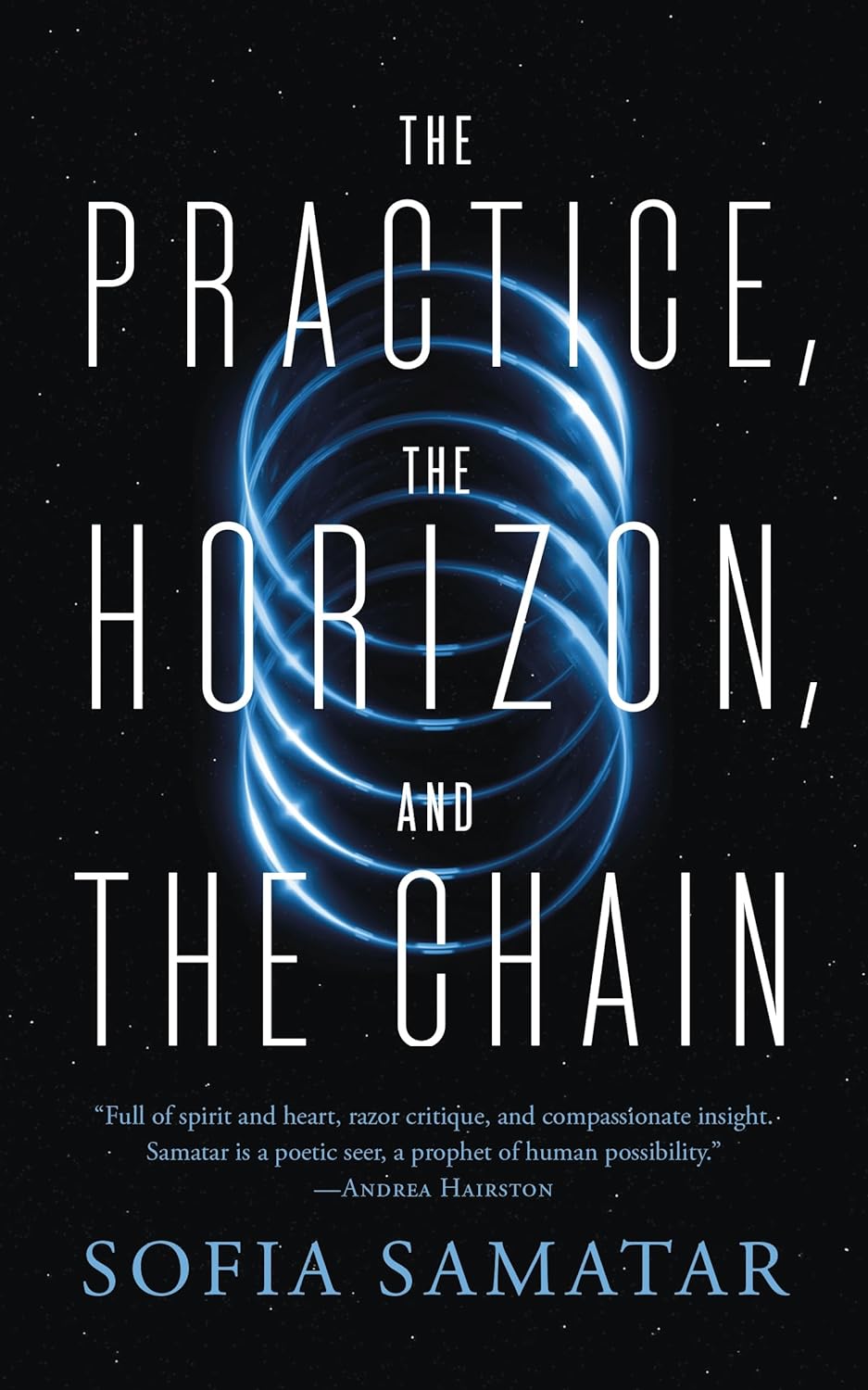
Sofia Samatar. The Practice, the Horizon, and the Chain. Tordotcom, 2024. Trade paperback. 128 pg. $18.99 Print, $4.99 EBook. ISBN 9781250881809. EBook ISBN 9780756415433.
Scavengers Reign marks an exciting and all-too-seldom new arrival in science fiction television: one that enfolds DNA from familiar SF narratives to create something fresh, and vibrant, and unsettling. The twelve-part series follows a group of survivors from the Demeter, a damaged cargo ship, who find themselves stranded on a planet populated by creatures that resemble the love-children of the imaginations of Salvador Dalí and Moebius. The trope of stranded colonists is a familiar one, but Scavengers Reign distinguishes itself through strong visual storytelling that manages to avoid the sometimes exposition-heavy world-building of science fiction, as well as through its convoluted and at times grotesque ecology. Boundaries are porous in this world; everything can and may be used as fuel, or food, or an aid to traverse the diverse environs of Vesta—that is, unless it kills you first.
The cast of characters is strong and manages to avoid clichés. Azi (Wunmi Mosaku) and Levi (Alia Shawkat), an automaton, try to maintain a self-sufficient encampment on Vesta. However, Levi’s circuitry becomes infiltrated with rhizomatic organic matter that begins to affect their behavior in odd ways (they bury a spanner in the opening episode: a small act that has a wonderful pay-off, later). Another pair, Sam (Bob Stephenson) and Ursula (Sunita Mani), are attempting to contact the still-orbiting Demeter to bring it down to the planet, and are similarly adept at using the flora and fauna, often in quite gruesome ways, to their advantage.
The show is not without its antagonists; as well as the predatory and bizarre lifeforms of Vesta, the characters find themselves in a race against time to reach the Demeter before Kamen (Ted Travelstead)—a pitiful figure responsible for the fate of the ship, and one who falls under the sway of the ‘Hollow,’ a malevolent telekinetic creature—and Kris (Pollyanna McIntosh), a ruthless mercenary. Indeed, after the first few episodes that introduce the ecology of Vesta, the drama wisely centers on the always-compelling human characters. As their storylines converge, the series starts to show its influences more nakedly in a largely satisfying manner—right up to the resolution, wherein the creators shy away from the murderous dream-logic of their world-building.
The surreal visuals (and discordant and often startling sound design) owe much to the disturbing classic from René Laloux, La Planète Sauvage, as well as the technicolor marvels and gentle ecological subtexts of Spirited Away or Princess Mononoke. These influences do not always work harmoniously. The resolution of Kamen and the ‘Hollow’s’ storyline, for instance, is particularly jarring, and feels disingenuous to the brutality of the world-building established in the former half of the show. Kamen’s and the creature’s redemptions feel odd, and unearned, almost exactly paralleling the character of ‘No Face’ in Spirited Away, wherein a monstrous, gluttonous creature finds peace and rehabilitation. There, it worked because the creature is a spirit; in the SF universe of Scavengers Reign, the conceit falls a little flat. Lurching from violence to rehabilitation seemingly for the sake of it, the narrative here starts to unsettle the integrity of Vesta and raises questions such as: Are its creatures truly malevolent, or are they just inscrutable? What do they ‘want?’ Why does everything function so symbiotically, on the one hand, and so violently on the other? Why do some human characters die, while others are changed?
These questions bring to mind yet another science-fiction/horror text: Jeff VanderMeer’s Annihilation. There, again, ambiguity is maintained more successfully, with Area X seeming a truly alien intelligence (both in the novel and its cinematic adaptation) that nonetheless operates with parameters and rules that both viewers and the in-world characters are not privy to. Scavengers Reign plays with similar themes but loses some of its ambiguity, and thematic consistency, as the episodes progress.
It’s a problem exaggerated by the short film the series started life as. ‘Scavengers’ (2015) sees an unnamed (and unspeaking) man and woman manipulate alien lifeforms in increasingly elaborate and convoluted ways that culminates in an orb of blue liquid excreted from a flying titan; upon submerging their heads in it, the characters experience powerful visions of something I won’t spoil here. Whereas the ecology of the series-length Scavengers Reign is far more convincing, it still at times comes across as science fictional Tetris, drawing attention to visual pattern and interplay in a way that is deeply satisfying on a sensory, if not a narrative, level.
If I’m seeming overly critical, it’s because I truly do love Scavengers Reign and the genres it combines (the epilogue hints at a larger and more terrifying universe, and promises to shift the show, should it have a second season, into a far different tonal register). Make no mistake: this is first-rate science fiction and top-tier animation, of any standard: one that manages to synthesize its references into something truly unique. It has much to say about the labor of space, for instance, in the way that Alien is tale of ‘truckers in space’ and their concomitant mis/treatment as expendable capital by world-spanning organization (the opening of Scavengers Reign sees a tense, but brief, exchange between the larger fleet, remorsefully leaving the stricken Demeter to its fate as an acceptable loss) In contrast, the world of Vesta shows us that nothing is truly lost, in strikingly un-Capitalist and irrational logic. Nothing is wasted: it is ingested, transfigured, or consumed. If the series doesn’t quite reach the nihilism of something like Joanna Russ’s We Who Are About To…, which fiercely refuses any and all attempts of human life trying to situate itself and flourish in unfamiliar kingdoms, it also avoids the anti-colonial message of something like The Word for World is Forest. Instead, it poses a challenge: by all means, make contact with other, make planetfall—just know that the colonizer/colonized dynamic is short-circuited, here, and if the characters want to survive on Vesta, they will have to make peace with the undoing of categories of every kind (the biological and the mechanical, the living and the dead, the hostile and the peaceful).A love letter to the genre (the final episode alone contains references to Aliens and 2001:A Space Odyssey), Scavengers Reign will, I hope, lean further into the uniqueness of its vision as it continues, making landfall on new, and stranger, worlds.
Phoenix Alexander is a queer, Greek-Cypriot author and curator of SF/F. He stewards the Eaton Collection of Science Fiction and Fantasy at the University of California, Riverside—one of the world’s largest collections of genre materials—and also serves as the Editor-in-Chief of Vector: the Journal of the British Science Fiction Association. His fiction and academic writing has been published in The Magazine of Fantasy and Science Fiction, Escape Pod, Beneath Ceaseless Skies, and the Journal of Fantasy and Science Fiction, among others. He is represented by Angeline Rodriguez at WME Books.

 SFRA Review