
Media Reviews
Review of Poor Things
Jess Maginity
Poor Things. Dir. Yorgos Lanthimos. Searchlight Pictures, 2023
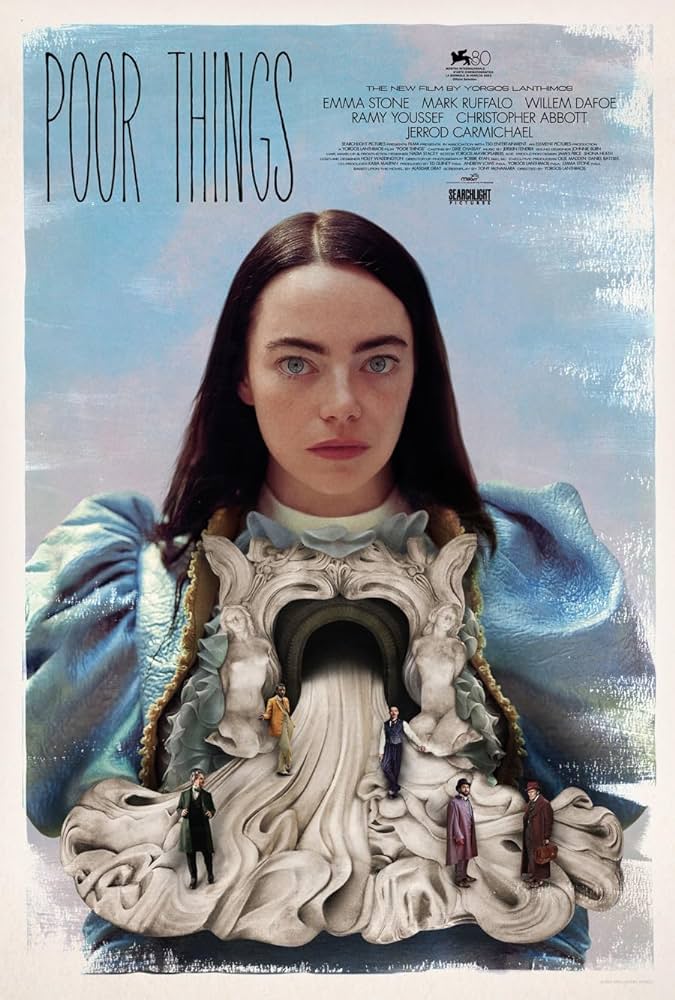
Yorgos Lanthimos’s Poor Things offers a rich field of possibilities for scholars of science fiction, especially when considering the film alongside the novel from which it was adapted. Both are interested in the question of perspective and narrative framing; both thoughtfully interrogate the relationship between gender, power, and science; both are engaged with the history of speculative genres and with gothic tropes and Victorian scientific culture in particular. The film would be an interesting object of analysis for projects about the history of science fiction as a genre or a mode or the relationship between contemporary science fiction and history. In the classroom, looking at Poor Things as an adaptation would provide the opportunity to think through the aesthetic strategies each artist uses to convey similar thematic concerns in different media, in particular the different toolkits that novels and films have to shape narrative around a distinct perspective or set of perspectives. It could work particularly well in a class dedicated to adaptations of gothic fiction, or even specifically Frankenstein adaptations.
The story begins when mad scientist Dr. Godwin Baxter (Willem Defoe) fishes the corpse of the pregnant Victoria Blessington from a river and implants the fetus’s brain into her skull. This procedure creates Bella Baxter (Emma Stone). As Bella’s brain rapidly grows into its adult body, we watch her learning how to be a person by following the scientific model of her father-figure, which demands a radically open mind and a willingness to endure socially uncomfortable or even physically painful experiences for the sake of knowledge. This is important as a gendered commentary on the history of science, where women have been explicitly considered objects of scientific inquiry and not itssubjects. This scientific mindset often sets her at odds with the irrational patriarchal expectations of the men in her life who both love and seek to imprison her to varying degrees, from the paternal imprisonment of Dr. Baxter to the ineffective policing of her social and sexual behavior by her lovers (Ramy Youssef and Mark Ruffalo) to the ultimately murderous marital imprisonment of Alfie Blessington (Christopher Abbott). The focus follows Bella as she expands her world and experiences it freely in the face of all this attempted male control and finally decides to follow in the footsteps of her more-or-less creator and become a doctor herself.
The movie is adapted from the 1992 novel of the same name by Scottish author Alasdair Gray. The crucial difference between the two is perspective. In a self-conscious nod to a longstanding convention of the genre, the book channels its story through multiple levels of framing which support or contradict each other on the authority derived from social standing, scientific authority, and lived experience. Poor Things is “edited” by Alisdair Gray against the wishes of the local historian he’s been working with and “written” by Archibald McCandless against the wishes of his wife. The historian invoked in the introduction validates the perspective of Victoria McCandless, whose afterword informs the reader (to the protestations of the “editor”) that the entire story (whose events are essentially the same as those in the movie) consists of lies and gross exaggerations. Essentially, Gray hints to his reader that the story is a male fantasy, gives the reader said male fantasy, and then has the female protagonist inform the reader that this was indeed a male fantasy. The formal structure interestingly mirrors that of its Romantic foremother: the framing narrative (“editor” and “author”) is sympathetic with the scientist-creator while the authorial framing is ultimately sympathetic with the “creation” by giving the “creation” a chance to demonstrate that in fact she creates herself and to cast doubt on the self-importance of the scientist figure (afterword).
The movie accomplishes the same critical orientation towards male scientific authority using cinematic rather than structural techniques. Whereas the book questions science’s (and scientists’) ability and inclination to liberate society from arbitrary or oppressive social protocols by undercutting the pulpy, fantastical narrative framing, the movie is able to make the same critical intervention while investing even more deeply in the fantastical by taking on the perspective of Bella and using a set of tools unique to film. Lanthimos explains that in the novel, “she’s basically seen through other people’s eyes, and she’s described by other people” and in order to give the driving narrative agency to Bella, the film would need a world embellished from our own (Ari Aster & Yorgos Lanthimos 24:31-25:17). The evolution of the color palette over the course of the film, from its black and white beginning to its hypersaturated middle to its photorealistic conclusion, and the elaborately constructed sets and painted backdrops (inspired by the grand painted backdrops of midcentury films like The Red Shoes) are a mode of presenting the story from Bella’s perspective. The film’s sense of reality evolves with Bella’s.
The book asks its reader to think about the politics of gender, authority, and objectivity in the context of science fiction; the movie asks its viewer to think about the politics of gender, power, and science in the construction of a self. As an adaptation, the movie participates in the history of science fiction as a political genre, a genre thinking about the place of science in society and whether it makes us more or less free. As a standalone example of science fiction cinema, it modifies and innovates cinematic conventions of gothic science fiction, taking the potential of the fantastic to deal with the human condition very seriously.
REFERENCES
Ari Aster & Yorgos Lanthimos. Variety, 2023, https://www.youtube.com/watch?v=BXYD3UISwCs.
Gray, Alisdair. Poor Things. Mariner Books, 2023.
Jess Maginity (they, zi, he) is a PhD candidate at the University of Delaware. They research science fiction (particularly in the twentieth and twenty-first centuries, and particularly by either marginalized or highly politicized authors), Indigenous studies, and Right-Wing Studies and they teach classes about writing, literature, genre, and politics. Their dissertation project looks comparatively at right-wing and American Indian speculative fiction on the theme of violence and civilization, highlighting the centrality of settler-colonialism to the continued flare-up of global (but particularly, American) right-wing extremism.

 SFRA Review