
Fiction Reviews
Review of The Practice, The Horizon, and the Chain
Timothy S. Miller
Sofia Samatar. The Practice, the Horizon, and the Chain. Tordotcom, 2024. Trade paperback. 128 pg. $18.99 Print, $4.99 EBook. ISBN 9781250881809. EBook ISBN 9780756415433.
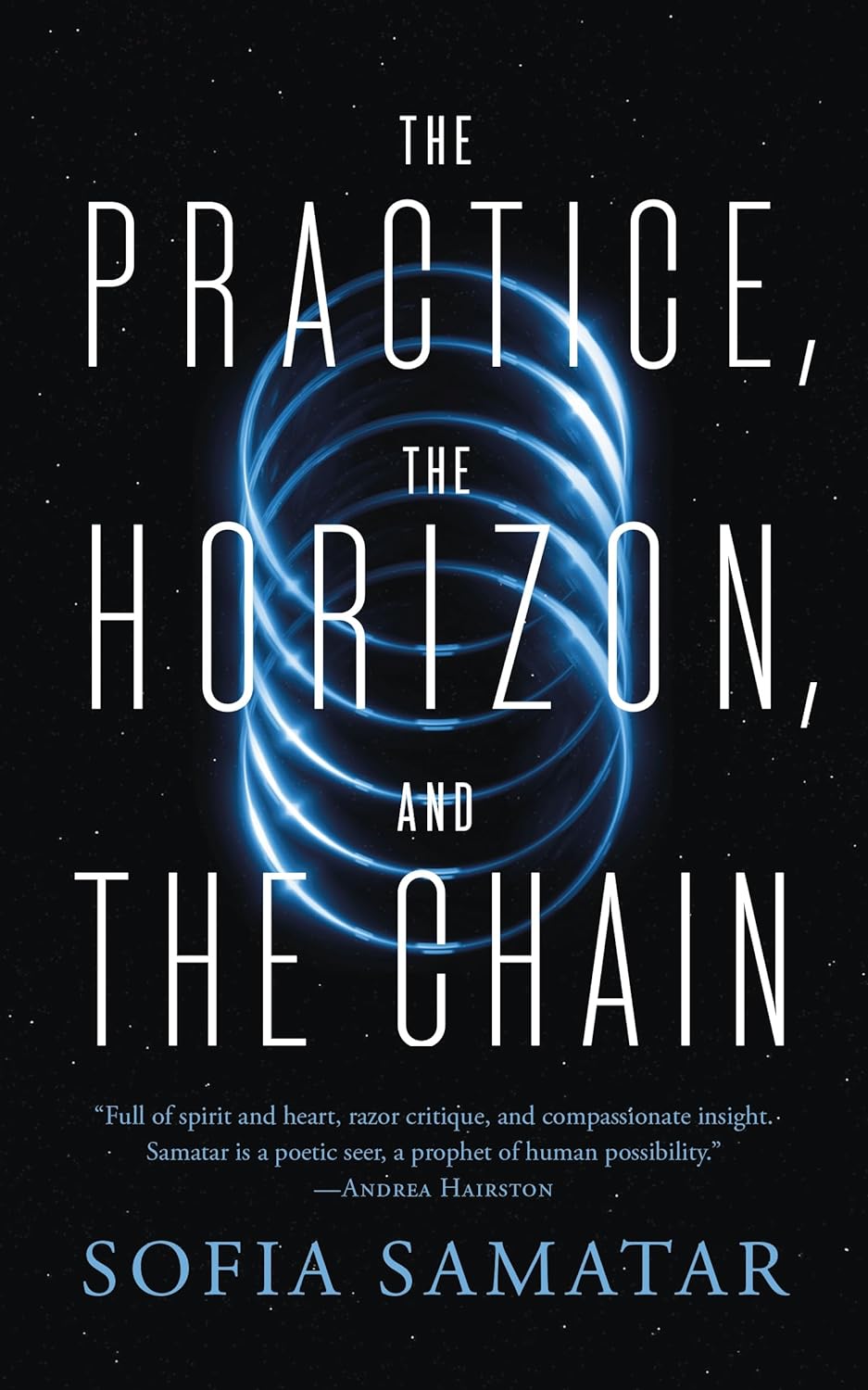
To describe Sofia Samatar’s carefully crafted new book as a “campus novel in space” would risk misleading potential readers into expecting a lighthearted romp through sci-fi versions of the satirical scenarios typical of the genre. Yet it is not not a campus novel in space, even though it reads quite differently from those earthbound satires of academe. David Lodge’s exemplars of that genre are taking place just out of sight, on a different starship, at a different social echelon. There is a satirical dimension to The Practice, as in the book’s bitter and not so comical critique of higher education’s self-satisfaction with superficial DEI initiatives. As the story unfolds, well-meaning allies prove not so well-meaning after all, and institutionally-sponsored celebrations of “Multiplicity” ring hollow because they change nothing fundamental about broken systems continuing to do real violence. In Samatar’s narrative world, as in ours, it is difficult to accomplish genuine justice work when our institutions rest on a foundation of exploited labor and inequalities of obscene proportions.
The Practice uses its science fictional novum to literalize those labor relations and social inequalities into a three-tiered caste system that governs life aboard a fleet of mining ships trawling the universe for minerals to sustain human life indefinitely. The book therefore also belongs to the generation ship subgenre of SF. While interstellar ark novels can be sprawling in terms of their worldbuilding and their page count, this one is spare; Kim Stanley Robinson’s hefty Aurora (2015) is more typical. What is strikingly different about Samatar’s premise is the absence of the lofty collective goal that propels most generation ship narratives: colonizing an untamed planet, or seeking a new home for humanity after some tragic fate has befallen Earth. We do learn from an aside in The Practice that Earth has suffered from rising sea levels, perhaps to the point of uninhabitability, but the book nevertheless holds out no hope for a new Eden: the ships are all we have, recalling the 2019 film Aniara with its accidental interstellar ark. The goal of Samatar’s fleet of generation ships is more suggestively tied to profit, and certainly not collective profit, as wealth still funnels to families associated with the mining company that runs the vessels. The Practice relies on a reader’s understanding of the basic parameters of a generation starship narrative without belaboring any details, ultimately in order to turn the premise sideways in pursuit of now defamiliarized but all too familiar subjects. In this sense, the narrative operates much like Ursula K. Le Guin’s ecofeminist antiwar parable The Word for World Is Forest (1972), which drew on the planetary colonization plot of so much “Golden Age” SF to critique the Vietnam War and other engines of destruction. The two books are also comparably short, and yet there are depths to both, as well as an urgency.
Below the new interstellar aristocracy imagined in The Practice are two oppressed castes, the lowest compelled to labor in deplorable conditions in the darkness of the Hold, literally chained to one another, effectively enslaved, and treated as nonpersons. In the middle is the protagonist’s caste, made up of people who live in fresher air and wider open spaces with the mining class, but have limited career and education options, and must wear an ankle bracelet that functions as an only slightly less obtrusive chain. The ankleted know that they are only a single misdemeanor away from the Hold themselves: they know to be grateful and have internalized rationalizations for their place. Our unnamed protagonist is one of the few ankleted professors at the ship’s university and also the daughter of one of the only Chained ever to have been raised up to ankleted status via a scholarship. Both the ankleted and the Chained are defined by their past participles, what has been done to them: only members of the upper caste are treated as individuals with names worth recording. Samatar traces some intricacies of this new social order, giving us glimpses into interactions among the classes that resonate with but are rarely fully mappable onto the complexities of our own social systems. For example, the ankleted do not have access to smartphones, and we hear that one of the professor’s colleagues “never liked to use it in front of the woman, a sensitivity she appreciated” (16). Another less-liked colleague shows no such restraint, but we might wonder whether the former colleague’s “sensitivity” is really a demonstration of tact, or instead a result of embarrassment about his privilege, or some other combination of emotions and social dynamics. The phones, as a symbol of class and power differential, also carry additional layers of significance, we later learn.
The plot centers on the (nominally) successful outcome of what is effectively a DEI program in space, the relocation of a Hold laborer with a talent for drawing to become an ankleted university student. The woman has expended an extraordinary degree of effort to revive this lapsed “University Scholarship for the Chained,” and such details attest to Samatar’s deep familiarity—and frustration—with the workings of academic bureaucracy and the realities of academic precarity, along with difficult colleagues, unequal access to university resources, time-consuming committee work that never seems to amount to anything, and the threat of burnout as the inevitable reward for caring about one’s work and one’s students. The story of The Practice, then, is the story of a woman trying to do something meaningful within the systems of power that seem to exist precisely in order to prevent her from doing anything of the sort and in the end attempting to learn new strategies for collective survival and flourishing. It is also the story of the boy who is acted upon by this scholarship program; the first sentence of the novel deploys the passive voice in a way that speaks to the treatment of persons in the Hold as objects: “The boy was taken upstairs without warning” (9). In the “outside” world above, he must endure the indignities and mockeries that come with being the scholarship kid, and from peers and professors alike, including “the insult of being taught about himself […] in anthropology class” (24), and learn how to perform to expectations: “Dr. Angela’s particular demand was for an easy camaraderie and warmth” (67). He is supposed to be grateful, of course, for this rare opportunity. He is supposed to make it okay that the rest of the Chained are still chained down below.
Increasingly aware of all of this and increasingly sensitive to the institutional forces curtailing her efforts to effect change, multiple times the woman asks herself the direct question that has been on many of our own academic minds here in 2024, “Can the University be a place of both training and transformation?” (63). The narrative voice directly answers that question in the negative, but eventually finds hope in a mantra that centers individuals rather than institutions: “Start with one” (94). That imperative, however, does not simply endorse the scholarship plan to uplift the boy, that single Chained student. Samatar rejects vertical metaphors entirely, especially the verticality inherent in the idea of “upward mobility,” that promise of so-many DEI initiatives, the education system more broadly, and the American Dream itself: “It seemed to him that up was their favorite word” (29). It emerges over the course of the story that the concept known as “the Practice” is tied to image of “the Horizon” from unremembered Earth, the horizon framed as a challenge to such vertical thinking: “to gaze on it was to look neither up nor down” (57). Instead, the book encourages horizontal thinking, a reclamation of that image of “the Chain” linking you to your fellows. The book’s underclasses are united in their marginalization, united even by the chains that link them together, and especially by those chains. The anklets — and even the literal iron chains — link, connect, and unite those bound by them. That is not what the chains or anklets are intended for, but it is something that they do. Because, we learn, the anklets are networked with one another, the ankleted can feel the presence of others through that network, and it turns out that technologies used to dominate and discipline can also be used in other ways.
At various times The Practice seems to be about social inequality in general: prisons and for-profit prisons in particular (“Look, the Hold is a business, get it?” [102]), the Middle Passage and its reverberations (the chain links the living to each other but also to the past and to the dead), higher education and its promises both kept and unkept, and institutions and state violence of all kinds. In the end, though, it is likely about solidarity above all else, forging links on a different kind of chain. It is about solidarity and also education, but education rethought beyond something that occurs only within institutional settings. Samatar dedicates the book to her teachers and her students, and the story affirms the duality inherent in the word education itself. We see the professor’s education of others, but also her own education, as she learns from the boy and from his own first teacher, a character known as the prophet who never leaves the Hold. From them the woman learns to grasp after “an outside knowledge” beyond the different ways that academic disciplines have sought to carve up human understanding (104). After the woman secures permission to visit the prophet as part of a “community engagement project,” the uplifted academic and the immiserated subaltern, along with their student from the next generation, work together to build a common language that transcends what any one of them could have achieved alone.
Professionally, the woman is a professor of “design” who specializes in the study of play, and we are treated to snippets of her research on children’s folk games featuring inventive uses of “castoff” or garbage, always framed with the appropriate academic jargon that she has mastered despite her yearning for a different kind of language: “it was necessary to set up her argument with theories familiar to the discipline, to couch her work in terms her audience knew” (41). The book takes a keen interest in castoff, garbage, “the potential of abandoned things” (103), and abandoned people. When meeting in the Hold with the prophet, the professor drops the jargon and defines design’s capacity to rearrange “the things that were” to create “a new way of being.” The prophet identifies this ambition with the concept he calls “the Practice” (66). If the Practice is “the longing for understanding” (29), as the boy thinks of it, it has some kind of affinity with the academic enterprise—the non-institutional part—and also with art, which he experiences when drawing as “the desire to breathe and know and live” (36). Together the three of them talk and think, and sometimes play those children’s games, “building imagined castles in the gloom” (66), a fair summation of the book’s own ambitions to hope for change against a rather grim backdrop (in the future, in the present).
The most extended explication of what exactly Samatar’s title means appears in a page-long aside positioned near the book’s center. This passage likely occupies a central position only because, in this view of the world, everything is a potential center, a node in the reconceptualized chain that has even rewritten the verticality of the Great Chain of Being: “the Chain of Being is not up and down” (64). Literally and metaphorically, too, “The Hold was in the center” (70). Throughout the book, Samatar evinces the complexities of space, temporality, and the metaphors and ways of thinking they engender. The Acknowledgments reference Stefano Harney and Fred Moten’s The Undercommons: Fugitive Planning and Black Study, as well as the work of Christina Sharpe and Dionne Brand, and their collective influence definitely shows. The syllabus practically writes itself, and The Practice, the Horizon, and the Chain is vital new reading for scholars and students of all kinds.
Timothy S. Miller teaches both medieval literature and contemporary speculative fiction as Assistant Professor of English at Florida Atlantic University, where he contributes to the department’s MA degree concentration in Science Fiction and Fantasy. He is the author of the books Ursula K. Le Guin’s A Wizard of Earthsea: A Critical Companion and Peter S. Beagle’s The Last Unicorn: A Critical Companion. Both belong to the series “Palgrave Science Fiction and Fantasy: A New Canon,” which he now co-edits with Dr. Anna McFarlane.

 SFRA Review