
Fiction Reviews
Review of The Imposition of Unnecessary Obstacles
Jeremy Brett
Malka Older. The Imposition of Unnecessary Obstacles. Tordotcom, 2024. Hardcover. 208 pg. $20.99. ISBN 978-1-250-90679-3.
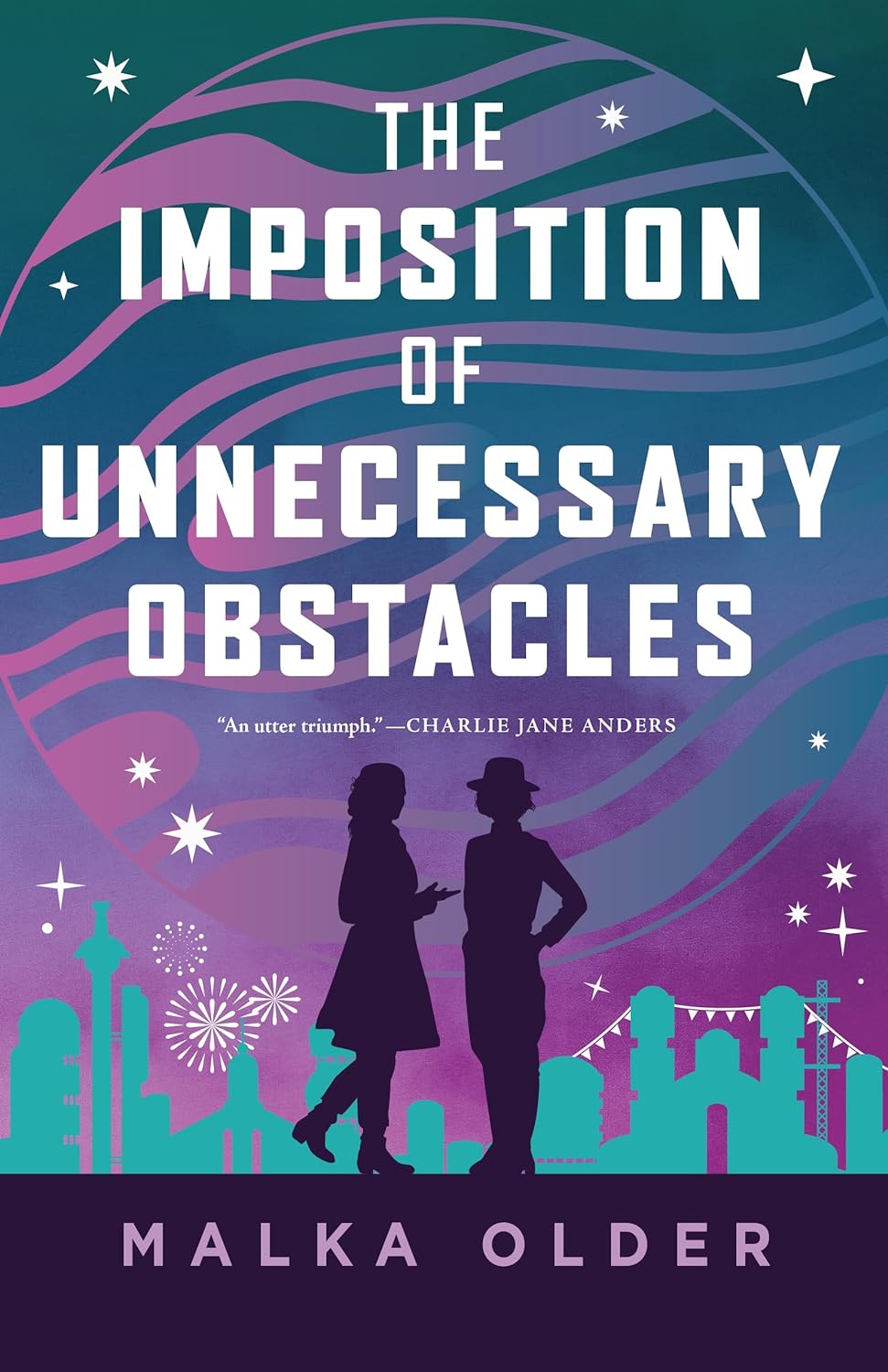
With The Mimicking of Known Successes, Malka Older introduced an intriguing queer detective duo awash in Holmes-and-Watson similarities (though perhaps all crime-solving duos are Holmes and Watson to one degree or another): the relentlessly logical, dogged investigator Mossa and her lover and partner-in-solving-crime, the academic researcher Pleiti. Following the crimes, scholarly scuffles, and dramatic revelations of Mimicking, Older has brought these two back together to solve another mystery set among the existential dangers inherent to life in deep space. In the grand tradition of mysteries, during the novella, important, and sometimes deadly, truths are exposed that lay bare the nature of the world around us as well as the deepest motivations and longings of the characters. All mysteries are, ultimately, searches for the truth of things, whether that truth is to be found in a cozy English drawing room, on the mean streets of 1940s Los Angeles, or even within a ring-structured colony that orbits Jupiter (or, as the book calls it,“Giant”) in the far future following the climatic destruction of Earth.
One central truth Older explores in this new chapter of the series involves the uncertainties that come with interplanetary existence. Mossa, at the story’s onset, has returned to Valdegeld University (where Pleiti works) because of a recent rash of seventeen disappearances among its population. We open with her musings on the disquieting ability of people to vanish from Ring society. She thinks to herself:
A startling percentage of cases brought to the Investigators dealt with missing persons. It might even be considered the raison d’etre of the service…After the controlled, condensed environments of the spaceships and stations, where everyone was within contact all the time, life on a planet with a dense, communications-unfriendly atmosphere seemed full of gaps and mystery. Particularly in the rapid expansion period, people would disappear into the growing network of platforms and rings, and there would be no way to know whether they were prospering or vaporized unless someone went to find out. (2)
Pleiti, enmeshed in her own more academic and theoretical mysteries, finds herself completely unaware of the vanishings all around her and is shocked to learn from Mossa how this went without notice, because the scattered can slip through the cracks without notice or perception of a pattern. But, then, patterns are what Mossa and her other fictional detective forbears seek to find. Detectives look to find meaning and purpose in seeming randomness. These are revelations for Pleiti, as is the uneasy feeling that perhaps she has been guilty of objectification and blindness towards her fellow residents. When Mossa notes that porters and other support staff are among the missing, Pleiti wonders, “‘Porters?’ That seemed even more surprising, somehow, and I wondered with a chill whether I did not see porters as people enough to be kidnapped” (32). That mindset, too, is a truth to be unraveled – how do we interact with each other in this kind of far-flung, disconnected society? How do we see one another and find value in each other, especially in an environment as unremittingly hostile as space, where coming together in viable communities may be the only way to survive?
Disconnection is key to the novella, as Older describes long-standing cleavages and prejudices among different Giant classes, particularly between people from Giant and the descendants of the rich, exclusionist settlers from its moon, Io. These kinds of familial and class prejudices form one variation of the kinds of “unnecessary obstacles” that we humans are always imposing among and between us, obstacles that constrain our ability to form communities and relationships and institutions and that can throw off a settlement’s unsteady balance. When Pleiti speaks to one of her scholarly colleagues, Zei, about the university faculty, Zei notes that “It has always been…precariously balanced, shall we say: dependent, like so many supposed systems, on the personalities involved. And their principles…Something is off” (97). Whereas Mimicking of Known Success involves a clash between differing, often violent opinions on when and how humans might return to an environmentally repaired and reconstructed Earth, Unnecessary Obstacles concerns itself with how we look at ourselves and those around us in the context of the societies in which we reside.
On a personal level, we see it with Pleiti, who is filled with doubts and insecurities about her relationship with Mossa:
…had I made it clear to her that it (Mossa’s home on Io) only mattered to me because it mattered to her? The thought that she might class me as an ignorant tourist, seeing only the surface, was like a pang of acid in my throat. Or maybe she hadn’t wanted me to see how much it mattered to her?..Round and round on their immutable rings went my thoughts, as I stared at the endless fog. (85)
Self-doubt and deliberate self-occlusion are also unnecessary obstacles Pleiti places in her path, as she confesses to Mossa her true feelings about her own dream of a renewed Earth: “I never really thought it was possible. I mean, reading about Earth, it was like…reading about Oz, or Pern, or Quistable. You want it to be your reality so much, but you also know it isn’t real. I believed in what I was doing, rationally I thought – think – it can happen, but it always felt…insubstantial somehow” (160). And on a more macro level, we see in the novella’s denouement how ideology and a heedless rush towards independence can themselves throw up obstacles such as self-deception or a romantic communal identity rooted in difficulty. As Mossa notes near the novella’s conclusion, “I dislike self-delusion. I particularly dislike when one or a few people’s chosen delusion is powerful enough to draw in others. And the idolization of the settlers for what they could not avoid as opposed to for their choices, the donkulous invention of obstacles to try and achieve the same status…” (192). When the final mystery is revealed, Pleiti sadly observes that “I looked again at the bare platform, sparse of society, precarious in every way, and wondered again at our human tendency to romanticize the imposition of unnecessary obstacles into our lives” (176). It’s the narrative moment where Pleiti expresses for the reader a fundamental human fallacy—in space or Earthside—that so many of our problems are of our own making, and that we risk a great deal of harm in making those problems seem inevitable and unavoidable.
We are, or should be anyway, long past the romantic literary trend of the individualist conquerors and pioneers of space; we now reside in an age in which we must, if we are to survive as a species and a planet, come together in a greater cooperative spirit and sense of common humanity and truly recognize the worth of one another. We must realize a world where the disappeared are considered worthy of finding. This is an increasingly popular trend in the genre, from authors such as Becky Chambers, Annalee Newitz, Carrie Vaughn, Travis Baldree (in a fantasy setting) and Martha Wells (Murderbot may be constantly exasperated by humans, but its journey is one towards greater understanding and feelings of care both by and towards itself); Older’s tales of Mossa and Pleiti as they negotiate both their own feelings towards each other and the obstacles we deliberately throw in each other’s paths as we work our way through interplanetary existence are valuable additions to this growing canon of authors who face uncertain human futures with optimism, who believe in the never-ending capacities of humans to learn and thus to remove the unnecessary obstacles that come our way. The best detective fiction relies not only on solving puzzles but on the detective learning new truths about their own abilities and perceptions. As Mossa uncovers the truth of both the crimes she investigates and the unexplored aspects of her own nature, so Pleiti gradually learns to expand her own limits. As she says to Mossa in the novella’s final pages, “Our experiences have influenced how I work, for the better. I am grateful to have gone back to Io and seen more of it, even if I did hate the process of getting there…Oh yes, the danger. Well. A little danger is salutary, I think. A tonic” (206). Risk becomes a crucial learning experience, a lesson which might define the entire enterprise of human space travel and colonization, in fact.
Jeremy Brett is a librarian at Cushing Memorial Library & Archives, where he is, among other things, the Curator of the Science Fiction & Fantasy Research Collection. He has also worked at the University of Iowa, the University of Wisconsin-Milwaukee, the National Archives and Records Administration-Pacific Region, and the Wisconsin Historical Society. He received his MLS and his MA in History from the University of Maryland – College Park in 1999. His professional interests include science fiction, fan studies, and the intersection of libraries and social justice.

 SFRA Review