
Fiction Reviews
Review of The Ferryman
Adam McLain
Cronin, Justin. The Ferryman. Ballantine Books, 2023.
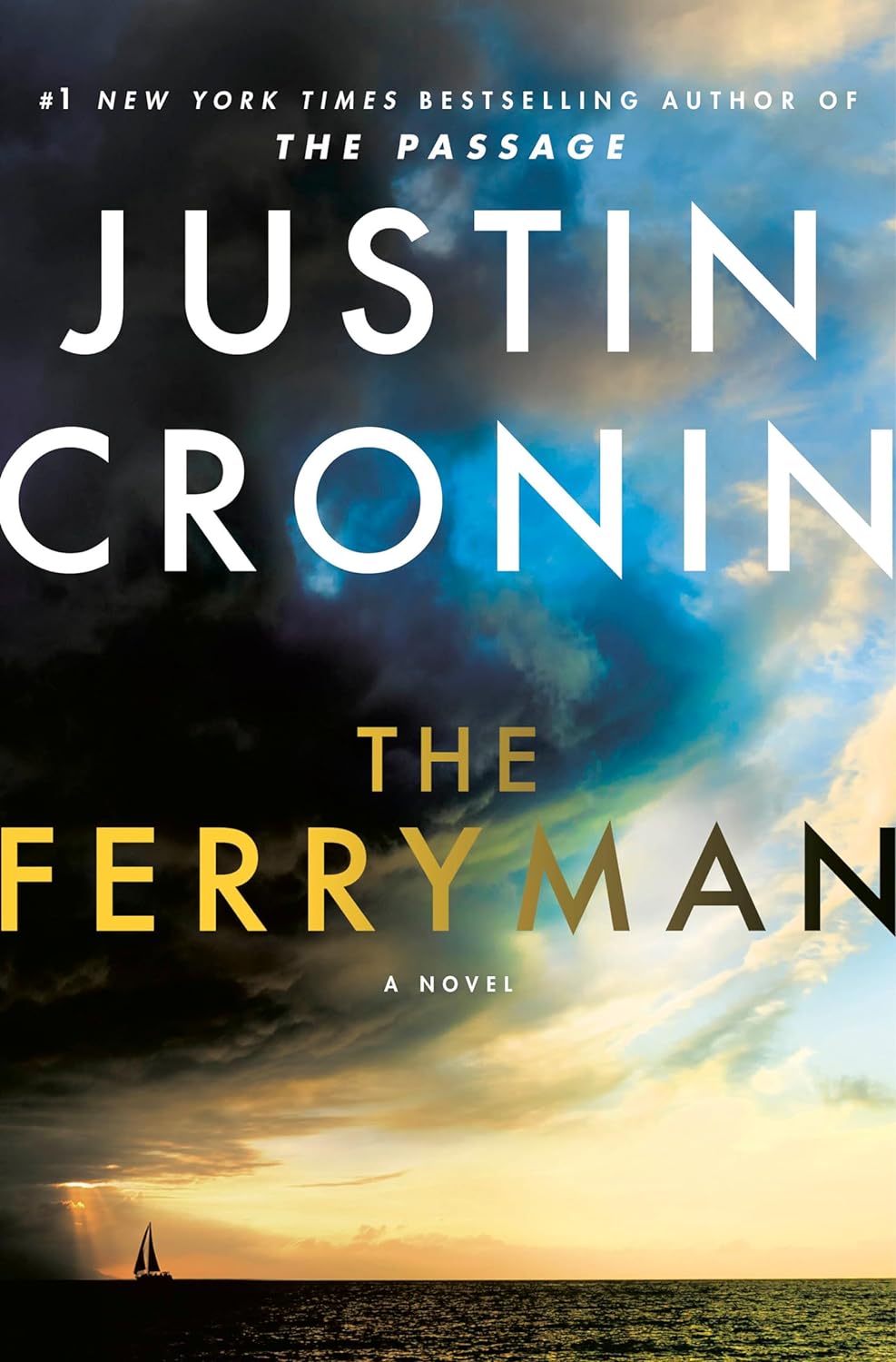
Separated into three islands—the main island, the Annex, and the Nursery—Prospera is a utopia cut off from the rest of the world. Created by the Designer to shelter the best of humanity, the inhabitants of the main island live paradisaically, pursuing whatever passion or desire drives them. This paradise does not mean that they do not work or live as mere mortals—they still age, if slowly; still work, just not menial labor jobs; and still die. But their death and birth are unique: they arrive by ferry from the Nursery in a body in its late teens, capable of basic human functions but also able to avidly learn new things, and they leave by ferry to the Nursery when their health number on their monitors reaches a low count, meaning they no longer enjoy life. This cyclical nature of existence is guided by Ferrymen like Proctor Bennett who lead those at the end of the cycle back to the ferry.
Proctor’s life in Prospera is idyllic. He has a good fifteen-year contract with his current partner, Elise. Although their relationship is cooling after many years together, they still are happy and content. His job is fulfilling, challenging, and a point of personal pride. He wouldn’t do anything to change his life. This changes, however, when he takes his father to the ferry and his father has a catatonic breakdown, telling his son, “The world is not the world. You’re not you… Oranios. It’s all Oranios” (62). His father leaves by ferry, but Proctor’s world is forever changed. As he searches for the answers to his father’s mumblings, he faces off against bureaucratic corruption bent on stopping him, class warfare building between the Annex and the main island, and the possibilities of what his life for the last hundreds of years really means.
Utopia, space exploration, climate fiction—Cronin writes the genre tropes well. I connected to each character as their backstory was revealed, and I lingered over sentences meticulously crafted to enhance the experience. The sentences are lyrical and whimsical; at times I thought I was moving through an ethereal dream only to be reminded that pain and strife still exist. Cronin’s use of the English language is his crowning point in this novel. But where I get stuck is there is no innovation with the tropes: each reveal is satisfying, but it is also predictable, if one knows science fiction well enough. This critique does not necessarily diminish the book. I wouldn’t go so far as to say that Cronin’s goal in the project is to subvert or expand tropes or send the genre along a new path. It is a text that is beautifully written, like Samuel R. Delany’s work, but also one that is not so concerned with generic questions, unlike Delany’s work.
Cronin’s exploration of utopia, turning point theory, simulation theory, climate catastrophe, and space travel are not meant to explore new depths in the subject; instead, he centers, and this is the beautiful part of the book, these grand ideas not around the ideas themselves but around the characters that enact them. His book becomes a meditation on relationships (parent to child, person to person, manager to employee) that left me re-thinking my own relationships and approaches to them. The central struggle of the book is with the loss of loved ones and not just a fight with authority, a quest for truth, and the revelation of survival.
However, after reading the book twice, I’m not entirely sure what the central message of the project is when it comes to the larger, systemic issues it presents. Along with its meditation on relationships, the book presents messages about class struggle, environmental destruction, and existence through mediations on simulation theory. These systemic questions become lost in the deployment of the tropes because Cronin does not emphasize one over the other; instead, he lets the tropes play out as they normally might in a blockbuster science fiction story. The critique of class, for example, is limited in its execution because it presents the same rich-vs.-poor dynamic that many utopias and dystopias exacerbate. The struggle leads to action—the oppressed in the Annex begin marching on the privileged on the main island—but Cronin doesn’t provide readers with enough paratextual information to give this struggle any heart or depth. A scene between the main character and his housekeeper illustrates this reading: Proctor converses with his housekeeper from the Annex about her son. He realizes that he barely knows anything about the son, even though he promised to take the son sailing. The scene shows the class separation and inhumanity between the wealthy of the main island and the working class of the Annex, but it barely goes beyond that presentation. His housekeeper is used later to smuggle Proctor information to sneak out of the Nursery, but beyond that, the book leaves this class relationship alone, thus leaving the message of class itself aborted in many ways. The final message on class, with the climactic reveal at the end, seems to be that class struggle brings about social change, since the Annex’s revolution against the main island ends in a social upheaval, but I am still unsure what the little moments about these broader, systemic arguments mean.
Even as I struggle with how Cronin does not do a lot with the tropes he’s working with, I also think that this deployment of tropes could be seen as a good part of the text: it is marketed toward a wider audience than academics discussing genre, and as such, the use of the tropes makes it easier to use The Ferryman as a starting point into the genre of the science fiction epic. When I went to the local Barnes and Noble to ask about Cronin, the bookseller took me to the horror genre bookshelves, because “that’s where Cronin is usually shelved” even though there is nothing remotely close to the horror genre in The Ferryman. The bookseller was thinking about Cronin’s earlier work, especially the 2010–2016 Passage trilogy, which is a post-apocalyptic, zombie-vampire series. But in shelving The Ferryman in this genre, I believe its use of utopia and climate fiction as a genre is a way to introduce this side of genre fiction to readers. Thus, I recommend The Ferryman as a strong entryway but not as a complication of science fiction. It can begin conversation rather than continue it, a good place to start an undergraduate or graduate course talking about utopia, futurism in science fiction, or climate fiction and space expansion.
Adam McLain is a Ph.D. student in the English department at the University of Connecticut. He researches dystopian literature, legal theory, and sexual justice.

 SFRA Review