
Media Reviews
Review of The Wandering Earth II
Mehdi Achouche
The Wandering Earth II. Dr. Frant Gwo, China Film Group Corporation, 2023.

In January 2019, China soft-landed the first lunar probe on the far side of the moon. The next month, The Wandering Earth (Frant Gwo) was released in Chinese theaters and made more than $700 million U.S. dollars at the box office, remaining to this day the 5th largest box office success in Chinese cinema and the first major homegrown science fiction production. That the two events should happen almost simultaneously was far from a coincidence, as the nation’s push in the science and technology fields has been accompanied by the dramatic rise of Chinese science fiction, dreaming of even more spectacular technological feats in the near or far away future. The genre in China has been spearheaded since the early 2000s by the works of novelist Liu Cixin, the Hugo recipient author of the eponymous short story (2000) loosely adapted for the screen by Gwo. Judging by the enormity of the means deployed by Chinese authorities to welcome the 81st World Science Fiction Convention in Chengdu, Sichuan, last October (a ceremony attended by both Liu and Gwo), the genre is taken very seriously by the government. It might, after all, help provide the means “to grow China’s cultural soft power and the appeal of Chinese culture,” in the words of Xi Jinping, the Chinese leader, earlier that month (Xinhua).
It should be noted, however, that both The Wandering Earth and its 2023 sequel, are as much disaster films as they are science fiction features, drawing largely from their U.S. counterparts, especially the Roland Emmerich variety. The “imagination of disaster” so elegantly described by Susan Sontag in the 1960s is at full work in these two films, as audiences can leisurely contemplate the wholesale destruction of entire metropolises and parts of the globe. This is especially the case in The Wandering Earth II, which is narratively a prequel taking place decades before the events of the first film and which can therefore focus on the cataclysms themselves rather than, like the first installment, on their aftermath. However, far from a pessimistic vision of the future, The Wandering Earth II, like its predecessor, is first a celebration of the technological marvels and possibilities that the future seems to hold, allowing humanity and China to overcome all the imaginable and unimaginable obstacles in their path. Although the film revels in destroying, it is first and foremost, as Jenifer Chao writes of the first film, an attempt at building the country’s national image, rebranding it as a technological superpower associated not with a long, glorious past but with a triumphant future (Chao).
Whereas the first film was set in the 2070s and focused on the Earth’s near destruction in the vicinity of Jupiter, the sequel takes place in the 2040s and 2050s, presenting itself as the chronicle of humanity’s early attempts at saving itself. The world governments have only recently become aware of the fact that the sun was rapidly expanding and would engulf the Earth within the next century. They have started work on what will become known as the Wandering Earth Project—the construction of 12,000 fusion-powered engines which will stop the Earth’s rotation and thrust it out of the Sun’s orbit and into deep space, in search of a new home. In due course, audiences are treated to giant waves engulfing New York City (featuring the now traditional shot of the Statue of Liberty being almost immersed in water) or meteors streaming across the globe and destroying various landmarks in the process. Urban ruins are also offered to audiences, as the panorama of a frozen Shanghai and its iconic towers recalls similar shots in A.I. Artificial Intelligence (Spielberg, 2001), for instance. This is essentially a demonstration of the newfound expertise of Chinese cinema at employing special effects that are up to par with Hollywood—cinema as essentially a technological apparatus, a cinema of attractions that doubles as a demonstration of Chinese technical prowess. If the disaster genre is “a supreme, basic and fundamental example of what cinema can do,” in the words of Stephen Keane in his study of the genre, here it also demonstrates everything that Chinese cinema can now do (5).
At the same time, The Wandering Earth II, even more than its predecessor, largely ignores some of the genre’s stereotypical characters—the greedy businessman, the cowardly stepfather—to focus instead on cooperation and unity. The old-fashioned H.G. Wells dream of a world government is resurrected in the form of a United Earth Government under the clear auspices of China. Anytime (which is often) a Western representative at the United Nations (most notably the U.S. and British ones) doubts the validity of the project and is ready to quit and accept defeat, the wise, old Chinese delegate has sensible words to remind the world of the necessity of global partnership. While careful never to hit the jingoistic tones of a film like Independence Day (Roland Emmerich, 1996), or of even recent Chinese blockbusters like Wolf Warriors (which shares with The Wandering Earth II its lead, Wu Jing), The Wandering Earth II is hard at work highlighting the merits of Chinese leadership. When terrorist attacks threaten the project and lead every other country to give up, China is left alone to heroically finish construction of the prototype engines. While we learn at one point that the U.S. Senate is preparing to opt out of the international partnership, the Chinese delegate addresses the General Assembly and reminds the world that civilization is about helping each other and mending what is broken: “In times of crisis, unity above all.” Shots of the U.N. building in New York always highlight the beauty of the structure or are careful to show the famous knotted gun sculpture and visually associate it with the Chinese delegation. China, we are assured, has the power, the know-how, the motivation and the wisdom to look after the world, contrary to the U.S.
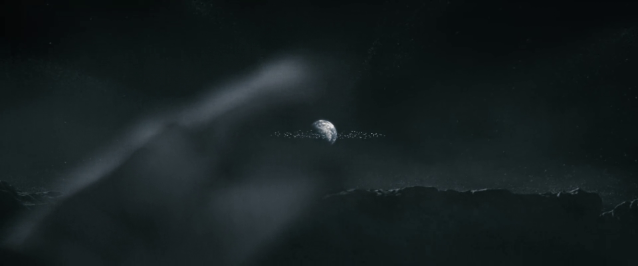
One of the similarities between the disaster film and the war narrative is their focus on the theme of sacrifice, and the film puts it to good use repeatedly. The climax of the film (which really consists in an unrelenting series of crises and climaxes) sees hundreds of senior astronauts from seemingly every nation bringing the world’s entire arsenal of nuclear weapons (no more wars) to the moon and blowing themselves up one by one to destroy the satellite and prevent it from crashing into the earth. This moment is perhaps one of the most emotionally effective in the film, and one of the most interesting visually. Before they arrive on the Moon, their approaching flotilla is visualized through a revealing frame within a frame: the film’s hero is holding a hex nut, through which he is framing the entire earth, making it look like a tiny little atom in the distance and emphasizing its fragility (fig. 2). Before the focus switches from the foreground (the nut) to the background (the earth and the approaching flotilla), we are given time to read the inscription on the edge of the nut: “made in China” (fig. 1). That a single shot can convey so much meaning (the nut is also an ironic stand in for the ring the hero could never hand to his love interest, symbolically making humanity as a whole his new love interest) is a testament to the director’s capacity to offer great visuals that do not simply feed the audience’s presumed thirst for mayhem and destruction.

The Wandering Earth II offers interesting avenues for the comparative study of science fiction and disaster films from the U.S., China as well as other countries (South Korea’s 2023 The Moon, for example) and their close connection to nation branding and soft power. The first film has already been largely discussed from such a perspective, but the sequel offers an even stronger case study. 2023 also saw the release of Tencent’s 30-episode TV adaptation of Liu’s Three Body Problem (available in many countries on Tencent’s YouTube channel), while Netflix will unveil its own version in the spring of 2024. This offers the potential for further comparative studies of differing perceptions and problematizations of scientific and technological progress across East and West, especially as their respective space programs kick into higher gear in the coming years.
WORKS CITED
Chao, Jenifer. The visual politics of Brand China: Exceptional history and speculative future, Aug 30, 2022, Vol. 19, 305-316, https://link.springer.com/article/10.1057/s41254-022-00270-6
Keane, Stephen. Disaster Movies: The Cinema of Catastrophe. Columbia University Press, 2006 (2nd ed.).
NASA, “Voyager 1’s Pale Blue Dot,” https://science.nasa.gov/resource/voyager-1s-pale-blue-dot/, last accessed Jan 10, 2024.
Thomala, Lai Lin. “The most successful movies of all time in China 2023,” Dec 13, 2023, https://www.statista.com/statistics/260007/box-office-revenue-of-the-most-successful-movies-of-all-time-in-china/, last accessed Jan 10, 2024.
Wall, Mike. “China Makes Historic 1st Landing on Mysterious Far Side of the Moon,” space.com, Jan 3, 2019, https://www.space.com/42883-china-first-landing-moon-far-side.html, last accessed Jan 10, 2024.
Xinhua News Agency. “Xi Jinping Thought on Culture put forward at national meeting,” Oct 9, 2023, https://www.chinatoday.com.cn/China/202310/t20231009_800344309.html, last accessed Jan 10, 2024.
Mehdi Achouche is an Associate Professor in Anglophone Film and TV Studies at Sorbonne Paris Nord University. He works on the representations of techno-utopianism, transhumanism and ideologies of progress in science fiction films and TV series. He is currently working on a monograph on such representations in films and series from the 1960s and 1970s.

 SFRA Review