
Media Reviews
Review of Star Trek: Strange New Worlds, season 2
Ian Campbell
The Sandman. Neil Gaiman, Davis S. Goyer, and Allan Heinberg. Netflix, 2023.
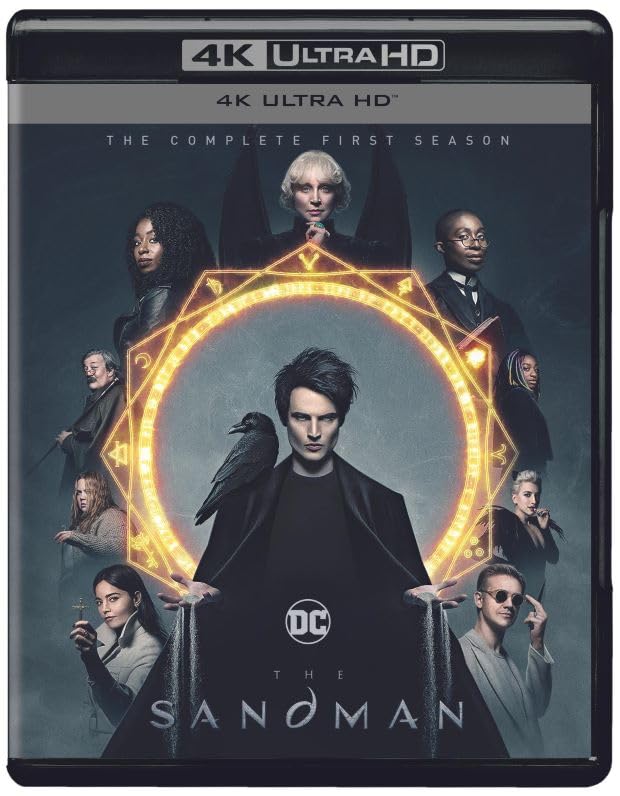
Netflix and the creative team behind the television adaptation, including executive producer Neil Gaiman, who wrote the story that was published in comic book form (1989-1996), deserve every ounce of praise for The Sandman, especially given the long interval and many false starts at presenting a television series—attempts to adapt the story go all the way back to 1991. Season 1 of the series adapts the first two arcs of the comics: these were published in collected volumes as Preludes and Nocturnes and The Doll’s House. The adaptation is entirely faithful to the spirit of the comics and often hews quite literally to the events and characters therein, with only minor deviations, nearly all of which improve upon the story. The adaptation is a tour de force in essentially every aspect and should be held up as the gold standard by which television versions of well-regarded fantasy and SF literature can be judged.
The story of season 1 begins just after World War I, when an English magus, Roderick Burgess (Charles Dance), conducts a ritual that seals Morpheus (Tom Sturridge), the incarnation of Dream, into a glass prison for a century. When Morpheus finally manages to free himself, he has to first seek out the tools that were stolen from him upon his imprisonment, then rebuild the Dreaming, his realm, and track down those among the dreams and nightmares who escaped into the real world during his absence. Once this is accomplished, he has to deal with a “dream vortex”, a mortal whose powerful dreaming ability threatens both the Dreaming and the real world. The theme running through this is that whereas the Morpheus who was first imprisoned was cold, distant, and not so much deliberately cruel as indifferent to the suffering caused by the actions he felt necessary, the freed Morpheus becomes somewhat more humane. During the season, we are given some of the information necessary to understand that Morpheus is the third of the seven siblings called the Endless; we meet his elder sister Death (Kirby Howell-Baptiste) and his younger twin siblings Desire (Mason Alexander Park) and very briefly Despair (Donna Preston). We do not meet his eldest brother Destiny nor his youngest sister Delirium, and only see a blank rectangle where the middle brother Destruction might be: as we will likely find out in season 2 or 3, Destruction has quit his job and left the family.
There are a number of deviations from the comics in the series, but they all improve upon the story. The timeframe of the story has been bumped from the late 1980s to the 2020s. Brute and Glob are replaced by Gault (Ann Ogbomo), a much better character with a real arc of her own; within the same storyline, it is Jed (Eddie Karanja) rather than Hector who is deluded into thinking he’s the real Sandman. Ethel Cripps (Joely Richardson), Burgess’ lover and Dee’s mother, gets a character arc of her own, linking Dee much more closely to the story of Dream’s tools. The Corinthian is more present as an antagonist throughout the season. It is rather clearer from the start that Desire has it out for Dream and is trying to ensnare or destroy him: this will become a central feature of the overall plot.
There are also a number of casting decisions that created controversy as the show was filming. Notably, when Howell-Baptiste was cast as Death, who in the comics is mostly portrayed as a very pale goth girl, the sort of bottom-feeders who use “woke” as a pejorative pitched a fit about it, with their usual delicacy and respect for others. It’s true that the original image of Death was based off of a white woman, Cinamon Hadley (d. 2020), but few outside the right-wing outrage machine believed the fig leaf that casting a black woman for the role was somehow disrespectful to the memory of Hadley. Gaiman provided a model for how to deal with such trolls, by being forthright yet humane in the face of a barrage of hate and death threats. Several other of the characters are played by actors of different races than those of the comics: Jed, Rose (Vanesu Samunyai) and Unity (Sandra James-Young) are all black rather than white, and Lucien, the Dreaming’s librarian, who is a white man in the comics, is played by a black woman, comedian Vivienne Acheampong, and the character is now Lucienne. If you’ve not read the comics, you won’t notice, and if you have read the comics and aren’t a bottom-feeding right-wing troll, you won’t care: as I said above, the acting and writing is top-notch.
One of the ongoing themes across the long series of comics is that the Endless are eternal manifestations of the principles whose names they share: their task is to embody these principles as a means of guiding, punishing or serving as inspiration for mortals. This is done well in season 1, especially in a pair of scenes where Shakespeare (Samuel Blenkin) becomes of interest to Dream because he wants to tell great stories, which is Dream’s magisterium. As the comics progress, it becomes more clear that each of the Endless has a personality that’s more or less opposite to their function: Destiny is clueless, Death perky, Dream a sober realist, Desire firmly unwantable, etc. None of this much manifests in the first two volumes that season 1 adapts, but I’m interested to see what happens as the show goes forward. The contrast between personality and function, and what this does to the Endless—especially Dream, Destruction and Delirium—and how they cope with it, becomes part of the central plotline as the story progresses.
From an academic perspective, two avenues open for consideration of the show in research and teaching. Its take on mythology and the oddly constrained lives of the (semi-)divinely powerful is worth exploration, notably in how Morpheus gradually goes from filling his function because that is what he’s supposed to do all the way to understanding the incompatibility between his humanity and filling his function. The other avenue is to consider how it is that some adaptations, like this one, are so very good, and others, such as Amazon Prime’s versions of The Wheel of Time, which comprehensively botches both the spirit and the letter of the novels, and of a few paragraphs of Tolkien’s notes for the absolute fiasco that is Rings of Power, are so very bad. It’s not related to network: Prime did a great job with The Expanse and Lee Child’s Reacher novels. What choices are made that enable one adaptation to be genuinely moving and others cringeworthy, and to what extent are these artistic decisions and to what extent are they related to business? These are all commercial productions, intended to make money, and no matter how much we might wish for art unencumbered by business, that’s not possible now and never truly has been.
Ian Campbell is the editor of SFRA Review.

 SFRA Review