
Fiction Reviews
Review of The World We Make
Sreelakshmy M
Jemisin, N.K. The World We Make. Orbit, 2022.
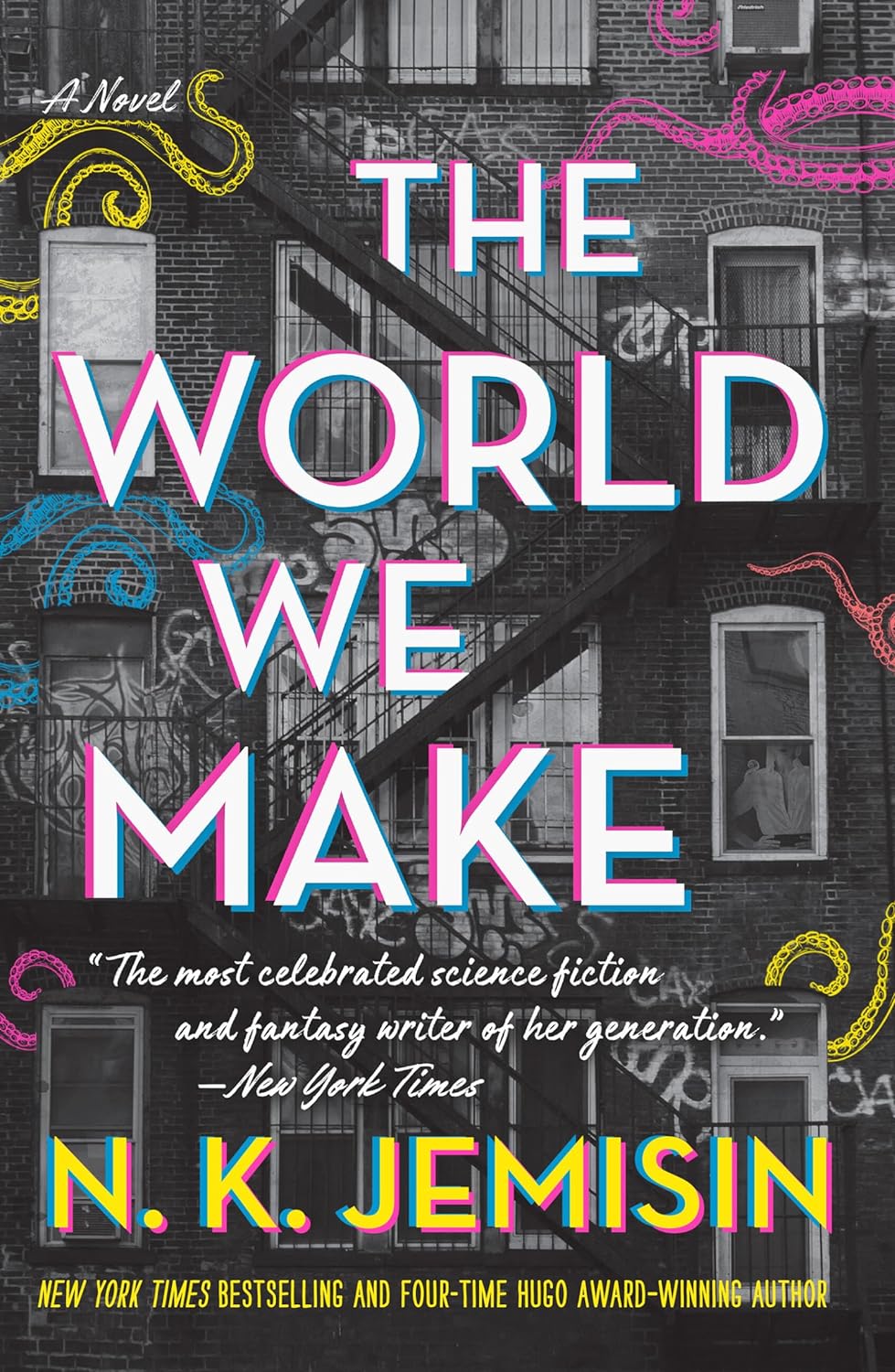
The trope of the city as a literal living, breathing entity is not new: it appears in the weird sci-fi of H. P. Lovecraft (whom Jemisin mentions in The City We Became) and Jeff VanderMeer to Jorge Luis Borges and Italo Calvino’s postmodernist narratives. However, what makes Jemisin’s cities stand out are their manifest avatars—human beings. Her Great Cities duology, The City We Became and The World We Make, is set in contemporary New York. It revolves around New York/Neek and his boroughs/avatars as they try to take back control of the city from an extraterrestrial entity that threatens to consume New York.
N. K. Jemisin is a multiple Hugo and Nebula award-winning sci-fi and fantasy author, best known for her Broken Earth trilogy. Her protagonists are trapped within a constant struggle against alien power structures that are usually thwarted via the use of fantastical elements. Great Cities is then comparable to a dystopic world ruled by utter chaos, anarchy, and totalitarianism that the Other entities try to impose upon New York and the rest of the world. The human manifestations of the boroughs must now wage a war for a normal world order free of surveillance and xenophobia. The juxtaposition of the alien world onto New York can be read as the literal descend of a totalitarian regime.
The first part of the duology ends in a promising note as the boroughs struggle and almost succeed at keeping “the Woman in White” at bay. The second part, however, is where things spiral as four of the boroughs—Manhattan, The Bronx, Brooklyn, and Queens—and New Jersey are forced to encounter the Woman who strives to get rid of them one by one. The novel follows the first-person narratives of each of them, and of Staten Island, which is exiled in The City We Became and subsequently aligns with the antagonists in their personal and multi-versal fights. The World We Make is Jemisin’s attempt at creating a world that lives and breathes on its own, full of cities that are constantly born and reborn with the help of their human manifestations. Employing the usual trope of good vs. evil, Jemisin stages a fight against xenophobia and gender inequality as the cities must fight with an alien entity that threatens to literally consume the earth.
Being a Butler scholar, Jemisin has always expressed a deep interest in Octavia E. Butler’s fiction. The premise of The World We Make, for instance, is comparable to Butler’s 1977 novel Mind of My Mind where Butler imagines an interconnected world in which telepaths are connected to each other via threads and patterns, constantly drawing energies from each other. It is this kaleidoscopic world that determines the future of humanity, a telepathic network that exists because of intricate mental connections and is ultimately controlled by a “patternmaster” who can mentally control/kill each of the participants. Jemisin’s avatars, then, behave in a similar fashion. They draw energy from abstract concepts such as mathematical equations or rap music or from concrete phenomena such as credit cards and souvenirs in order to amass enough power to fight their common enemy.
By creating a world that functions on proximity and the need to connect and cohere, Jemisin proposes the need for communication and community in our real world. This is not to say that Jemisin’s cities are free of racism, sexism, misogyny, and patriarchy. She advocates a world where multiversal corporate companies that enforce deep rooted misogyny and xenophobia can be fought with the help of goodwill and community. For instance, the extraterrestrial entity appears in the form of an impeccably dressed white woman who inadvertently captures human beings by attaching a small, white, fleshy tentacle into their bodies. Once you have this tentacle sprouting out of your body, you are under the absolute control of the “Woman in White” (Jemisin does not shy away from using conspicuous tropes of race and surveillance here).
Though she employs fantasy and speculation, Jemisin’s novel is steeped in realistic representations of the world. Neek notes at one point,
Periodically R’lyeh [Woman in White] sends forth a hollow, tooth-aching, atonal song that echoes across the whole city. The song’s a problem; listen to it for more than a few minutes and you start thinking Mexicans and birth control are what’s really wrong with the world, and maybe a nice mass shooting would solve both problems. (10)
WORKS CITED
Butler, Octavia E. Seed to Harvest. Grand Central Publishing, 2007.
Sreelakshmy M is Visiting Faculty (Assistant Professor) at the Department of Humanities & Social Sciences, National Institute of Technology, Warangal, India. She recently submitted her doctoral thesis titled “Reproduction, (M)Othering and Multispecies Community: A Study of Octavia E. Butler’s Select Fiction” at the Department of English, University of Hyderabad. Her areas of interest are speculative fiction, Afrofuturism, and fantasy studies. She has published in the Journal of Literary & Cultural Disability Studies (JLCDS).

 SFRA Review