
Fiction Reviews
Review of The Terraformers
Ian Campbell
Newitz, Annalee. The Terraformers. Tor, 2023. Hardcover, 338 pg. $28.99. ISBN 9781250228017.
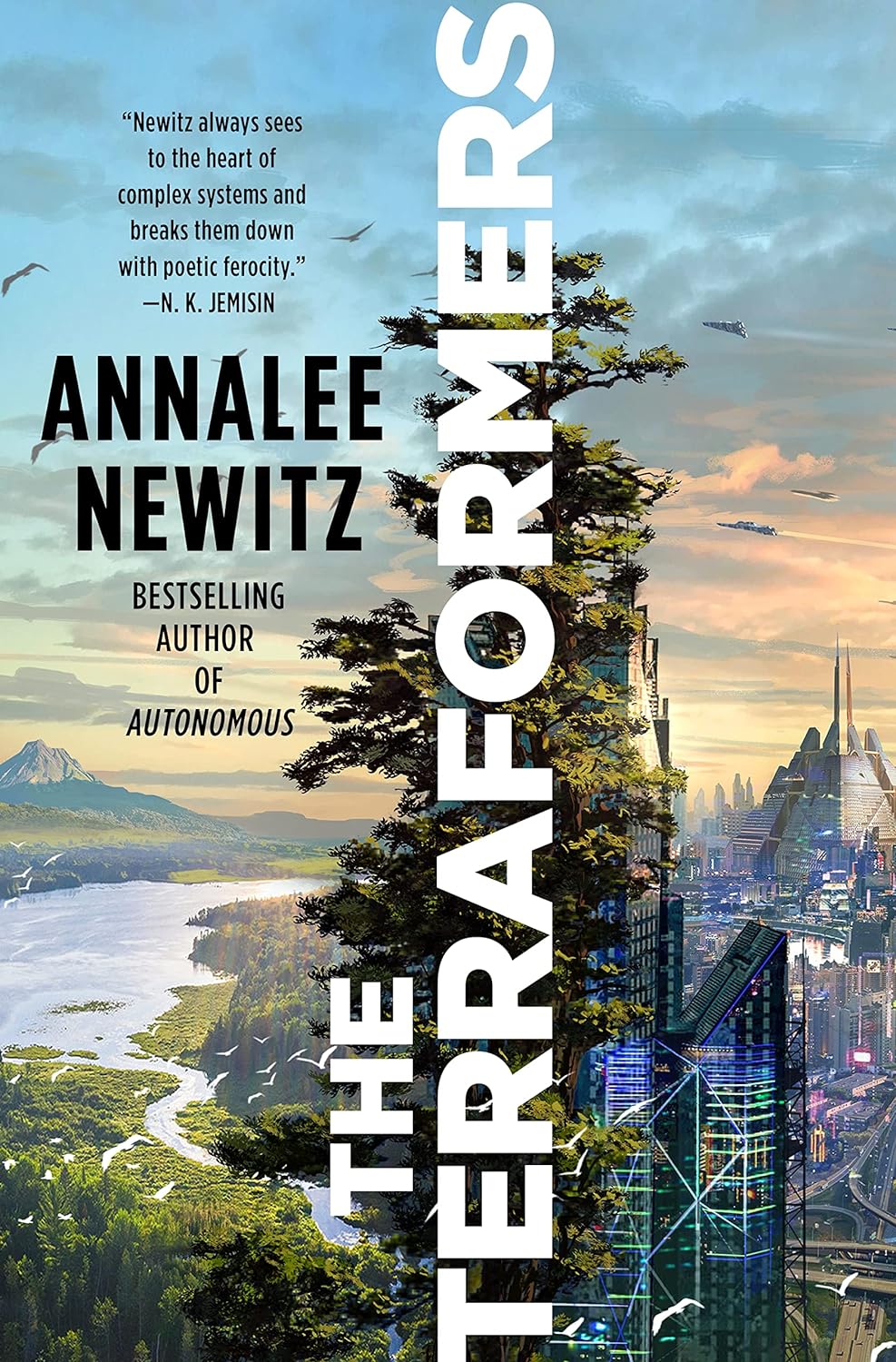
In essence, the process of terraforming is quite simple: find an inhospitable planet and change its ecosystem to transform it into a garden. The existing planet, be it Venus, or one of the seven theoretically terraformable planets in the TRAPPIST-1 system, or the planet called Sask-E in Newitz’s text, maintains its motion about its sun, but everything else about it becomes new, different, better. Yet this process is in fact complex, difficult, tedious, and requires a tremendous amount of work and even more time. Moreover, it renders extinct the existing ecosystem, which may well not have been hospitable to humans, but was unlikely to have been entirely devoid of life. To actually terraform a planet requires vast resources of time, capital, and labor, in addition to the continuity of focus and organization necessary to maintain the process over a timescale likely longer than that of recorded human history.
Anyone reading this review is likely to understand that SF outside of pure adventure stories generally works on more than one level: it provides us with an engaging story about a world different from our own and permits us to read that world as an estrangement of our own as a means of critiquing or reframing some aspect of our societies. Heinlein’s The Moon is a Harsh Mistress has its inhospitable planet right in its title: it uses the Moon as a penal colony in order to describe the conditions under which an anarcho-libertarian society might evolve. The engaging story of how a computer repairman is led by an artificial intelligence to help direct a revolution against Earth also enables us to explore anarcho-libertarianism from the perspective of its adherents; the novel shows us that nearly anyone who has the opportunity to escape anarcho-libertarianism does so at once, but compels us to infer this while at the same time having its narrator extol its virtues. It’s quite possible to read Harsh Mistress as promoting rather than critiquing the political system it examines, because of the layers of subtlety in the text. Le Guin’s The Dispossessed performs through its own engaging story a structurally similar and even more nuanced presentation and critique of anarcho-communism with its inhospitable planet and the intense and less than totally successful attempt to terraform it over the decades since its colonization. The Terraformers, at its heart, is a fascinating piece of science-fictional metafiction: it compels us as readers to perform the complex, difficult, and time-consuming work of transforming over a hundred thousand words into an interlocked ecosystem of text hospitable to meaning.
The text presents us, in the year 59,006 of a calendar that we’re told began somewhere around now, with the planet Sask-E, whose terraforming is in its final stages. The Verdance Corporation, over the course of forty thousand years, had first seeded the oceans with blue-green algae to transform its atmosphere, then worked on seeding and maintaining a new ecosystem so as to create a version of Earth from the Pleistocene—i.e., the period of glacial cycles between c. 2.6 million and 11,600 years ago, during which hominins developed into anatomically modern humans. Verdance plans to profit from this by selling plots of land to the idle rich, who can then decant themselves or remote-operate human bodies in order to enjoy the unspoilt/created wilderness or life in the cities prebuilt by a different, subcontracted corporation. The ecosystem is maintained/expanded by a cadre of rangers, from which our initial protagonist Destry is drawn. She spots an anomaly, which turns out to be a squatter: someone off-planet operating the body of a human enjoying the Pleistocene by building a shelter and eating and skinning animals, the last of which horrifies Destry. She eliminates and recycles the remote body, then returns to base only to find that the Verdance VP in charge of the project is furious with her: the squatter was in fact a potential customer.
The desire to get away from direct supervision leads Destry to a distant location where Verdance is having a river rerouted to make an area more attractive to potential clients. She finds a community of Archaeans, the original rangers, who seeded the oceans and were then discarded by Verdance and supposedly left to die in the new atmosphere inhospitable to them, but who instead created an underground and hitherto fully concealed city near a volcano. The rerouting of the river will cause them huge problems, so they ally with Destry: because the Archaeans have (an also hitherto fully concealed) system of machines with which they can manipulate Sask-E’s plate tectonics, they are able to threaten Verdance’s profits to the point where Verdance is compelled to negotiate with them. The first and longest of the three sections of Newitz’s text ends with a treaty whereby the inhabitants of the underground city are recognized as self-governing. The second two sections address conditions after the planet has come to be inhabited by those to whom Verdance has sold the experience. At no point does the text raise the question of what the original ecosystem of the planet might have been like.
A primary novum of The Terraformers is that technology enables the creation of sentient nonhuman animals: in the text, larger herbivores such as cows and moose (though in fact neither animal is a pure herbivore here on Earth), then smaller ones such as cats and naked mole rats, all the way down to earthworms in the later sections. Verdance limits the sentience of animals and even some humans, in order that they have only enough to do their jobs properly. When a group of rangers including a sentient cow encounter a corporate dairy farm in the second section, great hay is made of the horror this evokes in the characters, both in that one might choose to drink milk from cows rather than almonds or oats and also in that animals’ potential sentience would be as limited as that of these cows clearly is. Later, a means is found to cancel the limitations on sentience and further the treatment of nonhuman animals as people. This is the closest The Terraformers comes to a traditional presentation of SF: we can read this particular story, engaging or not, and also understand the hypocrisy of how we in the West in the 21st century treat nonhuman animals. There is cow’s milk in the coffee I’m sipping as I write this, and when I’m done, I’m going to use the beef I bought at the farmer’s market to make tacos, but I would never even consider exploiting or mistreating the cat currently on my lap and whom I absolutely treat as capable of understanding what I say to her. I’m well aware of my own hypocrisy, but another reader might well be moved by Nemitz’s portrayal of how Verdance bottlenecks the intelligence of nonhuman animals and thereby re-examine their own practices or beliefs.
This serves as an example through which we as readers can understand what must be done to most of the rest of the text. With respect to characters, Harsh Mistress and The Dispossessed give us detailed background material on how Man and Shevek came to be: their childhood and young adult experiences determine their perspectives, their politics, their very language. Heinlein and Le Guin give us characters who have evolved inside their hothouse environments, in such a manner that they are not only vivid and engaging characters, but also represent their political perspectives from the point of view of natives of those societies. The Terraformers is metafictional: it compels us to extrapolate from the characters’ words and actions what made them come to take these positions. Destry is the only one of a couple of dozen speaking parts who gets any background at all, and it’s quite minimal. It’s up to us as readers to infer, or to create out of whole cloth, the societies or particular circumstances that might have created the other characters such that they all—humans, Archaeans and sentient animals alike—have essentially the same attitudes as very self-consciously progressive young Western people from our own century, even though the book is set on another planet, fifty-six millennia in the future. It occurred to me as I wrote the characters’ names and species on an index card in order to keep track of who they were, that Nemitz’s near-total lack of differentiation among them was part and parcel of the metafiction: it is as if the text were the blank planet upon whose new ecosystem was the complicated and time-consuming work I was doing to formulate species, societies or families that might have generated such convergent characters.
This same metafictional trope of terraformation exists on many other levels of the text, as well. We are told by Destry that the sort of ranger she is generally has the protection of the ERT, an interstellar umbrella organization of rangers, but that Verdance has cloned, or built from scratch (it’s not clear) rangers not subject to this protection. Destry knows this despite the repeated statement that Verdance prevents its on-planet employees from accessing interstellar networks. It’s left to us as readers to build the network of whispers or samizdat that might have clued Destry and her fellows into the knowledge of this protection coupled with the inability to (e.g.) signal the organization that might come to their aid. We are entirely left to infer, or to build for ourselves, what society might exist so far in the future that still has corporations controlling planets yet permitting something akin to free will among human employees, instead of using drones or AI to maintain their new ecosystem. We’re told the controller of the squatter body destroyed by Destry is thinking about taking Verdance to court, but entirely left to build what a society that still had courts this far in the future might be like. We’re told that Verdance has been at this for at least forty thousand years, but left to build from the ground up an economic system where corporations, which are governed by the constant desire of their investors for short-term profit increases, not only exist over that long of a timespan but also are able to justify to those investors the tremendous work and cost involved in terraforming a planet in terms of its distant future profit. Perhaps this is a deflationary universe, where the value of a given sum of money increases rather than decreases over time. We don’t know! We get to impose our own ecosystem upon the text, and thereby replicate the process of terraforming.
We’re constantly told things, rather than shown them: it’s up to us to terraform this text. Whereas Heinlein or Le Guin might have a character tell us one thing and show us another, The Terraformers leaves it up to us to show what might have happened. Very early in the text, the narration tells us that:
The ancient order of environmental engineers and first responders traced their lineage all the way back to the Farm Revolutions that ended the Anthropocene on Earth, and started the calendar system people still used today. According to old Handbook lore, the Trickster Squad—Sky, Beaver, Muskrat and Wasakeejack—founded the Environmental Rescue Team 59,006 years ago. That’s when the legendary heroes saved the world from apocalyptic floods by inventing a new form of agriculture. The Great Bargain, they called it. A way to open communication with other life forms in order to manage the land more democratically. (13)
We’ve already explored the question of how Destry knows this yet remains essentially a slave to Verdance, unable both to access networks and receive help from the ERT. But there’s more metafiction to this. Imagine this story in the hands of Heinlein, where some grizzled old Loonie would be telling the narrative with some detail to an audience, likely with sardonic commentary by some equally cantankerous author insert. Imagine it in the hands of Le Guin, who would show it to us through a tapestry or interpretive dance, complete with storytelling that made the legend meaningful (and plausible) and also included the distortions imposed by the vast timescale of the novel. But instead, we’re simply handed this story, and then the text essentially never touches upon it again other than to use the phrase Great Bargain every so often. What did the Trickster Squad actually do? What is the new form of agriculture? The text shows us multiple examples of farm fields: wheat, sugar, lavender, and somehow the fifty-Xth millennium still has people growing and using tobacco. How did this save the world? How did the Trickster Squad overcome the modern corporate state yet still preserve for aeons a corporate state? Or is this a new corporate state, and if so, how does it differ from our own? The text of The Terraformers does not show nor tell us any of this, and while at first this might be frustrating, it may eventually dawn upon other readers that it’s metafictional. We get to terraform the text: it’s almost literally a whole blank new world. It’s tremendously exciting.
Ian Campbell is the editor of SFRA Review.

 SFRA Review