
Fiction Reviews
Review of The Scourge Between Stars
Kristine Larsen
Jemisin, N.K. The World We Make. Orbit, 2022.
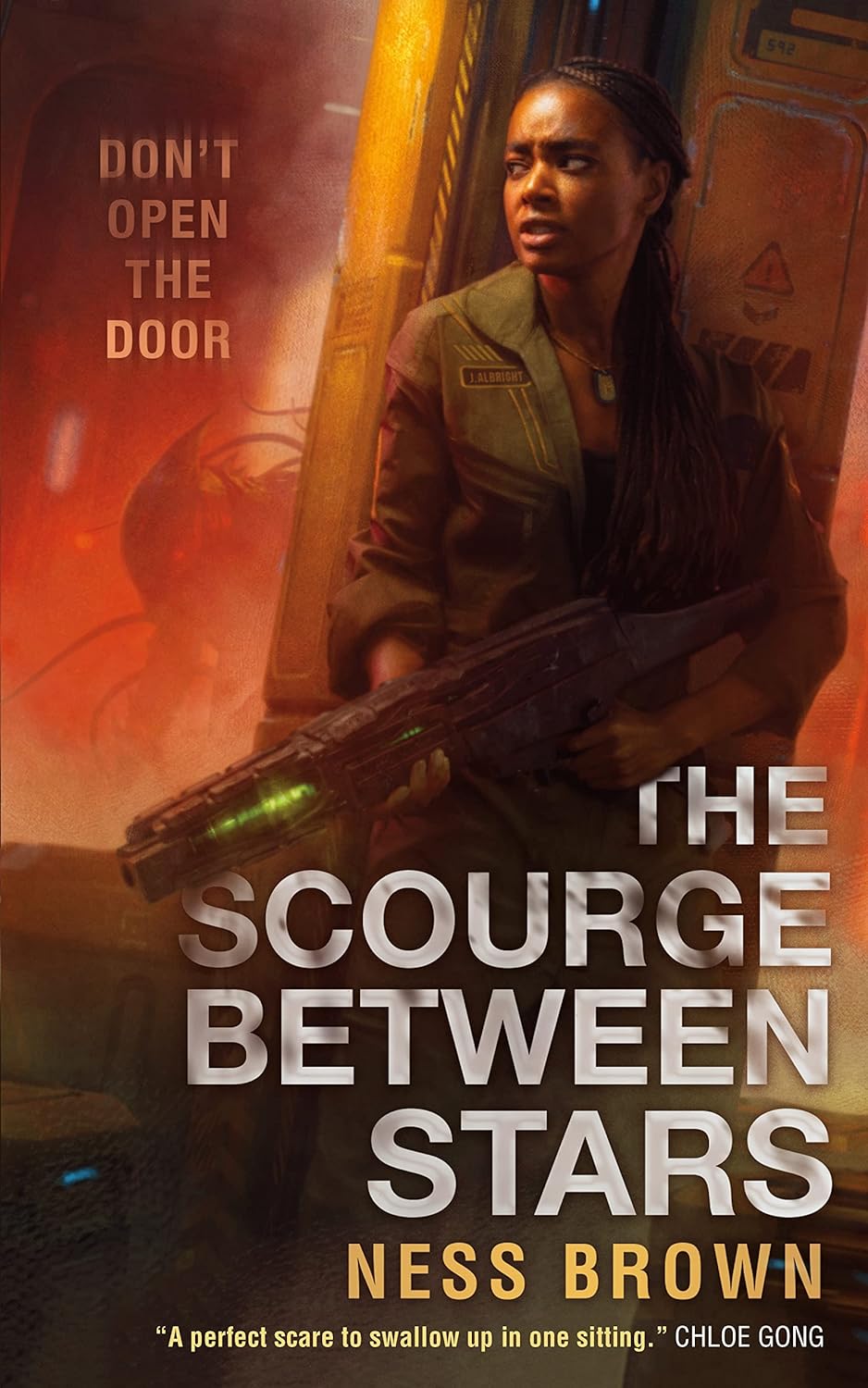
Scientists trying their hand at writing science fiction is certainly not a new phenomenon. However, since the landscape of the physical sciences has been (and to a lesser extent, continues to be) largely populated by white cis-het men, their tales will often be told through the lens of mirroring protagonists. CUNY Graduate Center astrophysics master’s degree student Ness Brown openly explains that one of their priorities in writing their 2023 sci-fi horror novella The Scourge Between Stars was “contributing to black female representation in these genres and specifically queer black female representation” (“Ness Brown”). Accordingly, Brown’s inaugural work features a diverse cast of characters, including a Black LGBTQ female lead and a dark-skinned, female-presenting and identifying android.
In a YouTube interview, Brown offers how they wanted to start the story from “a place of failure,” the crew of the interstellar spacecraft Calypso and the rest of its ragtag fleet fleeing a failed colony on the planet Proxima b, “limping back [to Earth], tail between our legs” (“Ness Brown). Indeed, conditions are painted as extremely grim for the humans aboard this multi-generational retreat to a climate change ravaged Earth. With dwindling supplies and limited means to communicate between ships, their desperation is palpable. Jacklyn “Jack” Albright, second-in-command and acting captain of the Calypso, strikes a precarious balance between pushing the barely functioning technology to its limits and stretching the resources to feed an increasingly agitated crew who are apparently destined to know no other home than this hamstrung ship. It is a powder keg waiting to explode, until they are faced with a uniting enemy, a pack of stereotypical deadly xenomorphs who hitched a ride from Proxima b, hunting down and horrifically disemboweling their human victims.
Brown successfully paints a dark, haunted house atmosphere, one of intense claustrophobia and visceral terror. While the author admits to openly drawing upon works such as Dead Space, Doom, Pitch Black, Alien, and Event Horizon, I also noted subtle echoes of the Cloverfield franchise (Semel). Taking a page from the Alien playbook, Brown wisely shows us mainly glimpses of the creatures, enough to demonstrate their utter alienness and mode of killing but leave sufficient mystery for the imagination to work on. What descriptions we do get are indeed evocative of generic insectoid ETs and the xenomorphs of Alien. However, while this work is obviously derivative of the Alien franchise in some ways (including the strong female lead and the uncannily human android), it sufficiently avoids being a direct copycat.
A scientist’s first fictional work may succumb to several additional traps, for example, a plot slavishly bogged down in the science, stilted and antiseptic writing, or a formulaic and linear plot. To their credit, Brown avoids all of these pitfalls, even while admittedly drawing heavily upon their six years as an instructor of introductory astronomy and astrobiology (Semel). Astronomical accuracy is added in clever rather than heavy handed ways, perhaps so understated that the casual reader may not appreciate them. Discovered in 2016, Proxima b is an earth-sized planet in the habitable zone of the nearest star system, the red dwarf Proxima Centauri, but as Brown correctly explains, it is subject to intense and possibly fatal superflares (Howard et al. 1). As a planet likely to be tidally locked, the most habitable (in a human sense) area is probably the terminator, the twilight area between the permanently star-facing and sunlit side (in the bulls-eye of said superflares) and the colder dark side. The terminator is precisely where Brown has their failed colony set up shop on this rocky world. While the planet’s atmosphere apparently shields the human residents from the star’s flare-generated ionizing radiation, the orbiting spaceships suffer significant degradation, similar to effects on the electronics of Earth-orbiting satellites from our Sun’s much smaller outbursts. The author expertly (yet, again, subtly) draws upon reasonable science in crafting the evolutionary adaptations found in their monsters, explaining the creatures’ strengths and (as one might expect) exploitable weaknesses.
There are, however, numerous missed opportunities for even more detailed storytelling due to the relatively short length of the novella format. For example, there is minimal information on the colonists’ time on Proxima b and why their colony failed (other than a vague inability to establish self-sustaining food production). There is also limited motivation for the whispered legends of the deadly indigenous life, now relegated to merely scary bedtime stories told aboard the retreating ships. Brown shares in an interview that the novella format was decided upon in concert with their publisher, and “a lot was necessarily cut from the story” as a result. Brown now admits that they would “love to … wax on at incredible length about Proxima b and the conditions of the failed colony” if the opportunity arose (“Ness Brown”).
Despite these limitations, Jack’s past (and present) family drama is treated with sufficient detail to motivate her conflicted emotions and desperate plans of action. She and the handful of characters she interacts with most often (including her lover, Jolie) are described in necessary detail for the reader to have a reasonable sense of their distinct personalities. But in such minimalist storytelling, little flesh is built over the bones of most of the other characters before it is literally ripped off by the monsters. This work could have easily been more fully rounded out as a full-fledged novel, especially as there are at least three distinct mysteries to be solved—the immediate one of the deadly xenomorphs threatening the ship; the disturbing relationship between the android Watson and its creator, Otto Watson; and the intermittent events that, like rogue waves in the ocean, jolt the ship without warning. In terms of the xenomorphs themselves, this astrophysicist was left with multiple questions concerning their biology. Discussions of destroying versus experimenting with the xenomorphs’ eggs are given short shrift, yet such investigations apparently take place off stage (resulting in one of several examples of deus ex machina in the story). The final twist of contact with advanced extraterrestrials (related to the intermittent jostling events) is vaguely sketched out in the finale, leaving the ultimate fate of the Calypso (and humanity more broadly) wide open.
While the novella does a decent job in painting the creepiness of the hubristic robotics specialist Otto Watson, there is no clear motivation to it. In many ways he is a two-dimensional character, when he could have been much more deeply nuanced. In contrast, his creation, the lifelike android Watson, is a fully integrated character that is given sufficient, endearing personality to evoke concern for her safety in the reader’s mind. The disturbing relationship between the android and its creator cleverly draws upon the history of the American master/slave relationship in nuanced ways, including the android’s forced taking of its master’s name, episodes of punitive physical restraint, and nonconsensual sexual attention. The Watson secondary story is creative and meaningful, and could have been easily expanded upon with a longer page count. Turning this limitation into a strength, the story’s relatively short length makes it more easy to include in the classroom, focusing on the Watson subplot in particular, and the experiences of the female/queer/BIPOC characters more broadly.
Brown has divulged that they have a work of “fungal horror” in the works, taking place on an alien world (“Ness Brown”). Hopefully the publisher of that work will allow them to produce a complete novel so that we might have a fuller sense of Brown’s talent as a science fiction writer and world-builder.
WORKS CITED
Howard, Ward S., et al. “The First Naked-eye Superflare Detected from Proxima Centauri.” Astrophysical Journal Letters, vol. 860, 2018, pp. 1-6, doi: 10.3847/2041-8213/aacaf3.
“Ness Brown author of The Scourge Between Stars.” YouTube, uploaded by UpperPen Podcast, 25 Apr. 2023, www.youtube.com/watch?v=MBEJwfuRVPo.
Semel, Paul. “Exclusive Interview: ‘The Scourge Between Stars’ Author Ness Brown.” PaulSemel, 1 May 2023, paulsemel.com/exclusive-interview-the-scourge-between-stars-author-ness-brown.
Kristine Larsen, Ph.D., has been an astronomy professor at Central Connecticut State University since 1989. Her teaching and research focus on the intersections between science and society, including sexism and science; science and popular culture (especially science in the works of J.R.R. Tolkien); and the history of science. She is the author of the books Stephen Hawking: A Biography, Cosmology 101, The Women Who Popularized Geology in the 19th Century, Particle Panic!, and Science, Technology and Magic in The Witcher: A Medievalist Spin on Modern Monsters.

 SFRA Review