
Fiction Reviews
Review of Ursula K. Le Guin: Collected Poems
RB Lemberg
Le Guin, Ursula K. Ursula K. Le Guin: Collected Poems. Library of America, 2023. Hardcover. 850 pg. $28.73. ISBN 1598537369.
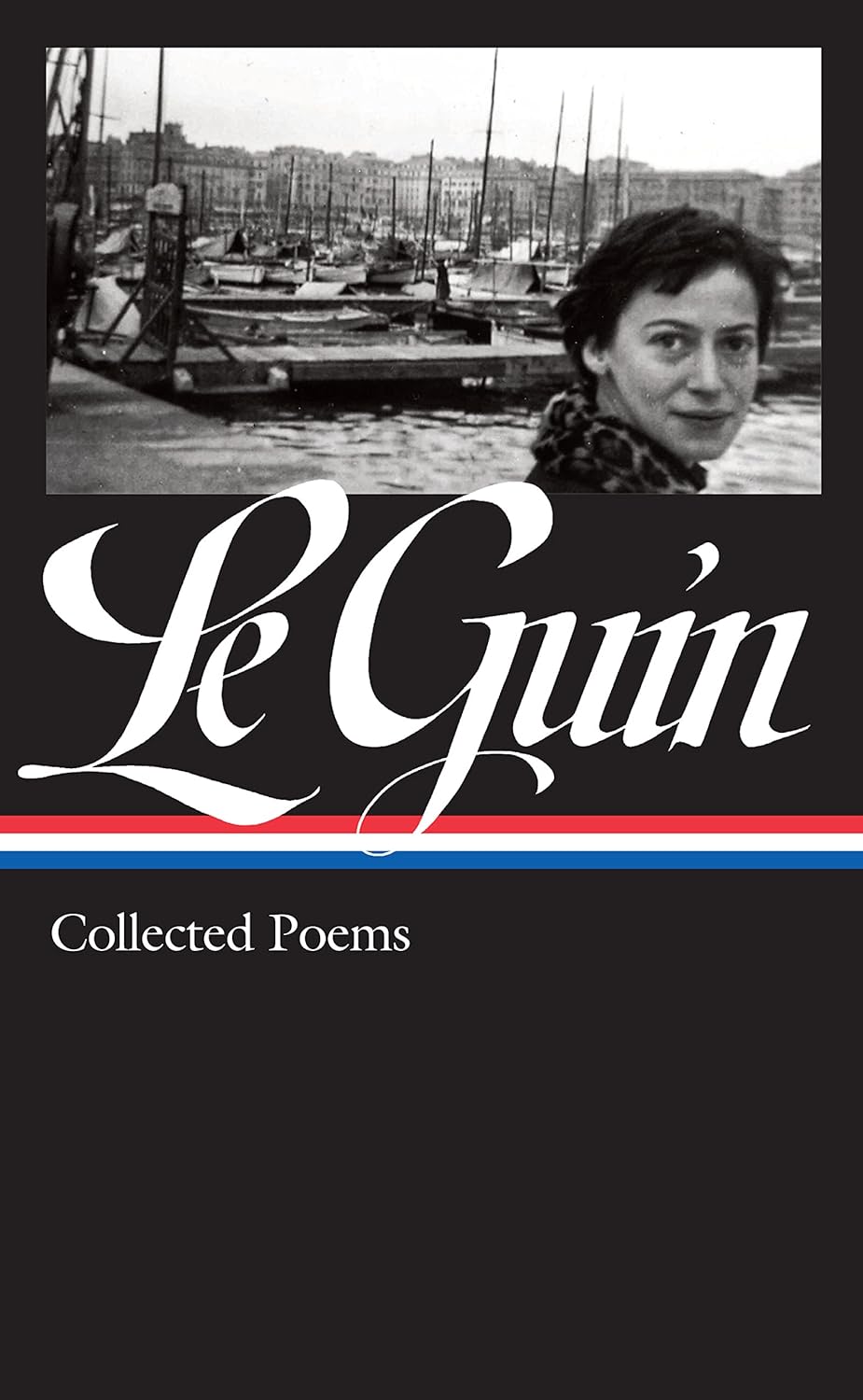
Overview of the Collection
Ursula K. Le Guin was one of the world’s most renowned science fiction authors, but her poetry is rarely discussed. Yet, poetry was a constant in Le Guin’s life. She began writing it at age five (Collected Poems 569); her first published work was a poem, “Songs of Montayna Province” (Collected Poems 647). She finalized her last book, a collection of poetry titled So Far, So Good, a mere week before she passed away. It was published posthumously in October 2018. Le Guin the prose writer remains famous for her lyrical, evocative style, which can be described as “a poet’s prose” (Collected Poems, xl). Le Guin’s poems are windows into her emotional life, her relationships with family and friends, and her deep and abiding love of the natural world.
Despite the importance of poetry in Le Guin’s life and writing, her poetic legacy remains largely unknown. Ursula K. Le Guin: Collected Poems is thus an important addition to many bookshelves. This book will help Le Guin readers gain a deeper understanding of her fiction through these poignant and intimate works; it will appeal in general to lovers of poetry and to readers of regional literature who are attracted to intricate and powerful writing about the Pacific Northwest. Le Guin’s writing is arboreal, and readers who delight in nature-inspired poetry will find many wonderful works in this book. Le Guin is, of course, a powerful feminist figure, and this collection will appeal to readers of feminist literature, broadly construed. Finally, this text is also an invaluable source for researchers.
Ursula K. Le Guin: Collected Poems reprints all nine of Le Guin’s major poetry collections, beginning with her wonderful Capra Press chapbook Wild Angels (1974), and ending with So Far, So Good (2018). In addition to the nine poetry collections, Collected Poems includes her translation of the Tao Te Ching and poems from chapbooks and collaborations such as No Boats (chapbook), The Uses of Music in the Uttermost Parts (poems set to music by Elinor Armer), and Out Here: Poems and Images from Steens Mountain Country (a collaboration with photographer Roger Dorband). The book also includes an important selection of Le Guin’s published but uncollected poems, including her very first publications from 1959 and 1960. I would have loved to know more about how the “Selected Uncollected Poems” were selected, and if anything was left out.
The supplementary material consists of an introduction by series editor Harold Bloom, a chronology of Ursula’s life and accomplishments, a bibliography, and an index of titles and first lines. The book also offers a handy section of notes explaining references in individual poems, such as various mythical figures (Ariadne, Anansi, Tlaloc), specific geographic locales (Oasis of Mara, Kishamish), and translations of words that appear in languages such as Welsh, Latin, Spanish, and Le Guin’s own constructed language, Kesh. In addition to Le Guin’s poetry, the book includes seven pieces of her nonfiction: two essays, two prefaces to books of poetry, a foreword, an afterword, and finally an interview focused on poetry.
A few words about what the book does not contain: while the Selected Uncollected Poems section reprints some of the poems that originally appeared in other books, such as Buffalo Gals: And Other Animal Presences (1987), it does not include all of the poems published in Le Guin’s non-poetry books. For example, her novel Always Coming Home (1985) contains many striking poems, which were not included here. Collected Poems does not include the collaborative translation with Diana Bellessi, The Twins, The Dream / Las Gemelas, El Sueño, perhaps because many of Le Guin’s poems published in that volume were also reprinted elsewhere and thus ultimately included as a part of other books (more on this collaboration below). The supplementary material supplies bibliographic information for the uncollected poems, but does not provide information about the first publication of individual poems from the nine collections – this would be good information to have, especially for the poems that were reprinted, rather than originally published, in the nine collections.
Collected Poems also does not include, or mention, Le Guin’s unpublished poems, such as those I have discovered in her archives (I plan to discuss them in my manuscript on Le Guin’s poetry).
Despite these minor qualms with some of the supplementary materials and editorial choices, I am extremely happy that this book exists and is available to readers. While Ursula K. Le Guin: Collected Poems is not an exhaustive volume, it contains most of her poetry—certainly the vast majority of her published poetry—and a good taste of her poetry-adjacent work.
The Introduction
As a scholar of Le Guin’s poetry and a poet myself, I confess that I was not satisfied with Harold Bloom’s introduction. Bloom looms large in the world of American literary criticism, but in this case, I would have appreciated a lot less looming, which is to say, less of a focus upon Bloom himself. For example, he highlights a poem on Le Guin’s long marriage to Charles Le Guin because he, Harold Bloom, has also enjoyed a long marriage. At times, the introduction reads as condescending in tone—he talks about Le Guin’s “intuitive poetics” (Collected Poems xlvi) and calls her “primordial” (Collected Poems xlvi) despite Ursula’s meticulous attention to matters of craft and her extensive knowledge of it, some documented in this book’s nonfiction sections. When discussing a single poem Le Guin wrote about Lorca, Bloom remarks that he feels that there is “a daemon speaking in and through Ursula K. Le Guin” (Collected Poems xliii). Her feminism is mentioned, but not discussed at all; at one point Bloom writes about “her Taoism, anarchism, ‘feminism,’ literary aesthetic” (Collected Poems li)—but Le Guin’s feminism does not need the assistance of scare quotes.
And while it was heartwarming for me to imagine two such prominent octogenarians corresponding, I would have much preferred to read an introduction by a different person—perhaps an SFF author who is both a prose writer and a poet (Amal El-Mohtar immediately comes to mind, or Sofia Samatar), or alternatively a writer-scholar and/or a biographer who could help connect the poetry to Le Guin’s life and larger body of work (like Lisa Tuttle or Sandra J. Lindow). Judith Barrington, a feminist author, friend, and collaborator, would be another fantastic choice. I wished for the introduction to highlight Le Guin the poet’s significant contributions to feminist letters, to nature writing, and to regional / Pacific Northwest writing, and I did not find much of it in this text.
In addition to ultimately finding the introduction unsatisfying, I also dispute the inclusion of Le Guin’s Tao Te Ching translation in this volume and the simultaneous exclusion of her translations of Gabriela Mistral and Diana Bellessi. Perhaps just Le Guin’s introduction to her translation of Mistral could have been included (Mistral xix-xiii).
Le Guin’s translation/version of the Tao Te Ching relies on Paul Carus’s translation and transliteration (“The Feminine and the Tao”). Le Guin herself explains that her version is “a rendition, not a translation. I do not know any Chinese” (Collected Poems, 290). Regarding the inclusion of the Tao Te Ching, Bloom highlights and immediately dismisses any concerns: “Scholars tell me that her work is disputable, but I see nothing to dispute” (Collected Poems li). Translating without understanding the original is a practice specifically perpetuated by white translators, often involving the East Asian literary tradition. Ezra Pound engaged in exactly such a practice with regards to Classical Chinese poetry, and this remains a topic of criticism and debate in translation studies (Williams; Yeh). This important issue continues to be discussed in the field (specifically concerning the practice of “bridge translation,” see Calleja and Collins; Wang).
Since the Tao Te Ching translation was included, I was surprised not to see any of Le Guin’s other poetry translations. I am especially concerned with the exclusion of The Twins, The Dream / Las Gemelas, El Sueño, a brilliant volume of co-translations with the Argentinean poet Diana Bellessi. Le Guin held translation close to her heart and engaged in it throughout her lifetime, but the practice of translating from a language one does not know at all is problematic. On the other hand, The Twins, The Dream / Las Gemelas, El Sueño is a beautiful collaboration between two feminist poets (Bellessi and Le Guin), who corresponded, exchanged translations, discussed and corrected each other’s work—certainly a much more intimate and thoughtful process, which honors the principles of feminist translation (Eshelman). Since the Tao Te Ching translation was included, these excluded translations warrant a discussion.
Walking with Ursula
With 700-odd pages of poems alone, it would not be possible for me to present a broad overview of Le Guin’s poetic work in a book review—although I refer the readers to my earlier essay in Climbing Lightly through Forests (Lemberg), which surveys all nine of Le Guin’s major collections. For this review, I will discuss a single aspect of her poetry—a theme of walking, and an echoing and recurring approach.
Ursula K. Le Guin was an avid walker. She went on walks everywhere she went, in some cases repeatedly, sometimes, over the span of years. These intimate walks reflect the poet’s personal journeys. Most of these walking poems are not speculative, but perhaps one can think of them as speculative-adjacent: these earthly landscapes are transformed and reappear or reverberate through her fantastical worlds.
Ursula’s early and privately printed chapbook Walking in Cornwall (1976), reprinted in her second collection, Hard Words, is an example of such a walk, in which the poet reflects on the enduring power of togetherness, and of women’s labor:
It was home, once, Chysasuster village was.
Nine families, their cattle, their heartfires.
O small cold hearths, so old, so old,
Yet you could light a fire in them tonight.
It would be the same fire.
We don’t need very much:
water and warmth and walls, the flickering ring of faces. (73)
There are three long poems in Walking in Cornwall. The second and third poem both end with an almost identical line: “and the wind is sweet as honey in the mouth” / “and the wind as sweet as honey in the mouth,” which reflect one of Ursula’s favorite poetic devices, repetition, an echoing return to places and thoughts that evoke the senses.
After the cataclysmic eruption of Mount St. Helens in 1980, Le Guin returns repeatedly to the desolate landscape, writing four poems originally published in the chapbook In the Red Zone (1983), later reprinted in her third poetry collection, Wild Oats and Fireweed (1988) and included in Collected Poems:
The earth fell on the earth. It looked like cloud
but it was dirt: the planet turning on itself.
Rock, slag, dust, earthgas, earthfire, earthwork.
A column of boiling stone. Ponderous.
From a distance thunderblue, but in itself earthdark,
grey, brown, black: a mountain inside out.
And the lightning struck, and struck, and struck.
Dancing like a hopjack strung up on the groundcloud,
the stoneplume, jagging between earth and earth,
the lightning struck, and struck, and struck.
The forest was dead in the first five minutes. (98-101)
Three decades after the explosion of Mount St. Helens, Le Guin returns to the same spot in “Summer Morning on the Volcano,” originally published in Finding my Elegy (2012):
The mist lifts off the little lake down there,
way down, across a gulf of shining air.
The upward spiral song of Swainson’s thrush,
a white-crown’s teedle-eedle in the hush:
there is this music in the morning, where
was only silence, and grey dust, and ash.
“We are her children, we are in her care,
our destroyer-mother,” sings the mountain thrush. (497)
In her collaboration with the photographer Roger Dorband, Blue Moon over Thurman Street (1993), Le Guin writes about walking the street for decades: “To walk a street is to be told a story. Through the years that I have lived in Portland, as I walked up and down my street, Thurman Street, it kept telling me its story. … When we started working on this book, I had lived on Thurman Street for over twenty-five years” (6-9). A poem from that book, “The Aching Air,” was later collected in Finding my Elegy (2012) and in Collected Poems (863). In this resonant and heartbreaking piece, Le Guin narrates how a gorgeous chestnut tree, a neighborhood fixture for all the years she lived there, was cut down by neighbors who thought trees—and their companions, birds—were dirty:@font-face {font-family:”Cambria Math”; panose-1:2 4 5 3 5 4 6 3 2 4; mso-font-charset:0; mso-generic-font-family:roman; mso-font-pitch:variable; mso-font-signature:-536870145 1107305727 0 0 415 0;}@font-face {font-family:Calibri; panose-1:2 15 5 2 2 2 4 3 2 4; mso-font-charset:0; mso-generic-font-family:swiss; mso-font-pitch:variable; mso-font-signature:-536859905 -1073697537 9 0 511 0;}p.MsoNormal, li.MsoNormal, div.MsoNormal {mso-style-unhide:no; mso-style-qformat:yes; mso-style-parent:””; margin:0in; mso-pagination:widow-orphan; mso-hyphenate:none; font-size:12.0pt; font-family:”Calibri”,sans-serif; mso-ascii-font-family:Calibri; mso-ascii-theme-font:minor-latin; mso-fareast-font-family:Calibri; mso-fareast-theme-font:minor-latin; mso-hansi-font-family:Calibri; mso-hansi-theme-font:minor-latin; mso-bidi-font-family:Calibri; mso-bidi-theme-font:minor-bidi; mso-font-kerning:1.0pt; mso-ligatures:standardcontextual;}.MsoChpDefault {mso-style-type:export-only; mso-default-props:yes; font-family:”Calibri”,sans-serif; mso-ascii-font-family:Calibri; mso-ascii-theme-font:minor-latin; mso-fareast-font-family:Calibri; mso-fareast-theme-font:minor-latin; mso-hansi-font-family:Calibri; mso-hansi-theme-font:minor-latin; mso-bidi-font-family:Calibri; mso-bidi-theme-font:minor-bidi; mso-font-kerning:1.0pt; mso-ligatures:standardcontextual;}.MsoPapDefault {mso-style-type:export-only; mso-hyphenate:none;}div.WordSection1 {page:WordSection1;}
Where the most beautiful
horsechestnut held up deep branches
in a cathedral
full of wings and voices
and a golden light,
and the tall, rose-white flowers
smelled like the bread of heaven,
and eyes praised upraised,
being blest by seeing:where the tree was
the air’s empty. (683)
In this book and elsewhere, Le Guin’s abiding love for nature is tinged with a deep concern for the scope of environmental destruction perpetuated by humans—corporations and individuals.
Nature poems are abundant in the collection, but they are far from the only kind of poems one finds in Collected Works. Some of Le Guin’s poems focus on family; others remark on current events and engage with feminist themes, especially women’s rights. Some poems deal with Le Guin’s personal experiences (she discusses her abortion in a number of poems throughout her life). Many poems feature animals—Le Guin was especially fond of cats; some of the poems are humorous, such as the delightful “A Palindrome I Do not Want to Write” (Collected Poems 698). With a few notable exceptions such as the 1982 Rhysling-winning “The Well of Baln” (Collected Poems 80-81), Le Guin’s poems do not offer us much speculative / science fictional material. Instead, these pieces are glimpses into Le Guin’s life and her interests, and her incessant and enduring attention to the natural world, to the trees perhaps most of all, but also to animals, rocks, mountains—in the Pacific Northwest and beyond.
To read these poems is to become immersed in Le Guin’s world: a world of quiet wonder and great intricacy, of mythic grandeur, with wonderful flashes of humor and play. Ursula K. Le Guin: Collected Poems invites us to take many long walks with her. This book will become a staple for many readers, as well as scholars of Le Guin’s work—including myself.
WORKS CITED
Calleja, Jen, and Sophie Collins. “She Knows Too Much: ‘Bridge Translations,’ ‘Literal Translations,’ and Long-Term Harm.” Asymptote Journal. Accessed 8 August 2023.
Eshelman, David J. “Feminist Translation as Interpretation.” Translation Review, vol. 74, no. 1, 2007, pp. 16-27.
Le Guin, Ursula K. Always Coming Home. Harper & Row, 1985.
—. Buffalo Gals and Other Animal Presences. Capra Press, 1987.
—. Finding My Elegy: New and Selected Poems. Houghton Mifflin Harcourt, 2012.
—. Hard Words, and Other Poems. HarperCollins Publishers, 1981.
—. Lao Tzu: Tao Te Ching: A Book About the Way and the Power of the Way. A New English Version by Ursula K. Le Guin. Shambhala, 1998.
—. So Far, So Good: Final Poems 2014-2018. Copper Canyon, 2018
—. and Diana Bellessi. The Twins, The Dream / Las Gemelas, El Sueño. Arte Publico Press, 1997.
—. Wild Angels. Capra Press, 1975.
—. Wild Oats and Fireweed: New Poems. Harper Perennial, 1988.
—. (text), and Elinor Armer (music). The Uses of Music in the Uttermost Parts. Koch International Classics, 1995.
—., and Roger Dorband. Out Here: Poems and Images from Steens Mountain Country. Raven Studios, 2010.
Lemberg, R.B. “The Poetry of Ursula K. Le Guin: A Retrospective.” Climbing Lightly Through Forests, edited by R.B. Lemberg and Lisa M. Bradley, Aqueduct, 2021, pp. 101-150.
Mistral, Gabriela. Selected Poems of Gabriela Mistral. University of New Mexico Press, 2003.
Peterson, Brenda. “The Feminine and The Tao: An Interview with Ursula K. LeGuin [sic].” Embrace the Moon, https://embracethemoon.com/ursula-k-leguin/. Accessed 7 August 2023.
Wang, Yilin. “Barriers, Privileges, and Invisible Labor: A Sino Diaspora Translator’s Perspective.” Words Without Borders, https://wordswithoutborders.org/read/article/2021-06/june-2021-queer-barriers-privileges-and-invisible-labor-yilin-wang/. Accessed 8 August 2023.
R. John Williams. “Modernist Scandals: Ezra Pound’s Translations of ‘the’Chinese Poem.” Orient and Orientalisms in American Poetry and Poetics, edited by Sabine Sielke and Christian Kloeckner, Peter Lang GmbH, 2009, pp. 145-165.
Yeh, Michelle Mi-Hsi. “The Chinese Poem: The Visible and the Invisible in Chinese Poetry.” Manoa, vol. 12, no. 1, 2000, pp. 139-146.
R.B. Lemberg is a 2020 Le Guin Feminist Fellow and a scholar of SFF, LGBTQIA+ studies, and translation studies. As R.B. Perelmutter, they are a Professor of Jewish Studies and Slavic, German, and Eurasian Studies at the University of Kansas. R.B.’s literary work has been shortlisted for the 2023 Le Guin Prize for fiction, and was a finalist for the Nebula, Ignyte, Locus, World Fantasy, and other awards. Their novel The Unbalancing (Tachyon) and short story collection Geometries of Belonging (Fairwood) were published in 2022.

 SFRA Review